Most advice on the best time to visit the Greek islands stops at “May or September.” That's tidy, memorable, and incomplete. A luxury trip isn't judged by sunshine alone. It's judged by whether your villa is available, your private driver can meet you at the port without a scramble, your ferry sequence leaves room for a late lunch, and the island still feels inviting rather than overrun.
The practical travel season for most Greek islands generally runs from April through late October. Yet demand is far from evenly distributed. 73.9% of overnight stays in Greece occur between June and September, and some island groups exceed 90% concentration in those months, according to Greece's seasonal travel overview. For affluent travelers, that makes timing a logistics decision as much as a weather decision.
My direct recommendation is late May through June or September, with the exact choice shaped by your islands and priorities. July and August still make sense for travelers who want the full high-summer scene, but they require earlier planning and a greater tolerance for crowded ports, higher rates, and Aegean wind.
Why Generic Best Time Advice Falls Short for the Greek Islands
“Go in May or September” works as a broad answer. It doesn't work as a luxury itinerary strategy.
A private villa on Santorini, a suite in Mykonos, and a restored estate in Crete don't follow the same seasonal rhythm. A traveler combining Mykonos, Paros, and Milos faces different ferry and wind considerations from someone pairing Corfu with Paxos or choosing a villa near Chania. Even within the same month, the experience changes according to how many transfers your itinerary requires and how dependent you are on fixed reservations.
The real luxury trade-off
Peak season brings the most energy. Beach clubs are fully active, restaurants have their strongest atmosphere, and the sea is at its warmest. It also brings tighter inventory, crowded ports, and less flexibility when a ferry timetable or wind forecast changes.
The shoulder months offer more breathing room, but “shoulder” doesn't mean every service operates at full summer capacity. Early in the season, some resorts, restaurants, and smaller ferry connections may still be ramping up. Late in the season, selected venues may begin reducing operations even while the weather remains pleasant.
Advisor rule: Choose the month after choosing the island combination, not before.
The demand concentration is substantial. In 2025, July through October represented 56.7% of annual arrivals and 63.7% of overnight stays, while August alone accounted for 19% of arrivals and 21.7% of overnight stays, as reported in recent Greece travel timing data. Those figures explain why a supposedly simple summer escape can become a complicated exercise in inventory management.
For a high-touch trip, the best month is the one that protects the experience you value most. That may mean September for a honeymoon, June for a multigenerational group, or August for a couple who specifically wants Mykonos at full volume. The calendar matters, but the itinerary matters more.
The Greek Island Season Month by Month
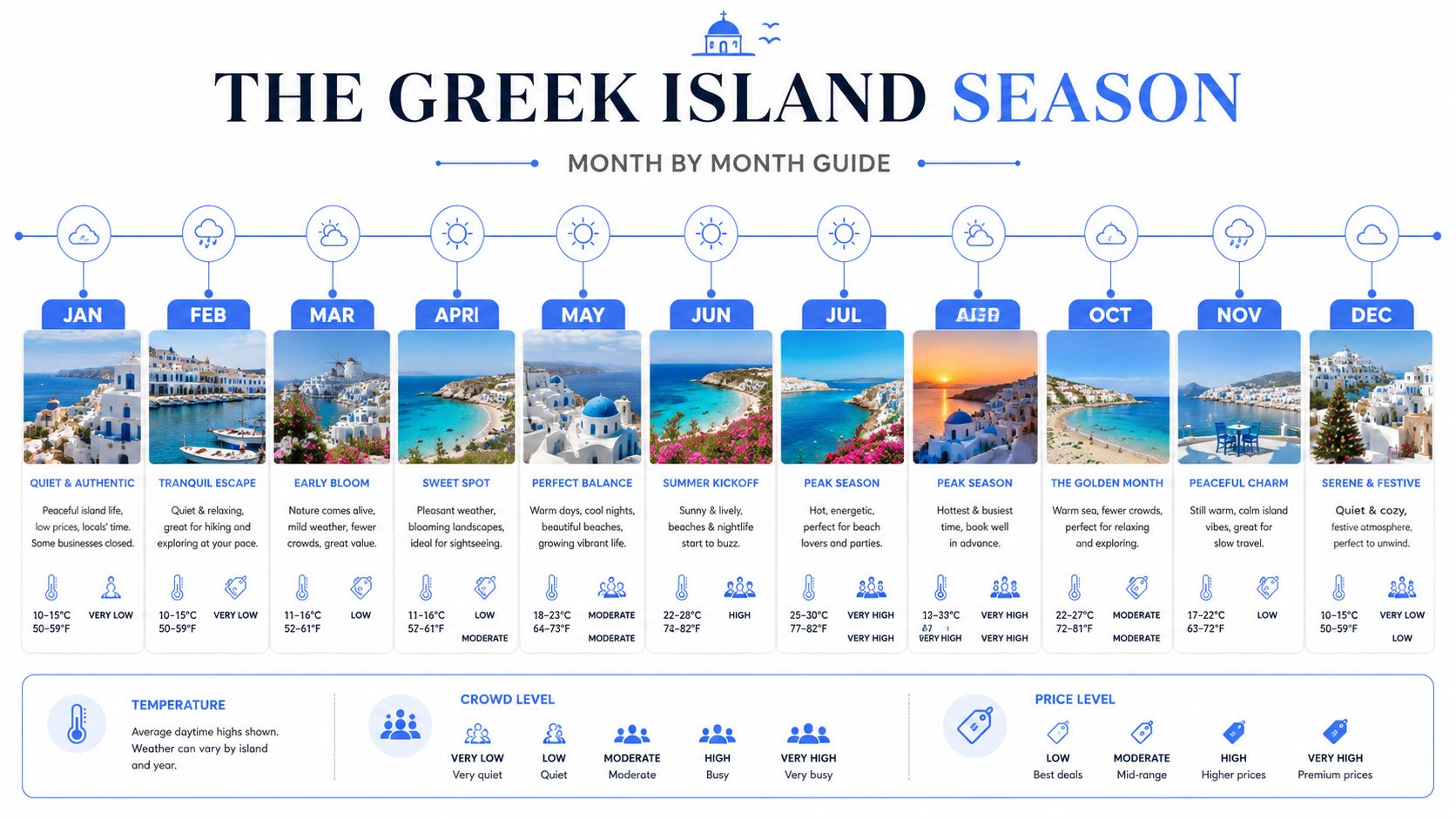
The Greek Islands do not have one universal best month. April through late October is the dependable operating season for ferry links, hospitality, and beach-focused travel, yet the right timing depends on whether you prioritize open inventory, warm water, active venues, or the calmest possible ports. Demand concentrates heavily in midsummer, so villa availability, ferry choices, and private-transfer consistency become part of the luxury planning decision.
April and early May
April marks the reopening phase. Sightseeing is comfortable and the islands feel quiet, but sea temperatures remain cool, while some seasonal hotels, beach clubs, and restaurants are still preparing for summer. Choose April for cultural touring and privacy, not for a full beach-service experience.
May is a stronger luxury choice for calm ports and comfortable days. Average island temperatures reach about 23°C, with around 18 mm of precipitation, according to Greek Islands climate averages. Late May suits travelers who want more swimming, while early May favors architecture, private touring, hiking, and long lunches.
June
June provides the cleanest transition into summer. Average temperatures rise to around 28°C, and rainfall falls to roughly 5 mm, based on monthly weather conditions in Greece. The first half of the month is especially appealing: restaurants and beach venues are active, while ports and villas face less pressure than in July and August.
Pair a high-demand island with a quieter alternative in June. Reserve villas and private boat days early, but retain enough flexibility to adjust around wind or transport conditions.
July and August
July and August deliver the islands at full volume. Temperatures reach around 30°C, rainfall can fall to 2 to 4 mm, and beach clubs, restaurants, and nightlife operate at their strongest. They are also the busiest and most expensive months, with fuller ports, tighter villas, and little room for last-minute changes.
The Meltemi, a dry northerly Aegean wind, generally strengthens from late June through September and peaks in July and August. Sustained conditions around 20 to 35 knots can occur, with multi-day events and stronger afternoon gusts described in this guide to the Greek Meltemi. Build alternative plans for ferries, sailing, and open-water swimming.
September and October
September is my preferred month for many luxury clients. The sea retains summer warmth, services remain active, and the second half usually brings noticeably more space. It is the strongest choice for travelers who want polished operations without August's pressure.
Early October still works well for cultural touring, quiet beaches, and a slower pace. Temperatures average roughly 22°C, with about 45 mm of precipitation, according to Greek Islands climate data. Late October requires direct confirmation of seasonal hotel operations, ferry schedules, restaurants, and private transfers before booking.
Which Greek Islands to Visit and When
There is no single best month for the Greek islands. The right choice depends on the island, your priorities, and how much logistical pressure you are willing to accept. Demand concentrates sharply in July and August, which affects villa availability, ferry space, and the consistency of private transfers. Build the route around those realities, not a generic weather chart.
Cyclades for iconic scenery and high demand
Santorini and Mykonos face the strongest peak-season pressure. September is the smartest luxury window for polished service, warm water, and fewer complications at ports, restaurants, and transfer points. May and early June suit clients who prioritise scenery, architecture, and private touring over late-night beach clubs. Book villas and preferred dining early, particularly if your itinerary includes both islands.
Paros, Milos, and Folegandros offer a more measured Cycladic experience. July and August still bring substantial demand, but these islands are less dependent on the most intense party scene. Choose late May, June, or September according to the trip's focus. Late May and June favour exploration, while September gives swimming and dining operations more summer momentum.
For a broader route-planning framework, see Explore Effortlessly's luxury Greece travel guide when you are comparing several islands rather than arranging a single stay.
Ionian islands for a softer rhythm
Corfu and Zakynthos are strong choices from late April through May. The scenery is fresh, the pace is calmer, and villa stays are easier to shape around private touring. June, September, and early October also work well for warm days without the sharper operational pressure of Cycladic midsummer.
The Ionian islands suit clients who want leisurely coastal touring, longer villa stays, and a holiday centred on the destination rather than the busiest address. Their western setting also creates a different visual and cultural rhythm from the Cyclades.
Saronic islands for easier access
The Saronic islands are practical for travellers beginning or ending near Athens. May, June, September, and October allow a relaxed city-and-island sequence without forcing long Aegean crossings into a short itinerary. They work particularly well when private transfers, simple embarkation, and schedule control matter more than collecting famous island names.
Crete as the flexible anchor
Crete gives you the widest planning range. Its scale supports a substantial itinerary combining beaches, cultural sites, inland terrain, and established resort infrastructure. Tourism demand has varied considerably over time, so confirm room inventory, transfers, and seasonal operations rather than assuming availability.
I favour Crete in May and October for a slower, more layered journey. September is the stronger choice for clients who want dependable beach time while avoiding the most concentrated Cyclades demand. Its size also makes a private driver and carefully staged route worthwhile, especially when moving between coastal resorts and inland sites.
Peak Season Versus Shoulder Season for Luxury Travelers
Peak and shoulder season serve different definitions of luxury. July and August deliver maximum warmth, full programming, and the most animated social scene. May, June, September, and October usually deliver greater ease, more generous breathing room, and better value, with some seasonal compromises.
| Factor | Peak, July and August | Shoulder, May, June, September, and October |
|---|---|---|
| Atmosphere | Lively, social, and highly energetic | Quieter, more personal, and easier to pace |
| Weather | Around 30°C, with very limited rainfall | Around 23°C in May, 28°C in June, and 22°C in October |
| Sea and swimming | Warmest sea conditions | Late May through October remains a practical swimming season, with sea temperatures commonly around 21°C to 28°C in August, according to sea temperature guidance |
| Crowds | Busiest ports and most concentrated demand | Lower density, especially outside the edges of the season |
| Pricing | Highest accommodation and service demand | May and September can be 30% to 40% lower than July and August for hotel pricing, based on Greek travel weather and value guidance |
| Ferry planning | More routes, but fuller vessels and greater disruption impact | Useful seasonal routes operate, though frequency can reduce outside the core summer period |
| Wind exposure | Meltemi is strongest in July and August | Usually easier for open-water plans in late spring and early autumn |
What peak season buys you
July and August are right for travelers who want the islands fully switched on. Mykonos nightlife, late dinners, beach clubs, and warm water are all at their strongest. Families tied to school calendars may have little practical choice, while couples who want the most visible social scene may actively prefer August. If you would rather spend your couples' trip at a resort than island-hop, my Bahamas couples resort selection guide lays out a different approach.
The cost is not only the nightly rate. It's the loss of flexibility. A delayed ferry can disrupt a tightly sequenced itinerary, and a popular restaurant or private transfer may have no convenient alternative.
What shoulder season protects
Shoulder season saves time and effort. Transfers tend to feel less frantic, ports are easier to manage, and your itinerary has more room for a long lunch or a spontaneous swim. September is particularly strong because the sea remains comfortable while the islands begin to exhale.
The compromise comes earlier in May and later in October. The water may be cooler, rain becomes more plausible, and some venues operate on a reduced seasonal schedule. For clients paying for a smooth experience, I prefer to solve that through careful property selection and realistic routing rather than promise that every island works identically.
Luxury perspective: Better value means more of the trip feels effortless, not merely that the room costs less.
Matching the Season to Your Traveler Type
The right month depends on the people traveling and the type of day they want to repeat. A honeymoon couple, a family with school-aged children, and a group of friends seeking Mykonos nightlife should not receive the same recommendation.
Honeymooners
Choose late September, especially for Santorini paired with a quieter Cycladic island or Crete. The sea is still inviting, the atmosphere is more composed than midsummer, and cliffside villas feel more private when the island isn't operating at maximum intensity.
For a more detailed romantic planning approach, review this Greek Islands honeymoon guide. I'd build in generous time on each island rather than chase a long list of postcard stops.
Families with school-aged children
Late June or July is the practical recommendation. Families usually need dependable beach conditions, active resort programming, and transportation operating at its fullest. Choose an island with straightforward transfers and accommodation that makes downtime easy, rather than building a complicated chain of small-island connections.
Crete, Corfu, and selected Cycladic combinations can work well when the itinerary gives children room to settle in. The most common mistake is trying to prove you've “done Greece” by changing islands too often.
Couples seeking high-energy summer
If beach clubs, nightlife, and a social atmosphere are central, choose Mykonos in August and accept the operational reality. Book the villa, dining, transfers, and boat plans early, then keep enough flexibility for the Aegean wind to change the order of your days.
Solo and slow-travel clients
Late April, May, or October suits travelers who want a more intimate island rhythm. Crete, Corfu, and less crowded Cycladic islands offer stronger opportunities for unhurried touring, scenic drives, and time spent in one place.
Multigenerational groups
Mid-June and early September are my preferred windows. They offer a useful middle ground for different ages and energy levels, with warm conditions, active services, and a better chance of moving the group without making every day feel like a transport exercise.
Planning and Booking Strategy for a Luxury Greek Islands Trip
Timing becomes useful only when it controls the operational details. Ferry routes between major islands such as Santorini, Mykonos, Naxos, Paros, Milos, Ios, and Crete are easiest to use from late May through September, while frequency declines outside that window and some smaller islands may have limited or no winter service, according to Greek island-hopping ferry guidance.
Reserve the pieces that can't be replaced
The most desirable villas, suites, private drivers, and dining reservations are the first elements to become difficult, even when the broader destination appears available. Recent booking behavior has shifted toward shorter, closer-in, last-minute travel, but that doesn't make waiting a good strategy for a high-value itinerary with limited flexibility. It can compress inventory rather than create it.
For July and August, I recommend committing as early as your dates allow. For May, June, September, and October, there may be more room to maneuver, but premium room categories and private villas can still disappear well before departure.
Build around the wind, not against it
The Meltemi matters most when your itinerary relies on exposed ferry crossings, sailing days, or open-water swim stops. I sequence routes with buffer where possible, avoid making a major international connection depend on a same-day island transfer, and keep land-based alternatives available for a windy afternoon.
Air planning deserves the same care. Travelers comparing routing options can use these Greece flight price tips as a starting point, then evaluate the full journey cost in time, connections, and transfer complexity rather than focusing only on the fare.
Use an advisor to manage the choreography
Explore Effortlessly designs high-touch itineraries around flights, hotels, private drivers, dining reservations, and curated experiences, with planning available to clients nationwide through virtual consultations. For complex combinations, a private Greece tour can provide a more coherent structure than assembling each island, ferry, and transfer separately.
My role is to connect the season to your priorities, secure preferred partner perks where available, coordinate trusted in-destination suppliers, and keep the itinerary practical before you depart. On the ground, local partners and suppliers provide support while I coordinate the planning and logistics in advance.
Greek Islands Travel Questions Luxury Clients Ask Most
Is September still warm enough for swimming?
Yes, September is my first choice for clients prioritising swimming, beach time, and comfortable villa living without July and August demand. For October, choose a villa with a heated pool, sheltered outdoor space, and strong indoor living areas rather than booking solely for the sea.
How much does the Meltemi affect ferries and yacht days?
The Meltemi can change comfort, crossing times, and open-water plans, particularly in the Aegean during July and August. I keep sailing days flexible and avoid placing a critical international connection immediately after an exposed ferry crossing.
How much buffer should I allow between island connections?
For a same-day ferry connection, allow several hours between scheduled arrivals and departures, especially when the itinerary depends on separate tickets or a private transfer. For high-value trips, an overnight stop is the safer choice when missing the connection would disrupt flights, a villa check-in, or a yacht charter.
When should luxury travelers book?
Book July and August early if you want a particular villa, suite category, private transfer schedule, or dining time. Shoulder-season inventory is more flexible, but premium villas and reliable local suppliers can still be taken by travelers booking later than expected.
What's the best overall answer?
Choose late May through June or September for the strongest balance of swimming, atmosphere, and service availability. Select July or August only when full high-summer energy matters more than price, crowd levels, and operational flexibility.
Explore Effortlessly creates custom Greek island itineraries with sequenced ferries, private transfers, luxury stays, and advisor-led planning. Start with the Explore Effortlessly team through a nationwide virtual consultation, and join the Explore Effortlessly newsletter for curated luxury travel ideas and practical planning guidance.