You've found the beach, saved the villa photos, and started a guest list that somehow includes everyone from your parents' closest friends to your college roommate's children. Then the practical questions arrive. Should you marry legally in Costa Rica or at home? Is a resort package easier, or just less personal? Will your guests spend the weekend in transit?
Destination weddings in Costa Rica can be remarkably straightforward, but only when the decisions happen in the right order. I recommend choosing the ceremony format first, then the region, venue style, season, and guest logistics. That sequence protects your time, your budget, and the experience you want everyone to remember.
Why Costa Rica Works So Well for a Luxury Destination Wedding
A busy couple usually doesn't need more inspiration. They need someone to reduce the number of decisions. Costa Rica offers beaches, villas, eco-lodges, rainforest settings, and resort infrastructure, but that variety becomes a liability when every option appears equally appealing.
Costa Rica has become one of Central America's most established destination-wedding markets. Most celebrations concentrate on the Pacific coast, especially Guanacaste and the Papagayo Peninsula, where the driest season, roughly November through April, aligns with a strong concentration of resort and villa venues. (Aisle Wedding's Costa Rica destination guide)
The practical advantage for international couples
Foreign couples can marry in Costa Rica without residency requirements, blood tests, or a waiting period. That legal simplicity is a meaningful advantage when compared with destinations where paperwork or local presence can dictate the entire timeline. (Aisle Wedding's Costa Rica destination guide)
The celebration still requires planning. Most couples stay at least three days, and guest groups can range from 40 to 500 people, according to destination-wedding planning guidance. (Aisle Wedding's Costa Rica destination guide) That means the wedding is rarely just a ceremony. It's a shared travel experience involving arrivals, room assignments, meals, transfers, downtime, and possibly a honeymoon extension.
My recommendation: Treat the wedding as a complete journey, not a single event. The venue should make guest movement easier, not simply look beautiful in photographs.
Why the Pacific coast works for premium celebrations
Guanacaste and Papagayo suit couples who want reliable outdoor plans, polished hospitality, and a clear arrival strategy. Resorts can simplify room blocks, dining, ceremony spaces, and guest communication. Private villas can create a more intimate rhythm, especially when the group wants to spend meaningful time together rather than separate into hotel corridors.
The market supports both value-conscious planning and substantial premium investment. Guides cite $15,000 to $35,000 as a realistic all-in range for a 50-guest Pacific-coast wedding, while luxury villa and eco-resort celebrations can exceed $15,000. (The Villa Costa Rica wedding guide)
I'd start by asking one question: Do you want the destination to provide the operating system, or do you want to design the operating system yourself? Resorts provide more built-in structure. Villas offer more control, but they require stronger coordination.
Choosing Your Region and Venue Style in Costa Rica
Your venue needs to solve the planning problem, not just provide a beautiful backdrop. I assess every Costa Rica wedding location against four practical criteria: privacy, guest movement, design control, and vendor flexibility.
Guanacaste and the Papagayo Peninsula are strong choices for couples planning a beach-forward celebration with established resort and villa infrastructure. The Pacific coast's dry-season pattern and concentration of venues make it easier to keep accommodation and events within one area. (Aisle Wedding's Costa Rica destination guide)
Resort, villa, and eco-lodge differences
| Venue style | Best for | Main advantage | Main tradeoff |
|---|---|---|---|
| Resort | Couples prioritizing convenience | Accommodation, dining, and event operations may sit in one place | Less privacy and potentially less design flexibility |
| Private villa | Couples hosting a smaller, highly personal celebration | Buyout-style privacy and stronger control over the setting | More responsibility for staffing, transport, rentals, and guest coordination |
| Eco-lodge | Couples who want nature and a sense of place | A more immersive setting with locally connected character | Access, weather protection, and inventory require closer review |
| Beachfront estate | Couples focused on a private visual experience | Strong ceremony and reception atmosphere | Guest lodging may need to be arranged separately |
A 2026 trend report from a Costa Rica venue identifies 40 to 80 guests as the most common group size and points to longer stays with greater use of local Costa Rican vendors instead of imported suppliers. (The Point Luxury Villa's Costa Rica wedding trends report)
That shift makes private villas more attractive for smaller groups that want to live together for several days, not only attend one reception. A villa earns its premium when guests can share the property comfortably, the setting supports private meals and downtime, and you want control over the design and schedule. Choose a resort instead if guests need independent activities, reliable on-site services, or a simpler arrival and dining plan.
How I'd make the decision
Choose a resort when predictable operations matter most. Resorts suit groups with different preferences because guests can access their own dining, activities, and downtime without asking the couple to coordinate every movement.
Choose a villa when privacy and design control justify the added work. Villa buyouts may run $25,000 to $45,000 or more, while an all-inclusive resort wedding may average around $9,792 for the couple, according to the published wedding planning figures in The Villa Costa Rica wedding guide. The villa figure covers the full property buyout. The resort figure covers the couple's package only, which is exactly why the two numbers cannot be compared directly. The villa premium pays for a different operating model, including shared privacy, residential space, and greater control over the guest experience.
For help assessing how location affects accommodation and travel flow, review this guide to the best places to stay in Costa Rica. Use it to decide whether guests should remain at one base or split the celebration across regions.
Best Time to Marry and How Weather Shapes Your Plan B
A beautiful outdoor ceremony can become an uncomfortable guest experience if the venue has no credible rain setup. In Costa Rica, weather should shape your date, contract, event layout, photography schedule, and guest comfort from the beginning.
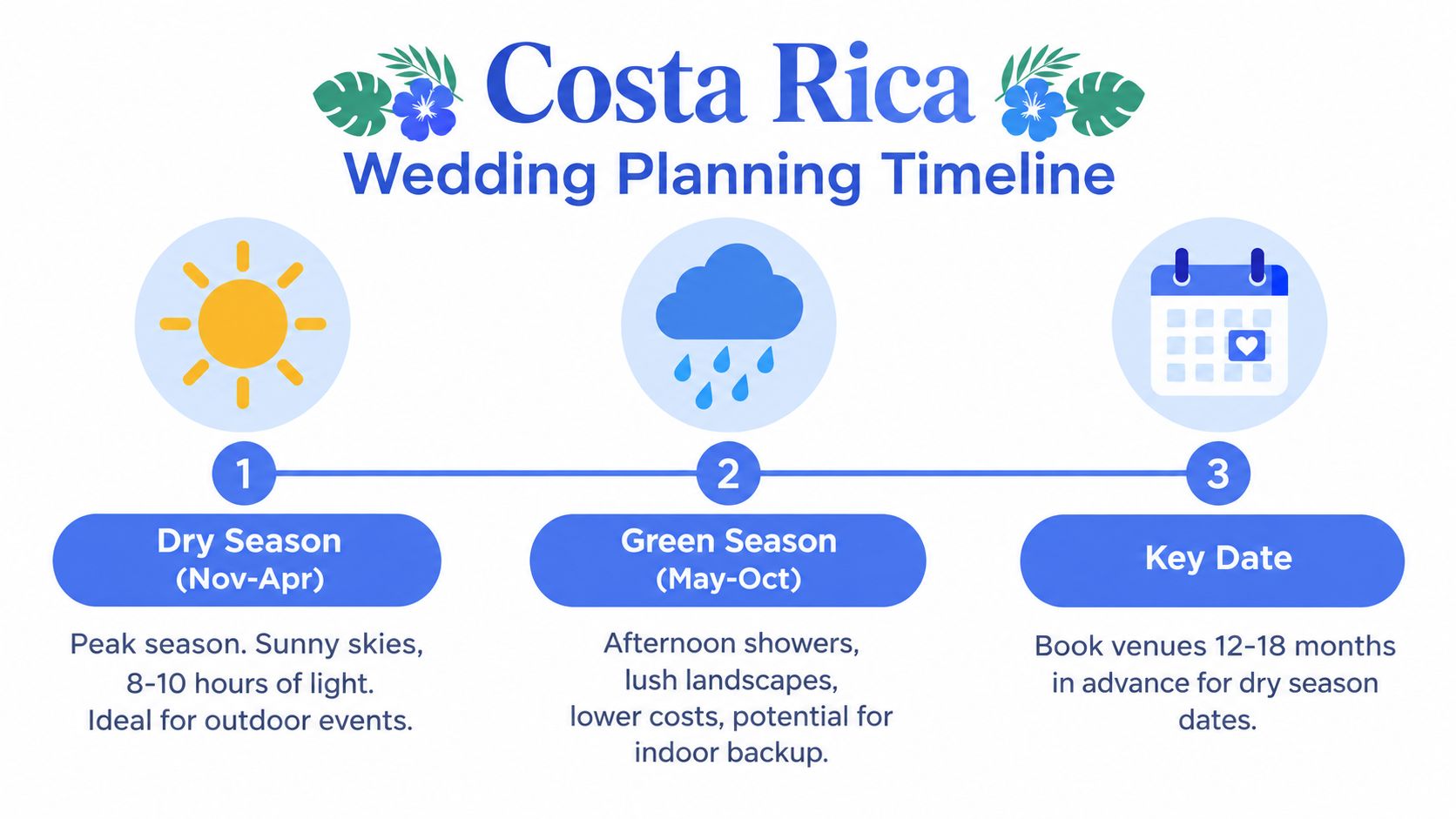
On the Pacific coast, the dry season runs roughly from mid-November through April, followed by a rainy or green season from May through mid-November. The Caribbean coast follows a different pattern, so apply regional weather logic rather than treating Costa Rica as one climate zone. (Elancla Wedding Films' Costa Rica season guide)
Dry season favors outdoor certainty
For Pacific-coast celebrations, December through April generally provides the most predictable conditions for ceremonies, cocktails, and portraits. Late November and May can work as shoulder periods. September and October are typically the wettest months, so outdoor plans during this window need stronger contingencies. (Costa Rica climate data)
More predictable weather can simplify tent decisions, room flips, rain-resistant décor, and schedule changes. It does not remove the need for a Plan B. It gives your team more room to execute the day without rushing.
Green season can work with the right structure
A green-season wedding rewards couples who value lush scenery and can build flexibility into the schedule. Afternoon showers may affect seating, ceremony timing, portraits, sound equipment, floral installations, and vendor load-in, so your venue must support quick changes.
I require a Plan B for every outdoor moment:
- Ceremony: Confirm a covered or indoor location with a comparable guest experience.
- Cocktail hour: Choose a transition space that keeps guests comfortable without sending them into a cramped corridor.
- Portraits: Ask your photographer how the timeline changes if the original outdoor setting becomes unusable.
- Materials: Select décor and furnishings that tolerate humidity and brief downpours.
- Load-in: Build flexibility into vendor access so weather does not compress setup into an impossible window.
A rain plan is not a backup if guests discover it only after the sky changes. It belongs in the original design.
Geography matters as much as architecture. A protected resort terrace, covered villa courtyard, and remote beachfront estate will handle the same shower differently. Ask each shortlisted venue for current photos and floor plans of its actual rain space. Confirm its capacity, guest flow, power access, and vendor setup before you sign.
Legal Versus Symbolic Ceremonies and What Paperwork Really Takes
Before signing a venue contract, decide whether Costa Rica needs to be the place where your marriage becomes legal. Foreign couples can marry there without residency, a waiting period, or blood tests, but the process still requires document validation, witnesses, and local coordination. For smaller celebrations built around longer villa stays, this choice often determines whether a private home is worth its premium over a resort package.
Choose a legal Costa Rican ceremony if local recognition matters and you are prepared to manage the paperwork. Choose a symbolic ceremony if you want greater creative freedom, a shorter planning window, or fewer international documents. You can complete the legal marriage at home, then hold the meaningful celebration in Costa Rica with the same vows, setting, and guest experience.
The legal ceremony checkpoint
A legal ceremony must be officiated by a licensed notary public, a judge at the Civil Registry, or a Catholic priest who registers the marriage. Both partners must be legally free to marry and provide valid passports and sworn status declarations. (Expat.com's Costa Rica marriage formalities guide)
If either partner was previously married, finalized divorce decrees or death certificates must be ready before the ceremony. You also need two non-family witnesses who are at least 18 years old. Witnesses generally provide passports or other identification in advance. (CostaRica.org's wedding requirements guide)
The venue is only one part of the schedule. Build time for validation, translations where required, witness coordination, and the officiant's availability. Assign one person, usually your planner or local legal contact, to track every document and deadline.
The symbolic ceremony decision tree
Ask four direct questions:
- Must the ceremony itself be legally performed in Costa Rica? Start the legal process early.
- Would document administration distract from the weekend? Complete the legal marriage at home.
- Do you want full control over the officiant, location, and timing? A symbolic ceremony usually gives you more flexibility.
- Will family members question the distinction? Explain the arrangement before invitations go out.
Planning guidance places a typical Costa Rica wedding timeline at 12 to 18 months, while smaller weddings may come together in 6 to 9 months. Use the longer window for a legal ceremony, especially if documents need correction or validation. (Destination Weddings' Costa Rica planning guide)
My advice: If your schedule is tight, choose the symbolic route unless being legally married in Costa Rica carries personal importance. A private villa then earns its premium through privacy and time together, rather than forcing the celebration to revolve around paperwork.
Realistic Budgets Vendors and Timeline for a Premium Celebration
A premium Costa Rica wedding becomes expensive when the venue, guest experience, and coordination scope remain undefined. Set the investment framework first, then choose the format that earns it. A private villa can justify its premium when your group values privacy, shared time, design control, and a longer stay. A resort package may suit couples who prefer built-in services and a simpler operating model.
Published estimates place a 50-guest Pacific-coast wedding at $15,000 to $35,000. Smaller celebrations and elopements can require less, while luxury villa or eco-resort events can exceed the higher end. Review this Costa Rica destination wedding cost guide as one planning reference, then request current proposals from your shortlisted venues and vendors.
Sample budget ranges for a Costa Rica destination wedding
| Category | Typical range | Planning note |
|---|---|---|
| 50-guest Pacific-coast wedding | $15,000 to $35,000 | Published all-in planning range |
| Private villa rental | $3,000 to $15,000+ | Typically covers 3 to 5 nights |
| Wedding planner | $2,000 to $8,000 | Confirm whether design, production, and event-day staffing are included |
| Airport transfers | $150 to $400 per trip | Cost depends on route, vehicle, and group size |
| Smaller destination wedding | $7,000 to $12,000 | Published estimate for 30 to 60 guests |
| Elopement | $1,500 to $3,000 | Published starting range |
| Luxury villa or eco-resort celebration | More than $15,000 | Premium formats can exceed this level |
The planner fee often excludes catering, rentals, florals, photography, entertainment, officiant services, taxes, and gratuities. Ask for a line-item proposal before comparing a villa plan with a resort package. A lower headline price can shift work and costs onto the couple.
Transportation deserves its own review. Vehicle choices affect arrival times, vendor setup, photography windows, and how much of the wedding day you enjoy. Use the Unique Private Transportation wedding rates as a separate reference, then compare its scope with your routes, guest count, and schedule.
Where premium spending earns its place
Prioritize the details guests experience repeatedly:
- A well-located venue: Shorter transfers protect time and energy.
- A strong planner: The planner manages vendor dependencies and keeps the timeline usable.
- Comfortable transfers: Reliable vehicles matter more than another decorative detail.
- Photography timing: Light, weather, and travel time shape the images you keep.
- Guest accommodation: Clear room logistics support the entire weekend.
For another benchmark, review this guide to the average cost of a destination wedding. Choose a villa when privacy and shared time are central to the celebration. Choose a resort when packaged services and individual guest flexibility matter more.
Guest Travel, Accommodation and Group Logistics
Your guests experience the wedding through airport arrivals, luggage handling, room access, transfer timing, meals, heat, and the hours between scheduled events. Plan those details before choosing activities or finalizing the room plan.
Start with airport and venue geography. Liberia is often the practical gateway for Pacific-coast celebrations, while San José may suit other routes or a multi-region itinerary. Choose based on the venue, flight options, and whether guests are extending their trip elsewhere.
Build the weekend around energy, not events
A three-day stay can feel generous on paper yet become tiring if guests arrive late, transfer immediately, and attend a welcome event before settling in. Give people private arrival time before asking them to socialize.
A workable structure looks like this:
- Arrival day: Airport reception, private transfer, check-in support, and open time.
- Welcome gathering: A relaxed meal or drinks event, not a second wedding.
- Wedding day: Protect the morning, simplify transportation, and limit unnecessary movement.
- Departure or extension: Provide a clear transfer window and optional activities instead of another required schedule.
Room blocks suit guests who want hotel services and individual flexibility. A villa buyout fits a smaller group that values shared space, privacy, and a residential setting. The premium is justified when the couple wants everyone together for longer stays, private meals, pool time, and a setting that feels personal rather than packaged. A resort is the better choice when guests need independent schedules, on-site services, and less coordination from the couple.
The tradeoff with a villa is practical: meals, housekeeping expectations, transfers, and activity departures need deliberate planning. Assign one planner or point person to manage those details so the couple is not solving them during the celebration.
The guest experience improves when the itinerary has breathing room. Togetherness should feel chosen, not scheduled into every hour.
Comparing villas, monthly rentals, and different ownership or management arrangements can complicate accommodation research. This Costa Rica rental guide for owners provides context on how rental structures can differ, while your wedding plan still needs a venue-specific review.
Send guests one central travel brief covering the arrival airport, transfer instructions, accommodation details, dress guidance, weather expectations, and emergency contacts. It prevents repeated questions and gives everyone the same practical information before the weekend begins.
Sample Itineraries Honeymoon Add Ons and Your Next Step With Explore Effortlessly
If guests are flying to Costa Rica for your wedding, give the weekend room to breathe. Keep the celebration focused, then add one honeymoon region that matches how you want to spend the rest of the trip. If your honeymoon is a separate journey rather than an extension here, my 10-day Argentina itinerary planning guide offers a route to compare before you settle on flights.
For a three-day wedding stay, use a simple rhythm: arrival and settling in, a relaxed welcome gathering, the wedding, then departure or an optional extra night. A five-day stay gives you space for recovery after the ceremony or one low-pressure group activity. Protect open time. Guests should enjoy the destination without feeling managed from breakfast through bedtime.
Choose the honeymoon extension by travel style:
- Arenal: Best for rainforest scenery, volcano views, and a clear change from the coast.
- Manuel Antonio: A strong fit for couples who want beaches, wildlife, and a more varied setting.
- Papagayo: Suits couples who want to stay in a polished coastal environment and avoid another major transfer.
A Few Words on Planning and Packing
Beyond getting around, a little prep goes a long way. You'll be dealing with Costa Rica’s famous microclimates, where you can start your day in the humid coastal heat and end it in the cool, misty air of a cloud forest.
A well-thought-out packing list is a must. I provide my clients custom lists with everything they need, from lightweight layers and proper hiking shoes to the right attire for a nice dinner out.
Decide the legal versus symbolic ceremony before signing the venue contract. A legal ceremony brings more administrative work, while a symbolic ceremony keeps the destination celebration simpler when the legal marriage is completed at home. Choose based on the experience you want, then build the paperwork and ceremony plan around that decision.
Explore Effortlessly designs custom destination weddings and related travel through professional planning fees. One consultation establishes the direction, then a dedicated planner coordinates transfers, dining, accommodation details, and day-of logistics. VIP support also extends into evenings and weekends when canceled flights or missed connections disrupt the plan.
For couples extending the celebration, the Costa Rica trip planning guide helps shape the broader route before wedding details take over. The travel newsletter offers practical destination guidance and planning ideas that save research time.
Explore Effortlessly can organize the wedding journey around your ceremony choice, guest logistics, private transfers, accommodation, and honeymoon pacing. If you want one advisor to turn the options into a workable plan, visit Explore Effortlessly and start planning your trip.