Title: Argentina Itinerary 10 Days Luxury Planning Guide
Meta description: A smart 10-day Argentina itinerary for luxury travelers deciding between Buenos Aires plus Iguazú or Patagonia.
Short URL: /argentina-itinerary-10-days
You're probably staring at a map of Argentina thinking ten days sounds generous. It isn't. Not if you try to do Buenos Aires, Iguazú, Mendoza, and Patagonia in one trip.
That's the mistake I see most often. Travelers book beautiful hotels, great guides, and premium flights, then spend too much of the trip packing, checking out, rechecking flights, and losing daylight to airport logistics. A strong Argentina itinerary for 10 days is not about squeezing in more pins on the map. It's about choosing the right version of Argentina for this trip and doing it well.
If you want my direct opinion, pick one marquee region beyond Buenos Aires. For most first trips, that means either Buenos Aires + Iguazú or Buenos Aires + Patagonia. Both work. Both feel special. Only one will fit your priorities. If you're comparing how to divide ten days across destinations, my Portugal and Azores itinerary guide shows another way to balance a mainland stay with island time.
Why Ten Days in Argentina Requires a Different Strategy
Argentina is big enough to punish overambition. The country stretches from subtropical Iguazú in the northeast to glacial Patagonia in the south, and that geography is the whole planning problem. A lot of travelers assume ten days means they can “sample” several regions. In practice, that usually creates a trip built around airport transfers.
In 2024, Argentina's travel and tourism sector welcomed 4.7 million international arrivals and contributed $35.9 billion, equal to 5.8% of GDP and 956,000 jobs according to tourism data on Argentina. That scale matters because the main routes are well established, but it doesn't change the distances.
The mistake most travelers make
Most generic guides push a loop. Buenos Aires, Iguazú, Mendoza, Patagonia. It sounds efficient on paper. It isn't. Neutral planning guidance also points to a better rule for first-timers: focus on one main region, since Iguazú and Patagonia each realistically need at least 3 to 4 full days, not counting travel time, as noted in this Argentina trip planning guide.
Practical rule: In ten days, depth beats coverage every single time in Argentina.
A smarter framework is simple:
- Anchor Buenos Aires first: Give the capital three nights so you can recover from the long-haul flight, enjoy the city properly, and avoid a rushed airport handoff.
- Choose one secondary region: Go north for waterfalls and jungle, or south for glaciers and mountain scenery.
- Build around flights: Don't build around road transfers. Domestic air is the backbone of the trip.
- Protect your final night: I prefer ending in Buenos Aires before your international departure.
If you're comparing styles of trip, I also like using resources that help narrow the experience type before hotel shopping starts. For travelers considering resort-style pacing, this overview of Argentina all inclusive trips is useful because it highlights how different Argentina feels from a classic beach-resort destination.
What I recommend instead
I design this trip in two clean archetypes.
- Culture and waterfalls with Buenos Aires and Iguazú
- Capital and Patagonia with Buenos Aires and the far south
That's the right strategy for a premium trip where comfort, sequencing, and time matter. If you want help structuring the route before locking flights and hotels, custom trip planning is where that process starts.
Choosing Between Iguazú and Patagonia First
This choice should be fast. You don't need more inspiration. You need a filter.
A ten-day trip usually works best as Buenos Aires + Iguazú or Buenos Aires + Patagonia. Argentina's average international stay can run about 14.1 days, which tells you something important. Many visitors treat the country as a full single-country journey, not a quick add-on, according to Argentina tourism statistics. If you only have ten days, you need to edit hard.
Iguazú vs Patagonia for a 10-Day Argentina Trip
| Factor | Buenos Aires + Iguazú | Buenos Aires + Patagonia |
|---|---|---|
| Flight time from Buenos Aires | About 1 hour 55 minutes nonstop to Puerto Iguazú on a route with multiple daily frequencies and around 17 weekly departures via flight route data | About 3 hours 20 minutes nonstop to El Calafate via Buenos Aires to El Calafate route data |
| Seasonal fit | Easier to plan year-round | Best in late October through early April, with November to March the strongest access window |
| Trip feel | Softer pace, easier compression | Bigger scenery, more transfer friction |
| Activity style | Walkways, viewpoints, boat excursions, jungle setting | Glaciers, trekking, lodges, wind, wilderness |
| Best for | First-timers, couples, anniversary trips, travelers who want nature without heavy exertion | Active travelers, hikers, landscape-driven travelers, guests willing to move more |
| Hotel rhythm | One city hotel and one falls hotel works very well | Lodge sequencing matters more than star count |
| My opinion for 10 days | Easier and cleaner | Worth it only if Patagonia is the point of the trip |
My direct recommendation
Choose Iguazú if you want a trip that feels polished and not overworked. The flight is shorter, the logistics are cleaner, and the reward is immediate. You can pair steak dinners, architecture, and closed-door dining in Buenos Aires with one of the world's great waterfall areas and still have room to breathe.
Choose Patagonia if glaciers and southern scenery are the reason you're going. Don't choose Patagonia because you feel you “should.” Choose it because you're happy to spend more, fly more, and build the trip around scenery rather than city energy.
Patagonia is spectacular, but it only works in ten days when you accept that the trip needs discipline.
A second operational point matters here. Buenos Aires has 34 domestic flight routes with direct service to key building blocks like El Calafate, Mendoza, and Puerto Iguazú, according to flight network information from Buenos Aires. That gives you options, but options are not the same thing as time. The route may exist. That doesn't mean you should use all of them on one trip.
Buenos Aires and Iguazú in Ten Days
This is the route I recommend most often for first-time luxury travelers to Argentina. It has contrast, but it doesn't feel punishing.
The pacing I like
Days 1 to 3 belong to Buenos Aires. Stay in Recoleta if you want classic luxury and easier access to grand old-city landmarks. Stay in Puerto Madero if you prefer a sleeker base with polished service and a more modern feel. Stay in Palermo if design, restaurants, and neighborhood energy matter more than formality.
I'd use those first days for a private city introduction, a Recoleta Cemetery walk, slow lunches, and one proper steakhouse night. Save San Telmo for a measured half day, not an all-day forced march.
Then move north and keep it simple
Fly to Puerto Iguazú on Day 4. The route from Buenos Aires to Puerto Iguazú is about 1 hour 55 minutes nonstop over roughly 1,081 to 1,086 km, and adding a connection can push the trip closer to 5 hours total, which is exactly why I avoid cute overcomplicated routing on this corridor, based on route timing data.
For a high-end trip, I like three nights at Iguazú.
- Day 4: Arrive, settle in, light activity only
- Day 5: Brazilian side for panoramic views
- Day 6: Argentine side for the immersive trail network and closer feel of the falls
- Day 7: Return to Buenos Aires
- Days 8 to 9: Final Buenos Aires stay
- Day 10: Departure
Start early at the falls. The humidity builds, the light changes, and the walkways are more pleasant before the day thickens.
Hotel and experience notes
For a classic splurge, I'd prioritize staying inside or as close as possible to the falls experience, because location changes the rhythm of the visit. At this level, I care less about generic star ratings and more about whether you can enter early, return midday, and avoid wasting the best hours in transit.
In Buenos Aires, I'd separate neighborhoods by travel style:
- Recoleta: Formal service, established flagship hotels, elegant public spaces
- Puerto Madero: Contemporary feel, smoother for short stays, convenient private transfers
- Palermo: Better if you want restaurant access and less traditional hotel energy
For dining, a concierge-led trip pays off. Closed-door restaurants, steakhouses with sensible reservation times, and transfer timing matter more than people think after a long-haul arrival. I also like ending the trip with two final city nights so Buenos Aires doesn't feel like an airport lounge with good architecture.
Buenos Aires and Patagonia in Ten Days
This version is more dramatic and less forgiving. If you choose it, commit to it.
Buenos Aires + Patagonia 10-Day Plan
| Day | Location | Anchor Stay | Primary Activity | Transfer |
|---|---|---|---|---|
| 1 | Buenos Aires | Recoleta or Puerto Madero hotel | Arrival and recovery dinner | International arrival |
| 2 | Buenos Aires | Same hotel | Private city touring, Recoleta Cemetery | Minimal |
| 3 | Buenos Aires | Same hotel | Tigre Delta day trip or lighter city day | Minimal |
| 4 | El Calafate | Eolo Patagonia Lodge or similar glacier-focused base | Fly south and settle in | Flight from Buenos Aires |
| 5 | El Calafate | Same lodge | Perito Moreno Glacier private excursion with boat approach | Road transfer locally |
| 6 | Ushuaia | Arakur Ushuaia Resort or Los Cauquenes | Transfer south | Air or overland plus air |
| 7 | Ushuaia | Same hotel | Tierra del Fuego National Park | Local touring |
| 8 | Ushuaia | Same hotel | Beagle Channel private navigation | Local touring |
| 9 | Buenos Aires | Airport-convenient city hotel | Return and final dinner or estancia-style asado | Flight to Buenos Aires |
| 10 | Departure | , | Depart Argentina | International departure |
Why this route works
The backbone is distance. Buenos Aires to El Calafate is about 1,273 miles, and the nonstop flight takes about 3 hours 20 minutes, according to flight data for the EZE to FTE route. That's manageable. Driving is not.
This is also why I don't support fantasy overland loops in ten days. The same logic applies deeper south. Mendoza is about 650 miles from Buenos Aires, while Ushuaia is nearly 2,000 miles away, which is why every Patagonia-heavy itinerary needs ruthless prioritization, based on Argentina transportation guidance.
Season matters more here than people expect
For Patagonia, I strongly prefer the main travel window from late October through early April, with November to March repeatedly identified as the best access period in this Patagonia season guide. For hiking weather specifically, the Patagonian summer from December to February brings average temperatures around 10 to 20°C, while November and March are milder and less crowded according to this Patagonia climate overview.
That translates into a practical recommendation:
- December and January: Great access, highest pressure on rooms and logistics
- November and March: My favorite balance for many clients
- Late shoulder season: Fine for some travelers, but service availability matters
If you're glacier-first, trim Buenos Aires by a night before you trim Patagonia. If you're wildlife-first and want marine time in Ushuaia, keep the Ushuaia stay intact and don't overstuff El Calafate with extra movement.
Internal Flights and Routing Strategy
A ten-day Argentina trip goes off course fast when the flight plan is careless. The usual mistake is cramming in too many sectors, then pretending airport transfers and schedule padding do not count as vacation time. They do.
For this trip length, I plan flights around one standard: protect daylight hours that you can use. If a routing looks efficient on paper but forces an airport change, a rushed connection, or a late hotel arrival followed by an early checkout, I cut it.
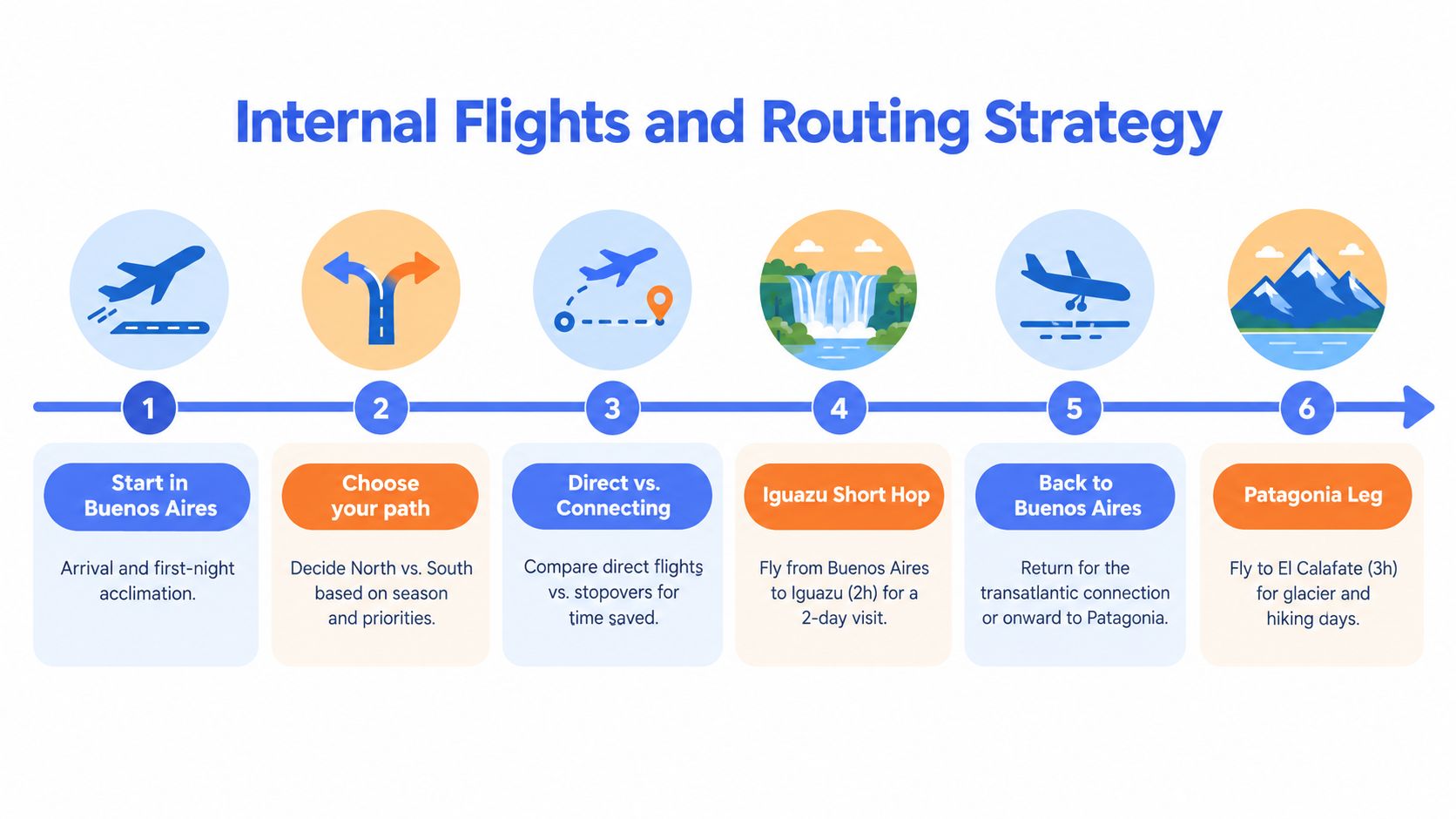
The routing rules I actually use
Sleep in Buenos Aires after your international arrival
I do not book same-day onward domestic flights for high-value trips unless the schedule is unusually forgiving. Start with one proper city night, reset, and fly onward the next day.Keep the trip in one direction
Buenos Aires plus Iguazú works cleanly. Buenos Aires plus Patagonia works cleanly. Trying to force both into the same ten-day framework usually produces dead time, not range.Pay for nonstop logic
A cheaper fare with an extra stop often costs you the better part of a day once delays, airport dwell time, and transfer windows are factored in.Treat airport choice as part of the hotel strategy
In Buenos Aires, airport positioning affects how the day feels. A smart pairing between your hotel base and departure airport can save enough friction to justify a higher room rate in the right neighborhood.
Where I would spend more
I spend more readily on Patagonia flights than on Iguazú flights. The southern sectors are longer, weather can tighten schedules, and fatigue shows up faster there. Better departure times, stronger seat assignments, and less awkward connection structure are worth paying for.
I also prefer open-jaw ticketing when the trip design supports it, rather than forcing a neat round-trip that burns time. If you want a practical framework for structuring those tickets, review this guide on the best way to book multi-city flights.
Luggage matters more than travelers expect on Argentina domestic hops. If you are moving between climates and changing hotels, a disciplined carry-on setup is far better than hauling oversized hard cases through repeated check-ins. This Grainmark Leather travel bag guide is a useful reference for travelers who want a sharper personal-item strategy.
A beautiful itinerary still fails if the flight pattern is clumsy. Get the routing right first. Then book the rooms around it.
Hotel Tiers and Concierge Service Standards
The right hotel pairing in Argentina matters more than chasing a generic idea of “luxury.” I'd rather put you in the correct property with the right flow than in the most famous name in the wrong location.
Buenos Aires and Iguazú tiers
In Buenos Aires, the flagship Recoleta houses are where I place travelers who want formal service, polished public areas, and a more classic city feel. Four Seasons Buenos Aires and Palacio Duhau, Park Hyatt Buenos Aires fit that lane well.
For Iguazú, I think there are two smart lanes. One is the grand hotel approach, where Gran Meliá Iguazú wins on direct access logic. The other is the private-lodge model, where privacy, guiding, and a more cocooned rhythm become the point. Properties like Awasi or La Reserva appeal to travelers who care more about space and individualized pacing than being in a larger flagship setting.
Patagonia and Ushuaia choices
In Patagonia, I prefer a lodge-first mindset. Eolo works for travelers who want atmosphere, land, and a sense of remoteness. Explora suits people who want the lodge to function almost like part of the expedition logic. Awasi fits privacy-led travelers who value a more secluded rhythm.
In Ushuaia, I usually narrow the conversation quickly. Arakur Ushuaia Resort works well if views and a larger full-service setup matter. Los Cauquenes is the better fit when travelers want a more intimate waterfront feel.
What concierge standards I care about
This is the service checklist I look for:
- Pre-arrival contact: A real pre-trip message flow, often on WhatsApp, so requests don't start at check-in.
- Airport handling: Private greeters and clearly staged transfers matter on an itinerary with domestic flight movement.
- Guiding quality: In-house naturalists or properly coordinated private guides make a visible difference in Patagonia.
- Operational support: Same-day laundry is not glamorous, but in wind, rain, or trail conditions, it's valuable.
The hotel delivers the on-site experience. A travel advisor structures the pairing, timing, and service expectations around it. For travelers who want support at that level, luxury travel concierge planning is the kind of service model that fits this sort of Argentina itinerary.
Investment Expectations and Who This Trip Suits
Let's keep this straightforward. This is not a cheap destination at this level once you add strong hotels, private transfers, internal flights, and guided touring.
For the right traveler, it's worth it. For the wrong traveler, it feels like too much motion and not enough beach time.
Argentina 10-Day Investment by Archetype
| Component | BA + Iguazú | BA + Patagonia |
|---|---|---|
| Hotels | Five-star city hotel plus premium falls stay | Five-star city hotel plus Patagonia lodges |
| Internal flights | Moderate | Higher due to longer sectors and additional routing |
| Private touring | City guiding and falls touring | City guiding, glacier touring, and southern logistics |
| Overall starting point | Starts around USD 18,000 per couple | Climbs past USD 28,000 per couple |
| Best fit | Couples, honeymooners, first-time Argentina travelers | Active luxury travelers, scenery-first travelers |
Those starting points are for travelers booking a premium version of the trip with private transfers and strong hotel choices. They do not automatically include every add-on. Park fees, specialty wine pairings, and helicopter or charter-style upgrades are the kinds of extras that shift the final number.
Who should book this trip
This trip suits:
- Honeymooners who want scenery and good pacing without a rigid daily march
- Anniversary couples who value comfort, private touring, and memorable hotel choices
- Active luxury travelers who don't need to sit still, but also don't want chaos
It does not suit travelers looking for nightlife-heavy city hopping, bargain-first planning, or a classic fly-and-flop beach holiday.
If you only have ten days, the smartest spend is protecting time, not adding one more destination.
My strong recommendation is to put internal flights on hold well ahead of departure and confirm hotel availability before your preferred room categories disappear. Argentina rewards decisiveness.
Frequently Asked Argentina Trip Questions
When should I go
For Patagonia, the most reliable travel window is November to March if you want the strongest access and stable touring conditions. Buenos Aires works well year-round, but spring and fall are often the most comfortable in feel. Iguazú is workable across the year, though some travelers prefer cooler months for easier walking conditions.
Do U.S., U.K., and EU travelers need a visa
Entry rules can change, and travelers are responsible for checking current requirements before departure. In many cases, tourist entry is straightforward, but I tell clients to check passport validity carefully and not assume a nearly expired passport will slide through.
How should I handle money
Use a mix. Luxury hotels and established high-end operators generally accept major cards. It's still smart to carry local currency for smaller purchases, tips, and incidental city spending. I also like clients to keep payment strategy simple rather than juggling too many forms of cash.
What about tipping
Tip private drivers and guides thoughtfully, and round up in restaurants when service merits it. Argentina is not the place to overcomplicate every small transaction, but a good guide or well-handled private transfer deserves acknowledgment.
Is there altitude to worry about
Not in the way travelers worry about in high-altitude Andean itineraries. The bigger comfort issue is usually humidity in Iguazú and wind and shifting weather in Patagonia. Pack for the route you chose, not for a theoretical all-Argentina wardrobe.
Can I add Mendoza
Yes, but not inside this core ten-day framework if you want the trip to feel polished. Mendoza works much better as a two-night extension with its own domestic flight rather than as a forced extra stop in the middle of the itinerary.
If you want an Argentina trip that fits your time, pacing, and travel style, I can help you narrow the route, sequence the flights, and choose the right hotels without turning ten days into an airport marathon. Explore Effortlessly plans custom international itineraries for travelers who want clear recommendations, strong logistics, and a trip that feels worth the investment.