You're probably here because travel planning has started to feel like a second job.
You open a few tabs for flights, then hotels, then villas, then transfer options, then private guides, then suddenly you're comparing ferry schedules, room categories, and cancellation policies at midnight. For high-value travel, that's not a minor inconvenience. It's how expensive mistakes happen.
That's why I'm opinionated about custom trip planning. If your time is valuable and your trip matters, the answer isn't more tabs. It's a better process.
- Custom trip planning is not a package. It's a customized design process built around your pace, preferences, and priorities.
- Time is a true luxury. Priceline found the average traveler spends two full work days planning and booking a trip, and 22% of U.S. adults say itinerary creation is one of the most frustrating parts of the process, according to Priceline's travel planning research.
- A strong itinerary has to be feasible. Beautiful ideas mean nothing if transfer timing, availability, and real-world logistics don't hold up.
- AI can help, but it can't replace judgment. It's useful for early ideas. It's weak at nuance, verification, and protecting a complex trip from preventable errors.
- The right advisor should feel like a strategic partner. You're not buying a list of hotels. You're buying clarity, curation, and a smoother outcome.
What Custom Trip Planning Truly Means
You know the destination. You may even know the hotel brand. Then the important questions start. Which room category is worth the premium? How many nights belong in each stop? Which transfers will feel easy instead of annoying? Where should you leave white space, and where should you spend for access?
That is the point of custom trip planning. It turns scattered preferences into a trip that fits the way you travel.
A bespoke trip is built through judgment, curation, and refinement. The advisor is not there to dump options in your lap. The advisor filters, interprets, and steers. Good planning protects your time, sharpens your choices, and removes the friction that usually shows up later as wasted hours, clumsy logistics, or a trip that looks impressive on paper and feels wrong in practice.
If an itinerary has ever sounded good but felt slightly off, you were reacting to a lack of fit.
Bespoke means designed around you
A standard trip pulls together available inventory. A custom trip is shaped around your habits, priorities, and tolerance for effort while you are away.
That means asking better questions from the start:
- Pacing: Do you want long breakfasts, slow afternoons, and one excellent plan per day, or do you want structured days with private touring and very little downtime?
- Energy: Do you enjoy movement and variety, or do you travel best with fewer hotel changes and more room to settle in?
- Privacy: Do you want a sociable flagship hotel, a discreet villa, or a suite that gives your family space and quiet?
- Decision style: Do you want a short list, or do you want your advisor to make the call and present the strongest option?
- Purpose: A honeymoon, milestone celebration, family trip, safari, or executive getaway each follows different planning logic.
For busy professionals, the pain point is not only personalization. It is time, attention, and the cost of getting details wrong.
Practical rule: Once a trip includes multiple stops, premium air, private transfers, special access, or a meaningful occasion, expert planning usually saves money, stress, and disappointment.
A good advisor hears the brief behind the brief
Clients rarely arrive with perfect language. They say, “We want Italy, but not the exhausting version,” or “We want Greece, but we do not want to fight crowds all week.” My job is to translate that into concrete decisions.
Sometimes the right answer is fewer stops. Sometimes it is one exceptional hotel instead of two nice ones. Sometimes it is building in a quiet day after a long-haul arrival because energy matters more than squeezing in another reservation. For a leadership offsite, it can mean choosing setting and flow before anything else, which is why a piece like best corporate retreat locations for 2026 can be a useful starting point for thinking about group dynamics and environment.
This is the key value of the relationship. You are not buying a template. You are working with someone who can identify what will make the trip feel effortless for you, then shape the itinerary accordingly.
For travelers seeking an advisor-led model rather than a fixed package, bespoke travel experiences reflect that more customized planning relationship.
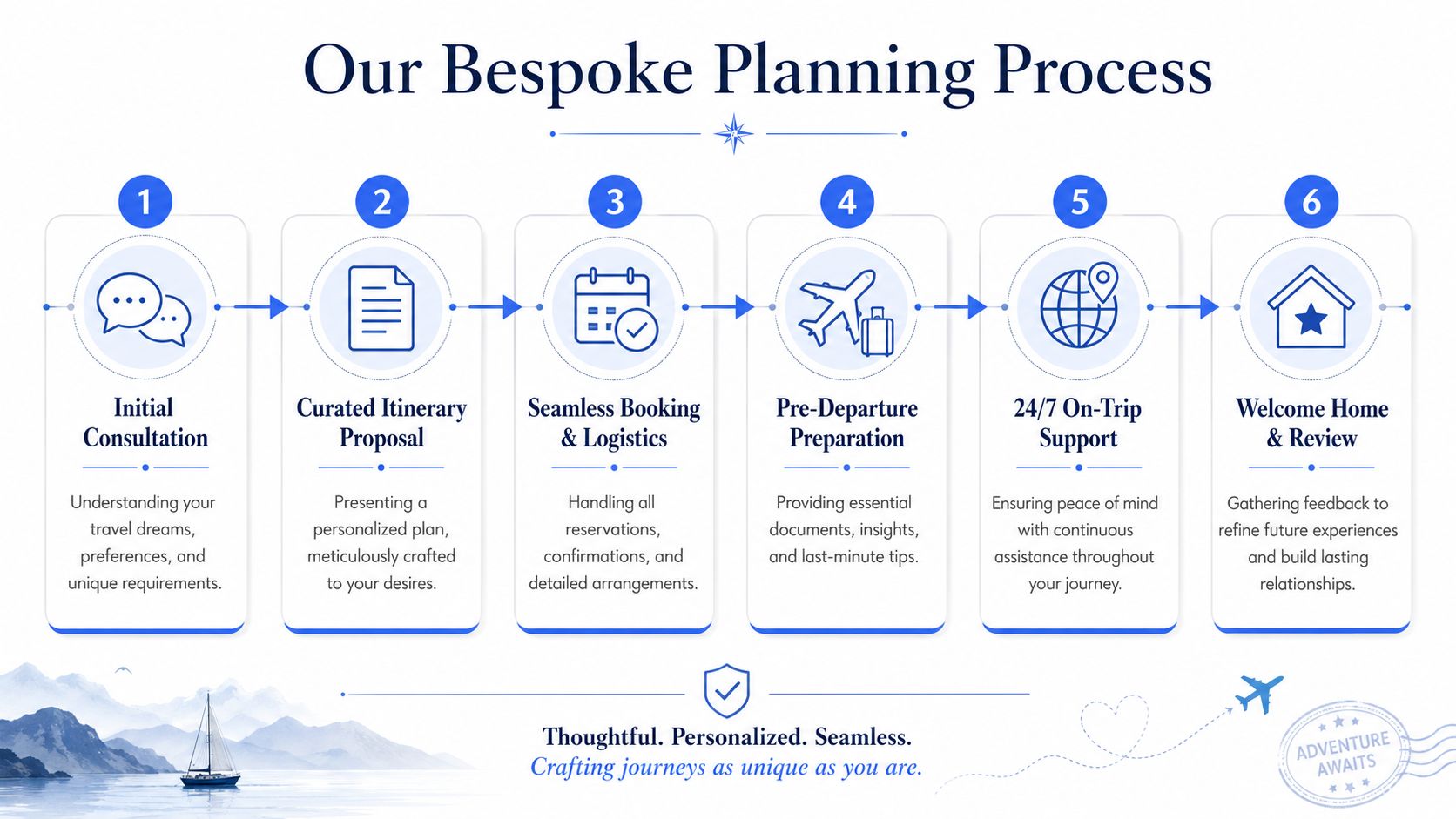
Our Signature Process From Consultation to Welcome Home
Luxury travel should feel smooth long before departure. The trip itself is only part of the experience. The planning should be calm, structured, and decisive.
That's why I don't treat custom trip planning as a one-off booking task. I treat it as a managed process with clear stages, because that's how you avoid missed details and prevent chaos from creeping in later.
The first conversation sets the direction
The consultation is where the trip gets its shape. Not just destination, but purpose, style, and deal-breakers.
Sometimes clients know exactly what they want. More often, they know the feeling they want. Quiet luxury. A celebratory atmosphere. Fewer hotel moves. Better flight flow. Enough structure to make the trip sing, but not so much that it feels managed to death.
From there, the process usually looks like this:
Discovery and fit
We define what matters most. The room matters or it doesn't. The food scene matters or it doesn't. Privacy, beach quality, guide quality, transfer ease, family configuration, and tolerance for movement all get surfaced early.Itinerary design
I build a working plan that connects the major parts of the trip. Flights, routing, hotel logic, touring rhythm, transfer timing, and experience sequencing need to work together.Presentation and refinement
You review a curated proposal, not a messy pile of options. We refine where needed without losing the integrity of the trip.
A polished itinerary is not a list of nice ideas. It's a sequence that still works when real life enters the room.
Logistics are where luxury is won or lost
Anyone can suggest a beautiful hotel. The harder part is making the entire journey function well.
A key part of strong planning is accounting for real-world logistics and potential disruptions. As discussed in this tailored itinerary perspective, online planning tools can have limited accuracy, which is why smart itineraries include transfer buffers and contingency thinking. I agree with that completely. A smooth trip is a feasible, well-vetted one.
That affects choices like:
- Arrival day design: Don't schedule a major touring block right after a long-haul flight.
- Connection logic: Tight handoffs between flights, ferries, or drivers look efficient on paper and fall apart fast.
- Hotel sequencing: The right order reduces friction and improves the feel of the trip.
- Backup thinking: If weather, closures, or timing issues arise, the day should be recoverable.
Before departure and after return
Once the trip is confirmed, the work shifts to precision. Final documents, reservation alignment, pre-departure guidance, and destination-specific notes all need to be buttoned up.
On the ground, trusted in-destination partners and suppliers provide local support while I coordinate the planning and logistics before departure. After you return, I want the honest debrief. What felt perfect. What felt rushed. What should change next time.
If you want a clearer view of that advisor-led workflow, our process lays out how the planning relationship works from first call to final follow-up.
Understanding the Investment and Planning Timeline
Let's deal with the question clients often circle around. What are you paying for?
You're not paying for someone to click “book.” You're investing in judgment, structure, industry knowledge, supplier coordination, and the ability to spot weak points before they turn into trip problems. That's the difference between a booking and a managed travel experience.
Why a planning fee makes sense
A planning fee creates clarity. It means the work starts with strategy, not scattered transactions. That's better for everyone.
A proper custom itinerary requires destination knowledge, hotel matching, routing logic, experience design, and repeated quality control. It also requires restraint. One of the most valuable things an advisor does is reject options that are merely acceptable so you don't waste time reviewing things that were never right for you.
You should want transparency here. A professional planning relationship works better when the value exchange is obvious.
Timing is not a detail
For complex luxury trips, lead time shapes quality. It affects hotel choice, room category availability, guide access, transfer options, and the overall smoothness of the journey.
If you're planning a safari, peak holiday travel, a European summer, a milestone anniversary trip, or a multi-country itinerary, earlier is smarter. You get more control. You keep the best options in play. You avoid building a dream trip around what's already gone.
Here's how I'd frame timing:
| Trip type | Planning advice |
|---|---|
| Honeymoon or anniversary trip | Start early enough to secure the right room, not just any room |
| Multi-stop Europe itinerary | Leave room to optimize routing and hotel flow |
| Safari or expedition-style travel | Treat early planning as part of the experience, not an admin task |
| Villa or holiday travel | Expect top inventory to move first, especially for prime dates |
If you're considering a longer stay or villa-style setup in Europe, something like choosing your Spain vacation home can help you think through space, setting, and practical fit before the formal itinerary takes shape.
Sample Itineraries From Our Portfolio
The easiest way to understand custom trip planning is to see how it changes the outcome.
The clients below didn't need more information. They needed a better plan.
The honeymoon that stopped trying to do too much
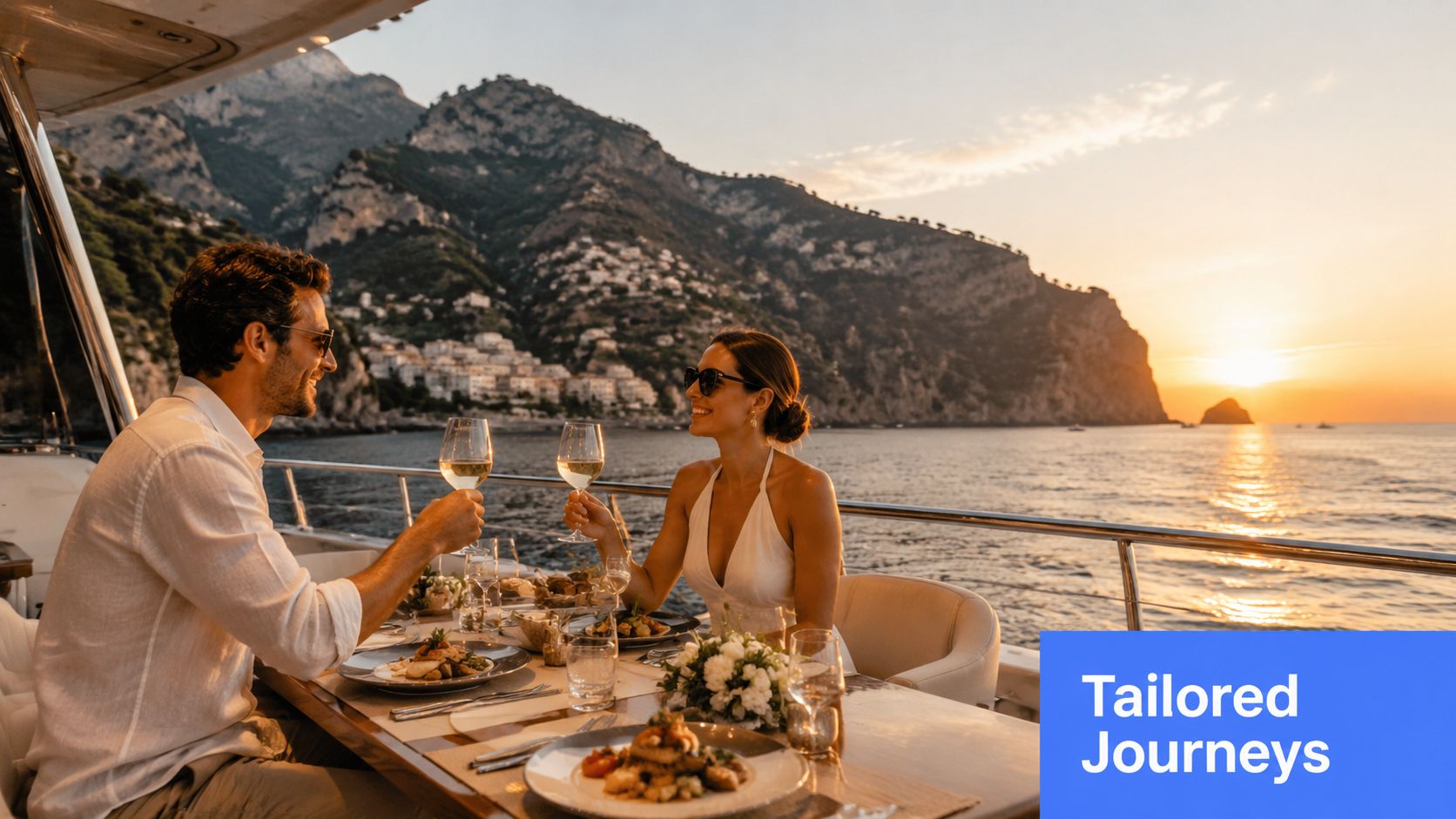
A couple came in wanting a Mediterranean honeymoon with “a little bit of everything.” That usually translates to too many hotel changes, too many transfers, and not enough actual romance.
So we cut the noise.
We kept the emotional high points, removed the unnecessary movement, and built the trip around atmosphere. A suite worth lingering in. Private boat time instead of group touring. Dinner reservations that felt celebratory, not performative. The result was a honeymoon that felt cinematic without becoming exhausting.
The lesson was simple. Luxury isn't more stops. It's better choices.
The milestone family trip that had to work for everyone
A multigenerational family wanted a major celebration trip, but the ages, interests, and energy levels were all different. That's where generic itineraries go to die.
The answer wasn't compromise in the bland sense. It was selective customization. We balanced private touring with downtime, chose accommodations that gave everyone breathing room, and structured days so grandparents, parents, and teenagers could all enjoy the same trip without being attached at the hip every hour.
That's where advisor-led planning earns its keep. The right trip doesn't flatten everyone into one schedule.
Families don't need identical experiences. They need a shared framework that still allows for different rhythms.
The complex itinerary with a non-negotiable smooth arrival
Another client had one request that sounded simple and wasn't. “I do not want to land tired and start making decisions.”
Good. That's the right instinct.
We designed the opening days around easy entry. Clean airport-to-hotel flow, enough recovery time, reservations that fit the traveler's actual energy on arrival, and a sequence that eased them into the destination instead of demanding immediate performance. For clients traveling with pets, paperwork and movement can add another layer, which is why a resource like mastering pet travel rules is useful for understanding how documentation and timing affect the broader trip plan.
These examples aren't about extravagance for its own sake. They're about fit. That's what custom trip planning is supposed to deliver.
How to Choose the Right Travel Advisor for You
Not every advisor is right for every traveler. That's fine. What matters is asking better questions before you hand someone your time, budget, and milestone trip.
A polished Instagram feed tells you almost nothing. Process tells you everything.
Ask how they learn your travel style
If an advisor doesn't have a clear method for understanding how you travel, the itinerary will reflect that.
Ask how they identify pacing preferences, room priorities, transfer tolerance, dining style, and the tradeoffs you care about most. A good advisor won't just ask where you want to go. They'll ask how you want the trip to feel.
Ask how they handle verification
This matters even more now because AI has become part of travel planning. In a recent travel-industry commentary, about one-third of travelers were described as using AI tools such as ChatGPT, Gemini, or Claude during trip planning, but the same discussion makes the more important point: AI is weak at live verification, local nuance, and logistics checking, which is why human review still matters in this perspective on using AI to plan a trip.
That matches my view exactly. AI is fine for early brainstorming. It is not enough for high-stakes travel. Human expertise is what verifies logistics, mitigates risk, and adds the level of personalization that prevents expensive mistakes.
Ask what professional credibility looks like
You should care about credentials, but not in a decorative way. They should signal training, industry fluency, and serious commitment to the craft.
I'd look for an advisor who can show:
- A defined planning process: Not vague promises, but a real workflow
- Destination and product fluency: Especially for premium cruises, villas, safaris, and complex multi-stop travel
- Professional credentials: I'm a Circle of Excellence Advisor, Top 5 percent at Nexion, and a CLIA Accredited Cruise Counselor
- A relationship-based approach: The work should feel collaborative, not transactional
If you're sorting through options, how to find a travel agent is a practical place to start because it helps frame what competence looks like.
Frequently Asked Questions About Custom Planning
Below are the questions I hear most often from clients who want a high-touch planning relationship but don't want surprises.
| Question | Answer |
|---|---|
| Do I need to know exactly where I want to go before reaching out? | No. Many clients come in knowing the feeling they want, not the exact destination. That's enough to start. |
| Is custom trip planning only for very complicated trips? | Not at all. It's most valuable any time the trip matters, the budget is meaningful, or you simply don't want to waste time sorting through the wrong options. |
| Can you help with flights, hotels, transfers, and experiences together? | Yes. The point is coordination. A strong itinerary connects the major parts of the trip so they work as one journey, not as separate bookings. |
| What if plans change after the itinerary is designed? | Changes happen. A good plan should be adaptable without forcing you to rebuild the entire trip from scratch. |
| Do you provide support while I'm traveling? | Trusted in-destination partners and suppliers provide on-the-ground support, while I coordinate the planning details and pre-departure logistics that set the trip up properly. |
| Is this a fit for clients outside Miami? | Yes. I work with clients nationwide through virtual consultations. |
If you've reached the point where DIY planning feels inefficient, that's usually your answer. The trip is ready for a more thoughtful process.
If you want a trip that feels considered from the first conversation to your return home, plan my luxury trip with Explore Effortlessly. I work with clients nationwide through virtual consultations, designing bespoke, high-touch itineraries for honeymoons, milestone journeys, premium cruises, family travel, and complex multi-stop escapes. You can also join the newsletter for more luxury travel insight and inspiration here.
Hi, I'm Karrah, owner, founder, and lead travel advisor at Explore Effortlessly, a luxury award winning travel agency based in Miami.
I specialize in designing bespoke, high touch itineraries to bucket list destinations around the world. Every trip is curated with intention, insight, and seamless logistics from start to finish.
From luxury cruises and private villas to honeymoons, safaris, and once in a lifetime journeys, my role is to simplify the planning process while elevating every detail.