You've done the big career years, the family logistics, the group trips that always revolved around everyone else's schedule. Now you're standing at your kitchen counter with a cup of tea gone cold, looking at flights, and realizing the trip you want might be the one you take alone. That's not a crisis. It's a design decision, and solo travel for women over 50 deserves to be planned like the high-value, high-comfort experience it is.
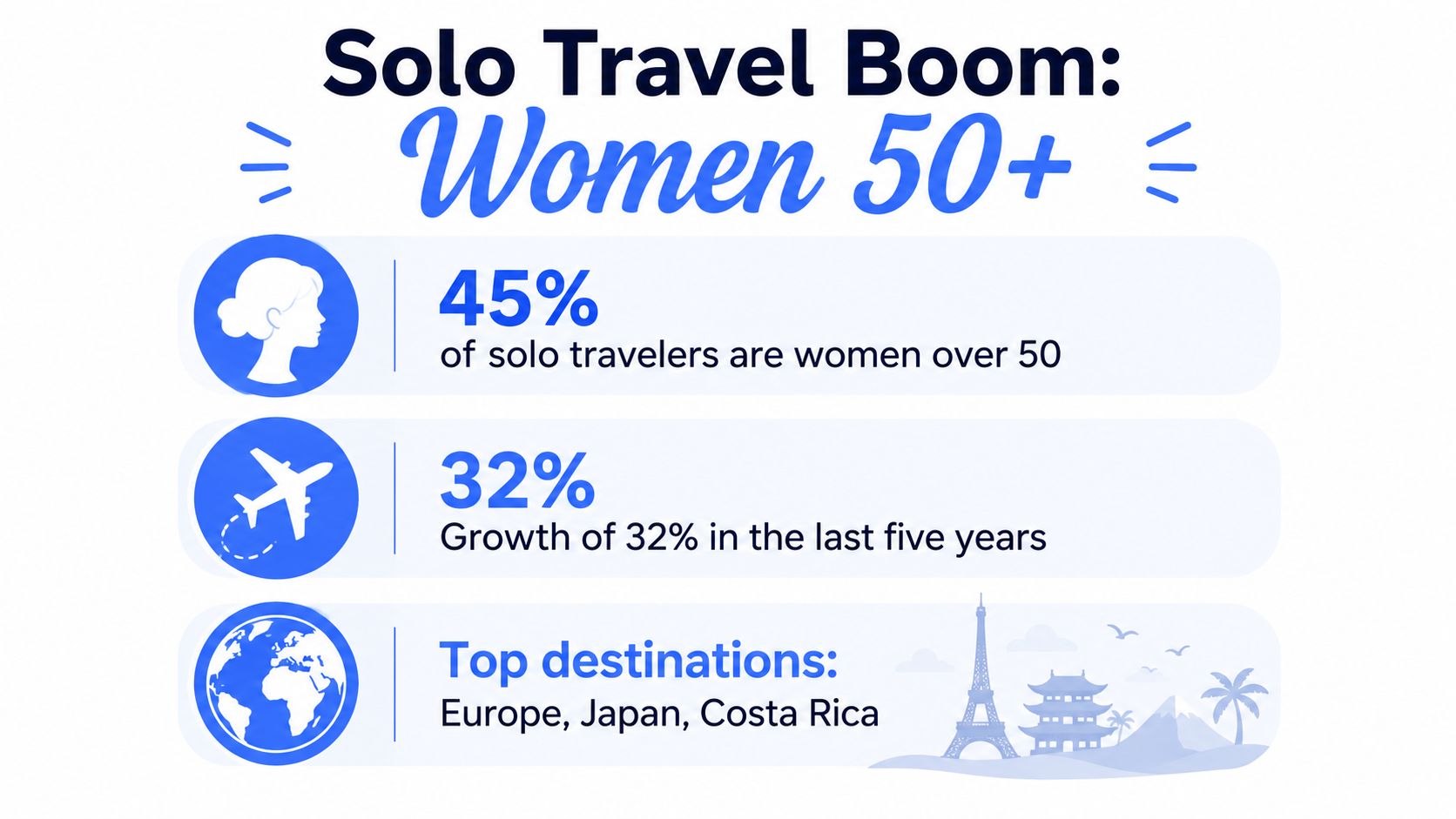
The smart conversation here is not fear. It's fit. The right trip should respect your pace, protect your energy, and avoid the quiet money drain that most articles barely mention, the single supplement and other forms of solo pricing friction. Women over 50 are already shaping this market in a real way, with 61% saying solo travel is their preferred way to travel, and a projected rise to US$363 billion and 25.2 million women by 2035 in the U.S. and Canada alone, according to JourneyWoman's research set on women over 50 JourneyWoman's study on women 50+ solo travel demand. That is not niche behavior. That is serious purchasing power.
For a practical mindset reset, I like sending clients to a solid resource like travel alone without fear when they're ready to move from hesitation to action. Confidence matters, but confidence without structure is just expensive improvisation.
Why Women Over 50 Are Leading the Solo Travel Boom
She's not backpacking through uncertainty with a paper map and a hope. She's booking the trip on her terms, maybe to Lisbon, maybe to Kyoto, maybe to a safari lodge with proper linens and a driver who reliably shows up on time. That's the image behind the trend, a woman who knows what she likes and refuses to waste a week of her life in an itinerary that feels like punishment.
The numbers back up what travel advisors are seeing every day. JourneyWoman reports that 77% of all women's tour bookings in 2022 came from female solo travelers age 55+, and a later 2024 survey found 100% of bookings came from women over 45, including 75% from women 55+ and 25% from women 45–55JourneyWoman's solo travel statistics for women over 50, JourneyWoman's 2024 women's travel survey. In other words, the over-50 traveler isn't on the margins. She's driving demand.
What that means for luxury planning
If you're traveling alone after 50, you're usually not asking for chaos. You're asking for thoughtful pacing, attractive hotels, dependable transfers, and a trip that doesn't treat you like a problem to be solved. That is why women over 50 are influencing premium solo travel product design, especially in guided and semi-guided formats.
Practical rule: if a trip sounds “adventurous” but makes you nervous about logistics, it's probably underplanned, not exciting.
The best framing is simple. You're not booking a safety exercise. You're buying a well-built experience that respects how you travel now, not how you traveled at 28. And if you want to sanity-check your options before you commit, Explore Effortlessly's solo adventure travel planning is the kind of starting point that keeps the process organized without making you dig through ten tabs and three supplier sites.
Mapping Your Solo Travel Style Before You Book
Before flights, before hotels, before you get seduced by a glossy photo of a rooftop pool in Barcelona, answer four questions. How fast do you like to move. How social do you want the trip to be. How much physical effort do you enjoy. How much structure helps you relax. The wrong answer to any one of those can make a beautiful destination feel exhausting.

A smart solo trip starts with a travel personality check, not a packing list. If you love museum mornings, restaurant reservations, and a single elegant hotel base, you're probably a culture-deep generalist. If long lunches, spa time, and one excellent view matter more than checking boxes, you're a restoration-first traveler. If you want private guides, lots of movement, and a packed calendar, you're the high-energy explorer. If you want space, scenery, and minimal decision fatigue, you're a slow-luxury lingerer.
Use your profile to pick the right format
Women over 50 often do better when the first solo trip has a little structure. JourneyWoman found that 51% of respondents recommended a woman-friendly group tour as the best first step, and 90% of over-50 solo female travelers prefer guided tours some or all of the time JourneyWoman's guide to getting started in solo travel. That doesn't mean you're handing over control. It means you're reducing friction where it matters.
If you're strong on confidence but low on patience for logistics, start with a guided itinerary and then layer in independent nights later. If you already know how you like to move through a city, independent travel can work beautifully, especially in places with simple transfers and a clear rhythm. For a more self-directed model, you might also want to find self-drive Ireland inspiration and compare how much structure you want before choosing your first route.
The goal is not to prove anything. The goal is to choose the trip style that fits your energy this year, not your fantasies about who you used to be.
Engineering Solo-Friendly Pricing and the Single Supplement
The biggest issue for many women isn't fear. It's getting charged for the privilege of traveling alone. JourneyWoman says 78% of women over 50 named the single supplement as the number-one barrier JourneyWoman on what solo women travelers over 50 want in 2025. That's the core business problem. Everything else is secondary.
Where solo pricing hurts most
Cruises tend to be the bluntest example because the cabin inventory is built for two. Classic hotel rooms can also be frustrating if the rate structure assumes double occupancy and then penalizes you for being one person. Tours vary widely. Some are fair, some are padded, and some clearly treat solo travelers as an afterthought.
| Solo Pricing Tactics by Travel Type | Where the Penalty Hurts Most | Advisor Tactic |
|---|---|---|
| Luxury hotels | Standard room rates that don't reflect single occupancy value | Choose properties where suite categories feel proportionate, then compare inclusions instead of chasing the lowest base rate |
| Cruises | Cabins priced for two, especially on popular sailings | Look for single cabins, reduced supplements, or shoulder-season departures with better solo inventory |
| Guided tours | Per-person pricing that adds a steep room surcharge | Ask about room-share options, solo-friendly departures, or itinerary dates that historically accommodate single travelers |
| Villas and private homes | Entire-property pricing can look high at first glance | Split the stay across more nights so the nightly burden feels more reasonable, especially for longer trips |
What to ask for before you book
Ask whether the trip has a true single occupancy option, not just a double room sold to one person. Ask whether shoulder-season departures improve solo availability. Ask whether a women-led departure exists, because that often signals a more thoughtful product design for solo travelers. On a longer trip, the per-night math often looks more sensible because the experience spreads across more days instead of being crushed into a short, expensive weekend.
My rule for affluent solo travelers: don't chase the cheapest trip. Chase the most honest pricing.
This is also where a luxury advisor earns her keep. She can spot when a cabin category, suite type, or itinerary design softens the supplement without making you feel like you settled for less. If a supplier's solo inventory is weak, she should say so plainly and move you elsewhere.
Matching Destinations to the Way You Want to Feel
A destination is never just a place. It's a pace, a level of social energy, a walking burden, and a transfer experience. That matters even more when you're traveling alone, because every friction point becomes more visible. Your best trip might be a city stay this year and a safari lodge next year. There's no virtue in being consistent if consistency makes you tired.
For many women, the question is not where is famous. It's where does this trip feel breathable. A European city stay can be perfect if you want culture, cafes, and short hops between neighborhoods. Expedition and river cruises suit travelers who like movement without constant unpacking. Safari lodges work for women who want immersive days with strong structure. Wellness retreats are for travelers who'd rather leave with more energy than they arrived with.
A quick fit check by archetype
| Destination Archetype | Best For | Watch Outs |
|---|---|---|
| European city stay | Walkable culture, museum time, independent dining | Too much hotel switching, long transfer days, crowded arrivals |
| Expedition or river cruise | Structure, unpack-once convenience, social comfort | Cabin selection, port days that overfill the schedule |
| African safari | Big experience, guided days, strong logistics support | Long transit chains, fatigue if the itinerary is too aggressive |
| Wellness retreat | Restoration, spa time, gentle rhythm | Overly curated programming that leaves no room for spontaneity |
JourneyWoman and Adventure.com both note that women over 50 want more emphasis on mobility, accessibility, and age-appropriate imagery, along with trips that reflect their stage of life Adventure.com on over-50 women solo travelers. That aligns with what I see in planning calls. Some clients want more culture, some want more connection, and some want a reset that doesn't involve hiking three miles after breakfast.
If you're still deciding on your first or next solo style, Explore Effortlessly's safe solo travel destinations guidance is useful because it keeps the conversation grounded in fit, not fantasy. The right destination should support your energy, not drain it before dinner.
Logistics, Transfers, and the Art of a Calm Arrival
The most luxurious part of a solo trip is often not the suite. It's the arrival that doesn't feel chaotic. A private transfer that's waiting. A hotel that understands your arrival time. A first afternoon built around rest, not forced sightseeing. That's what makes the whole experience feel composed instead of improvised.
The first two nights of a solo itinerary should usually be the softest ones. Not because you can't handle more, but because your body has to catch up with the trip. Jet lag, new surroundings, and transport friction can make a gorgeous hotel feel less luxurious if you land too hard. Keep the first day light, then build intensity once you've settled.
Calm arrival details that matter
Private transfers remove the awkward curbside guessing game. Lounge access gives you a better place to land if flights run early or late. Hotel proximity to your first-day plan saves energy, especially in cities where traffic can turn a short distance into a ridiculous ordeal. If you can, confirm the details 48 hours before departure so nothing is left to chance.
For solo women over 50, this kind of planning isn't about fear. It's about good service. Situational awareness still matters everywhere, whether you're in Boston, Barcelona, or Bangkok, and you should always check official government travel advisories and local guidance before you go. You can also ask for vetted drivers, local guides, and in-destination support so someone reliable is handling the ground logistics while your advisor manages the bigger picture.
The phrase I use with clients is simple. Don't let the transit day become the trip. If the arrival is calm, the whole itinerary usually behaves better.
For a useful arrival reference, I like the practical detail around seamless Faro Airport arrival because it illustrates how much difference clean transfer planning makes when the landing is handled properly.
Two Sample Itineraries You Can Adapt This Year
A good solo itinerary needs rhythm. Too much empty time and you feel untethered. Too much structure and you start to resent the trip. The answer is not more activity. It's better pacing.

One-week city and coast template
Start with a city base that's easy to get around, then add a short extension once you've settled. Three nights in Lisbon works well for a first-time solo traveler because it gives you room for orientation, a guided cultural day, and one unstructured afternoon. Add a Douro Valley stay or a coastal extension only if the transfers are sensible and you're not turning the itinerary into a race.
A smart rhythm looks like this, one arrival day with dinner close to the hotel, two full days in the city, a transfer morning, then two nights in the extension with one signature splurge such as a private tasting, spa session, or suite category that buys you quiet. Leave one block entirely open. That's your pressure-release valve if you discover a neighborhood you love or want to sit at a cafe and do nothing for an hour.
Two-week expedition or safari and beach template
Longer solo trips work best when the middle has momentum but the edges have softness. For a safari-based trip, keep the arrival city gentle, then move into the main lodge stay, then finish somewhere restorative. For an expedition or river cruise, anchor the trip with a pre-night in the embarkation city and a post-night at the end so disembarkation doesn't feel abrupt.
Build in one deliberate alone block every few days. That could be a spa afternoon, a suite lunch, or a quiet morning with no guide and no agenda. Seasoned solo travelers often do better when the itinerary has a built-in exhale, not just a checklist. That's how you protect energy without making the trip feel thin.
Working With a Luxury Advisor to Make It Effortless
A luxury advisor changes the math of solo travel after 50. She doesn't just find a hotel. She shapes the whole experience so you're not paying the planning tax in time, energy, and avoidable mistakes. That means sourcing solo-friendly inventory, balancing itinerary pacing, and steering you away from trips that look good online but feel clunky in reality.
What matters most is coordination. A good advisor handles the moving parts before you leave, from transfers and hotel selection to timing, logistics, and the kind of details that make a solo woman feel hosted instead of left to figure it out herself. Trusted in-destination partners and suppliers provide the on-the-ground support, while the advisor orchestrates the planning and keeps the trip moving cleanly. If you want to test a shorter solo itinerary first, my guide to weekend getaways from New York City can help you choose a manageable pace.
What you should expect from the process
You should expect an honest conversation about budget, timing, and comfort level. You should also expect preferred partner perks and VIP amenities through established relationships, not hollow promises about upgrades. If a trip needs a different hotel category or a different departure date to work properly, that should be said plainly.
Explore Effortlessly works with clients nationwide through virtual consultations, which is exactly how high-touch solo planning should work when your time is valuable. If you want a more curated process, vacation travel agents are only worth it when they remove friction, and that's the standard here.
For solo travel for women over 50, the win is not just taking the trip. It's taking the right trip with fewer compromises, fewer surprises, and more of the experience you wanted.
If you're ready to design a solo journey that fits your pace, your standards, and your budget logic, Explore Effortlessly can plan, book, and manage the details for you. Reach out to build a luxury itinerary that respects your time, then join the newsletter at Explore Effortlessly updates for more smart travel insight and destination ideas.
Hi, I'm Karrah, owner, founder, and lead travel advisor at Explore Effortlessly, a luxury award winning travel agency based in Miami.
I specialize in designing bespoke, high touch itineraries to bucket list destinations around the world. Every trip is curated with intention, insight, and flawless logistics from start to finish.
From luxury cruises and private villas to honeymoons, safaris, and once in a lifetime journeys, my role is to simplify the planning process while elevating every detail.