You have one open day in Italy and somehow five ancient cities on the list. My vote? Choose Pompeii for a Roman city you can walk through, Matera for an overnight stay in an ancient cave district, or Rome if this is your first trip and you don't want to move hotels.
The hard part isn't finding a place worth seeing. It's looking at three perfectly good options and admitting that you don't actually want to spend your vacation checking out of hotels. Before you give up a night somewhere you were excited to stay, decide what you want to do with the hours you have.
Give the Ancient City the Time It Deserves
If the thing you want to see is an entire Roman town laid out in front of you, Pompeii earns the morning. If what you really want is to wake up in a room carved into stone and go back to the same little stretch of town for dinner, that's Matera. The two are about as interchangeable as a walking tour and a hotel stay. They're both on the list for good reasons. Just not the same reason.
| Where | Makes sense if | Doesn't make sense if |
|---|---|---|
| Matera | You want to stay in the Sassi and have an evening there. | You'd have to squeeze it between a long drive and a flight. |
| Pompeii | You want streets, houses and public buildings on the scale of a Roman city. | Uneven stone or a long outdoor walk would spoil the morning. |
| Herculaneum | You're more curious about how people lived inside their homes. | What you really want is Pompeii's big public spaces. |
| Rome | It's your first time and you want ancient sites without another hotel. | You've seen the Forum and want a different story. |
| Ostia Antica | You're staying in Rome and have a morning for the old port city. | You'd be taking time away from the one thing in central Rome you came to see. |
Still figuring out how much Italy to put on the map? Start with how to choose your Italy route before giving away a night in Rome. You can add an ancient city without adding a stop. More on that in a minute.
Matera Is the One I'd Sleep In
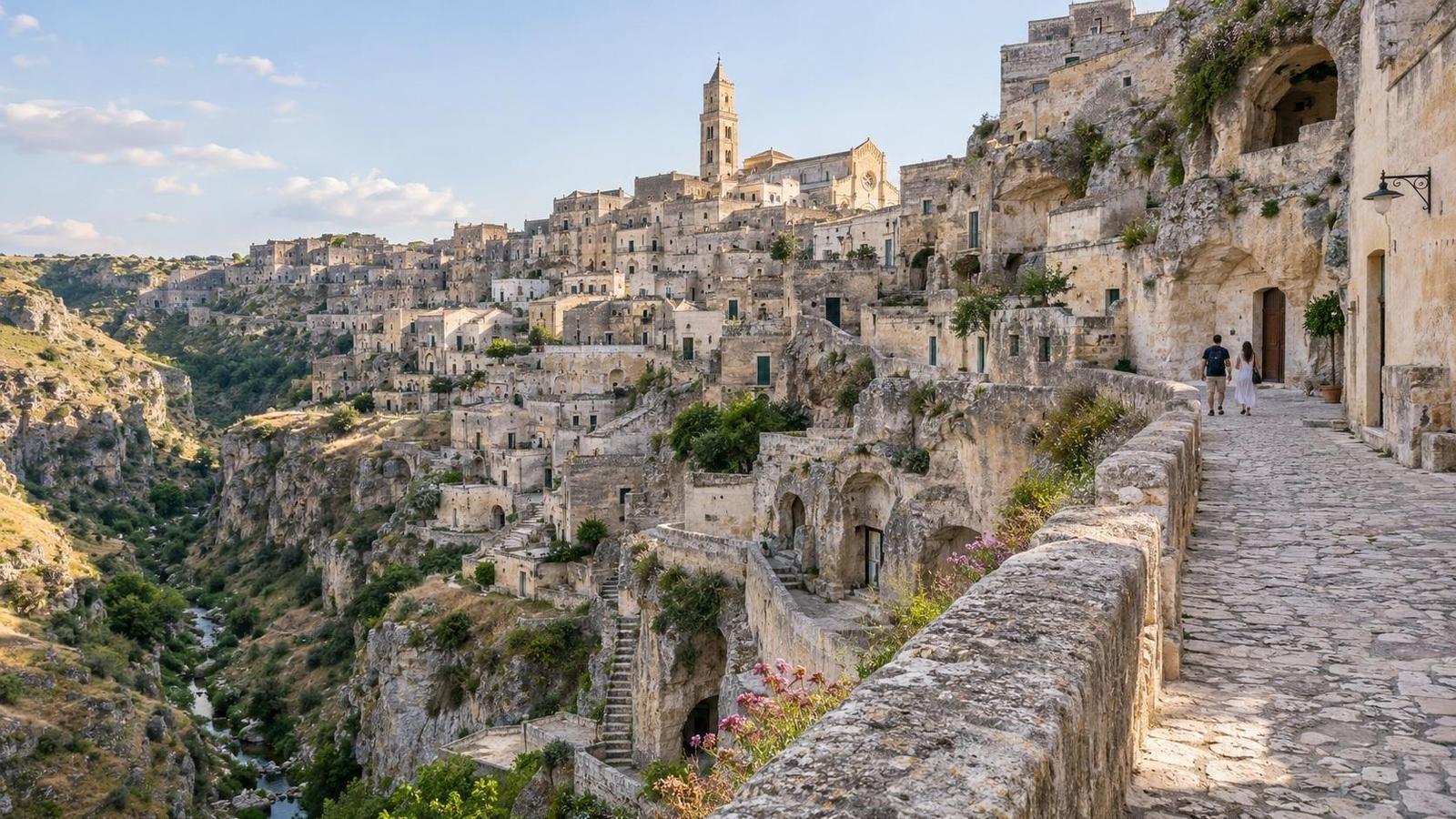
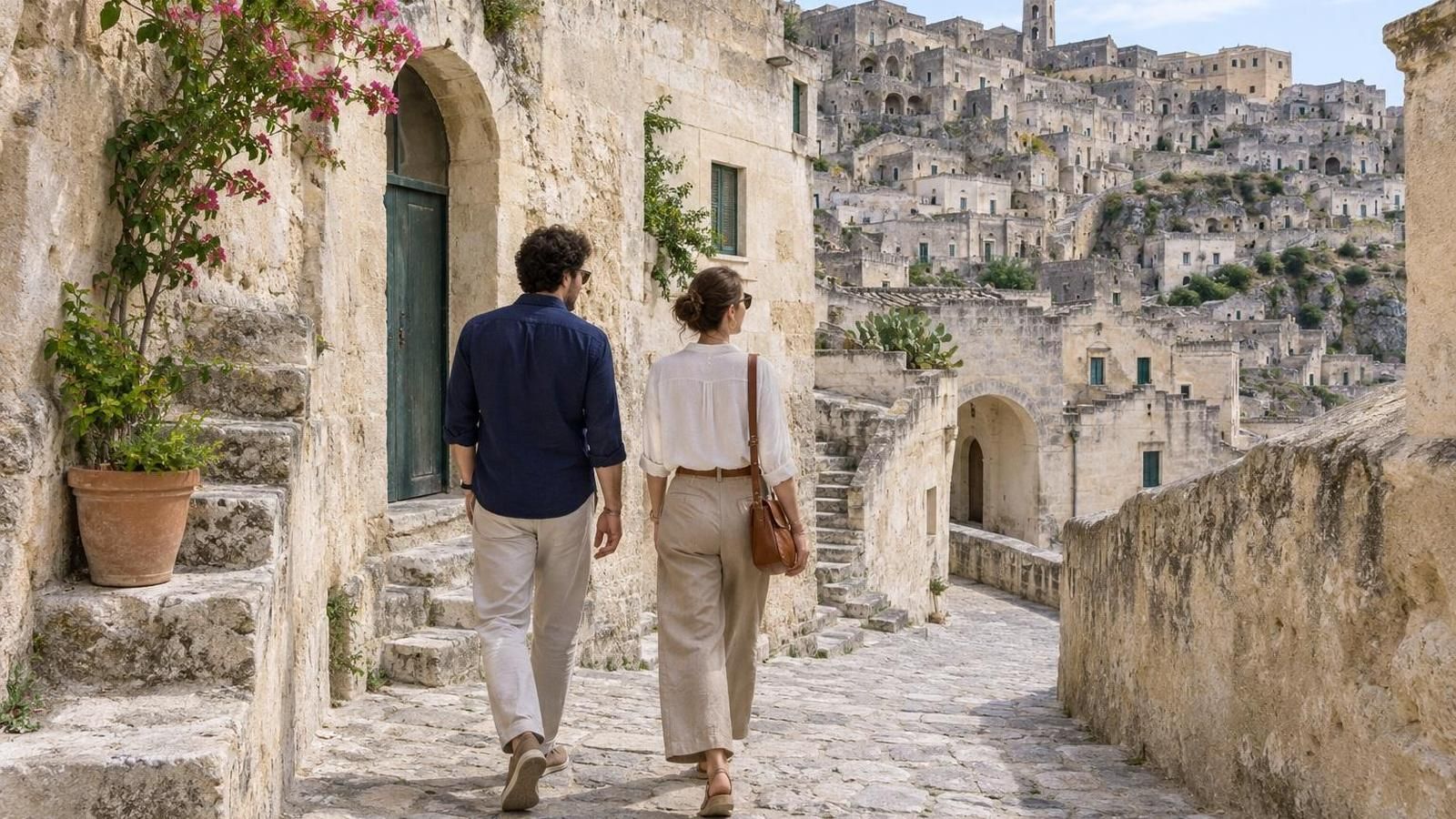
Matera is a living city in Basilicata, not an excavation you walk through and leave at closing time. UNESCO's listing for the Sassi traces habitation in the area back to the Paleolithic. The old districts have houses and churches cut into rock, and the lanes wind above and below one another. It's the sort of place where your room can be close to dinner and a very different distance from dinner on the way back up.
Give it two nights if you can. Arrive, put your bags down and take an evening walk. The next morning, have a guide show you a cave dwelling and a rock church instead of trying to work out what you're looking at from a doorway. The Italian tourism board's Matera guide points to the furnished cave house on Vico Solitario. That's where I'd start if you want to picture a family living in one of these spaces, not just see what a hotel can do with one.
Ask about the room, not just the hotel
Do you want to sleep inside the rock, or do you want to wake up and see the city from your window? Different rooms. Aquatio, for example, says not all its rooms are carved into the rock. Sextantio's Cave 17 has a tub in the sleeping area. Romantic? Sure! It's also worth asking where the shower is if that's what you use every morning.
The downside of staying deep in the Sassi is all those steps between you and everything else. If that sounds like work, look on the flatter upper edge near the Piano. And ask how you get from the car to the room, not how close the hotel is to the address your driver can reach. I want to know who's taking the luggage from there. That matters a lot more to me than the square footage on the room description.
Pick Pompeii or Herculaneum Before You Pick Both
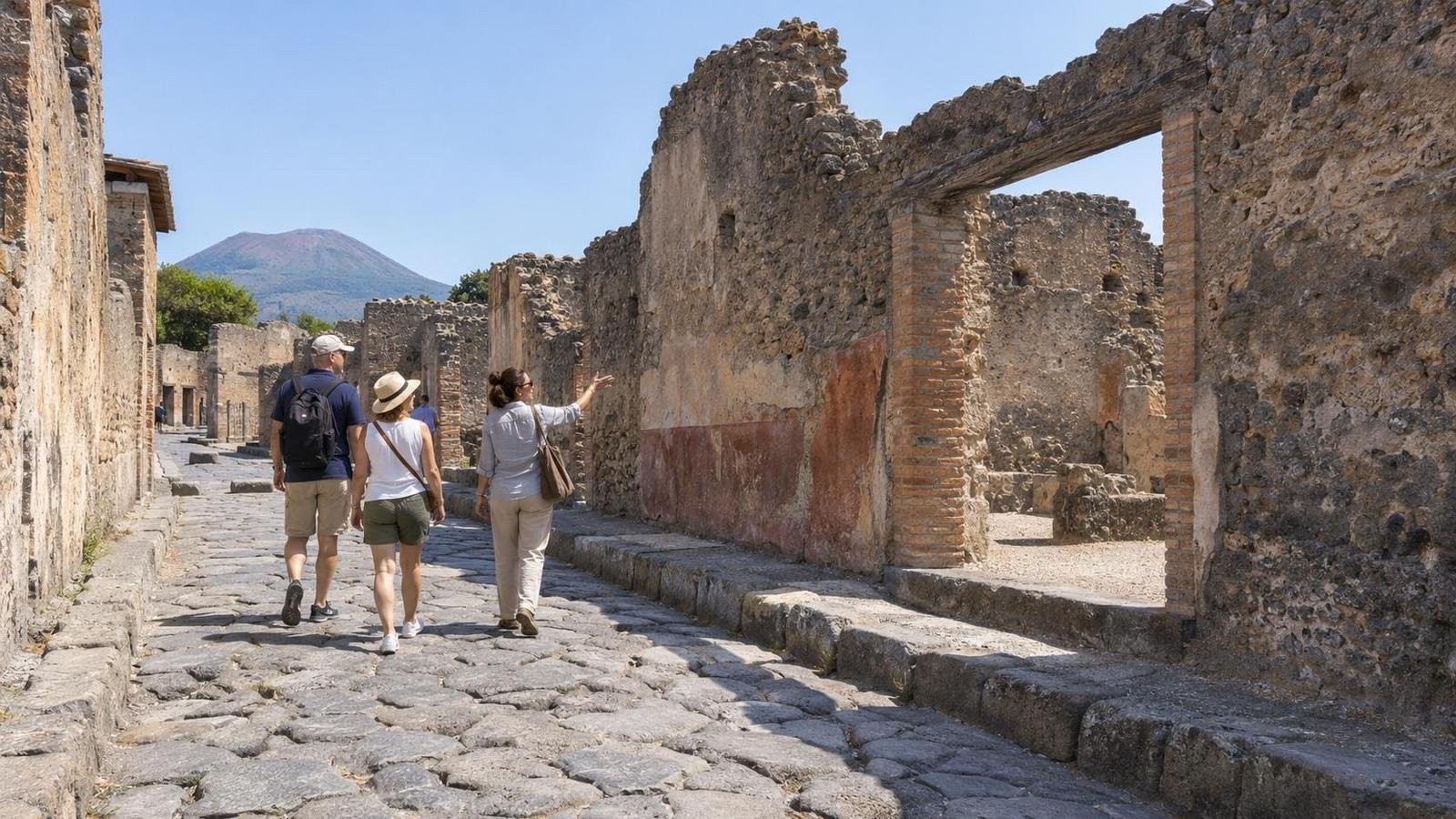
Vesuvius buried both towns in AD 79, but you won't come away with the same memory of each. In Pompeii, start with the forum and fit in a house or a bath complex. There's a reason I like that order. You get a sense of the city as a whole, then you can look at one place long enough to notice how it worked.
At Herculaneum, the surviving wood and the houses are the draw. The excavated area is smaller, and it's where I'd send you if you like looking closely at ordinary things that weren't made to survive two thousand years. The two towns are part of the same UNESCO World Heritage listing. That doesn't mean you owe them the same day.
Doing both sounds efficient. So does eating lunch in the car. Are either of those what you actually want? Pick one if you've got a mixed group or somebody who likes history in smaller doses. If you're the person who'll still have questions after three hours in Pompeii, put Herculaneum on another morning and make it a proper visit.
Tell your guide how you like to walk
For Pompeii, the park's Pompeii for All route starts at Piazza Anfiteatro. Even there, the park notes slopes and uneven paving. Herculaneum is shorter to explore, but smaller doesn't mean flat. Its park describes a ramp and a bridge entrance option. If someone's knees dictate the itinerary, say so early. That's not a minor detail to sort out when the driver drops you off.
And if there's one particular house you care about, tell your guide that too. Pompeii's open buildings have different hours and some close temporarily. I'd rather plan the route around what you came to see than spend the visit trying doors.
Stay in Rome and Choose Between the Forum and Ostia
First visit? Give the Roman Forum in central Rome a morning. It was the center of Roman public life, and it's where I'd put your guide money if you want to see how politics, commerce and religion occupied the same piece of ground. Without someone to help you make sense of it, one broken column can start to look suspiciously like the last broken column.
Already walked the Forum? Go to the old port at Ostia Antica and stay in the same Rome hotel. The public spaces there tell a different story. At the old commercial square, mosaics depict work tied to the port, including the movement of grain. Some mosaics are covered seasonally for conservation, so don't plan an entire morning around a single floor.
Ostia is also the one I'd keep in mind if you were about to add Naples just to fit in an archaeological site. Do you want Naples and Pompeii? Go. Do you want one good morning with a guide and to be back at the same hotel by dinner? Stay in Rome.
Keep Transfer Day Out of the Ruins
The version of the itinerary I don't like goes like this. Check out. Meet the driver. Find the right gate. Do the whole site. Check in somewhere else. Now find dinner while everyone's looking at you like the whole thing was your idea. (It was.)
Put your big outdoor visit on a morning when you've already slept in the right city. For Campania, I'd stay in Naples if you're there for Pompeii or Herculaneum and want time in Naples itself. For Matera, think of it as a southern Italy stay. Bari is a useful airport for that route; if you're going straight to Matera, I'd put the private transfer money toward the ride that ends as close to your room as possible.
Spring or fall is my first choice for a trip with this much walking. Going in summer? Keep the morning for the site and let lunch be lunch. No need to apologize to the itinerary. If you're still deciding between dates, start with the best months to visit Italy and see which one suits the rest of your trip.
- For a first Rome stay, make the Forum the main event that morning, not the thing you try to fit in after lunch.
- For two nights in Matera, put the guide on the full day, when you've got time to stop without checking your watch.
- For a Naples stay, keep the car pickup and site entrance on the same plan. A driver and a guide are only helpful if they send you to the same gate.
What a Privately Guided Italy Trip Costs
Pricing for this trip cannot be accurately estimated without knowing which route you're taking and when. A Roman Forum morning from a hotel you're already staying in and two nights in Matera with a cave suite and a driver are two very different purchases. A room rate on its own won't tell you what the second one costs.
For two people, price the dates, flights, nights and actual room category first. Then add the transfers and the guide time, meals and other experiences you want. If four of you are going, price the right car and room setup before you decide the trip is simply twice the price. And if the only cave room available is a suite, that one night can change where you want to spend on the rest of the trip.
Where would I spend first? On a guide for the site you came to see, then on the transfer that gets you to the right door with all your bags. Pay for the suite if you'll be glad you did when you wake up in it. If it's just somewhere to leave the luggage, put that money back into the day. Our guide to planning a luxury Italy trip can help you think about which upgrades you'll actually use.
Frequently Asked Questions
What is the oldest inhabited city in Italy?
Matera is one of the oldest still inhabited cities in Italy. There's evidence of people living in the area since the Paleolithic, which isn't the same thing as being able to give the city one exact birthday.
What happened to the ancient city of Rome?
It didn't disappear. Ancient Rome became the city you visit today, with centuries of building around and over what was there before. The Forum lets you see what remains of its old public center.
What are the big three cities for a first Italy trip?
Rome, Florence and Venice are the three I'd start with if you want the classic first trip. If the thing keeping you up at night is the thought of seeing Pompeii, I'd give Naples your extra nights before I tried to make a fourth city fit into the same week.
Does Italy shut down for vacation in August?
No, not for the whole month. Ferragosto is a national holiday on August 15, and hours and closures vary. Check your particular site and restaurant for that day, especially if dinner is the part of the plan you're not willing to leave to chance.
Start With the Place You Keep Thinking About
If you keep looking at pictures of those Matera lanes, tell me that. Don't send me a list of fourteen towns first. At Explore Effortlessly, we plan custom Italy trips, and knowing what you actually want to see makes it much easier to decide where to sleep, when to bring in a guide and where to leave an afternoon alone.
Still thinking it over? Join my travel newsletter for more advice on where I'd spend the extra day.
About the Author
Hi, I'm Karrah Kazravan, owner and lead travel advisor at Explore Effortlessly, an award winning Miami agency serving clients nationwide. I design custom journeys for busy travelers who want confident recommendations and thoughtful coordination. I have traveled to more than 67 countries across all seven continents and am a Nexion Circle of Excellence Top 5% advisor, ASTA Verified Travel Advisor, Certified Travel Associate, and CLIA Accredited Cruise Counselor.