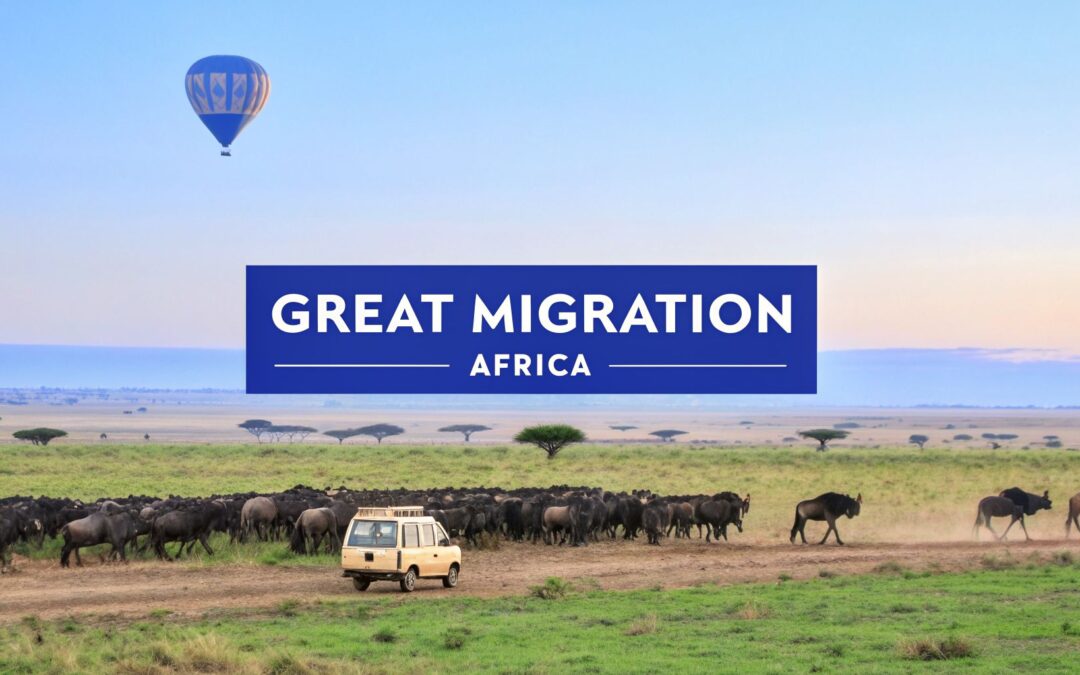
The Great Migration in Africa is, without a doubt, the most incredible wildlife spectacle on the planet. It’s a constant, circular pilgrimage of over two million animals, led by a massive army of wildebeest, forever chasing the rains and the fresh, green grass they bring. This isn't a single event you can just show up for; it's a year-long, raw drama of survival unfolding across the vast plains of Tanzania and Kenya.
As a luxury travel advisor, I specialize in navigating the complexities of this journey, transforming a bucket-list dream into a flawlessly executed, high-touch safari.
Key Takeaways for Planning Your Great Migration Safari:
- It’s a Year-Round Event: The "best" time depends on what you want to see. Choose the dramatic river crossings (July-October) or the heartwarming calving season (January-March).
- Location is Everything: The herds are always moving. Your itinerary must be strategically designed around their predicted location, often using elite mobile camps that follow the action.
- Book Far in Advance: For prime seasons, booking 12 to 18 months ahead is not a suggestion—it’s essential to secure the best guides and accommodations.
- Work with an Expert: Planning a migration safari is complex. My role is to handle all the logistics, from camp selection to private guides, ensuring you're in the right place at the right time.
Witnessing the World's Greatest Wildlife Show
When clients think of the Great Migration, they usually picture one iconic scene: thousands of wildebeest plunging into a roiling, crocodile-infested river. While those river crossings are heart-stopping, they’re just one moment in a much grander story. My job, as your advisor, is to help you see beyond that single snapshot and understand the migration for what it truly is—a living, breathing cycle you can step into.
This isn’t just about ticking an item off a bucket list. It’s about feeling the raw, untamed power of nature on a scale that’s hard to comprehend until you’re there. The sheer numbers alone are staggering.
- We're talking about 1.5 million wildebeest, marching alongside 200,000 zebras and another 300,000 gazelles. You can read more about the incredible scale of their journey across the Serengeti, but to see it in person is something else entirely.
- This colossal herd is in perpetual motion, covering a 1,000-kilometer circuit through Tanzania’s Serengeti and into Kenya’s Maasai Mara.
- And during the calving season, the spectacle of new life is overwhelming, with as many as 8,000 wildebeest born every single day.
The Advisor's Role in a Complex Journey
Trying to plan a safari around the Great Migration can feel like trying to hit a moving target. The herds are always on the move, and their path is dictated by the weather. A camp that’s in the thick of the action one week could be watching the herds disappear over the horizon the next. This is where my expertise makes the difference.
My role is to cut through the complexity and logistical chaos. I manage the timing, the locations, and the planning so that you can simply be present and immerse yourself in the moment.
I handle everything, from selecting the right mobile camps that follow the herds to securing the best private guides who know the animals' patterns inside and out. This goes far beyond just booking a lodge; it's about strategically placing you in the right place at the right time.
Whether you dream of seeing thousands of calves taking their first steps or feeling the ground shake during a river crossing, I build a bespoke itinerary that makes it happen. At Explore Effortlessly, we turn this once-in-a-lifetime ambition into a perfectly executed reality.
Following the Great Migration's Annual Calendar
The first question I always get is, "When should I go to see the Great Migration?" My answer is always the same: it depends on what you really want to see. The Migration isn't a single event you can circle on a calendar. Think of it less as a fixed schedule and more as an ancient, rain-fueled rhythm.
It’s a common misconception that the herds move as one enormous entity. In reality, they are a sprawling, dynamic collection of groups that merge and split, constantly seeking fresh grazing. An unexpected storm can hold them in one spot for weeks, while a dry spell might send them marching ahead of schedule. I follow these patterns daily through my in-destination partners to place you in the heart of the action.
The Southern Serengeti Calving Season (December – March)
From late December into March, the vast herds converge on the short-grass plains of the Southern Serengeti and Ngorongoro Conservation Area. The soil here is rich in volcanic minerals, producing the nutrient-dense grass the wildebeest need for what comes next: the calving season.
- A Population Explosion: February and March are the peak. It's an almost unbelievable spectacle, with an estimated 500,000 wildebeest calves born in just a few short weeks.
- Life in Fast-Forward: You’ll see wobbly-legged newborns take their first steps and, within a day, run fast enough to keep up with the herd. This precocious survival skill is essential.
- Predators on High Alert: This sudden abundance of vulnerable prey is a dinner bell for Africa's top predators. Lions, cheetahs, and hyenas are incredibly active, making this the absolute best time for witnessing the raw, dramatic circle of life play out.
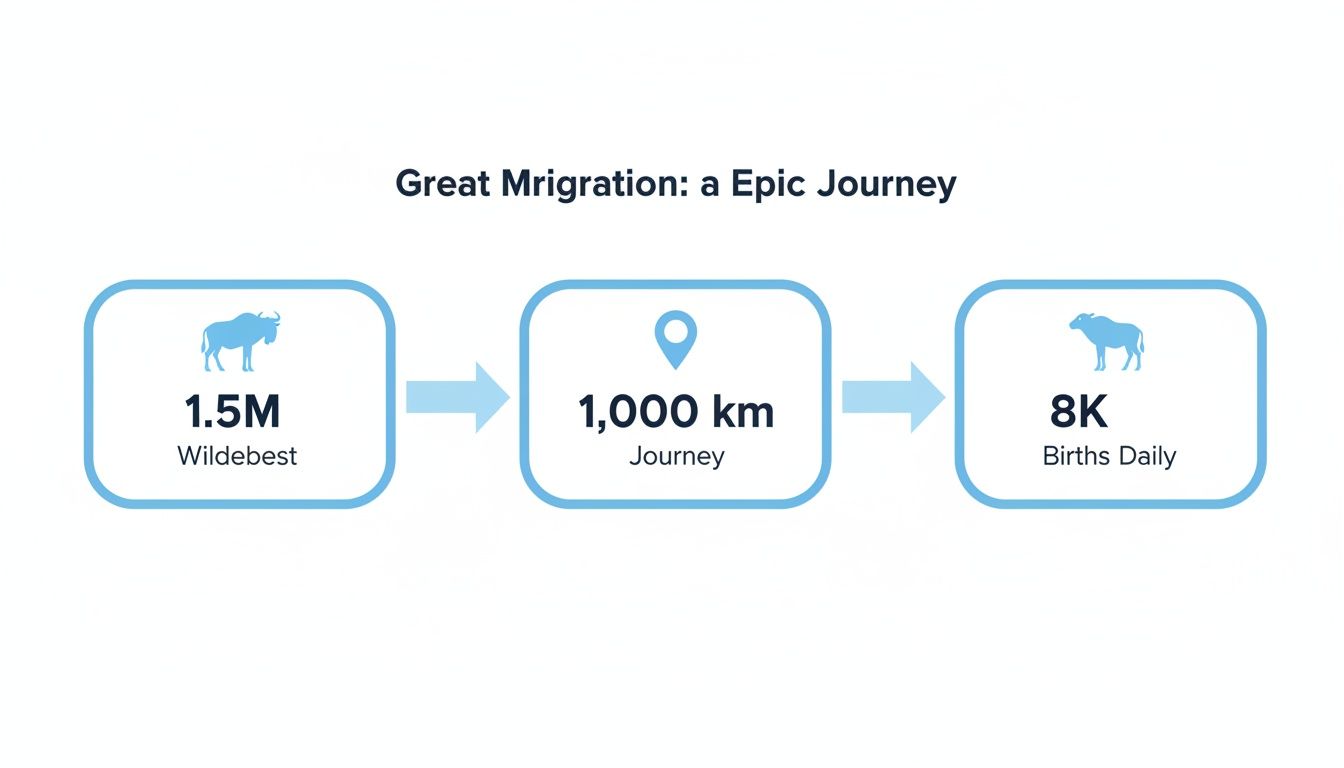
When you see the scale laid out like that, you start to understand why this is considered the greatest show on Earth.
To help you visualize the entire year, here is a month-by-month breakdown of where the herds are and what you can expect to see. This guide is your starting point for pinpointing the perfect time for your safari.
The Great Migration Monthly Guide
| Months | Location (Region) | Primary Activity and What to Expect |
|---|---|---|
| Dec – Mar | Southern Serengeti / Ndutu | Calving Season. Incredible predator action as big cats target vulnerable newborns. |
| Apr – May | Central & Western Serengeti | The Trek North. Herds gather into massive columns and begin the long march. |
| June – July | Western & Northern Serengeti | Grumeti & Mara River Crossings. The first major river obstacles. High drama. |
| Aug – Oct | Northern Serengeti / Maasai Mara | Peak River Crossings. The iconic Mara River crossings are in full swing. High tension and chaos. |
| Nov – Dec | Eastern & Southern Serengeti | The Return South. Herds move back down, following the rains to the southern plains. |
This table provides a general forecast, but remember, the herds march to the rhythm of the rains.
The Great Trek Northward (April – June)
The lush times in the south can't last. By April and May, the plains begin to dry out, and the instinctual pull north becomes irresistible. This is the start of the long journey, coinciding with the "rut" or mating season.
The herds consolidate into colossal columns that can stretch for miles, kicking up a rhythmic dust cloud you can feel as much as see. They move through the central Seronera region toward the Western Corridor, where the Grumeti River poses their first major challenge—a thrilling preview of the chaos to come.
Advisor Insight: Everyone gets excited about the river crossings, and for good reason. But don't underestimate the sheer awe of seeing the mega-herds on the move across the plains. The sound of hundreds of thousands of hooves thundering across the earth is something that stays with you forever.
The Legendary River Crossings (July – October)
This is it—the moment that defines the Great Migration for so many. From July through October, the herds reach the northern Serengeti and Kenya's Maasai Mara, where they face the ultimate gauntlet: the Mara River.
This isn’t one clean crossing. It’s a series of panicked, desperate struggles that unfold over several months. Herds might nervously crowd the banks for days, the tension building until one brave individual takes the plunge, triggering a mass stampede into the crocodile-infested water.
The Return Journey South (November – December)
As the short rains begin to fall in November, the cycle turns once more. The promise of fresh, green grass pulls the herds back south from the Maasai Mara, often moving through the eastern side of the Serengeti. The wildlife viewing is still phenomenal as they complete their epic, year-long pilgrimage, preparing the southern plains for the next generation.
The Unforgettable Drama of the Mara River Crossings
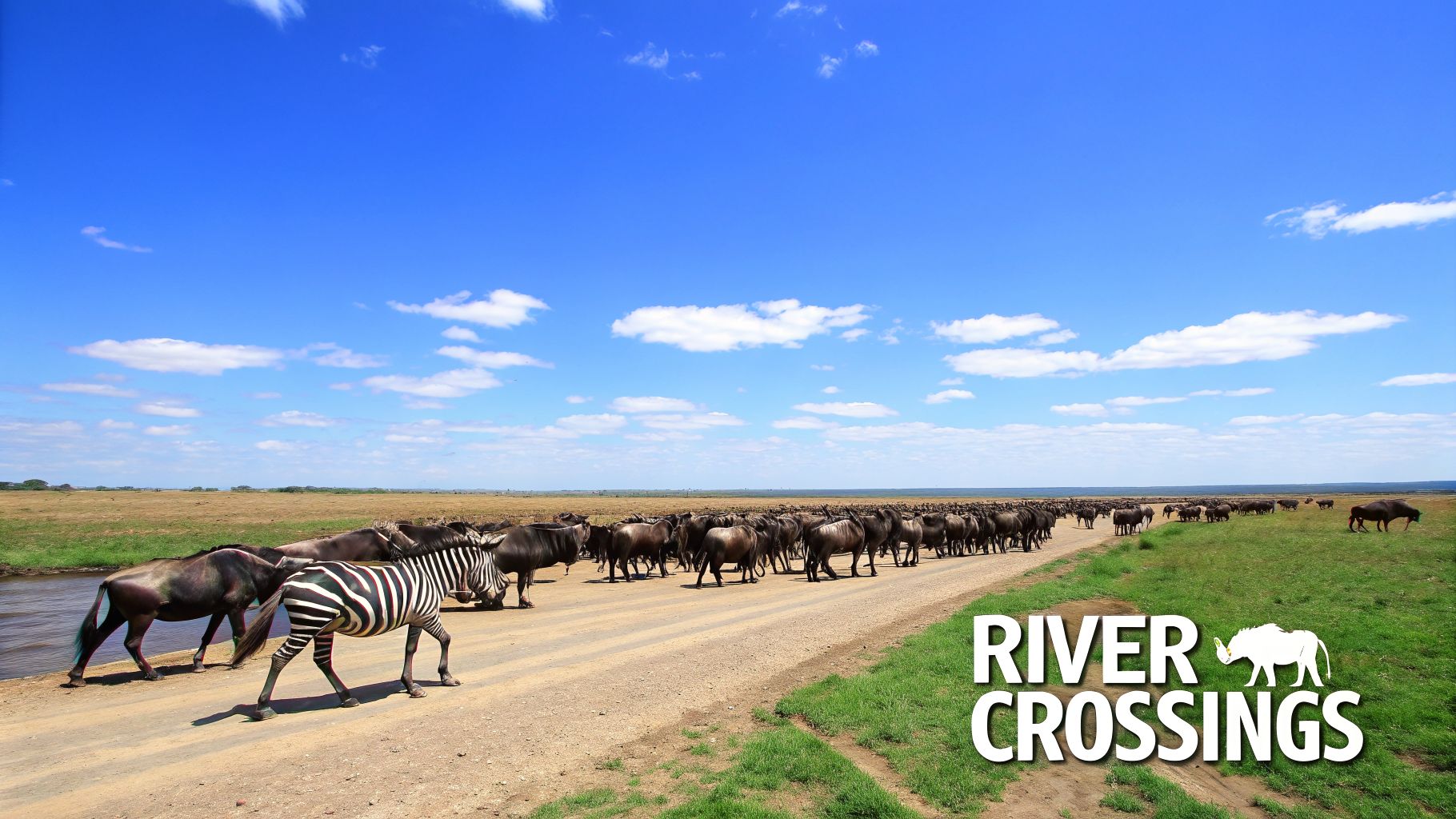
This is the moment that defines the Great Migration for so many. Between July and October, the massive herds reach the most perilous obstacle in their journey: the crocodile-infested Grumeti and Mara Rivers. What unfolds is not one event, but a series of raw, chaotic, high-stakes struggles that play out over several months. It is nature at its most visceral.
You can feel the tension in the air. Herds will gather on the riverbanks for days, a nervous mass of hide and horn. They pace, they edge toward the water, and they retreat, aware of the giant crocodiles lurking beneath the surface. The indecision is a palpable presence until, finally, one brave—or spooked—wildebeest takes the plunge.
That single act triggers an explosion. Suddenly, the river is a churning frenzy of life and death. Thousands of animals pour down the steep banks, fighting the current and predators in a desperate scramble to reach the other side. It’s a primordial scene, both brutal and breathtakingly beautiful.
How to Get a Front-Row Seat
Witnessing a river crossing is the absolute pinnacle of a safari, but it hinges entirely on patience and expert positioning. You can’t schedule a crossing. You can only be there, ready and waiting. This is where a deep understanding of the ecosystem and my network of incredible on-the-ground partners makes all the difference.
My approach is built on putting you in the right place at the right time.
- Elite Mobile Camps: I partner with a select few mobile tented camps designed to follow the migration. These camps relocate throughout the year to stay on top of the herds, giving you unparalleled proximity to the action.
- Master Guides: The local guides I work with are the true stars of the savanna. They have an almost sixth sense for reading animal behavior, spotting the subtle cues that signal a crossing is imminent, and positioning your vehicle for a safe and spectacular view.
My philosophy is simple: handle every single logistical detail flawlessly behind the scenes. This frees you to fully immerse yourself in the beautiful unpredictability of the wild, confident that you’re in the best possible hands.
The Reality of Witnessing a Crossing
It’s important to go in with the right expectations. A river crossing is a powerful, and at times, gut-wrenching spectacle. There is absolutely no guarantee you’ll see one on any given day, which is why I always recommend dedicating several days to the northern Serengeti or the Mara.
Sometimes, after hours of anticipation, the herds turn back from the edge. This waiting game, however, is part of the magic. It gives you time to appreciate the immense scale of the herds and observe their fascinating social dynamics.
When the crossing finally erupts, the emotional payoff is immense. You’re no longer just a spectator; you become a witness to one of the most powerful events on the planet. For travelers wanting to focus on this incredible experience, planning your Maasai Mara safari is the next logical step. Ultimately, my job is to craft an itinerary that maximizes your chances, helping turn a bucket-list dream into a real, tangible memory.
Designing Your Luxury Migration Safari
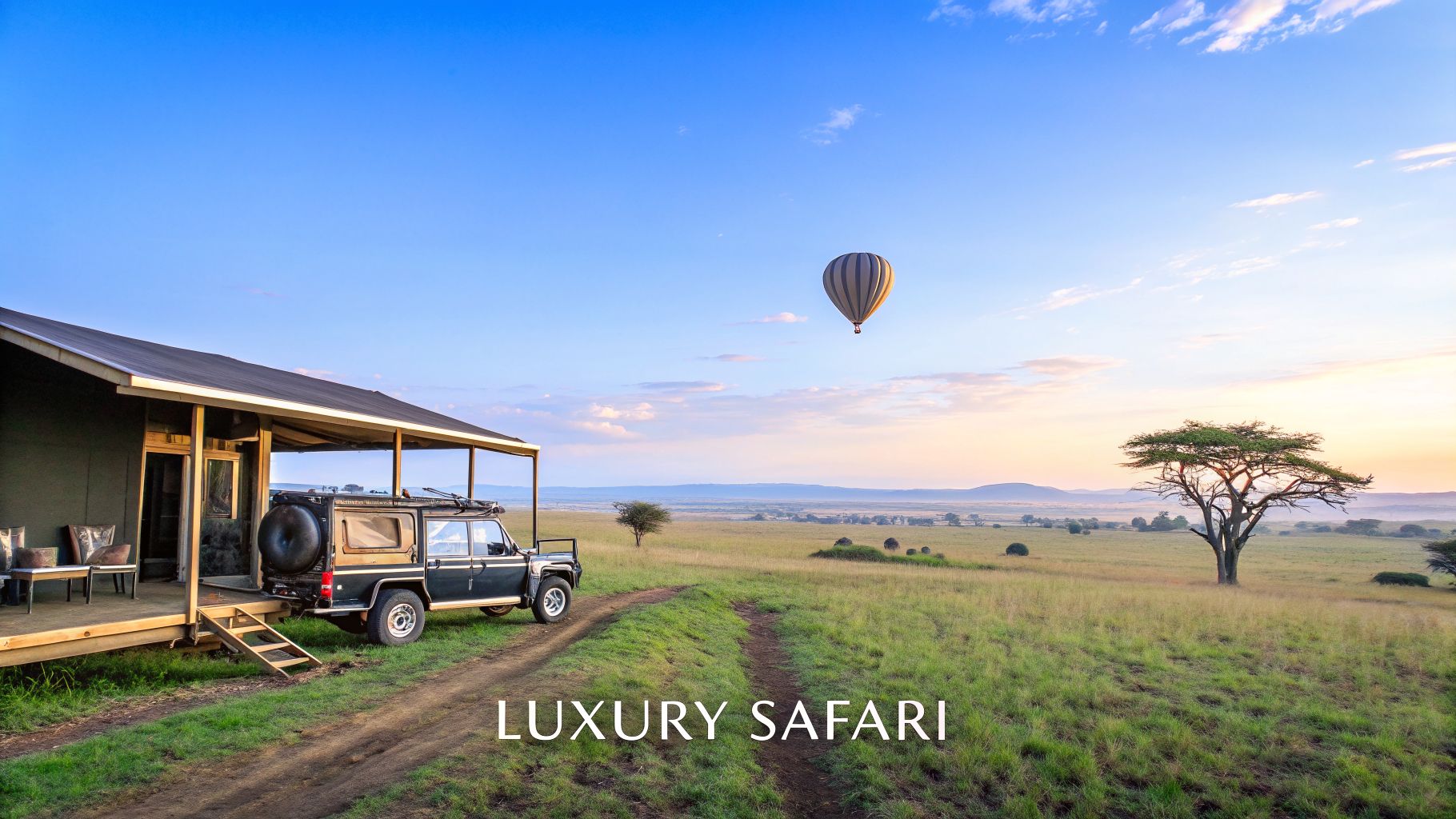
Knowing the migration’s timing is one thing; crafting the perfect journey around it is another entirely. A luxury safari isn't a package trip. It's a carefully curated collection of experiences and accommodations that fit together perfectly. Think of me as your safari architect—my job is to take all the possibilities and build an adventure that is uniquely yours.
Whether you're dreaming of a secluded honeymoon, an action-packed family safari, or a focused photographic expedition, every choice we make has a purpose. We’ll move far beyond any standard itinerary to create something that is truly yours.
Choosing Your Safari Accommodation Style
Where you stay is more than just a place to rest. It’s your front-row seat to the wilderness. The style of accommodation you choose fundamentally shapes how you experience the Great Migration in Africa.
Permanent Luxury Lodges: These are spectacular, solid-built properties representing the height of comfort. Think infinity pools spilling into the savanna and fine dining under the stars. They are perfect for travelers who value a fixed, supremely comfortable base. Through my partnerships, clients often receive special perks and VIP treatment.
Exclusive Mobile Tented Camps: If your goal is to be in the heart of the action, a mobile camp is the only way to go. Forget basic camping; these are elegant, canvas-walled suites that move two or three times a year to follow the herds, guaranteeing you are where the drama is unfolding.
The decision between a permanent lodge and a mobile camp often boils down to a trade-off: lavish amenities versus unparalleled proximity. For many of my clients, the best solution is a blend of both, giving them a taste of each incredible world.
Elevating Your Game Viewing Experience
How you explore the plains is as important as where you stay. A standard game drive is always a thrill, but a few key enhancements transform your safari from great into a once-in-a-lifetime experience.
First and foremost is your guide. A brilliant guide is the single most important element of any safari. I work with a very select group of professional guides—true masters of the bush who have a sixth sense for animal behavior. They don't just find wildlife; they anticipate it.
A private vehicle is, in my opinion, non-negotiable for a genuine luxury safari. It gives you absolute freedom. Want to spend hours watching a leopard snooze in a sausage tree? Or wait patiently for a river crossing to begin? With your own vehicle, your schedule is the only one that matters.
Finally, to truly appreciate the sheer scale of the migration, nothing compares to a hot-air balloon safari at sunrise. Drifting silently over the plains as the sun lights up millions of wildebeest below is a moment that will stay with you forever.
As you can see, pulling together the perfect itinerary is a complex art. To get a better sense of how I balance these moving parts, you can explore my approach to building luxury African safari trips on our dedicated page. My expertise makes it all feel effortless, so you can simply lose yourself in the magic.
Exploring Beyond the Wildebeest Herds
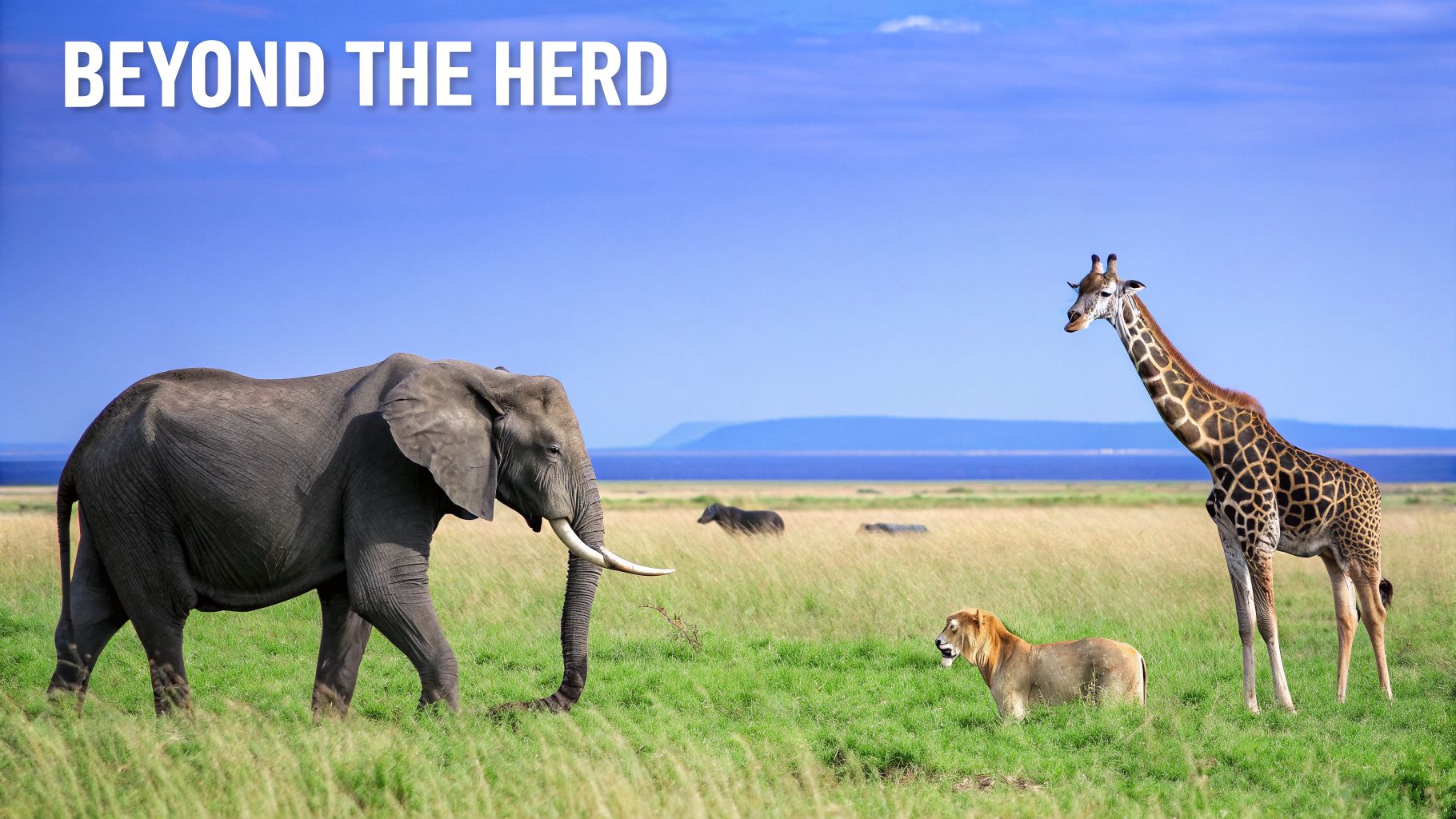
It’s easy to get tunnel vision when planning a trip around the Great Migration. But one of the biggest mistakes travelers make is focusing so intently on the herds that they miss the masterpiece all around them.
The Serengeti-Mara ecosystem is a world-class wildlife destination 365 days a year. A truly spectacular safari weaves the migration into the richer story of East Africa. The goal should be to treat the great migration in Africa as a thrilling chapter, not the entire book. After all, the supporting cast is just as captivating.
Discovering the Resident Wildlife
Even when the migratory mega-herds are hundreds of kilometers away, the plains are anything but empty. A staggering amount of resident wildlife remains, offering phenomenal game viewing no matter the season. This is where you get incredible, intimate opportunities to track Africa’s most iconic animals.
We can dedicate focused time to finding the "Big Five"—lion, leopard, elephant, buffalo, and the critically endangered black rhino. The Serengeti, for instance, is legendary for its powerful lion prides and is one of the best places on the continent for leopard sightings. These resident predators don't follow the wildebeest; they hold their territory, which means the action never really stops.
Expanding Your Itinerary
To create a truly unforgettable safari, I always recommend including destinations that perfectly complement the migration experience. These additions add incredible layers of depth, scenic beauty, and cultural richness to your journey.
The Ngorongoro Crater: Often called Africa's "Garden of Eden," this massive, intact volcanic caldera is a self-contained world. The moment you descend to the crater floor, you're met with an astonishing density of wildlife, including a healthy population of black rhinos.
Tarangire National Park: Famous for its colossal, ancient baobab trees and enormous elephant herds, Tarangire offers a completely different landscape and atmosphere. It’s particularly magical in the dry season (June to October), when the Tarangire River becomes a magnet for wildlife.
Cultural Encounters with the Maasai: An authentic, respectful visit to a local Maasai community offers a powerful human connection to these lands. I only partner with operators who ensure these interactions are genuine and mutually beneficial, giving you a true glimpse into a proud culture that has coexisted with this wildlife for centuries.
By looking beyond the thundering herds, we transform your trip from a single-focus event into a comprehensive exploration of East Africa. It’s about appreciating the entire ecosystem—from the smallest dik-dik to the largest bull elephant, and the ancient cultures that call this land home.
My role is to seamlessly weave these diverse elements together. This thoughtful curation ensures your time in Africa is as varied and unforgettable as the land itself.
Planning and Booking Your Great Migration Safari
You're captivated by the idea of the Great Migration. You can picture the thundering herds and the dramatic river crossings. Now comes the part where we make it happen. Turning this dream into a seamless reality is all about smart, early planning, and that’s where I come in. My job is to navigate the complexities—the timing, the logistics, the sheer number of choices—so you can simply look forward to the adventure.
Let's be clear: securing a front-row seat to this spectacle requires a head start. The very best lodges and mobile camps, especially those perfectly positioned for the river crossings or the calving season, are often fully booked more than a year out. This isn't a sales tactic; it's the simple truth for a trip of this caliber.
The Importance of Planning Ahead
If there's one mistake I see travelers make, it's underestimating just how far in advance they need to book. For prime viewing seasons (July-September for the river crossings and January-March for the calving), booking 12 to 18 months ahead is essential.
This isn't just about getting a room. It’s about securing the right room in the right camp, with the best guides, to put you in the heart of the action. Waiting too long often means settling for less. When we plan this far out, every single component is chosen with purpose.
This journey is a significant investment of both your time and money. I take that seriously, and my approach is to manage every single detail so your only job is to get excited for the trip of a lifetime.
What Working with Me Includes
When we work together, you're bringing on a personal travel architect. I handle all the intricate logistics from start to finish, leaving you free to focus on the experience.
Here’s what my planning process includes:
- Bespoke Itinerary Design: I’ll build a day-by-day plan that matches your personal travel style, whether you're after high adventure, a family-friendly pace, or a quiet, romantic escape.
- Vetted Accommodations and Guides: Every lodge, mobile camp, and guide I recommend comes from a trusted network I've built over years. This ensures top-tier quality and expertise.
- End-to-End Logistics: I arrange everything—the safari camps, the internal charter flights between them, private vehicle bookings, and all your ground transfers. It's a completely seamless process.
- In-Travel Support: From the moment you land, you'll have access to 24/7 assistance handled by my trusted in-destination suppliers and local partners, providing total peace of mind.
Ultimately, my expertise saves you dozens of hours of research and helps you avoid the common pitfalls of planning such a complex trip. Your safari adventure doesn't start with a frantic search; it starts with a simple conversation.
Ready to begin? To start designing your safari, you can Plan my luxury trip and we can get the ball rolling together.
Great Migration Africa FAQs
As a Circle of Excellence advisor, I've planned countless Great Migration safaris. Here are answers to the most common questions my clients ask as we begin the planning process.
What is the best month to see the Great Migration?
The best month depends entirely on the spectacle you want to witness. If your heart is set on the legendary river crossings, with all their tension and raw power, we should plan your trip for July through October. This is when herds brave the Mara River. If you're drawn to the tender sight of the plains blanketed with newborn calves, then the calving season from January to March in the Southern Serengeti is pure magic. As your advisor, I help you choose the right moment for your perfect trip.
How much does a luxury Great Migration safari cost?
A truly exceptional migration safari is an investment in a memory that will last a lifetime. My clients typically plan for a starting budget of $1,500 to $2,500 per person, per night for a seamless, top-tier experience with the best private guides and accommodations. The final figure will shift based on the season, duration, and your personal style. My role is to design a trip that not only fits your budget but also exceeds every expectation.
Is a Great Migration safari suitable for families?
Absolutely. It can be one of the most powerful and bonding experiences a family can share. Seeing this wonder through a child's eyes is unforgettable. I focus on selecting family-friendly lodges and private villas that welcome children, and we’ll design a trip with engaging activities and a comfortable pace for everyone. My partners on the ground are masters at crafting adventures that are both thrilling and safe for multi-generational groups.
How far in advance should I book my trip?
For the best lodges and mobile camps during the peak seasons (June-October and January-March), you must book 12 to 18 months in advance. Prime locations with front-row seats to the action are incredibly limited and sell out fast. Planning this far ahead is the secret to getting the exact trip you want without having to make compromises.
The Great Migration in Africa is a magnificent, moving spectacle. As your travel advisor, my job is to handle every intricate detail, leaving you free to simply be present for the wonder of it all. Ready to start planning?