
A Great Migration safari isn't just another trip—it's a front-row seat to one of the most staggering wildlife spectacles on Earth. I’m talking about a year-long pilgrimage of over 1.5 million animals moving across the Serengeti and Masai Mara plains. This is a primal, powerful encounter with nature on a scale that’s hard to comprehend, all driven by the relentless cycle of survival. As your travel advisor, I know that planning it right is crucial; you have to be in the exact right place at the right time.
A Wonder of the Natural World
Imagine the ground vibrating as a seemingly endless river of wildebeest thunders past your vehicle. A Great Migration safari is so much more than a game drive. It’s a full-immersion experience into a timeless drama of instinct and survival, set against the raw, magnificent backdrop of the African wilderness. My role is to take this epic phenomenon and shape it into a seamless, unforgettable journey designed specifically for you.
At its heart, the migration is a massive, continuous loop. Think of it as a clockwise journey stretching 1,800 miles across Tanzania's Serengeti and into Kenya's Masai Mara. Over 1.2 million wildebeest, along with 250,000 zebras and hundreds of thousands of gazelles, are constantly chasing the rains in search of fresh grass and water. It’s an ancient rhythm dictated by the seasons. You can get a deeper look into the mechanics of this wildlife spectacle on Bwindi Forest National Park.
Key Takeaways for Your Safari Planning
So, what does all this mean for your trip? Let's break down the essential advisor insights.
- It’s a Year-Round Event: The herds never stop moving. This means you can plan a migration safari for any month of the year, but the secret lies in knowing exactly where to position yourself to see the action.
- Two Key Moments Define the Drama: While the entire cycle is incredible, two events are particularly famous: the dramatic, heart-pounding river crossings in the north (usually June-September) and the tender calving season in the south (January-March), where thousands of new calves are born each day.
- Timing and Location Are Everything: This is the golden rule. A camp that’s in the perfect spot in March will be a ghost town by July. The success of your safari depends entirely on aligning your itinerary with the herd's predicted location.
- This Is a Complex Trip to Plan: Getting it right involves far more than just booking flights. Securing permits and reserving rooms at the best-located luxury camps—often a year or more ahead of time—requires real expertise.
This is exactly where working with me as your specialist advisor makes all the difference. My intimate knowledge of the region allows me to piece together all the complex logistics, from charter flights to exclusive camp bookings. I craft bespoke luxury African safari trips that put you right in the heart of the action, turning a great idea into a flawless, once-in-a-lifetime adventure.
Mapping the Annual Migration Cycle
Timing, as they say, is everything. For a Great Migration safari, it’s the secret ingredient that transforms a great trip into an unforgettable one. The herds are always on the move, but where they are changes dramatically throughout the year. As your advisor, nailing down this annual rhythm is my first step to ensuring you're in the heart of the action, not watching it from miles away.
Think of the migration less as a straight line and more as a massive, clockwise circuit driven by a single, powerful force: rain. The animals are perpetually chasing the promise of fresh, green grass. This means their exact location can shift slightly from year to year, adding a thrilling layer of unpredictability. It’s also why having an expert guide you can trust is so important.
The Calving Season: A Time of New Beginnings
From January to March, the migration settles in the vast southern plains of the Serengeti and the Ngorongoro Conservation Area. This is the calving season—a time of incredible beauty and raw, unfiltered drama.
The nutrient-rich grasslands transform into a massive nursery. In just a few short weeks, an estimated 500,000 wildebeest calves are born. Seeing thousands of wobbly-legged newborns finding their feet is a truly moving sight. But this explosion of new life doesn't go unnoticed; it rings the dinner bell for predators. Lions, cheetahs, and hyenas are on high alert, creating some of the most intense and compelling wildlife viewing opportunities you’ll ever witness.
The Long March and River Crossings
Once the southern plains begin to dry up around April and May, the herds start their long journey north and west. This leg of the trek takes them through the Serengeti's central region and into the Western Corridor, where they face their first major hurdle: the Grumeti River.
By June and July, the tension is palpable as huge columns of wildebeest gather on the riverbanks. The Grumeti is infamous for its enormous crocodiles, making each crossing a chaotic spectacle of instinct versus survival. It’s the dramatic opening act for the river crossing season, which only gets more intense as the herds push further north.
This chart gives you a quick visual of the migration's general timeline, showing how the major players—wildebeest, zebra, and antelope—move across the ecosystem.
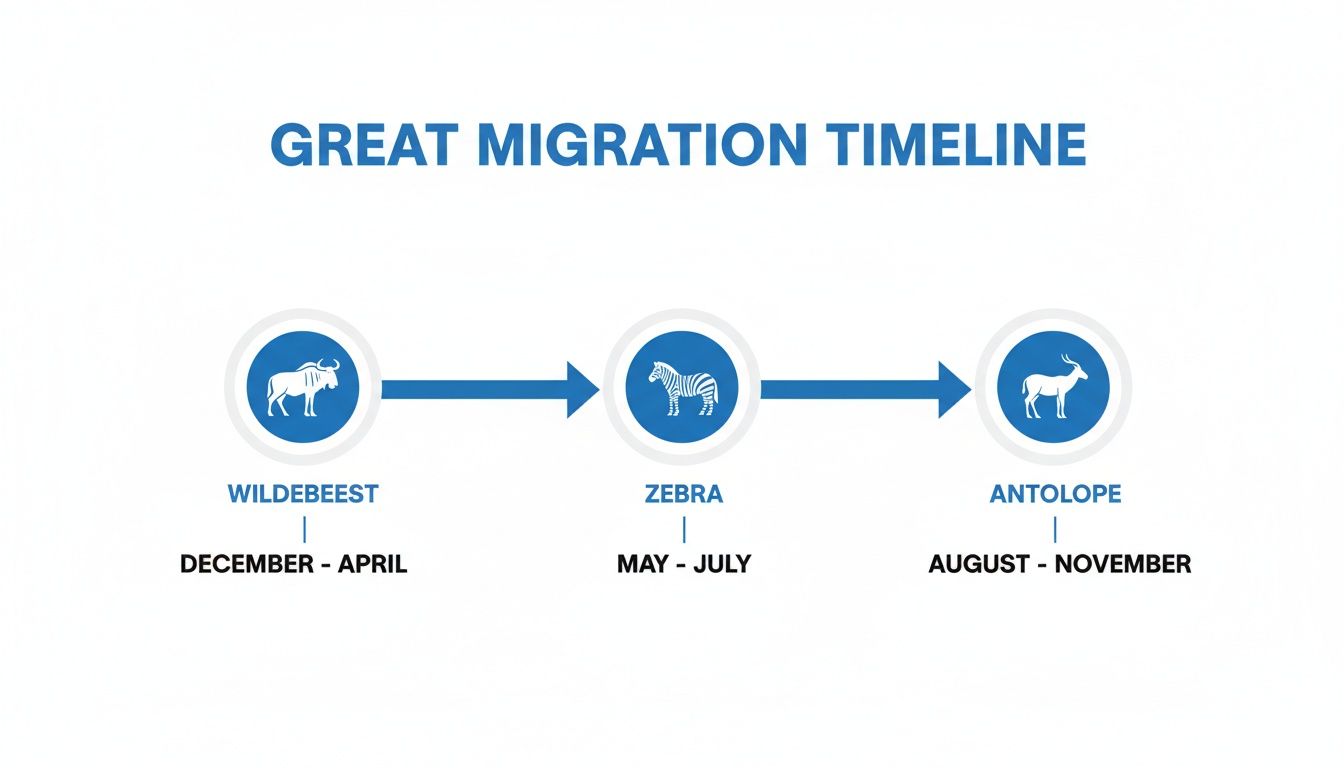
It’s a great way to understand the cyclical nature of their journey, all driven by that constant search for fresh grazing and water.
The Mara River: The Ultimate Test
From August through October, the migration hits its crescendo. This is the moment everyone has seen on documentary films, taking place in the Northern Serengeti and across the border in Kenya’s Maasai Mara. Here, the herds must cross the treacherous Mara River—a legendary, life-or-death struggle.
The scale is simply staggering. Tens of thousands of animals amass on the dusty banks, their collective anxiety building until a few brave souls take the first leap. The chaos, the courage, the sheer power of nature on full display… this is what makes great migration safaris during these months a true bucket-list experience.
It's also critical to remember that the migration is not a fixed route on a map. Part of the magic is its unpredictability. We've seen significant shifts in recent years, with herds moving east near Ngare Nanyuki in March, then surging at the Grumeti in June, leading to intense Mara crossings as early as mid-July. By August, some have even reversed course south before turning back north again. It’s a powerful reminder that this is a dynamic, living event, not a simple trek. You can see more real-time reports about these dynamic herd movements on Discover Africa.
The Return Journey South
As the year winds down, the short rains of November and December begin to fall back in the south. This is the signal for the herds to begin their journey home. They filter back down through the Serengeti, dispersing across the newly green plains to complete the cycle and prepare for the next calving season. It’s a quieter, more peaceful time on safari, with lush, beautiful landscapes and fewer vehicles.
Here's a simplified guide to help you pinpoint where the action is likely to be, month by month.
Great Migration Monthly Viewing Guide
| Months | Primary Location | Key Wildlife Spectacle |
|---|---|---|
| Jan – Mar | Southern Serengeti / Ngorongoro | Calving Season: Hundreds of thousands of newborns, intense predator action. |
| Apr – May | Central & Western Serengeti | The "long rains" begin; herds start their long trek north and west. |
| Jun – Jul | Western & Northern Serengeti | First major river crossings at the Grumeti River; herds consolidate. |
| Aug – Oct | Northern Serengeti & Maasai Mara | Peak Season: Famous, dramatic crossings of the Mara River. |
| Nov – Dec | Eastern & Southern Serengeti | The return journey south as the short rains begin; lush, green landscapes. |
This table provides a great starting point, but always remember that the timing is dictated by the rains, not the calendar. A little flexibility and my expert advice go a long way.
Choosing Your Ideal Safari Accommodation
Where you lay your head at night is just as critical to your safari experience as the game drives themselves. After a long day bouncing around in a 4×4, your accommodation is your sanctuary. It’s where you recharge, share stories, and soak in the magic of the African bush. I see my role as matching you with the perfect basecamp for your adventure, whether that’s a classic canvas tent that moves with the herds or a stunning lodge with a pool overlooking the plains.
This isn’t just a question of a comfortable bed; it's a strategic choice that can make or break your trip. Let's look at the options to figure out what feels right for you.
Luxury Mobile Tented Camps
If you want to live and breathe the Great Migration, nothing beats a mobile tented camp. And let's be clear: this isn't your average camping. Think canvas-walled suites with proper king-sized beds, flushing toilets, hot showers, and a private veranda to watch the sunrise. It's pure Out of Africa romance.
The real genius of these camps is right in the name: mobile. They literally pack up and move a few times a year, following the wildebeest's epic journey. This means you are always parked in the best possible real estate for witnessing the drama unfold, cutting down on travel time and putting you right in the heart of the action.
- The upside: You get an unbeatable front-row seat to the migration, a truly authentic connection to the wild, and a more intimate, exclusive feel since these camps are quite small.
- The downside: While incredibly luxurious, they can feel a bit more rustic than a permanent lodge. Don't expect Wi-Fi or a swimming pool.
Advisor Insight: One of the first things clients ask about is safety and the sounds at night. Yes, you will hear the wild—a lion's roar in the distance, the whoop of a hyena. For nearly everyone, this becomes a thrilling, unforgettable highlight, a visceral reminder of just how close you are to nature.
Permanent Luxury Lodges and Camps
Permanent lodges and camps offer a different flavor of safari luxury. These are beautiful, solid structures—often built from local stone, wood, and thatch—with incredible amenities. We're talking infinity pools blending into the savanna, world-class spas, and gourmet dining experiences. They’re a fantastic choice for families or anyone who just appreciates a few more creature comforts after a dusty day out.
While these lodges are fixed in place, the best ones are strategically built in areas teeming with resident wildlife, guaranteeing fantastic game viewing year-round. For a migration-focused trip, I often recommend a "best of both worlds" approach: start in a mobile camp to get deep into the migration action, then finish at a permanent lodge for a few days of pure indulgence, perhaps overlooking the Ngorongoro Crater.
Exclusive-Use Villas and Private Camps
For the absolute ultimate in privacy, flexibility, and personalized service, nothing compares to an exclusive-use villa or a private camp. This is the perfect setup for a multigenerational family trip, a group of friends celebrating a milestone, or a couple that simply wants total seclusion.
Booking a private villa means it’s all yours. You get a dedicated team—a private chef, a butler, and, most importantly, your own guide and safari vehicle. This puts you in complete control. Want to head out on a game drive at dawn and stay out all day? No problem. Fancy a lazy morning followed by a bush brunch? It's your call. This bespoke style is the pinnacle of luxury for great migration safaris, allowing me to craft an experience that is truly, entirely yours.
Sample Itineraries for Your Migration Safari
It’s one thing to talk about the Great Migration, but it’s another to see how it can all come together. Let’s move past the theory and look at what a real, thoughtfully planned migration safari can feel like.
A truly unforgettable trip isn't pulled off a shelf; it's a careful blend of logistics and experiences designed around you. These examples are just starting points—blueprints meant to spark your imagination and show you what’s possible when we craft your own personalized travel itinerary. Whether you’re seeking romance, family connection, or the perfect photograph, I build your journey from the ground up.
The Ultimate Honeymoon Migration Safari
This is all about romance, privacy, and creating those first shared memories that last a lifetime. I balance the raw thrill of the migration with quiet moments of pure luxury. It’s the perfect way for a couple to kick off their next chapter.
- Duration: 10 Days / 9 Nights
- Focus: Intense river crossings, exclusive luxury camps, and private, intimate experiences.
- Best Time to Travel: July – September
- The Journey: I'll start you right in the heart of the action in the Northern Serengeti, staying at a small mobile camp set up specifically for the Mara River crossings. Your days are spent on private game drives, getting a front-row seat to the drama. From there, we’ll shift gears, moving to a stunning permanent lodge with a spa and infinity pool for a few days of total relaxation. The adventure culminates on the rim of the Ngorongoro Crater, a UNESCO World Heritage Site, in a lodge built for romance.
- Unforgettable Moments: Imagine a sunrise hot-air balloon flight over the plains ending with a champagne breakfast. Or private, candlelit dinners set up just for you in the bush. Some camps even offer "star beds," letting you sleep safely under a blanket of brilliant African stars.
- Luxury Budget Estimate: Starting from $12,000 – $18,000 per person.
A Multigenerational Family Adventure
This trip is designed for creating shared stories that will be told for years. The pace is relaxed, the lodges are family-friendly, and the activities are crafted to wow everyone, from young kids to their grandparents.
- Duration: 8 Days / 7 Nights
- Focus: The magic of the calving season, meaningful cultural interactions, and plenty of educational fun.
- Best Time to Travel: January – March
- The Journey: Your adventure begins in the Southern Serengeti during the calving season—a time of new life and incredible predator action. We'll book family suites or interconnecting rooms at lodges that run fantastic kids' programs, like junior ranger training or learning archery with Maasai guides. A private vehicle is a must, giving your family the freedom to stop for every curious giraffe or start the day a little later. The itinerary also includes a visit to a local Maasai village for a genuine cultural exchange before heading to the wildlife-rich Ngorongoro Crater.
- Unforgettable Moments: A visit to a local school, guided nature walks around the lodge that are perfect for little legs, and private family dinners in the bush. We always prioritize lodges with pools—a perfect way for kids to cool off and play during the heat of the day.
- Luxury Budget Estimate: Starting from $9,000 – $14,000 per person.
The Solo Traveler's Photographic Journey
For the passionate photographer, this safari is about one thing: getting the shot. It’s built around patience, perfect positioning, and having incredible access with some of the best guides in the business.
- Duration: 12 Days / 11 Nights
- Focus: Maximizing every photographic opportunity with expert guides and strategically chosen camps.
- Best Time to Travel: August – October or February – March
- The Journey: We'll select camps known not just for their luxury, but for their prime locations and top-tier guides. I’ll arrange a private vehicle specially modified for photography, complete with beanbags for stability, multiple charging stations, and open sides for clear, unrestricted shots. Your trip will follow the action, whether it's the chaotic river crossings up north or the intense predator-prey drama down south. The key here is total flexibility; the light and the animals dictate your schedule, not a clock.
- Unforgettable Moments: Being paired with a renowned photographic guide who understands light and animal behavior. Having the freedom to spend hours at a single sighting, waiting for that perfect moment. Staying in camps that cater specifically to photographers' needs and using charter flights to get you from one epic location to the next with minimal travel time.
- Luxury Budget Estimate: Starting from $15,000 – $22,000 per person.
Of course, these are just ideas. Your own great migration safari will be a unique reflection of what you're dreaming of. My job is to take care of every last detail to make that dream a reality.
Why Expert Planning Is The Secret to a Great Safari
The real magic of a safari isn't just seeing incredible wildlife; it's how the entire journey feels completely seamless. Behind every jaw-dropping moment on a Great Migration safari is a huge amount of logistical planning. From nabbing the right permits to coordinating bush flights between tiny, remote airstrips, the details can be a real headache. That’s where having me in your corner makes all the difference.
My job is to handle all that complexity behind the scenes so you can just soak it all in. The best camps and lodges, especially the ones right in the heart of the action, often sell out more than a year in advance. Getting a spot requires knowing who to call and which places truly live up to their reputation.
The Devil Is in the Details
Putting together a world-class safari is so much more than just picking a few spots on a map. It’s about understanding how things actually work on the ground.
- Permits and Park Fees: These are an absolute must, and the rules change depending on where you are. I take care of all the paperwork so you can waltz right in without a worry.
- Internal Flights and Transfers: The Serengeti is enormous. We use a trusted network of bush planes and private drivers to get you from A to B, meaning more time watching wildlife and less time stuck in transit.
- Health and Visas: Figuring out visa rules and health precautions like malaria prevention is a critical part of the prep. I’ll give you clear, current advice based on your exact trip.
Expert planning also covers the practical stuff you might not think about, like figuring out how to get internet access while traveling abroad. It’s my job to anticipate these challenges and make sure your trip feels effortless.
Finding Solitude and Protecting the Wildlife
Let's be honest: a poorly planned trip can easily lead to crowded, disappointing, and even ethically troubling situations. The Great Migration is world-famous, and that popularity puts a lot of pressure on the environment.
Advisor Insight: A few years back, a now-infamous incident saw over 150 safari vehicles mob a single Mara River crossing. They literally blocked the wildebeests' path, causing an uproar and highlighting just how crucial responsible travel is.
A massive part of what I do is design itineraries that completely sidestep that kind of chaos. When you work with https://exploreeffortlessly.com/bespoke-travel-agent/, you're signing up for a much more exclusive and thoughtful experience. Here’s how we make that happen:
- We partner with the best guides in the business. These are the pros who understand animal behavior and know exactly where to go to find amazing sightings far from the crowds.
- We use private conservancies. These exclusive-use areas border the main parks and have strict rules about how many vehicles can be at a sighting, guaranteeing an intimate experience.
- We time your game drives strategically. By heading out at different times than most, we can often find you those quiet, magical moments with the animals.
Ultimately, my goal is to make sure your trip has a positive impact, supporting the conservation work and communities that make it all possible. It’s a concierge approach that turns a logistical puzzle into the adventure of a lifetime, where all you have to do is show up and be amazed.
Let's Plan Your Great Migration Safari Together
Trying to piece together a Great Migration safari on your own can be overwhelming. Knowing exactly where to be and when is the secret to transforming a good trip into an unforgettable one. That’s where I come in. My job is to take your ideas and dreams and turn them into a perfectly executed, high-touch adventure, managing all the complexities so you can simply immerse yourself in the magic of the wild.
As the founder of Explore Effortlessly and a Circle of Excellence advisor, my approach is deeply personal and destination-focused. I don't sell pre-packaged tours; I craft journeys. Every single recommendation I make comes from firsthand experience, tailored precisely to your travel style. I work with clients all over the country through virtual consultations, designing these incredible trips from the ground up.
Your Bespoke Safari Experience
When you work with me, you’re not just booking a trip; you’re investing in a seamless experience where every detail is handled with precision and a personal touch.
My service is built for discerning travelers who know their time is valuable and want absolute peace of mind.
- Truly Custom Itinerary Design: We'll start with a blank canvas. Whether you're dreaming of a romantic honeymoon, an adventurous family getaway, or a solo photographic expedition, we’ll design a journey that is uniquely yours.
- Exclusive Partner Perks: My strong relationships with Africa’s best lodges and camps mean you get VIP treatment. Think special perks, preferred partner benefits, and other advantages you can't get on your own.
- Meticulous Logistics Management: I personally handle it all—from securing the top guides and private vehicles to booking charter flights, managing park permits, and arranging every single transfer. Nothing is left to chance.
- 24/7 In-Country Support: From the moment you step on the plane until you’re safely back home, I'm your dedicated contact. If anything comes up, I'm just a call or a message away.
This is what a concierge-level, Explore Effortlessly safari feels like.
"Working with Karrah was the best decision we made for our anniversary trip to the Serengeti. She listened to what we wanted—a mix of adventure and pure luxury—and delivered an itinerary that was beyond our wildest dreams. Every transfer was seamless, the lodges were breathtaking, and her insider tips made all the difference. We just showed up and were amazed every single day."
– Jessica and Tom L.
The power of a great migration safari is in witnessing nature at its most raw and untamed. My goal is to make the planning process feel just as effortless and inspiring. I handle the logistics so you can be fully present for every spectacular sunrise, every heart-pounding river crossing, and every quiet moment beneath the vast African sky.
Your extraordinary journey is just a conversation away. Let's start designing an adventure that’s built with intention and delivered with perfection.
Frequently Asked Questions About Migration Safaris
Planning a trip to see the Great Migration is exciting, but it naturally comes with a lot of questions. As a safari specialist, I've helped hundreds of travelers navigate these details, and a few key questions always come up. Here are the honest, straightforward answers I give my clients to help them plan with confidence.
What’s the absolute best month for a Great Migration safari?
This is the classic question, and the honest answer is: it really depends on what part of the story you want to witness. Every single month of the migration cycle offers something spectacular. If you’re dreaming of those heart-in-your-throat river crossings—the massive herds plunging into the water with crocodiles waiting—then you need to be there between July and September. But if you're more drawn to the beginning of life's great cycle, January through March in the Southern Serengeti is pure magic. It’s the calving season. My job is to help you figure out which scene speaks to you most, then get you there at the perfect time.
How far in advance should I book my safari?
My best advice? Plan ahead. For the Great Migration, booking 12 to 18 months in advance is the norm, not the exception. This is especially critical if you want to travel during the peak months for river crossings or calving. The very best camps and lodges—the ones perfectly positioned to put you in the heart of the action—are small, intimate, and get booked up over a year out. Booking well in advance is the secret to securing not just a spot, but the right spot with the best guides.
Is this safari suitable for families with children?
Absolutely! A migration safari isn't just a vacation; it's a shared adventure that can forge family memories for a lifetime. The key, however, is thoughtful planning. I always steer families toward lodges known for their fantastic family programs—think junior ranger courses or special nature walks. We'll almost certainly book a private vehicle for your family, which gives you total freedom to stop when you want or head back to camp when the kids are running out of steam. This seamless approach makes the entire journey feel safe, comfortable, and endlessly fun.
What does a luxury Great Migration safari cost?
The investment for a safari like this can vary quite a bit, depending on the time of year, how long you stay, and the level of exclusivity you're after. For a beautifully crafted, 7 to 10-day luxury migration safari, you should typically budget between $8,000 and $15,000 per person. This cost generally covers your stay in premier lodges or boutique mobile camps, a private vehicle and expert guide, all internal flights, conservation fees, and meals. I work with you to design a trip that fits your budget while ensuring every dollar delivers an incredible, high-value experience.
Your extraordinary journey is just a conversation away. At Explore Effortlessly, I handle the logistics so you can be fully present for every spectacular moment. Ready to begin?
For more travel insights, join my newsletter for curated inspiration delivered straight to your inbox.
https://exploreeffortlessly.myflodesk.com/linkinbio