You're probably asking this because your trip isn't small.
It's a honeymoon with five nights you can't get wrong. A milestone anniversary with multiple stops, private transfers, and hotels that all look perfect until you read twenty conflicting reviews. A cruise where the ship, suite category, and pre and post stay matter just as much as the sailing itself.
That's where the question changes. It stops being “can I book this myself?” and becomes is self-booking the luxury option?
For simple trips, sometimes yes. For high-stakes luxury travel, usually no. If your time is limited, your standards are high, and the trip has a lot of moving parts, a good advisor isn't an extra. They're part of the product.
Is a Travel Agent Still Worth It in 2026
You are not hiring a luxury travel advisor to book a room. You are hiring judgment before you spend five figures on a trip that has no room for bad calls.
That distinction matters more in 2026, not less. Booking sites can surface hundreds of attractive options in seconds. They cannot tell you which suite has the better view, which “private” transfer company is unreliable, which island pairing creates too much transit, or which hotel will handle your anniversary like valued guests instead of another confirmation number.
For luxury travel, the answer is yes. A travel agent is still worth it because the value sits in access, precision, and protection.
Access means preferred partner perks, priority for upgrades, and the kind of hotel attention that can shape the stay. Precision means choosing the right room, pacing, routing, and property for the way you travel. Protection means having someone who can step in fast when weather shifts, flights fall apart, or a supplier misses the mark. On a simple one-hotel weekend, that may be optional. On a honeymoon, milestone trip, private yacht charter, safari, or multi-stop Europe itinerary, it is part of buying well.
Luxury travelers are not trying to save twenty minutes on Google. They are trying to avoid a wrong villa, a wasted day in transit, a noisy suite, a bad guide, or a trip that looks impressive on paper and feels flat in real life.
That is why busy clients keep outsourcing this work. Executives, founders, physicians, and attorneys do not need more browser tabs. They need clear recommendations, trusted contacts, and a point person who can handle details without constant supervision. If that sounds familiar, this piece on travel agencies for busy professionals is a useful companion read.
My view is simple:
- High-value trips deserve expert design: Complex routing, cruises, villas, safaris, and celebratory travel are where professional advice pays for itself.
- The biggest return is not a lower headline price: It is better room selection, smarter pacing, stronger supplier relationships, and fewer expensive mistakes.
- Luxury should feel easy from the start: If planning the trip feels like project management, you are missing part of the point.
- Perks are nice. Fit is the main win: Breakfast and credits help. Booking the right hotel, in the right category, in the right location matters more.
- Risk gets expensive fast: One poor transfer plan or one misjudged hotel choice can cost far more than an advisor fee.
- Simple trips do not need the same level of support: One straightforward hotel stay is different from a trip with multiple moving parts.
If you want a concise overview of that philosophy, review the benefits of using a travel agent. Explore Effortlessly focuses on well-orchestrated, high-end travel that feels effortless for the client, which is exactly the standard luxury travelers should expect.
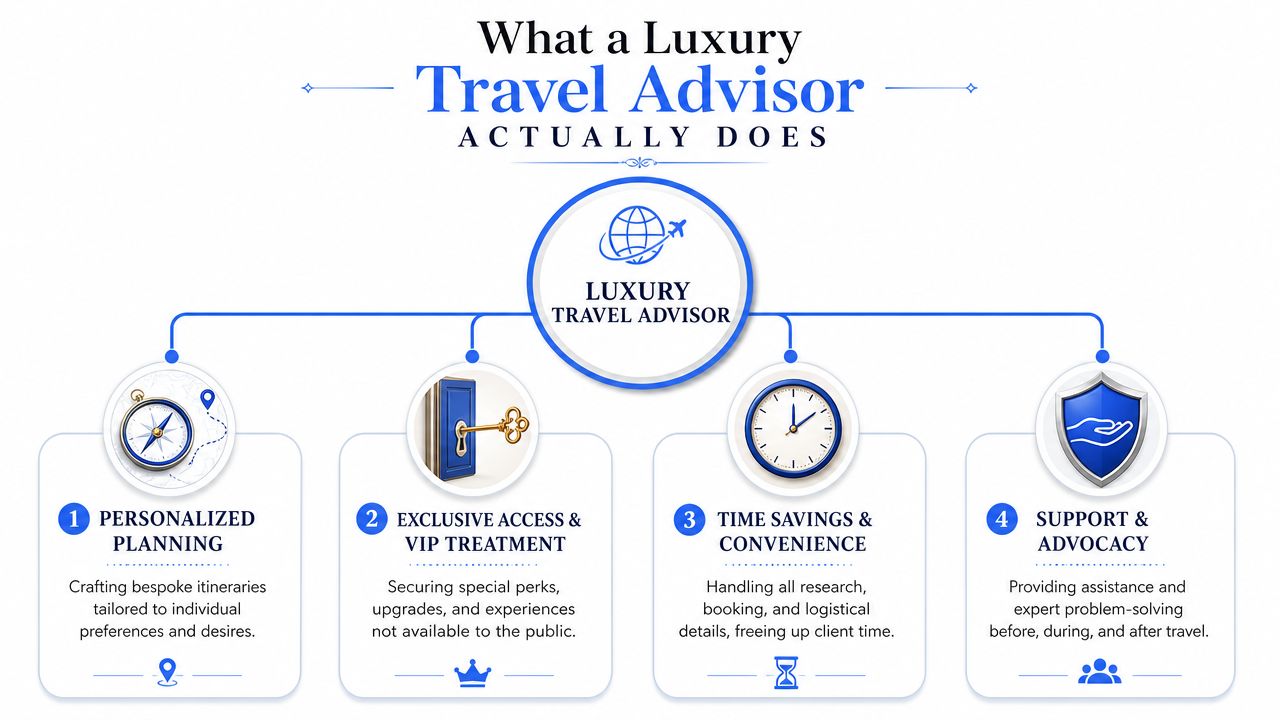
What a Luxury Travel Advisor Actually Does
A modern luxury travel advisor is not a glorified booking button.
A good one acts as your strategist, editor, project manager, and advocate. That work starts long before anything is reserved, and it continues after the confirmation emails land in your inbox.
Curation and personalization
The fundamental distinction emerges at this point. You tell me you want Greece. That's not enough. Do you want beach clubs and late dinners, or quiet coves and privacy? Are you the couple that wants three hotels in ten nights, or one spectacular base with a few strategic day experiences?
Luxury planning is about editing. Not adding more.
A strong advisor narrows the field based on your travel style, tolerance for movement, room preferences, dining priorities, and how you want the trip to feel. That prevents the most common luxury mistake. Booking what looks impressive instead of what fits. That is why I start with personalized vacation planning around your priorities rather than a list of impressive properties.
Access and relationship-based value
Not all rooms are equal, even in the same category. Not all properties handle special requests equally well. Not all itineraries benefit from the same partner relationships.
Established industry connections matter. Preferred partner perks, added amenities, priority notes on reservations, and stronger communication with hotel and cruise partners can shape the experience in ways travelers often don't see until they arrive.
Practical rule: The best luxury planning is rarely about finding “more.” It's about knowing which details matter enough to request, confirm, and monitor.
Logistics and flow
The more complex the trip, the more invisible logistics matter.
That means train timing in Italy that doesn't force you to drag luggage through a station at the hottest hour of the day. It means choosing the right side of a transfer island in the Maldives. It means understanding whether a private driver, seaplane, tender, or helicopter connection changes the tone of the trip.
This is also where cruise planning becomes technical. As a CLIA Accredited Cruise Counselor, I look at ship fit, suite location, dining patterns, embarkation strategy, and pre and post cruise design. As a Circle of Excellence Advisor. Top 5 percent at Nexion, I also know that the best trip on paper can still fail if the transitions are clumsy.
For travelers comparing what support looks like, the services of a travel agency usually matter far more than a generic promise to “save you time.”
Advocacy before and during travel
Things happen. Weather shifts. Flights move. Entry requirements change. A hotel room assignment isn't right. A connection gets tighter than it should be.
Your advisor's job isn't to prevent every disruption. That's impossible. The job is to reduce the odds of bad outcomes, build smarter plans upfront, and coordinate with trusted in-destination partners and suppliers when something needs attention.
A luxury trip should not depend on how good you are at fixing problems from an airport lounge.
That's the piece people underestimate until they need it.
The Real Cost Benefit Analysis Fees vs Value
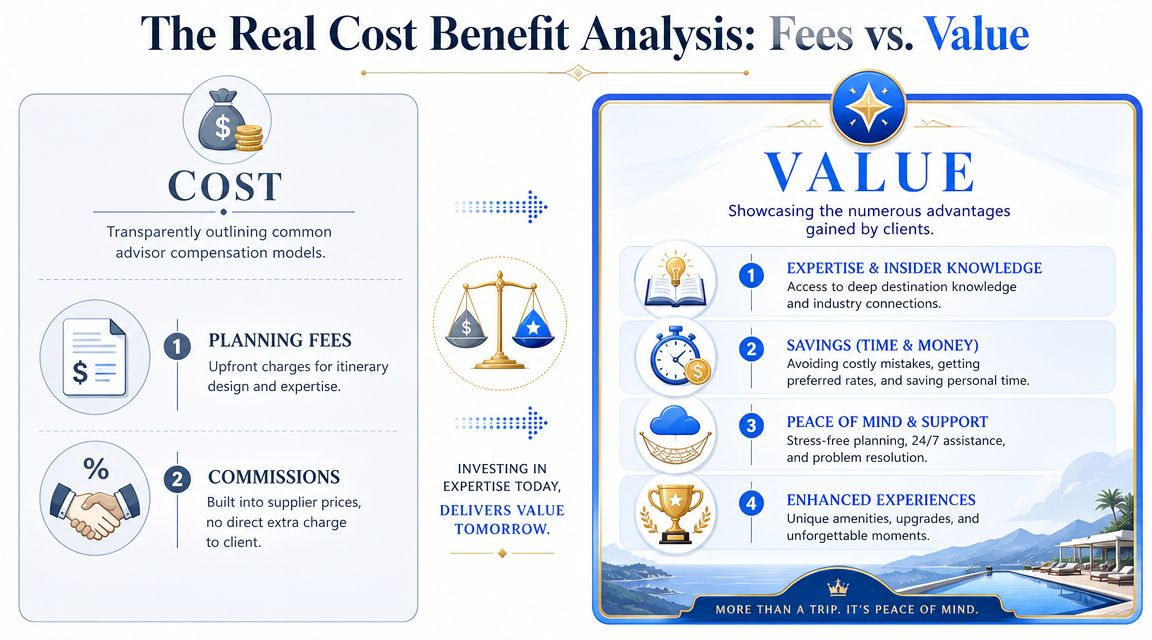
Let's get to the part people dance around. Yes, some advisors charge planning fees. Some work primarily on commission. Some use a mix of both.
That's normal. Expertise has value, and complex itinerary design is work.
The mistake is treating the advisor fee as the whole cost equation. It isn't. The better question is whether the total value exceeds the fee and the answer is often yes on the right trip.
What you're paying for
Sometimes you're paying for itinerary design. That includes hotel vetting, routing, transfer coordination, timing decisions, and overall trip architecture.
Sometimes you aren't paying directly because compensation is built into supplier commissions. AAA notes that many agents are commission-based or free to travelers, while some independent advisors charge flat fees, so the break-even point depends on trip complexity, booking volume, and whether perks offset the service cost. NerdWallet also notes advisors can save travelers hundreds or even thousands of dollars on complex trips through exclusive rates and stronger navigation of booking systems, as outlined by NerdWallet's analysis of whether travel agents save money.
Where the value shows up
It shows up financially, yes. But also operationally.
| Trip type | Self-booking reality | Advisor value |
|---|---|---|
| Simple weekend hotel stay | Usually manageable on your own | Often limited unless you want specific perks or hands-on planning |
| Multi-city Europe trip | Dozens of decisions across hotels, rail, drivers, pacing, and timing | High value through routing, hotel fit, transfer flow, and reduced friction |
| Luxury cruise | Ship and suite selection can be confusing, especially for first-timers | High value through matching you to the right sailing and cabin strategy |
| Honeymoon | High emotional stakes and little room for mistakes | High value through personalization, pacing, privacy, and special touches |
| Safari or remote lodge itinerary | Logistics can be complicated and expensive to fix | High value through sequencing, air and ground coordination, and trusted partners |
Here's the part affluent travelers care about most. A bad decision at the luxury level is expensive. The wrong room category, the wrong island pairing, the wrong cruise ship, or a poorly timed transfer can cost far more in disappointment than a planning fee ever will.
Advisor perspective: The fee is rarely the most expensive part of the wrong trip. The wrong trip is.
Time is part of the math
Busy professionals often underprice their own time.
If you spend evenings comparing hotels, reading conflicting reviews, checking room categories, cross-referencing transfer options, and second-guessing your choices, that has a cost. Even if you enjoy some of that research, it stops being fun when the itinerary gets complex.
And then there's the emotional value. Confidence. Clarity. Not wondering if you missed a better option. Knowing someone pressure-tested the plan before you committed.
That's why my opinion is simple. For a straightforward booking, keep it simple. For a big trip, is travel agent worth it becomes less of a debate and more of a quality-control question.
When an Advisor Delivers Outsized Value Key Scenarios
You're boarding a flight for a $25,000 honeymoon, a private driver is supposed to meet you on arrival, your suite is a specific category you chose for the view, and one missed handoff can ripple through the entire trip. That is the luxury context. At this level, advisor value is not about clipping coupons. It is about access, judgment, and protecting a high-stakes investment.
Analysts at Capital One highlight the same broad pattern affluent travelers already know from experience. Advisors earn their keep most clearly on trips with layered logistics, supplier coordination, and disruption risk, as noted in Capital One's overview of when travel agents are worth it.

For a once in a lifetime honeymoon
A luxury honeymoon needs more than pretty hotels. It needs emotional intelligence in the design.
The right advisor matches the trip to the couple, not to a trend. That means knowing when to book a larger suite because privacy will matter, when to avoid an overhyped resort that feels crowded, when to add a slow three-night stretch so the trip can breathe, and when to arrange private touring instead of stacking shared excursions. Those choices shape the experience far more than a generic list of top honeymoon destinations.
The financial side matters too. On a high-end honeymoon, one wrong room category or one poorly chosen transfer can cost more than the planning fee. If you are still deciding who should build a trip like this, start with a guide on how to find a travel agent for luxury travel.
For a multi-country Europe trip
Europe exposes weak planning fast.
Luxury travelers usually do not regret choosing Paris, Florence, or the Amalfi Coast. They regret losing half a day to a bad arrival plan, booking a gorgeous hotel that is wrong for their daily routing, or stringing together too many stops because the itinerary looked efficient on paper. It rarely is.
A strong advisor tightens the trip where it should be tighter and softens it where it should be softer. Better hotel positioning. Better train or flight timing. Better room selection. Better pacing. The result is not just convenience. It is a trip that feels intentional from the first night to the last.
For safari and remote lodge travel
Safari is expensive to fix once you are in motion.
Value here is expert sequencing and partner quality. Which camps pair well for wildlife and flow. Which routing avoids punishing transit days. Which properties handle families well and which are better for couples. Which aircraft baggage limits will affect what you pack. Which border crossings look manageable online but create avoidable friction on the ground.
Professional judgment pays for itself subtly. You may never see the problems that were prevented, and that is the point.
In remote, high-ticket travel, the invisible details decide whether the trip feels polished or fragile.
For luxury cruises and expedition voyages
The ship is the product. The itinerary is only part of the decision.
An advisor who knows this category helps you choose the right line, the right ship, the right deck, and the right suite strategy. That matters because a guest who wants a hushed, design-forward experience will have a very different reaction to the same sailing than a guest who wants a social atmosphere, multiple dining venues, and a busier onboard rhythm.
Good cruise planning also covers the land side with discipline. Arrive too late before embarkation, choose the wrong hotel, or skip proper transfer planning, and the trip starts on unstable footing. Luxury travelers should not accept that.
For group and family milestone travel
Milestone trips create social risk as much as travel risk.
If you are planning a birthday villa stay, a family celebration in Europe, or a multigenerational holiday with several room types and competing preferences, someone has to control the details, manage supplier communication, and protect the overall standard of the trip. That job is real work. It usually lands on the family member who is already too busy.
An advisor takes that operational burden off the host and keeps the experience aligned with the occasion. Guests feel looked after. Expectations stay clear. The trip reflects the money being spent.
How to Choose the Right Advisor and Red Flags to Avoid
A luxury trip can look flawless on paper and still be poorly designed. The hotel may be famous, the route may be popular, and the room category may sound impressive. None of that tells you whether the advisor understands your standards, your pace, or the pressure points that can derail an expensive itinerary.
Choose the advisor the same way you would choose a private guide or wealth manager. Expertise first. Fit second. Pretty social media content comes last.
Green flags to look for
The right advisor asks sharper questions than a booking engine ever could.
- They plan the kind of travel you book: A safari specialist, a cruise specialist, and a honeymoon designer do different work. If you want a high-touch, multi-stop itinerary, hire someone who builds those trips every week.
- They ask about standards, not just preferences: You want someone who asks how you like to arrive, how much structure you want each day, what ruins a hotel for you, and what level of service feels right.
- They discuss supplier relationships with discipline: Good advisors know which hotel teams respond quickly, which partners handle special requests well, and where VIP status can improve your stay in concrete ways.
- They explain their planning model clearly: You should know what happens from consultation to final documents, what support is included, and when they step in if plans go sideways.
- They design around risk early: Air strategy, connection buffers, private transfers, early check-in plans, and backup options should come up before anyone starts selling you suites.
If you need a starting point, this guide on how to find a travel agent is useful for narrowing the field to advisors who match your trip style.
Questions worth asking
Ask direct questions. A serious advisor will answer them without fluff.
- What trips do you book most often at my budget level?
- Which destinations, hotels, or cruise lines do you know firsthand?
- How do you decide between two strong options for a client?
- What VIP amenities or on-property support can you usually secure?
- How do you handle schedule changes, supplier issues, or service recovery during travel?
You are listening for judgment. Specificity matters. You want to hear why they would choose one Belmond property over another, why they would route you through one city instead of another, or why one suite category is worth the premium and another is not.
For honeymoon clients, that same standard applies beyond Europe and the Caribbean. If you are considering the Indian Ocean, this guide to Mauritius honeymoon planning shows the level of destination-specific thinking you should expect from any advisor you hire.
Red flags that should make you pause
Poor luxury planning usually reveals itself early.
- They recommend hotels before they understand you: That is order-taking, not advising.
- They sell the same brand in every proposal: That often signals habit, commission bias, or limited range.
- They cannot explain tradeoffs: Every strong itinerary involves choices. Beach access versus privacy. A larger room versus a better location. Fewer stops versus a richer route.
- They stay vague about fees or scope: If you do not know what you are paying for, you cannot judge the value.
- They treat “luxury” as a price point instead of a service standard: Expensive is easy. Well-matched, well-executed, and protected is harder.
The right advisor brings taste, judgment, and control. You should feel that within the first conversation.
A Case Study The Effortless Italian Honeymoon
A recent type of trip I see often looks like this. Two busy professionals. Demanding jobs. Limited planning time. High standards. They want Italy for their honeymoon, but their search history has turned into a full-time side project.
They've saved fifteen hotels, changed cities three times, and still don't know whether they should do Florence, Tuscany, Rome, the Amalfi Coast, or all four. They're also worried about making one expensive mistake that shadows the whole trip.

The solution isn't “book everything fancy.” It's editing with intent.
For this kind of honeymoon, I'd refine the route to fit the couple's energy and priorities, choose hotels based on privacy and position rather than just reputation, and coordinate trains, private drivers, and arrival timing so the trip feels smooth from the first day. That's also where experiences get sharper. Not random add-ons, but thoughtful moments that belong in the itinerary.
This is why generic advice about travel advisors falls short. Yes, a simple hotel booking may not need an expert. But a multi-city honeymoon absolutely can. That's where the value becomes tangible.
NerdWallet makes the same broad distinction. Advisors often add little value for simple bookings, but their greatest impact is seen on complex trips, which is exactly the gap this kind of example helps close.
And if your honeymoon shortlist includes Indian Ocean ideas as well as Europe, a practical outside resource like this guide to Mauritius honeymoon planning can help you compare a very different style of romantic trip before you decide.
For travelers who want an advisor-led option, Explore Effortlessly designs bespoke itineraries that handle the routing, accommodations, transfers, and experience planning for milestone trips like this.
Frequently Asked Questions About Working With a Travel Advisor
Is a travel agent worth it for a simple trip
Usually not if the trip is a basic flight or hotel booking and you're comfortable handling it yourself. The value increases fast once the trip becomes multi-stop, high-budget, or emotionally important.
Do travel advisors only help with cruises
No. Cruises are a strong fit, but advisors are equally useful for honeymoons, safaris, villas, milestone trips, and multi-country itineraries.
Will I lose control if I use an advisor
No. You keep decision-making authority. The advisor narrows options, explains tradeoffs, and manages the details so you don't have to do all the labor yourself.
Are travel advisor fees worth it
For the right trip, yes. If the advisor improves hotel fit, trip flow, and overall execution while reducing mistakes and planning time, the fee is usually justified.
Can I work with a luxury advisor if I don't live nearby
Yes. I work with clients nationwide through virtual consultations, which makes the process easy for busy professionals and couples with packed schedules.
If you're planning a honeymoon, luxury cruise, safari, or multi-stop itinerary and want an expert to design it with care, clarity, and strong logistics, Plan my luxury trip with Explore Effortlessly. You can also join the newsletter for more luxury travel insight and inspiration through Explore Effortlessly's newsletter.
Author bio
Hi, I'm Karrah, owner, founder, and lead travel advisor at Explore Effortlessly, a luxury award winning travel agency based in Miami.I specialize in designing bespoke, high touch itineraries to bucket list destinations around the world. Every trip is curated with intention, insight, and seamless logistics from start to finish.
From luxury cruises and private villas to honeymoons, safaris, and once in a lifetime journeys, my role is to simplify the planning process while elevating every detail.