You've saved the leave, chosen the destination, and started comparing safari lodges. Then the practical questions arrive: Will a single room cost more? Who meets you after the bush flight? Is a city overnight sensible before the safari? Which malaria medication fits the route? Luxury solo travel to Africa works beautifully when those details are designed together, not added as an afterthought.
I plan Africa journeys for travelers who want privacy without isolation, refined lodges without a rigid group schedule, and meaningful experiences without spending their holiday coordinating transfers. The right itinerary gives you space to be alone when you want it, company when it adds something, and reliable local logistics throughout. This guide focuses on the mechanics that make the difference, from destination fit and safety planning to single supplements, health preparation, and booking strategy.
Why Solo Travel to Africa Is Having a Moment
A solo traveler steps off a small bush flight into a private concession. A guide is waiting by name. The transfer is short, the arrival is calm, and a suite prepared for one is ready with luggage service, a cool drink, and an afternoon plan that leaves room to breathe. There's no awkward scramble to join a group and no compromise on the quality of the room.
That experience once felt unusual. It increasingly feels like the product luxury operators should have been designing all along. Solo travel in African safari markets is expanding quickly, with Go2Africa reporting that solo travel rose from 13.07% of enquiries in 2024 to 15.42% in 2025, while a separate 2025 update placed solo travelers at 16% of enquiries (Go2Africa's luxury solo travel report). The same reporting identified a 230.6% rise in interest since 2016, with especially strong demand from the United States, Australia, Canada, and the United Kingdom.
The new solo safari profile
Many of the travelers I speak with are experienced women in their forties, fifties, and sixties. Some are traveling after divorce or after children have left home. Others have stopped waiting for a companion whose calendar, budget, and wish list align perfectly with theirs.
They aren't looking for a packaged group tour by default. They want a private suite, a knowledgeable guide, excellent food, and the freedom to spend an hour watching elephants at a waterhole instead of rushing to the next scheduled activity. Africa delivers that combination particularly well because the lodge environment naturally creates gentle social opportunities around shared drives and meals, while preserving genuine privacy.
For additional practical perspective, these tips for traveling solo on safari are useful when you're thinking through camp routines, social preferences, and independent travel expectations. The larger point is simple: solo Africa is no longer a workaround for travelers who couldn't find a partner. It's a premium, design-led category with its own planning logic.
The Solo Safari Market by the Numbers
Solo travel now represents a substantial safari market. The Beyond Africa Safari Report 2026 found that solo travelers accounted for 22% of safari bookings, up from 9% in 2022, with an average spend of $7,800 for an 8-night trip (Beyond Africa Safari Report 2026). That spending level matters when planning a private itinerary, particularly once single supplements and private vehicle costs enter the calculation.
The report describes a predominantly female segment, with bookings split 68% female and 32% male, and an average traveler age of 38. South Africa led destination demand at 37%, followed by Kenya at 28% and Tanzania at 19%. Go2Africa's separate reporting also places Tanzania, Kenya, and South Africa among the most popular safari countries for solo travelers.
Solo safari market snapshot, 2026
| Metric | Solo Traveler | Couple, per person | Notes |
|---|---|---|---|
| Share of safari bookings | 22% | Not provided | Solo share rose from 9% in 2022, according to the Beyond Africa Safari Report 2026 |
| Gender profile | 68% female | Not provided | Solo segment profile |
| Average age | 38 | Not provided | Solo segment average |
| Average trip spend | $7,800 | Not provided | Based on an 8-night trip |
| Leading destinations | South Africa 37%, Kenya 28%, Tanzania 19% | Not provided | Destination share within the report |
The pricing requires careful design. A lodge still has to provide a room, guide, vehicle, meals, staff, and conservation infrastructure whether one guest occupies the suite or two share it. Single supplements therefore remain common. Some properties reduce or waive them on selected dates, but the decision depends on room inventory and operating terms, not a general promise.
Private-driver pricing creates a second planning choice. A solo guest may pay for the full vehicle, or share drives where the lodge allows it. I recommend choosing the lodge and occupancy terms first, then deciding where private guiding adds enough value to justify the cost.
Advisor perspective: Demand is no longer the issue. Product fit is. Start with lodges offering workable single-occupancy terms, then build the route around those properties.
Best Solo-Friendly Destinations by Experience
The best destination depends on the experience you want, not the country you haven't visited. A first safari, a walking-focused journey, a gorilla trek, and a restorative beach stay require very different levels of structure.
For a first safari
South Africa's Sabi Sand and MalaMala are my preferred starting points for many first-time solo travelers. Excellent lodge infrastructure, straightforward connections through established gateways, and a polished service culture make the experience easier to manage. Private reserves also offer a more controlled rhythm than a self-drive itinerary, with guides managing the timing and logistics of game viewing.
Kenya's Laikipia conservancies suit travelers who want horseback riding, walking, conservation, and a more active relationship with the land. The guide-to-guest experience is central here, so your comfort with shared activities and small-group outings matters.
Rwanda combines Volcanoes National Park with Akagera National Park when a traveler wants gorilla trekking alongside classic wildlife viewing. The route has a strong sense of progression, from forest trekking to savanna, but it demands careful permit and accommodation coordination.
For migration-focused privacy, I favor southern Serengeti planning when the seasonal movement aligns. The right camp location matters more than choosing “Tanzania” on a form.
For culture and city time
Cape Town offers a particularly strong luxury base for a solo traveler who wants art, wine, scenery, and excellent hotel service. Marrakech can work well with a riad-based stay and prearranged touring, while Cape Coast and Accra suit travelers seeking history and culture with a carefully managed transport plan. Zanzibar Stone Town is atmospheric and rewarding, but I prefer pairing it with a well-serviced property and planned transfers rather than leaving every movement open-ended.
For beaches and solitude
The Bazaruto and Quirimbas archipelagos in Mozambique, the Seychelles' inner islands, and Mauritius all lend themselves to a quiet resort finish. These are not interchangeable. Bazaruto and Quirimbas feel more remote and transfer-sensitive, while the Seychelles and Mauritius offer broader resort infrastructure and easier access to wellness, boating, and dining options.
For adventure
Choose Namibia's Skeleton Coast for a fly-in journey built around remoteness and dramatic scenery. Botswana's Mokoro and quad routes add an active dimension to a lodge stay, while Uganda's Nile whitewater creates a completely different kind of solo adventure. For help comparing regions and lodge styles, read my guide to luxury Namibia safaris.
Single supplements and single-occupancy inventory vary sharply by property, especially in remote camps. That's where itinerary design earns its keep. You're not just selecting a destination. You're matching the room category, transfer pattern, guide model, and social atmosphere to the way you travel.
A Realistic Look at Safety for Solo Travelers
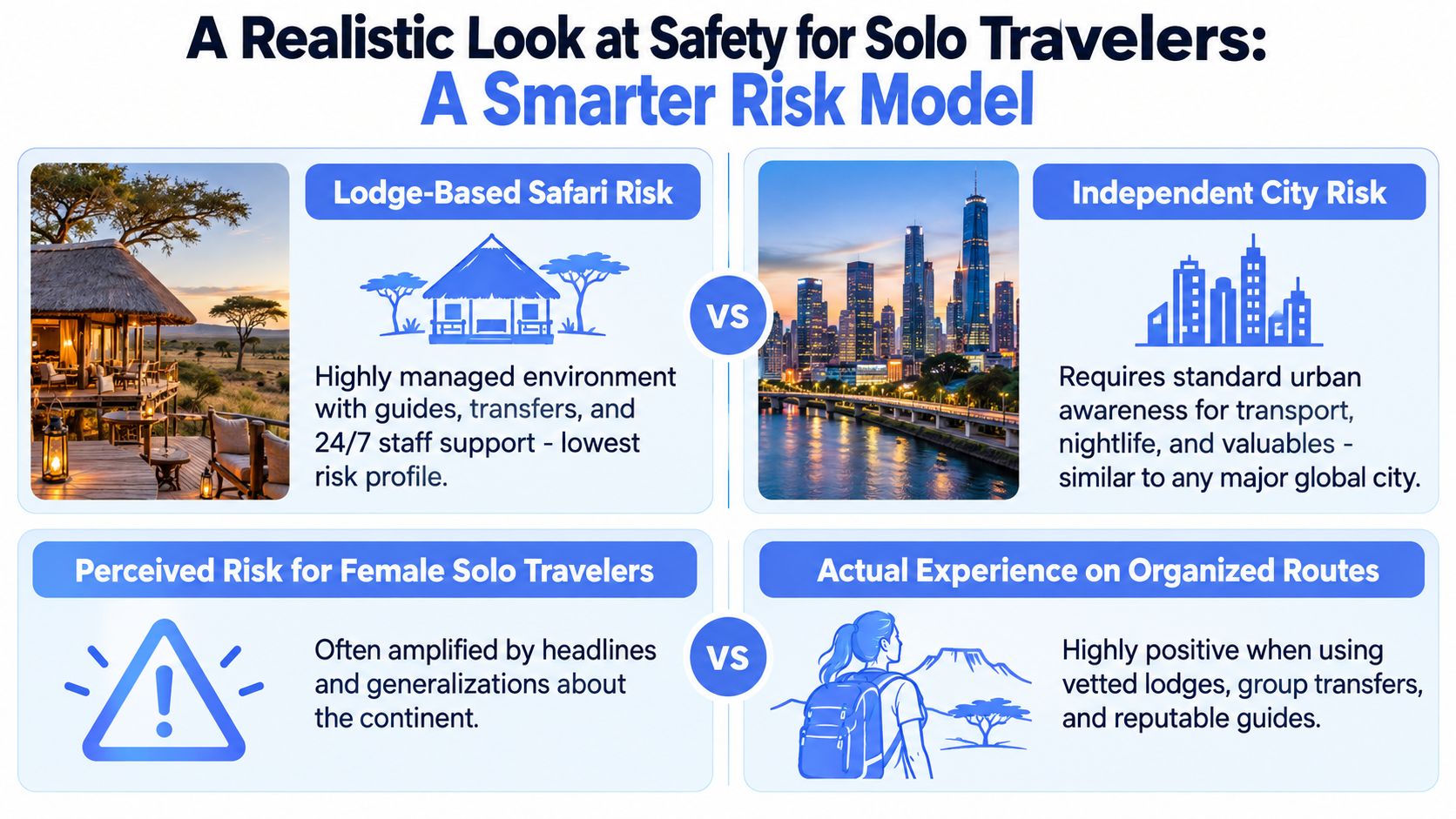
“Is Africa safe?” is too broad to help you plan. A lodge-based safari, an independent city stay, a self-drive route, and a late-night airport arrival carry different practical considerations.
At a safari lodge, guides, drivers, lodge teams, and scheduled transfers create a managed environment. That structure doesn't eliminate risk, and conditions can change, but it reduces the number of decisions you need to make alone. Walking from a vehicle to your suite with a lodge escort is not the same scenario as walking from a riad to a restaurant through a busy medina.
Build the route around the real risk points
City segments need normal big-city awareness. Cape Town, Nairobi, Johannesburg, and Marrakech each require attention to transport, valuables, nightlife, and unfamiliar neighborhoods. The U.S. Department of State lists South Africa at Travel Advisory Level 2, citing unrest, crime, kidnapping or hostage taking, and terrorism (South Africa advisory information). Check current government advisories before departure, since guidance can change.
My rules are direct:
- Avoid late arrivals: Schedule the first night so you're not navigating an unfamiliar city after dark.
- Use arranged transfers: A pre-screened driver removes much of the friction around airport pickups and hotel arrivals.
- Keep valuables discreet: Carry only what you need and avoid displaying expensive jewelry or electronics.
- Share the itinerary: Give a trusted contact your route and accommodation details.
- Treat online approaches cautiously: The UK Foreign Office warns about scams involving job or business opportunities, visa services, and romance or friendship offers, including dating apps (solo travel advice for South Africa).
For travelers who want an additional personal-security resource, this 3rd-i personal safety guide can support broader situational-awareness planning. I also keep a distinction between lodge-based comfort and urban independence at the center of every route. My guide to safe solo travel for women covers the planning principles I use when building that distinction into a trip.
Safety is an itinerary design issue, not a continent-wide verdict. The smarter question is where you'll be at each stage, who is handling the movement, and what support exists if plans change.
Pre-Departure Logistics, Health, and Visas
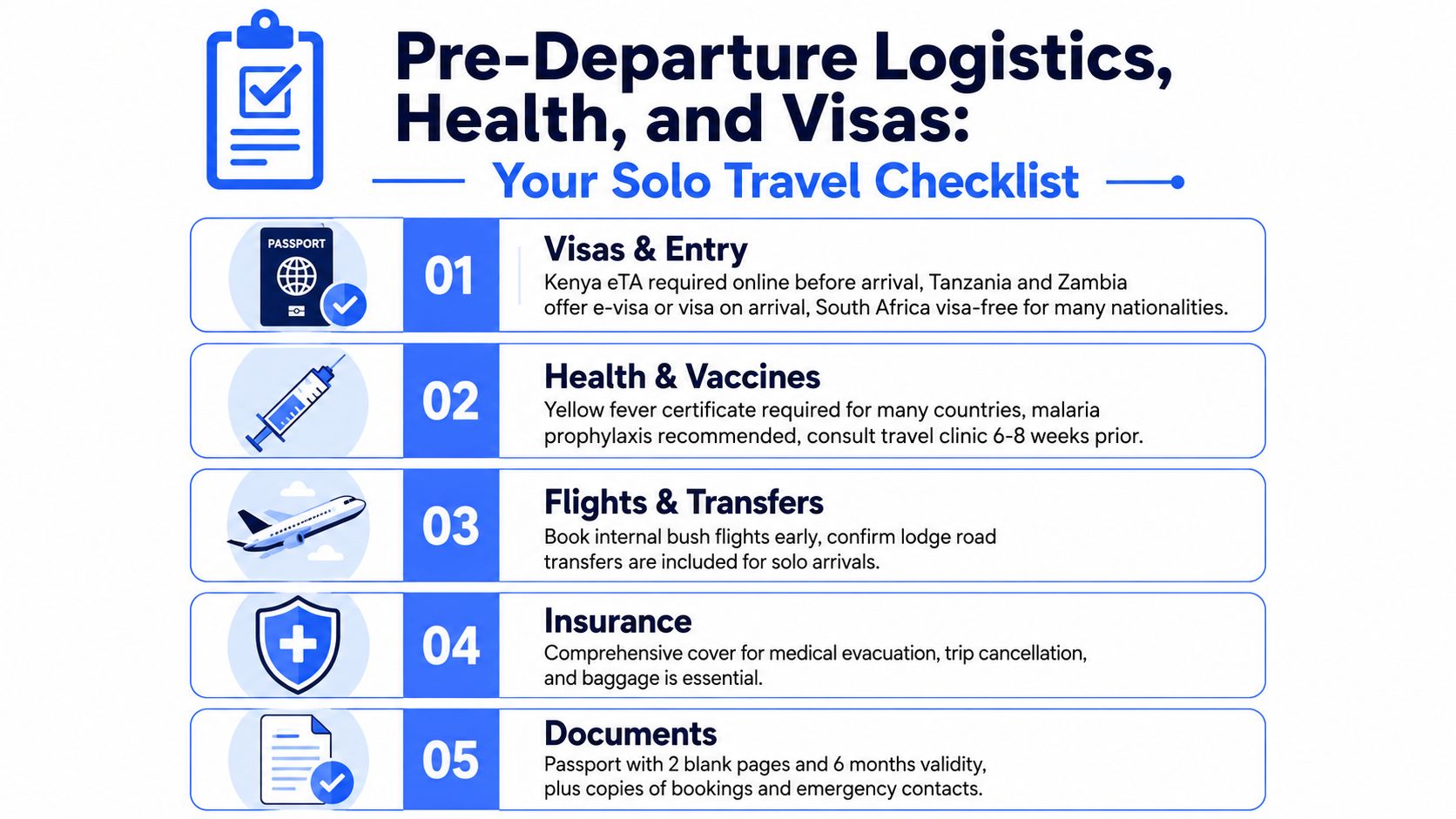
Solo travel rewards preparation because you're the person who notices every missing document, transfer gap, and medication question. I consolidate the operational work before tickets are issued, then verify requirements again closer to departure.
Start with destination-specific entry rules. Kenya's online authorization process, Tanzania's entry options, Zimbabwe and Namibia requirements, passport validity, and blank-page rules can differ and can change. Yellow fever documentation may also matter when your route crosses countries or includes specific travel histories, so a travel clinic should review the full itinerary rather than a single destination.
Medical planning is not a packing list
Malaria planning deserves a proper medical workflow. CDC guidance says chemoprophylaxis should begin 1 to 2 days before entering malaria-endemic areas, continue daily during exposure, and extend for 7 days after leaving (CDC malaria guidance). Malaria transmission is endemic in Sub-Saharan Africa and occurs in most game parks, while P. falciparum is considered chloroquine-resistant there. Your clinician should match medication to the route, timing, health history, and possible side effects.
Remote lodges, tents, evening drives, and water-hole viewing after dusk increase exposure during peak mosquito activity. Layered protection matters: permethrin-treated nets, long sleeves and pants, and repellent containing at least 25% DEET are practical safeguards where screens or air-conditioning aren't reliable (CDC-linked health counseling document).
A practical final-month sequence
- Thirty days out: Confirm passport validity, entry requirements, insurance, prescriptions, and medical appointments.
- Before departure: Review vaccinations with a qualified travel clinic, including yellow fever requirements for the specific routing.
- For remote travel: Confirm medical evacuation coverage and check that the policy recognizes safari, trekking, water activities, or self-drive plans where applicable.
- For driving legs: Arrange an international driving permit if the itinerary includes self-drive Namibia.
- For every arrival: Pre-book airport and lodge transfers, especially when the first or last night involves a long connection.
Use this safari packing list alongside the medical and document review. Packing is the easy part. The valuable work happens before the bag opens.
Sample Luxury Itineraries by Trip Length
Trip length should determine how much geography you attempt. A short trip needs concentration, not ambition. Every extra flight creates another opportunity for delay, a missed connection, or a tired arrival.
Seven days
A seven-day itinerary should focus on Cape Town and Franschhoek or the Okavango Delta. In South Africa, I'd pair a refined city hotel with a vineyard property, using private transfers between the airport, Cape Town, and the Winelands. In Botswana, I'd choose one exceptional camp with fly-in access rather than dividing the stay across several areas. Single supplements are easier to manage when the itinerary doesn't multiply remote nights.
Ten days
Ten days allows a city anchor and a private safari. Cape Town and Sabi Sand is an elegant first journey, with a city hotel, private driver, and lodge-based safari connected by scheduled or chartered regional flights. Another option is Marrakech followed by a luxury camp in the Serengeti, although the long-haul and regional flight pattern requires careful connection planning.
Expect premium accommodation throughout, but don't assume every lodge includes a waived single supplement. The costing needs to identify the exact room category and dates before the route is finalized.
Fourteen days
Fourteen days can support two signature experiences without becoming a parade of airports. Victoria Falls plus the Okavango creates a strong water-and-wilderness pairing, while Rwanda gorilla trekking plus Zanzibar combines active forest travel with a slower coastal finish.
| Trip Length | Suggested Route | Lodging Tier | Transfer Mode | Single Supplement |
|---|---|---|---|---|
| 7 days | Cape Town and Franschhoek, or one Okavango camp | Luxury city hotel, vineyard property, or premium safari camp | Private road transfers, or fly-in safari | Review by property and date, with fewer nights to manage |
| 10 days | Cape Town and Sabi Sand, or Marrakech and the Serengeti | Luxury hotel plus private safari lodge or camp | Private transfers and regional flights | Confirm room category and lodge policy before deposit |
| 14 days | Victoria Falls and Okavango, or Rwanda and Zanzibar | Luxury lodges, a boutique city stay, and a serviced beach resort | Scheduled or charter flights, private road transfers | More remote nights can increase the total supplement |
For deeper route planning, review the available luxury safari tours, then ask an advisor to reshape the framework around your preferred pace, room style, and activity level.
Solo Pricing, Booking Lead Times, and Where the Money Goes
Single supplements exist because most safari rooms, tents, vehicles, and operating costs are priced around shared occupancy. You're paying for private use of a space that could otherwise hold two guests, along with the fixed costs of running a remote property.
The supplement is only one part of the equation. Private guides, charter flights, park fees, conservation levies, internal transfers, and special activities can move the total more than the room rate alone. Shared game drives can reduce the cost while preserving a high-quality experience, especially at lodges where guides already operate on a scheduled basis.
Timing changes the value equation
For peak safari camps, I prefer starting around 12 to 18 months ahead. Shoulder-season planning can often begin around 6 to 9 months ahead, while Cape Town and beach extensions may work with 3 to 6 months when availability is flexible. These are planning guidelines, not guarantees, and popular room categories can disappear earlier.
Tented camps may offer a more favorable cost structure than full-service lodges, while Botswana's remote fly-in model can price differently from Namibia's broader road-and-air combinations. I look for disproportionate value in the places where the guide, location, and access materially change the experience, rather than paying for decorative extras you won't use.
| Cost Category | Safari-Only, Botswana | City + Safari, Cape Town + Sabi Sand | City + Beach, Cape Town + Mozambique |
|---|---|---|---|
| Accommodation | Remote safari camp, often with a solo occupancy adjustment | City hotel plus private reserve lodge | City hotel plus serviced island or coastal resort |
| Guiding | Shared or private game drives, depending on preference | Private city touring plus lodge game drives | Private city touring plus resort activities |
| Transportation | Bush flights and lodge transfers | Regional flight, private road transfers, and lodge transfers | Regional or charter connection, plus private transfers |
| Fixed destination costs | Park fees, conservation levies, and camp operations | Safari fees plus city logistics | Coastal transfers, resort operations, and activities |
| Payment planning | Deposit and cancellation terms vary by supplier | Staged payments tied to multiple components | Staged payments with close attention to air and resort terms |
A non-refundable deposit can secure scarce solo inventory, but I review the cancellation terms line by line before recommending it. Payment cadence should match the supplier conditions, your insurance coverage, and the flexibility you need.
How an Advisor Plans a Solo Africa Trip Differently
A couple's itinerary can absorb a mismatched activity or an inconvenient transfer because two people are sharing the decision-making. A solo itinerary can't. I build around your risk tolerance, mobility, social appetite, sleep preferences, and tolerance for moving between properties.
The pre-trip work includes confirming single-occupancy room categories, reviewing seasonal access and flooding patterns, vetting the guide and driver network, and identifying a backup property when availability is tight. I also check whether a lodge's social style fits you. Some travelers want communal dinners and shared drives. Others want private dining, a private vehicle, and a quiet suite once the day winds down.
What working with me includes
Explore Effortlessly works with clients nationwide through virtual consultations. Planning can include accommodation, flights, private drivers, lodge transfers, excursions, airport logistics, and the coordination of trusted in-destination partners and suppliers before departure. Those local partners provide on-the-ground support while I manage the planning framework and logistics with you.
My credentials include Circle of Excellence Advisor, Top 5 percent at Nexion, and CLIA Accredited Cruise Counselor. I don't promise that travel will be flawless or risk-free. I do make sure the itinerary has been examined from the perspective of the person traveling alone.
The luxury of an advisor-led trip is not simply access. It's having fewer avoidable decisions left to make once you arrive.
Author bio: Hi, I'm Karrah, owner, founder, and lead travel advisor at Explore Effortlessly, a luxury award winning travel agency based in Miami. I specialize in designing bespoke, high touch itineraries to bucket list destinations around the world. Every trip is curated with intention, insight, and seamless logistics from start to finish. From luxury cruises and private villas to honeymoons, safaris, and once in a lifetime journeys, my role is to simplify the planning process while elevating every detail. I work with clients nationwide through virtual consultations.
If you're ready to turn your solo Africa ideas into a polished itinerary, Explore Effortlessly can coordinate the lodges, transfers, private guiding, health-planning considerations, and single-occupancy details around the way you want to travel. Visit Explore Effortlessly to begin a virtual consultation, and join the newsletter for more luxury travel planning guidance.