A realistic all-in Antarctica expedition cost for a standard 10 to 12 day trip in 2026 is roughly US$11,000 to US$15,000 per person. If you want luxury, expect US$18,000 to US$30,000+, with some top-end voyages climbing to over US$45,000 once you step into the newest ships and best suites.
That's the number clients need, not the brochure fare. The headline cruise price can look manageable, then flights, hotels, insurance, gear, and tipping push the trip into low five figures fast. That's why Antarctica is one of the easiest trips to underbudget and one of the most expensive trips to fix once you've booked the wrong setup.
- Budgeting properly matters: the base fare rarely reflects the full trip.
- Itinerary choice matters more than people expect: route complexity changes the price dramatically.
- Luxury is often about logistics, not just style: faster access, newer ships, and smaller passenger counts all cost more.
- Advisor-led planning saves money in the right places: not by cutting corners, but by avoiding expensive mistakes.
If you're serious about Antarctica, plan the total trip, not the cruise alone. That's the only way to avoid sticker shock and make a clean decision. If you would rather build a land-based nature trip, my Pacific Northwest travel planning guide offers a useful contrast.
Understanding the Full Cost of an Antarctic Expedition
The Antarctica expedition cost starts with the full trip budget, not the sailing fare. For a standard 10 to 12 day itinerary, a realistic all-in target is US$11,000 to US$15,000 per person, and luxury trips can run well beyond that once flights, hotels, insurance, gear, and ground logistics are included (Antarctic Guide). The old mental benchmark of “about ten grand” is too shallow now, because serious travelers are paying for the pieces that make the trip work, not just the berth on the ship.
What the total cost usually includes
A cruise quote can look tidy because it usually covers only the ship portion. The journey still has to begin and end somewhere, and that means flights to the gateway city, hotel nights before departure, and practical extras you cannot avoid. On a standard Peninsula expedition, the cruise fare itself may sit in the US$7,800 to US$18,000 range depending on the ship and cabin category, but the trip total rises once you add the necessary components (Arctic Antarctic Travel).
Practical rule: if you are only budgeting the published fare, you are not budgeting Antarctica.
This catches affluent travelers off guard because Antarctica does not behave like a normal luxury resort trip. There is no easy replacement flight, no casual room upgrade at check-in, and no ability to improvise once you are locked into a remote departure window. Start with the landed cost, then work back to the ship.
A true trip budget normally covers international airfare, pre- and post-cruise hotels, insurance, and gear. In the market today, a standard Peninsula expedition typically lands in the US$11,000 to US$15,000 all-in range once those elements are included, with the broader market clustering around US$11,000 to US$16,000 for mid-range trips (Antarctica Tourism, Antarctica Tourism). That is the number I use when advising clients who want a clean, realistic budget.
The right move is to treat the brochure as a starting point, not a decision. Antarctica rewards travelers who plan with discipline and work with someone who knows where the hidden cost traps live.
How Itinerary Choices Drive the Price
Itinerary drives Antarctica pricing more than almost anything else. A classic Peninsula sailing sits at the entry point, while routes that extend to South Georgia and the Falklands, or switch to a fly-cruise format, add real operational cost that shows up in the fare. Start with the route, then judge the ship. That is how experienced buyers avoid paying for the wrong kind of trip.
Side by side, the spread is obvious
| Itinerary Type | Typical Duration | Estimated Cost Per Person |
|---|---|---|
| Classic Antarctic Peninsula | 10 to 12 days | US$7,800 to US$18,000 |
| Fly-and-cruise Peninsula | Similar trip length, with air segment | About 20% more than sailing-only |
| South Georgia and Falklands | Longer multi-region voyages | US$16,400 to US$61,200 |
| Antarctic Circle trips | Extended itineraries | US$12,300 to US$86,500 |
These differences come from logistics, not marketing polish. Longer and more remote routes mean more sailing time, more fuel, and more ship days devoted to the voyage, which is why the price climbs quickly. Fly-cruise products work for clients who value time and want to avoid the Drake Passage, but the air component costs more because it replaces ship time with limited-capacity transport.
For a useful benchmark, a 22-day expedition covering Antarctica, South Georgia, and the Falklands was reported at US$12,043.50 per person (The Travelling Sloth). That kind of example matters because longer itineraries do not always mean worse value on a per-day basis.
Direct advice: if wildlife is the priority, South Georgia usually justifies the higher fare. If time and comfort matter more, a fly-cruise can be worth paying for. If you want the cleanest entry into the market, the classic Peninsula remains the strongest buy.
For clients comparing options, I point them to this Antarctica expedition cruise planning guide and narrow the choice by priorities, not by brochure hype.
Hidden Costs Beyond the Cruise Fare
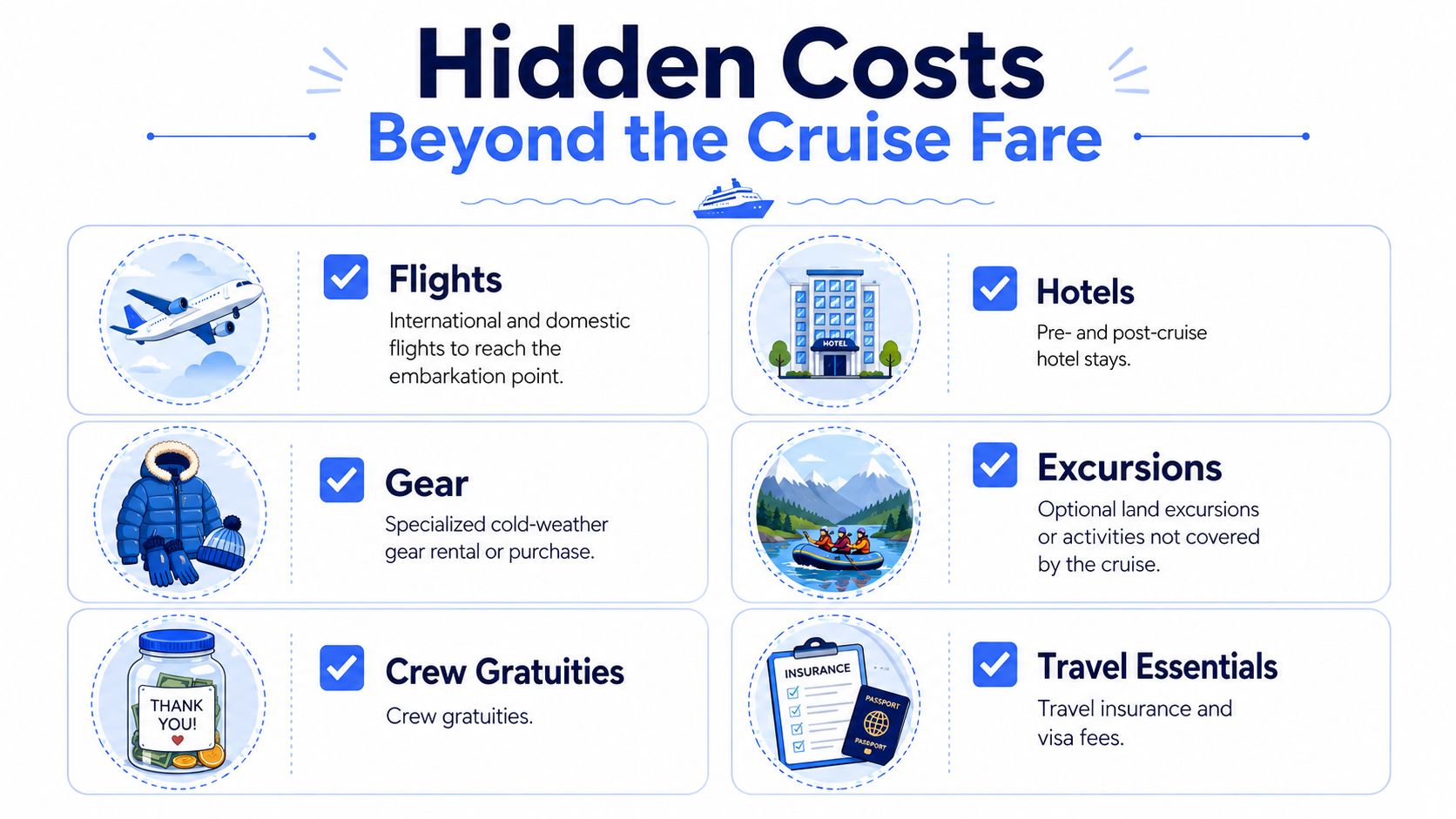
The fastest way to blow an Antarctica budget is to treat the brochure fare as the full bill. It never is. The all-in cost starts after you buy the cruise, and clients who plan properly budget for the extras before they book.
Build the budget in the right order
Start with flights to the gateway city, then add the pre-cruise hotel nights needed to protect the trip from weather delays. Antarctic departures often require a stop in Ushuaia or Punta Arenas before you even step on the ship, and those air and hotel costs sit outside the advertised fare. That is the first place budgets slip.
Insurance comes next. For an expedition of this kind, medical evacuation and trip protection belong in the plan from the beginning, not as an afterthought. Then look at gear. Cold-weather layers, waterproof trousers, insulated boots, gloves, and a proper outer shell are expensive if you do not already own them. A smart packing checklist, such as this cruise packing guide, keeps you from buying duplicates you will never use again.
Optional activities can move the total fast. Kayaking, camping, helicopter excursions, and similar add-ons can turn a comfortable fare into a much more expensive itinerary. I do not tell clients to avoid them. I tell them to choose them on purpose, because the right extras are worth paying for and the wrong ones are pure waste.
The part most travelers forget
Crew gratuities still matter. Laundry, drinks, and internet also belong in the budget, even on a high-end expedition where the base fare looks polished. Those smaller charges do not dominate the trip, but they do add friction if you ignore them.
Fly-cruise routes and more complex port logistics deserve a bigger cushion. If you are flying into the start point, carrying specialist gear, or arriving with little room to spare, build extra margin into the budget and spend it where it improves the trip. That is how you keep the experience controlled instead of letting surprise charges pile up at the end.
Pricing Tiers from Budget to Ultra-Luxury
Antarctica has four very different pricing bands hiding under one headline. Budget, mid-range, luxury, and ultra-luxury all get you to the White Continent, but they do not deliver the same comfort, privacy, or onboard quality once you step aboard. That is where many first-time buyers misread the market.
The tiers at a glance
Budget trips usually start around US$5,000 to US$8,000, or in some classic Peninsula cases around US$8,000 to US$11,000 once you account for the broader all-in picture (Antarctica Tourism, The Travelling Sloth). These are the voyages where older ships, smaller cabins, and less polished public spaces keep the fare down. You still get the core expedition experience, but you are not paying for plush surroundings.
Mid-range cruises, which cluster around US$11,000 to US$16,000, are where many luxury travelers land (Antarctica Tourism). This is the sweet spot for newer expedition ships, stronger cabin inventory, and better onboard design without jumping into eye-watering suite pricing. If you want good food, a polished feel, and a smaller passenger count, this is usually the most sensible spend.
Luxury trips generally run US$15,000 to US$45,000 per person on 11- to 14-night voyages, with entry-luxury sailings starting near US$12,000 and top suites on newer ships exceeding US$45,000 (Haus Travel). Ultra-luxury, including private interior fly-in experiences, begins around US$70,000 per person. That is not just a nicer bed. It is a different logistical product altogether.
The premium is justified when the ship is newer, the cabin is more comfortable, and the itinerary removes friction instead of adding it.
If a client wants the best balance of experience and sanity, I usually steer them toward the middle-to-upper middle of the market rather than the cheapest fare or the most expensive suite. Antarctica is too remote to book purely on price, and too special to book purely on flash.
Why a Luxury Travel Advisor Matters
Antarctica is not a last-minute, click-and-check-out destination. It's a complex expedition with limited inventory, multiple moving parts, and very little room for error. A luxury travel advisor earns their keep here by translating a glossy itinerary into a workable trip that fits your calendar, comfort level, and tolerance for risk.
What the advisor actually does
A good advisor helps you compare ships, cabin categories, and route styles without wasting time on noise. That matters because the same Peninsula voyage can feel very different depending on vessel class, cabin layout, and what's included in the fare. I also handle the pre-trip logistics, from flights and hotel sequencing to transfer timing in gateway cities and the practical pieces that keep the trip smooth.
If you're wondering whether that support is worth it, this guide on using a travel agent is the blunt answer. For Antarctica, the value isn't theoretical. It shows up in better matching, fewer mistakes, and a cleaner overall plan.
I work with clients nationwide through virtual consultations, which keeps the process simple even when your schedule is packed. Trusted in-destination partners and suppliers provide on-the-ground support while I coordinate the planning and logistics before departure.

A well-run Antarctica booking should also account for visa and insurance requirements, especially when your itinerary touches multiple countries or remote departure points. That is the difference between a trip that feels polished and one that feels assembled in a hurry.
Strategic Booking and Timing Advice
The best Antarctica departures don't sit around waiting for you. The strong cabins go first, the most sensible fares disappear early, and the worst mistake is assuming you can “just grab something later” without consequence. In this market, flexibility helps, but hesitation usually costs more.
Book with intent, not hope
If you care about cabin quality, book early. The market rewards travelers who commit before inventory tightens, especially on the ships that offer the most desirable cabin categories. Late booking can work if you're extremely flexible, but it narrows your options and can force you into whatever's left rather than what you actually want.
Seasonal timing matters too. Shoulder periods often create better value, while peak demand generally pushes prices higher. That's why I ask clients to decide whether they want the very best wildlife timing, the strongest price, or the most comfortable onboard experience, because you rarely get all three at once.
My rule: if the trip is bucket-list important, don't wait for a miracle fare to solve a planning problem.
Protect the trip after you book it
Flexible cancellation terms matter more on Antarctica than on a typical cruise. Weather, air schedules, and remote operations all create more moving parts than people expect, so travel insurance should be part of the original plan, not an afterthought. That's especially true if you're building in pre- and post-nights or choosing a fly-cruise itinerary.
Clients also make a common mistake by comparing the cheapest sailing-only fare to a fly-cruise without accounting for comfort, time, and schedule risk. Those are not identical products. One removes the Drake Passage and adds premium logistics, while the other keeps the sailing component and usually offers a lower starting point.
If you want a polished itinerary with the right cabin, the right routing, and a budget that reflects the trip, a booked-too-late scramble is the thing to avoid.
Plan Your Effortless Antarctic Journey
Antarctica demands a premium because the trip is built on remote operations, specialized ships, and tight routing. The brochure fare only shows part of the picture. The actual all-in cost is what matters, because flights, hotels, insurance, gear, and transfers can change the budget fast once you add them in.
For luxury travelers, the goal is clear. Buy the right Antarctica expedition, then price the full experience before you commit. If you compare only the cruise fare, you will underbudget and make avoidable compromises later.
I help clients shape that full picture from the start, so they know what the expedition really costs before they fall in love with a cabin category or itinerary headline. The planning starts with the ship and route, then moves to the extra layers that turn a good quote into a realistic one.
If you want a sharper view of what belongs in the budget, start with Explore Effortlessly. For ongoing guidance on luxury cruise planning and bucket-list travel, use this sign-up page. I'll help you match the route, cabin, and logistics to the way you want to travel, without the usual budget surprises.
If Antarctica is on your list, price it properly and build it with the full trip in mind. That is how you avoid the common trap of chasing a fare that looks manageable until the flights, protection, and pre-trip logistics are added on.