Fiji's dry season from May through October offers the most reliable weather, while May and October are the smartest shoulder-month choices for better value without giving up too much comfort. For the steadiest conditions, choose June through September, and accept that peak-season demand can make the trip more expensive and crowded.
You've found the resort, shortlisted the villa, and started picturing long afternoons on the water. Then the practical questions arrive. Will the weather support your snorkeling days? Will a private island transfer connect smoothly with your international flights? Are you paying a premium for conditions you could enjoy with fewer people a month earlier?
The best time to visit Fiji depends on what you value most. Reliable sunshine, privacy, marine life, flexibility, and value point to different parts of the calendar. I'd rather help you make that trade-off deliberately than give you a generic May-to-October answer.
Why Timing Everything Matters for Your Fiji Trip
A luxury Fiji itinerary can look perfect on paper and still feel poorly timed. Your resort may be exceptional, but an outdoor-heavy schedule becomes less comfortable when humidity rises, rain interrupts boat transfers, or a storm forces you to move the one excursion you built the trip around.
Consider two travelers planning similar island escapes. One wants clear skies for beach time, diving, and a carefully paced honeymoon. The other cares more about a quieter resort atmosphere and stronger value, and is comfortable leaving room for weather changes. They shouldn't receive the same recommendation.

Fiji's seasonal split affects more than rainfall. It influences how confidently you can schedule private boat days, how much flexibility you need between islands, and whether you'll want a resort with strong indoor dining and wellness options. Those details matter when you've invested significant time and money in a milestone trip.
The real luxury trade-off
The core dry season, June through September, is the natural choice for travelers who want the most dependable conditions for outdoor plans. May and October are more compelling for travelers who want a calmer setting and better value, while accepting that the weather may be less consistent.
The wet season can also suit the right traveler. It's warmer, more humid, and wetter, but the quieter atmosphere and potential value can appeal to experienced travelers who don't need every day to be perfect.
My planning rule: Choose your non-negotiables first, then select the month that protects them. A beautiful resort can't compensate for a calendar that works against your priorities.
Thoughtful planning earns its place. The decision isn't “dry season or wet season.” It's whether your trip depends on uninterrupted beach time, whether your schedule can absorb a change, and how much you value seclusion over maximum weather reliability.
Understanding Fiji's Two Distinct Seasons
Fiji's two seasons create different advantages for luxury travelers. Tourism Fiji describes a warm, subtropical climate with a dry season from May to October and a wet season from November to April (Tourism Fiji's climate overview).
The dry season is cooler, less humid, and generally drier. It is the stronger choice for guests planning several beach days, private cruises, or island transfers that need dependable conditions. The wet season is warmer and more humid, with more frequent rain and a higher chance of tropical weather disruptions. Rain rarely makes every day unusable, but it can reduce confidence in a tightly scheduled outdoor itinerary.
What the rainfall contrast means
Travel references describe a marked seasonal difference. Some dry-season months average roughly 86 to 177 millimeters of rain, while wet-season months can average roughly 245 to 374 millimeters.
That contrast explains the usual preference for the dry season among travelers focused on snorkeling, diving, beach time, and island-hopping. Fewer weather interruptions create more chances to enjoy the experiences you have prioritized. Travelers who value quieter resorts and potential value may accept the wet season's variability, particularly if they can keep their schedule flexible.
Fiji's geography also affects the decision. Conditions can vary between islands and between the windward and sheltered sides of larger islands, so one forecast should not define the entire trip. Check the specific resort location, transfer route, and planned activities before choosing dates.
For travelers comparing Pacific destinations, Explore Effortlessly's Bora Bora travel timing guide provides a useful parallel. The right month depends on your priorities after arrival, not just the season name. Flexibility can improve wet-season value, but cyclone risk still requires careful planning.
The Dry Season Deep Dive, When to Go and Why It Matters
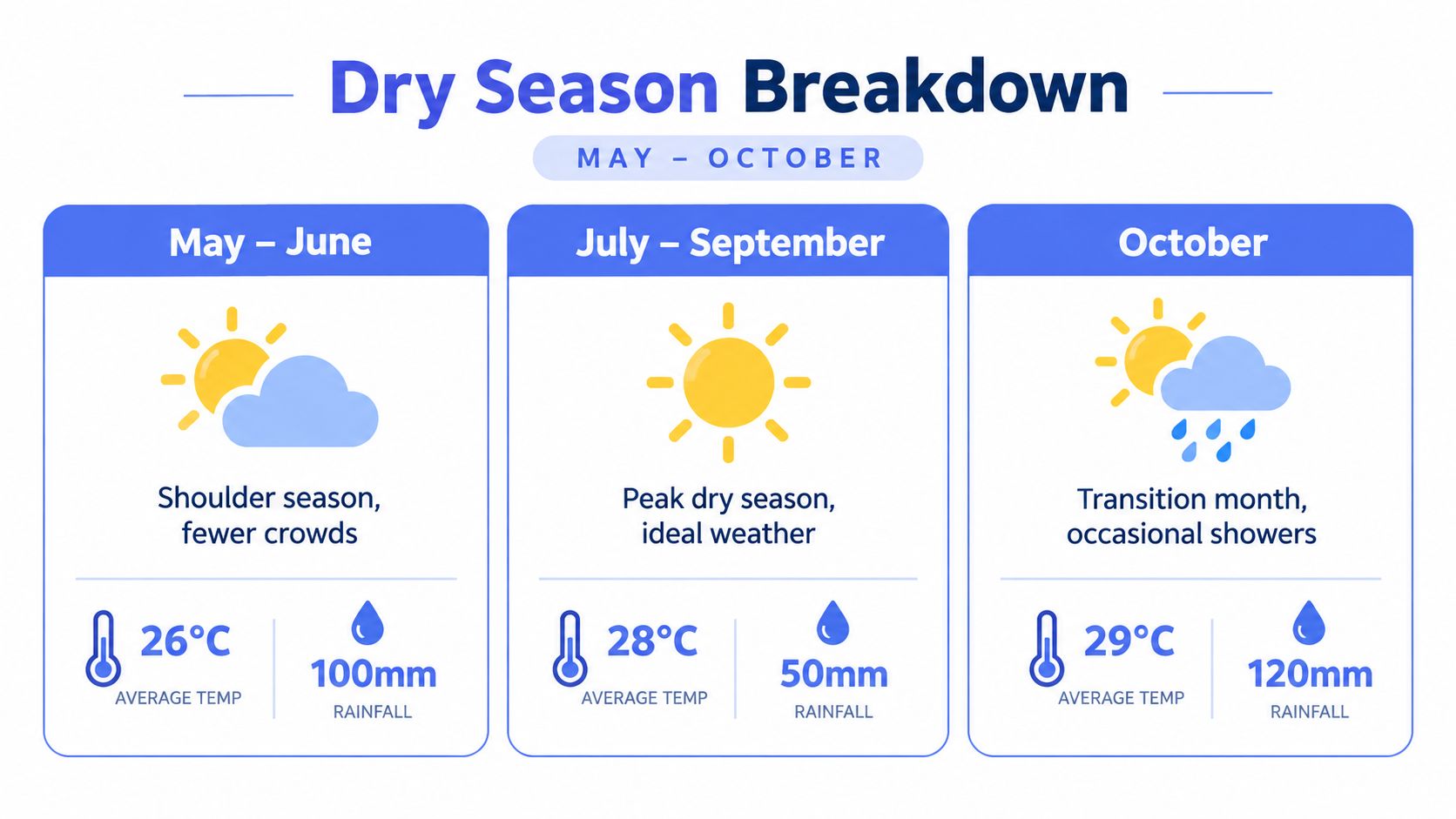
For a honeymoon built around clear-water sailing, diving, and beach time, choose mid-May through mid-October. Fiji is cooler and drier then, with lower humidity, clearer skies, and less rainfall (Climate to Travel's Fiji climate guide).
Luxury travelers should separate dependable weather from better value. June through September offers the strongest reliability for fixed outdoor plans. May and October suit couples who want quieter resorts, more privacy, and potentially better value, while accepting some variation in conditions.
Core versus shoulder timing
June through September is my recommendation for honeymoons with sailing, diving, beach days, or outdoor celebrations. It also works well for multigenerational groups. More dependable weather makes it easier to keep different ages and energy levels engaged without repeatedly changing plans.
May and October are the smarter compromise for flexible couples. They remain within Fiji's preferred dry-season window, yet demand can be calmer around resorts and activities. That privacy may matter more than the small gain in weather reliability offered by the core months.
The rainfall difference is meaningful. Travel references report roughly 86 to 177 millimeters in dry-season months, compared with roughly 245 to 374 millimeters during many wetter months. Use those figures as a planning guide, not a promise for every island. The planning conclusion is direct: budget your weather buffer based on your chosen island group, resort location, transfer route, and activities, not the national average.
| Period | Weather reliability | Crowd levels | Best for |
|---|---|---|---|
| May | Strong, with some variability | Lower than core season | Honeymoons, privacy, value-conscious luxury |
| June to September | Most reliable dry-season conditions | Higher demand | Diving, beach time, celebrations, active itineraries |
| October | Generally favorable, with transition risk | Often calmer | Couples, villas, relaxed island stays |
Choose the core months when a missed boat departure or outdoor celebration would materially affect the trip. Choose the shoulder months when privacy, flexible scheduling, and value deserve equal weight. Travelers comparing other warm-water escapes can also review beach destinations with Lounge Wagon, then judge each option by transfer complexity, weather priorities, and accommodation style rather than beach imagery alone.
The Wet Season, Who Should Consider It
The wet season runs from November through April. It brings more rain, higher humidity, warmer conditions, and greater cyclone exposure, but it isn't automatically the wrong choice (Tourism Fiji's weather guide).
I'd consider this period for a traveler who values a quieter resort atmosphere and potential value more than perfectly predictable weather. December and January can appeal to those who want a tropical holiday during that part of the year, while accepting that the itinerary needs breathing room.
When wetter months make sense
A wet-season Fiji trip works best when the itinerary isn't built around one irreversible outdoor event. A private villa stay with flexible spa, dining, cultural, and resort time is easier to manage than a tightly sequenced island-hopping trip with multiple fixed boat departures.
Some travelers also choose wetter months for marine experiences. Sources note that the season can overlap with manta ray activity and that the period may appeal to visitors who prioritize marine life, even though weather and visibility can be less consistent. Those benefits should be weighed against the possibility of interrupted excursions rather than treated as a guarantee.
The wet season's appeal is strongest for travelers who can adapt:
- Flexible couples: You can shift a boat day or move a beach excursion without sacrificing the entire trip.
- Value-focused luxury travelers: You care about the quality of the resort and experience, but you don't need the peak weather window.
- Repeat visitors: You may be happy to trade perfect conditions for a quieter, more relaxed stay.
- Marine-life enthusiasts: You're willing to accept variable conditions for activity-specific opportunities.
Cyclone exposure changes the calculation, especially for trips with limited time. The Australian government's Fiji travel advice identifies the wet-season period as the higher-risk travel window, so I wouldn't recommend it for a once-only celebration where weather disruption would be especially costly.
For another perspective on warm-weather timing and crowd trade-offs, see my Turks and Caicos travel guide. Different destinations have different patterns, but the planning question remains consistent: what must go right for the trip to feel worthwhile?
Navigating Cyclone Season as a Luxury Traveler
Fiji's official tropical cyclone season runs from 1 November through 30 April, and the Fiji Meteorological Service identifies January and February as the period when activity is usually strongest, while noting that cyclones can form at any time during the season (Fiji Meteorological Service cyclone outlook).
That doesn't mean every wet-season departure will encounter a cyclone. It does mean you should treat weather disruption as a real planning consideration, particularly when your itinerary includes multiple islands, nonrefundable arrangements, or a fixed celebration date.
Build flexibility into the booking
First, avoid creating a schedule with no recovery time. If one delayed transfer causes you to miss the next connection, the disruption can spread through the entire itinerary.
Second, review travel insurance before paying for the trip. Look specifically at coverage for weather-related cancellations, interruptions, delays, missed connections, and emergency assistance. Policies differ, and travelers are responsible for understanding the terms, exclusions, and claim requirements.
Third, choose suppliers and arrangements with sensible change policies where available. Flexibility matters more than a nominal saving when a storm affects flight operations, ferry movements, or resort access.
A practical wet-season plan should include:
- Protected connections: Allow enough time between international arrival, domestic travel, and boat transfers.
- Weather-aware pacing: Don't place the most important experience on the first available day.
- Official updates: Monitor the Fiji Meteorological Service and follow instructions from local authorities and resort teams.
- A response plan: Know who can help rearrange flights, transfers, accommodations, and activities if conditions change.
The luxury advantage is preparation. A flexible itinerary gives you options before a disruption becomes an emergency.
For urgent real-time issues, travelers should use supplier contacts provided with their booking. Explore Effortlessly's planning structure can also clarify who handles which part of the journey, but no advisor can guarantee immediate assistance, uninterrupted transport, or specific weather conditions.
Making Your Decision with Confidence

Fiji's best travel month depends on the trade-off you want to make. Choose June through September for the most reliable weather for beaches, diving, island-hopping, and outdoor celebrations. Choose May or October for a stronger balance of favorable conditions, privacy, and value. Consider November through April only if you accept higher humidity, rain, and the need for greater flexibility.
Your itinerary should determine how much weather certainty you buy. A honeymoon at one excellent resort can accommodate more uncertainty than a multigenerational journey with several transfers and fixed activity days. A destination wedding warrants the most dependable conditions you can reasonably choose. Repeat visitors may prefer a quieter atmosphere and better value, provided they can adjust plans.
Match the month to the trip
Before recommending dates, I assess four questions:
- What experience cannot move? A wedding, private charter, or once-planned marine excursion deserves stronger protection against unsettled weather.
- How much transfer complexity is involved? Each additional island, flight, ferry, or boat connection creates another point where timing matters.
- What does comfort mean to you? Lower humidity may matter most, or privacy and value may take priority.
- How much flexibility do you have? A longer, slower stay absorbs weather changes more easily than a compressed itinerary.
The same trade-off between ideal weather and ideal value applies whether you choose a tropical island or a national park in autumn. These October national park trip ideas can help you compare a beach escape with an active land-based journey. Assess each option against your available time, comfort preferences, and tolerance for logistical changes.
Fiji is also an itinerary design decision. The right islands, realistic transfer times, and suitable room category can matter as much as the season. My guide to the best islands to visit in Fiji offers a useful starting point, while a personalised recommendation should connect location, timing, and pacing.
Explore Effortlessly designs custom international journeys for travelers seeking expert recommendations and coordinated logistics. The standard service includes the initial consultation. VIP adds two scheduled calls, dining, spa, and special-arrangement assistance, plus extended evening and weekend help for canceled flights and missed connections. Standard business hours are Monday through Friday from 10:00 a.m. to 6:00 p.m. Eastern, and clients receive supplier contacts for urgent real-time assistance.
If you want Fiji planned around your priorities, Explore Effortlessly can match your dates with the right season, resort setting, transfers, and activity pacing. Book a consultation with our team for a thoughtful, personalized recommendation through our contact page, and join my newsletter for practical luxury travel guidance.