You've chosen the villa, saved the ceremony images, and started a spreadsheet that was supposed to make everything easier. Then the questions arrive: Which guests will travel? Does the destination recognize your marriage? Who coordinates airport transfers, room blocks, welcome events, weather plans, and vendors working across different time zones?
That's where destination wedding planning services earn their place. A luxury wedding abroad is part celebration, part international group trip, and part compliance exercise. The setting may be beautiful, but the experience depends on details guests never see.
Key takeaways
- A wedding week needs pacing, not just a ceremony and reception.
- Legal requirements vary by jurisdiction, including residency, translations, apostilles, witnesses, and proof of legal ability to marry.
- Guest attendance is never automatic. Published planning guidance places destination wedding RSVP rates around 50% to 65%, while another source cites roughly 60% to 70%, so the event should be sized conservatively. Wedding RSVP guidance
- Full-service planning matters. One market outlook says full-service planning represents 55.0% of the destination wedding market, reinforcing how central professional coordination has become. Future Market Insights destination wedding outlook
- Explore Effortlessly works with clients nationwide through virtual consultations, coordinating travel strategy and wedding logistics with trusted in-destination partners.
Why Destination Weddings Demand Expert Planning
A couple preparing from another country may be approving menus across time zones, coordinating international arrivals, reviewing unfamiliar contracts, and checking whether the ceremony will remain legally recognized after guests return home. Local weddings offer familiar vendors and quick access when plans change. A destination celebration replaces those safety nets with distance, borders, and a guest list moving through several stages of travel.
Beyond choosing between a garden terrace and a ballroom lies the harder task of aligning dozens of moving parts into one calm, elegant experience. A delayed transfer can disrupt a welcome dinner. One missing document can affect the ceremony. A guest sent to the wrong hotel shuttle may remember the confusion longer than the floral design.

The wedding is also a group journey
Luxury couples often start with a guest list and venue. I start with the guest journey. Can older relatives manage the transfer? Will arrivals from different countries require different entry or documentation guidance? Are accommodations close to the events, with a practical alternative for guests who prefer another level of lodging?
A strong plan gives guests clear instructions without making them feel managed. It covers arrival guidance, transportation, event timing, dress expectations, downtime, and departure options. That structure matters even more when the celebration becomes a multi-day wedding week, because guests need enough breathing room between airport transfers, welcome events, the ceremony, and farewell plans.
Guest pacing is an operational decision, not a decorative detail. Build in recovery time after long journeys, keep transport windows realistic, and avoid turning every day into another formal obligation.
A destination wedding market overview valued the sector at USD 34.2 billion in 2025, projecting USD 67.7 billion by 2036 and a 6.4% CAGR from 2026 to 2036. Future Market Insights The market may be expanding, but each celebration still requires a plan built around its people, destination, schedule, and legal framework.
My practical rule: If the couple is still chasing transfer confirmations, answering guest questions, and revising vendor details close to departure, the planning structure is not doing its job.
For an island celebration, a focused local resource such as this Mauritius wedding directory can identify destination-specific vendors and local considerations. Use a directory for research, then appoint someone who can connect those choices to flights, accommodations, guest pacing, documentation, and the couple's wider travel plans.
What Destination Wedding Planning Services Include
Professional destination wedding planning services must connect event production with travel operations. A local coordinator may know the property and nearby suppliers. A destination specialist also coordinates the couple, guests, documents, accommodations, transfers, and the schedule across the full wedding week.
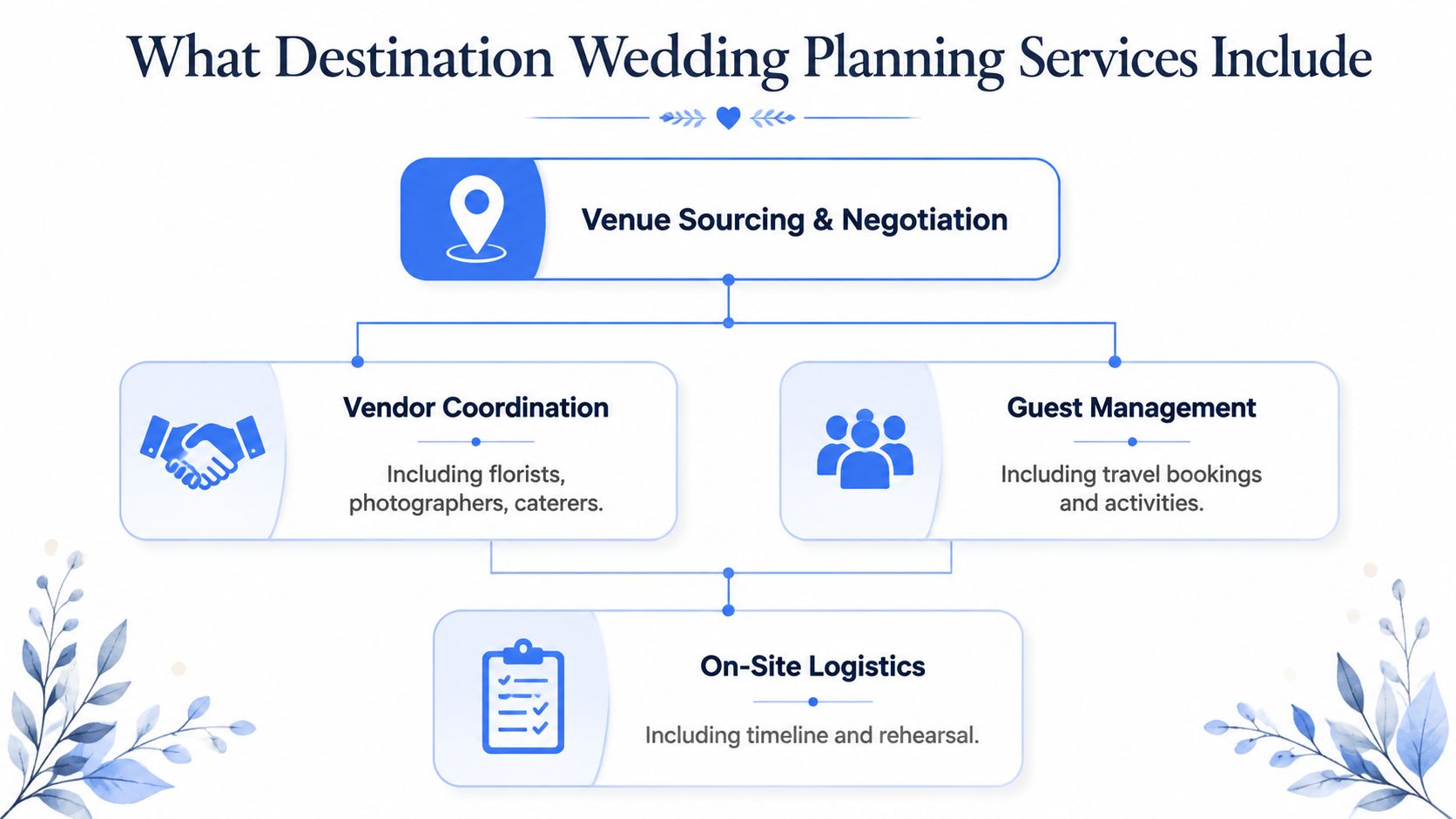
Venue sourcing and negotiation
Venue research starts with operations, not scenery. The planner should assess:
- Access: How guests reach the property, including airport transfers and difficult final-mile journeys.
- Capacity: Whether the venue can host the ceremony, reception, welcome event, weather backup, and service areas.
- Accommodation: Whether rooms are on site or require coordinated lodging nearby.
- Sound and timing: Local rules affecting music, outdoor events, and late-night celebrations.
- Weather flexibility: Indoor alternatives, covered spaces, and practical changeover plans.
Negotiation covers far more than the room rate. Review payment schedules, cancellation terms, minimum spends, room-block conditions, vendor restrictions, menus, staffing, and possible extra charges before signing.
Vendor coordination
A destination wedding may require a florist, photographer, entertainment team, caterer, hair and makeup artists, rental suppliers, transport providers, lighting specialists, and officiants. Their contracts must align, arrival windows must work, and responsibilities must be assigned without gaps or overlap.
The strongest setup often combines local knowledge with selected traveling vendors. Local caterers and florists understand regional ingredients, labor patterns, and production limits. A couple may still bring a trusted stylist or photographer for consistency, but the plan must account for travel, accommodation, equipment, and backup arrangements.
Use a practical checklist from ABC Hire to organize vendor conversations and confirm which services the celebration requires.
Guest travel and accommodation
Guest management includes room blocks, arrival windows, transfer manifests, travel reminders, accessibility needs, and event communications. It also covers a wedding website or digital guide that answers practical questions before guests need individual help.
Give guests structure without filling every hour. A welcome gathering, protected downtime, the wedding celebration, and an optional farewell breakfast usually create a more comfortable wedding week than a schedule packed with mandatory activities.
On-site production
Before departure, the planner builds the master timeline. On location, trusted partners and suppliers execute the plan while the advisor coordinates setup, rehearsals, arrivals, speeches, meals, transportation, photography windows, weather decisions, and teardown.
Explore Effortlessly coordinates resort options, group arrangements, guest travel, vendor vetting, and wedding logistics before departure, with local partners supporting the on-site experience.
Navigating Legal Requirements and Cross-Border Documentation
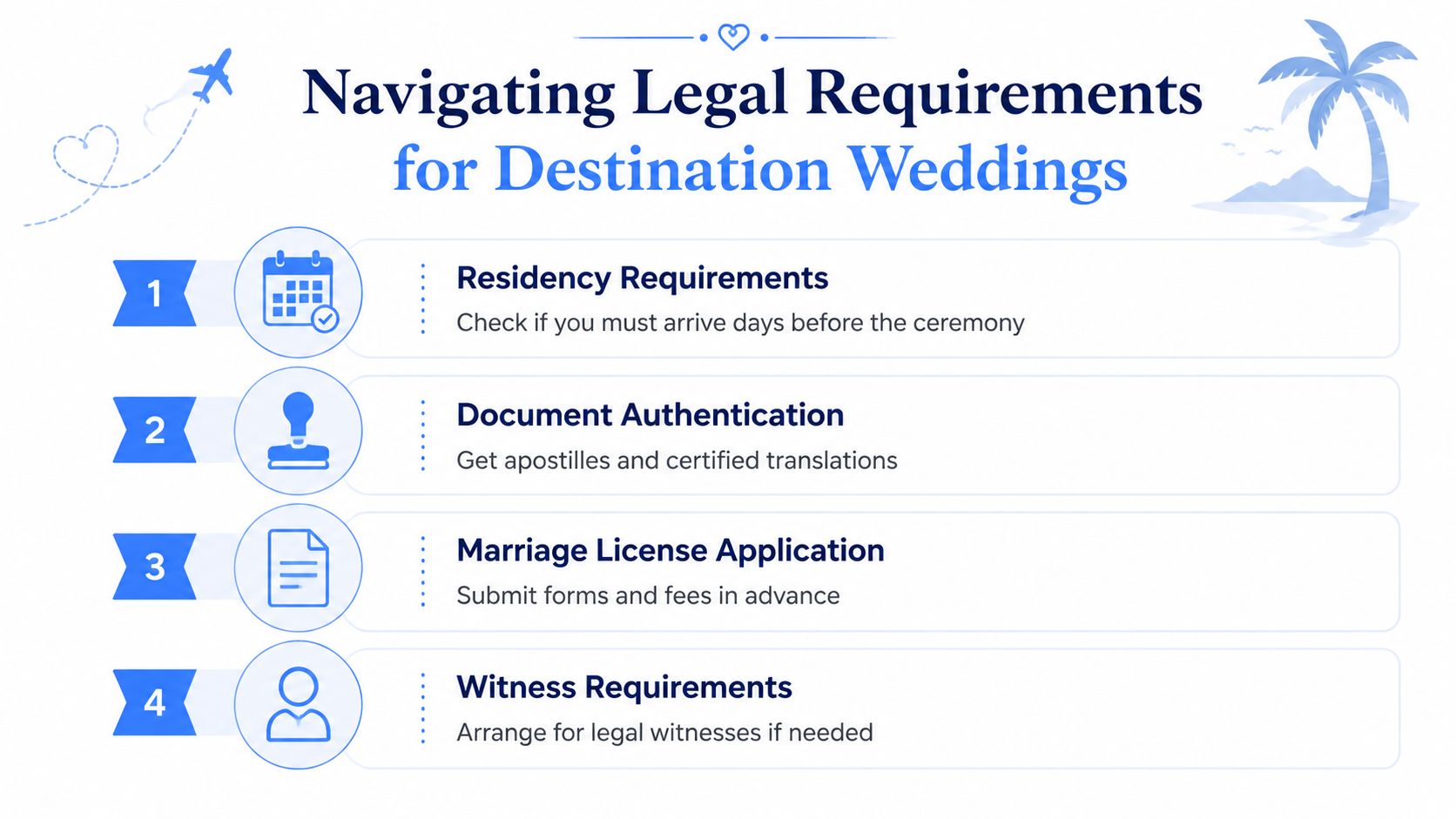
A beautiful ceremony isn't automatically a legal marriage. The destination may require residency before the ceremony, specific registries, authenticated documents, certified translations, witnesses, blood tests, age requirements, parental consent, or proof that a previous marriage ended.
The U.S. State Department advises couples marrying abroad to check the destination's rules because requirements can include residency periods, blood tests, age limits, parental consent, authenticated translations, proof that prior marriages ended, and proof of legal ability to marry. U.S. State Department guidance on marriage abroad
Build the document chain early
A typical document review may involve valid passports, long-form birth certificates, a single-status affidavit, divorce decrees or death certificates where applicable, certified translations, and an official marriage certificate. That certificate may then require an apostille or local legalization before the couple registers the marriage at home. Destination wedding legal requirements overview
The exact sequence depends on the jurisdiction. That's why a generic online checklist isn't enough. A planner should identify the governing authority, confirm current requirements directly through appropriate official channels, and assign responsibility for every document.
- Confirm validity periods: Some guidance sources state that many countries require passports to remain valid for at least six months beyond the wedding date, while other destinations add apostille or local registration requirements. Bride Advisor destination wedding laws
- Separate legal and symbolic decisions: A couple may complete a civil marriage at home and hold a symbolic ceremony abroad.
- Track translations: Confirm which documents need certified translations and whether the destination accepts the translator.
- Confirm witnesses: Requirements may apply to the number, identification, or residency of witnesses.
- Record post-ceremony steps: Determine how and where the official certificate receives authentication and how the home country recognizes it.
Legal abroad or symbolic abroad
Many couples choose a simple legal ceremony at home, then reserve the destination celebration for vows, cultural traditions, and the guest experience. That isn't less meaningful. It often removes residency uncertainty and reduces the number of administrative variables surrounding the main event.
Couples who want the destination ceremony to be legal should treat compliance as a core planning workstream, not a final paperwork task. The destination wedding planning checklist can help organize the questions that need answers before contracts and travel arrangements become difficult to change.
Realistic Timelines and Cost Expectations for Luxury Destination Weddings
A luxury wedding week can look relaxed to guests while your team manages arrivals, legal requirements, room assignments, rehearsals, and several separate events behind the scenes. A larger budget creates more options, not fewer decisions. Set the legal pathway, guest profile, destination access, and event format before discussing decorative details.
A workable planning framework
| Timeline Phase | Key Actions | Typical Lead Time |
|---|---|---|
| Vision and feasibility | Define destination, guest profile, ceremony type, travel expectations, and wedding-week shape | Early planning stage |
| Venue and date | Review access, accommodations, weather backup, contracts, and availability | Well before invitations |
| Guest travel | Establish room options, transfer strategy, travel guidance, and communication plan | Before formal guest commitments |
| Design and vendors | Confirm florals, photography, entertainment, catering, rentals, beauty, and production | After venue selection |
| Legal review | Confirm documents, residency, translations, authentication, witnesses, and certificate procedures | As soon as the jurisdiction is chosen |
| Final production | Approve menus, seating, timelines, packing, rehearsals, and contingency decisions | Final planning stage |
| Wedding week | Manage arrivals, events, guest communications, vendor setup, and the ceremony | On the ground |
Use this framework to sequence decisions, not to force every destination into one calendar. Administrative lead times vary by jurisdiction, venues may book quickly, and guests need time to coordinate work, school, passports, and international travel. Start with the items that can restrict every later choice, especially the ceremony format, venue availability, and documentation.
Guest pacing deserves its own plan. Schedule welcome activities and hosted meals, then leave room for sleep, independent exploring, and recovery before the main ceremony. A packed itinerary creates tired guests and makes transportation problems harder to absorb.
Budget beyond the ceremony
Build the budget around the complete wedding week. Include the venue and food, room blocks, transportation, planning trips, welcome events, farewell gatherings, staffing, rentals, taxes, service charges, entertainment, weather contingencies, document processing, translations, and the couple's accommodations.
Each additional event operates as a separate production. It needs decisions about menus, furniture, music, staffing, timing, and transfers. Decide which gatherings the couple will host, which remain optional, and where guests can spend unstructured time without losing access to practical support.
The budget should also distinguish fixed commitments from variable guest costs. Venue contracts, production deposits, and staffing may be locked early, while room nights, transfers, and optional activities can change as attendance develops. Keep a contingency reserve for weather changes, delayed arrivals, replacement transport, and last-minute operational adjustments.
For a detailed cost framework, review the average cost of a destination wedding. Protect transportation, hospitality, legal administration, and contingency planning before adding decorative extras. Guests remember whether the week felt well paced and cared for long after they forget a centerpiece.
Why a Luxury Travel Advisor Outperforms a Generic Wedding Planner
A generic wedding planner may produce a lovely event. A luxury travel advisor who specializes in destination weddings manages the entire arc, from the first flight decision to the final departure.
That difference becomes obvious when guests arrive from multiple cities or countries. The advisor considers flight timing, premium cabin preferences, airport transfers, room categories, private experiences, extensions, and honeymoon plans alongside the wedding schedule. The planner isn't just arranging tables. The planner is protecting the rhythm of the entire trip.

What the advisor adds
A travel advisor's relationships can create access to preferred partner perks, VIP amenities, special benefits, and curated experiences, but those benefits should never be presented as guaranteed upgrades. The advisor also knows how to match room categories to real needs, rather than assigning every guest to the same accommodation by default.
That might mean placing parents in quieter rooms, arranging suites for the couple, identifying accessible options, or creating a separate extension for guests who want more time in the destination. It can also mean coordinating premium flights and private transfers so the wedding week begins with less friction.
Couples comparing advisor support with self-booking may find this guide to the benefits of using a travel agent useful, particularly when several reservations need to work together.
The value isn't another person choosing flowers. It's having one person see the entire trip clearly enough to catch the problems before guests do.
Hospitality is part of the design
The most memorable wedding weeks don't force guests to attend everything. They create a graceful sequence: an arrival welcome, time to settle in, a meaningful celebration, and breathing room before departure. The advisor can coordinate optional excursions and private experiences without turning leisure into another obligation.
For couples evaluating concierge support, this premium fare guide from Passport Premiere offers useful context on the broader travel-concierge approach. The right advisor should also explain exactly what is included, which partners handle on-the-ground support, and how changes are managed before departure.
Explore Effortlessly works with clients nationwide through virtual consultations. Karrah is a Circle of Excellence Advisor, ranked in the top 5 percent at Nexion, and a CLIA Accredited Cruise Counselor, credentials that support a broader travel-planning perspective for couples combining a wedding with luxury air, resort stays, cruises, or a honeymoon.
Essential Questions to Ask Before Hiring a Destination Wedding Planner
A polished website won't tell you how a planner handles a document problem, a delayed transfer, or a guest who changes accommodations late in the process. Ask questions that reveal the operating model, not just the visual style.
Destination and vendor experience
Start with the destination itself.
- Destination familiarity: How often has the planner worked in this country or region, and who handles local-language communication?
- Venue knowledge: Has the planner worked at the venue, or will they conduct a detailed remote or on-site review?
- Vendor network: Which vendors are established local partners, and which would need to travel?
- Production capability: Who manages setup, rehearsals, timelines, transportation, and teardown on the ground?
A planner doesn't need to have produced the exact same wedding you saw online. They do need a credible process for vetting vendors, reviewing contracts, and adapting the design to local conditions.
Legal and guest management
Ask who owns the compliance timeline. The answer should identify the person checking residency, documents, translation, authentication, witnesses, and post-ceremony registration rather than vaguely promising help.
Then ask how guest travel works. You should understand who manages room blocks, transfer details, arrival information, accessibility requests, activity options, and changes. Ask how the planner will communicate with guests without turning you into the customer-service desk.
Fees and contingencies
Request a written scope that distinguishes planning fees, travel-advisor services, vendor costs, taxes, service charges, on-site staffing, planning trips, and emergency changes. Ask what happens if the venue changes its policy, a vendor cancels, weather disrupts an outdoor event, or a guest list shifts.
Finally, ask who remains responsible after contracts are signed. You want a planner who stays engaged through execution, not someone who hands you a vendor directory and disappears.
Your Next Steps to a Stress-Free Destination Wedding
Begin with a consultation focused on operations before aesthetics. Choose the destination according to meaning, access, seasonality, legal feasibility, accommodations, and the guest experience you want to create. Decide early whether you are planning one event or a wedding week. That choice shapes the budget, vendor scope, guest pacing, and everyone's energy.
Bring a preliminary guest list, preferred travel window, ceremony preference, and clear priorities. A finished vision board is unnecessary. Identify what matters most, whether that means privacy, food, a cultural tradition, premium travel, a villa setting, or an easy experience for relatives arriving from different places.
What working with me includes
I build the travel strategy around the wedding instead of treating flights and rooms as separate tasks. Services may include destination research, resort or villa selection, room-block guidance, guest travel coordination, transfers, vendor conversations, event-flow recommendations, and honeymoon or pre- and post-wedding extensions.
The planning process uses virtual consultations for clients nationwide. Before departure, I coordinate details and the communication plan. During the celebration, trusted in-destination partners and suppliers handle local support while I stay connected to the agreed travel and logistics framework.
Protect the guest experience
A thoughtful wedding week needs breathing room. Guests need accurate information, manageable transitions, dependable transportation, suitable accommodation choices, and downtime to enjoy the destination. The couple needs those same protections, plus privacy and calm around the wedding itself.
Keep the guest schedule purposeful. A welcome gathering, the ceremony, and one or two optional experiences can create connection without turning the trip into a demanding group tour.
Karrah is the owner, founder, and lead travel advisor at Explore Effortlessly, a luxury travel agency based in Miami. She specializes in bespoke, high-touch itineraries to bucket-list destinations worldwide, including destination weddings, honeymoons, private villas, safaris, luxury cruises, and once-in-a-lifetime journeys.
A well-planned destination wedding should feel generous to your guests and unhurried to you.
If you are ready to turn a beautiful destination into a workable wedding week, share your preferred location, guest profile, travel window, and the experience you want everyone to remember.
Explore Effortlessly designs destination wedding travel, guest logistics, luxury accommodations, private transfers, and honeymoon extensions around your priorities. Visit Explore Effortlessly to begin a virtual consultation, and join the newsletter for thoughtful luxury travel planning guidance.