You might be sitting on two tabs right now, one showing a glossy houseboat photo, the other showing a dozen nearly identical listings, all promising romance on the Kerala backwaters. That's exactly where smart travelers get stuck. The boats look similar, the words sound interchangeable, and the real differences, route quality, compliance, comfort, and environmental load, are buried under pretty marketing.
The blunt truth is that houseboats in Kerala backwaters reward a deliberate booking. If you treat this like a novelty overnight and pick the first attractive option, you'll probably get a fine trip. If you treat it like a luxury water journey that needs the right operator, route, and timing, you'll get the version worth remembering.
- Pick the route first, not the boat photo.
- Verify licensing, insurance, and pollution-control paperwork.
- Choose the duration based on how still you want the experience to feel.
- Use season and water conditions to your advantage.
- Treat “eco” claims as something to verify, not admire blindly.
Why Kerala Houseboats Reward a Deliberate Booking
A lot of clients start with the same sentence. “We want one beautiful night on a houseboat, nothing too complicated.” Fair request, but it usually leads people toward the most obvious dockside option, not the best one. In Kerala, that shortcut matters, because the experience is shaped by far more than décor.
The backwater fleet is large and uneven. Estimates range from about 560 houseboats statewide to more than 1,534 in Alappuzha alone, with some reports placing the total at over 2,000 in Vembanad Lake, while a CWRDM study cited by The Hindu put the recreational carrying capacity at only 262 houseboats. That gap tells you everything you need to know. Popularity has outrun regulation and environmental capacity by a wide margin, so the operator you choose matters as much as the scenery you're chasing. The same source also notes that 69.35% of houseboats were operating without valid third-party insurance and 53.88% without valid pollution-control consent, which is the kind of detail most glossy travel pages conveniently skip. Reference URL
The default overnight cruise is not the best one
Most first-timers book what looks easiest, a standard overnight from the busy gateway areas, then wonder why the trip feels crowded or oddly transactional. The problem isn't houseboats themselves. The problem is that many travelers book without asking whether they're getting a polished premium vessel, a compliant operator, and a route that suits their pace.
Practical rule: if the boat photo is doing all the selling, the operator probably isn't.
I tell honeymooners and busy professionals to think like this instead. First decide whether you want quiet, scenery, or convenience to Cochin. Then decide how much time you want on the water. Only after that should you compare boats, because the prettiest vessel can still deliver a mediocre cruise if it's on the wrong stretch, at the wrong time, with the wrong paperwork behind it.
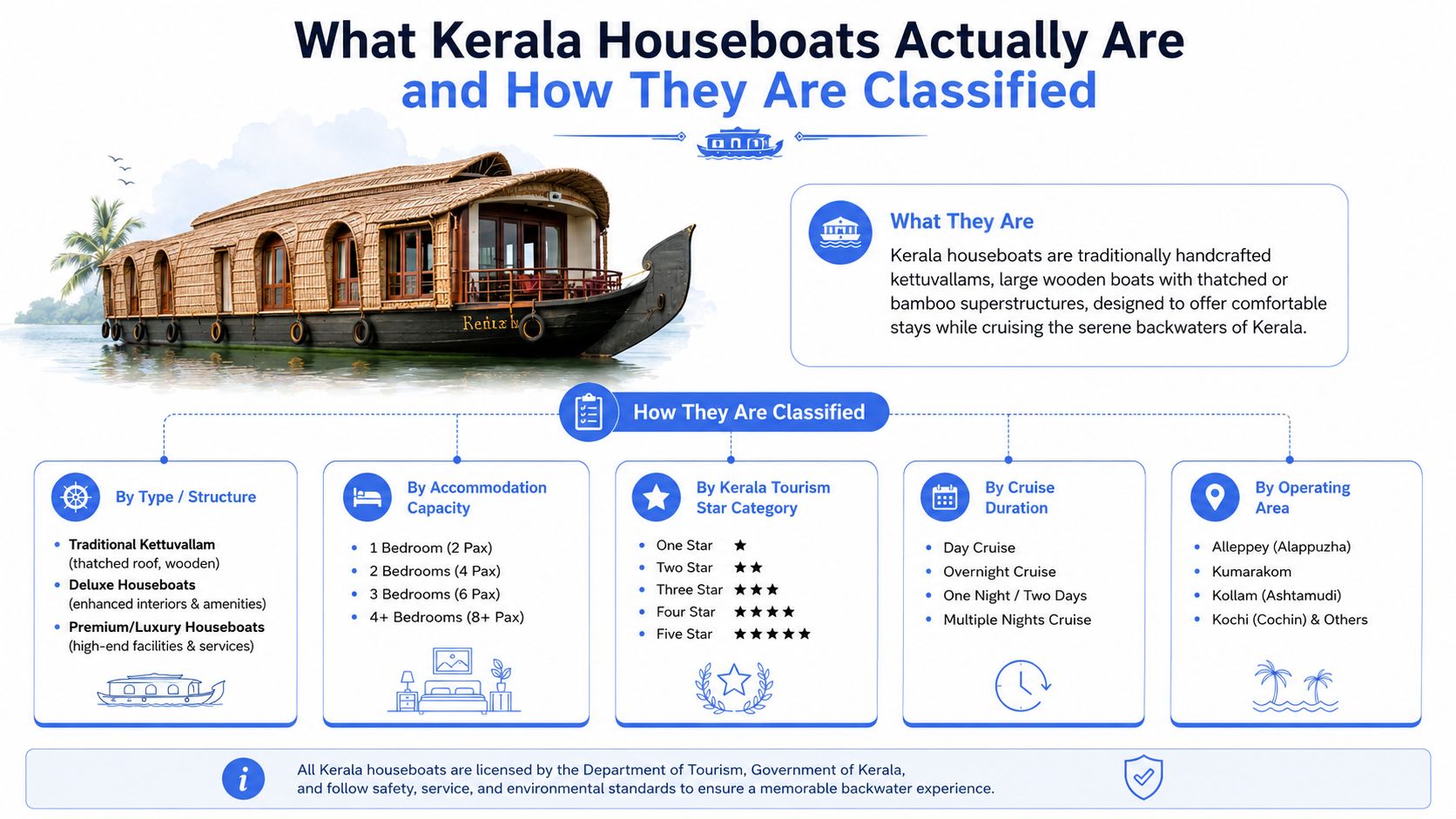
What Kerala Houseboats Actually Are and How They Are Classified
Kerala's houseboats began as kettuvallams, cargo vessels that moved rice and merchandise through the backwaters, and one academic source notes that a standard kettuvallam could carry about 30 tons of merchandise. That origin still matters. The long, low shape isn't ornamental, it's functional, built for shallow channels, narrow turns, and calm stability on water that's beautiful but not forgiving. Reference URL
Kerala Tourism classifies tourist houseboats into platinum, gold, and silver categories, and that label should mean something concrete, not just a shiny word on a flyer. Platinum usually signals a more polished onboard experience, better finishes, and stronger attention to guest comfort. Gold is often solid but less refined. Silver is functional, sometimes charming, but you should expect less consistency. The important thing is to ask what the classification covers, because labels are only useful when they map to real standards.
Read the hull, not just the brochure
Traditional kettuvallams were typically about 60 to 70 feet long and 13 to 15 feet wide, while newer luxury versions can exceed 80 feet in length. That geometry creates a very specific onboard feel. The hull is narrow enough to move through backwater channels without fuss, but the layout has to be managed carefully so the bedrooms, living area, kitchen, and toilets don't throw the boat off balance. Reference URL
That's why a luxury houseboat feels calm when it's done well and cramped when it isn't. You're not buying a floating hotel room in the abstract. You're buying a small engineering project that has to stay level, dry, and comfortable while moving through tight waterways.
A simple way to judge an operator's sheet
Look for these questions in the listing, or ask them directly:
- How is the boat classified? Platinum, gold, or silver should be stated clearly.
- What's the actual cabin layout? A beautiful exterior means nothing if the sleeping space is awkward.
- How new is the build or refurbishment? Fresh interiors usually matter more than photos.
- How does the boat manage weight? On a narrow hull, poor distribution affects comfort.
- What's included onboard? The answer should be concrete, not vague.
Choosing the Right Backwater Route for Your Traveler Style
Route choice beats boat choice more often than people expect. A beautiful vessel on a busy, overworked stretch can feel less special than a simpler boat on a quieter route with better light and better spacing. That's why I never start with “What boat do you want?” I start with “What kind of water experience do you want?”
Alappuzha is the classic option, and there's a reason it stays popular. It's the most famous gateway, it's straightforward to combine with broader Kerala travel, and it works well for first-timers who want the backwaters without too much logistical fuss. Kumarakom and Vembanad lean more toward clients who want a smoother, more polished feel. Kollam and the quieter canal networks suit travelers who care more about atmosphere than seeing the most photographed stretch. If you're combining the backwaters with a heritage stay in Cochin, I usually recommend planning around transfer convenience instead of chasing the most obvious headline route.
| Kerala Backwater Routes Compared | Best For | Scenery | Typical Duration |
|---|---|---|---|
| Alappuzha | First-timers, honeymooners, travelers who want the classic route | Busy, iconic, highly recognizable backwater views | Overnight or two nights |
| Kumarakom | Luxury travelers, couples, clients who want a calmer pace | Wider lake views and a more relaxed feel | Overnight or two nights |
| Vembanad | Premium travelers who care about open water and space | Broad water, houseboat traffic, and long horizon lines | Overnight or extended stay |
| Kollam and quieter canals | Slow travelers, photographers, repeat visitors | Less commercial, more intimate, more local texture | Day trip or overnight |
Match the route to the traveler, not the trend
Honeymooners usually want privacy, silence, and a sense of soft exclusivity. Kumarakom or a less congested Vembanad itinerary is usually the better call. Multi-generational families need space and predictable movement, which pushes me toward a route that minimizes fiddly transfers and dock chaos. Photographers want early light and less traffic on the water, so a quieter canal network often beats the classic route, even if the boat itself is less theatrical.
The best route is the one that changes the tempo of your trip, not just the scenery outside the window.
Busy professionals are a different story. They often have limited time and low tolerance for wasted movement. For them, I prefer a route that can be paired cleanly with Cochin arrivals and departures, because one smart transfer can save the whole experience from feeling rushed.
Sample One Night and Two Night Houseboat Itineraries
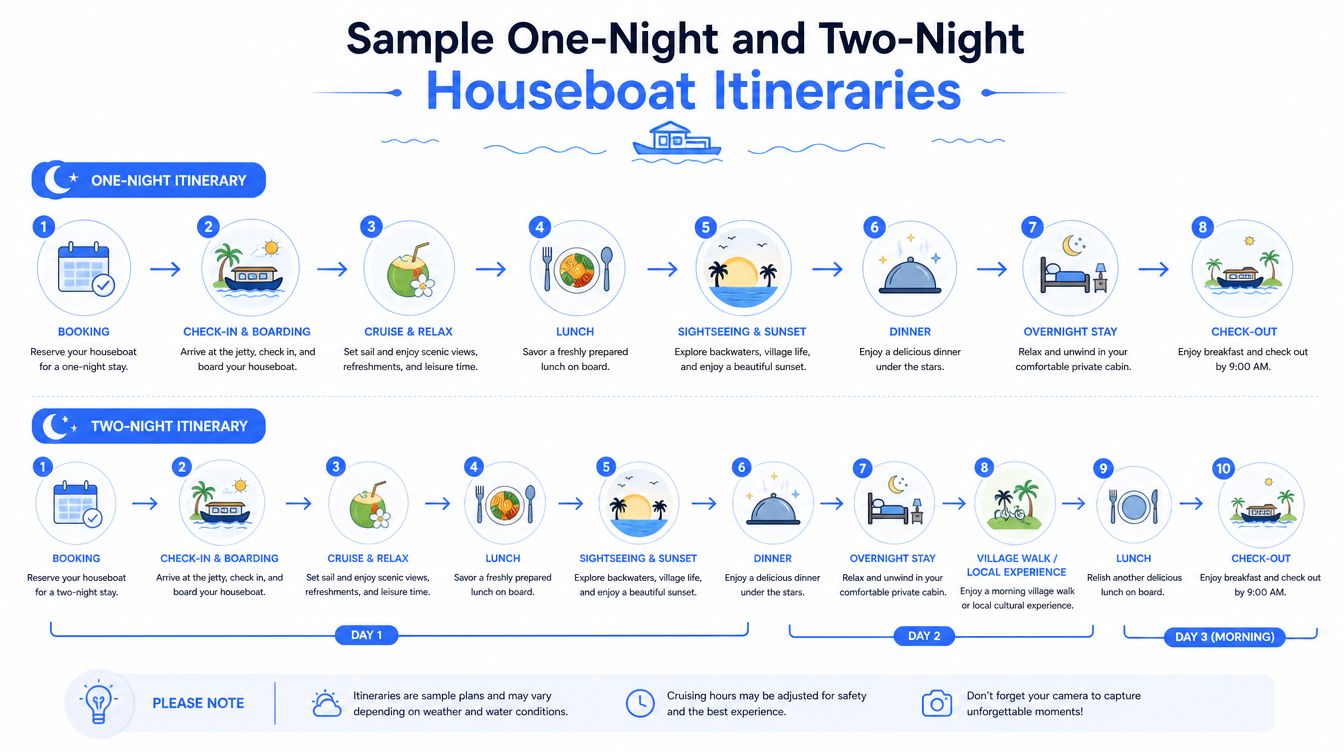
A one-night cruise should feel tight, smooth, and unhurried, not packed with forced activities. Most good itineraries board in the late morning, serve lunch on the water, drift through wider stretches in the afternoon, then settle into a quieter anchorage before dinner. The boat should feel less like a moving attraction and more like a private room that happens to glide.
What a one-night cruise should feel like
On a strong one-night itinerary, boarding is efficient, lunch arrives after you've settled in, and the afternoon is spent watching village life, palms, and narrow canals slide by at an easy pace. After dusk, the boat anchors, because the point is to sleep on still water, not keep moving all night. The morning should be simple, with tea, breakfast, and a gentle return to shore without any dramatic rush.
This is the right choice for clients who want the experience, but don't want to devote too much of the Kerala trip to it. It's also the safer option if your schedule is packed with flights, a Cochin stay, or a post-cruise transfer to the hills.
Why two nights feels completely different
Two nights changes the emotional rhythm. The first day introduces the water, the second day lets the quiet settle in, and by the final morning you're not just sightseeing, you're fully in the pace of the backwaters. That's why I prefer two nights for honeymooners or travelers who want genuine stillness rather than a checklist cruise.
A two-night booking also gives you breathing room if you care about small things, lighting, a better deck moment, a slower meal, or a more flexible village stop. It's the difference between sampling the backwaters and inhabiting them for a short stretch. If your next slow journey will center on food rather than waterways, my guide to Mendoza wine travel offers a different approach.
What to Expect On Board and Where Standards Vary
The onboard experience is more practical than romantic travel brochures make it sound. Good boats feel airy, organized, and calm. Weak ones feel improvised, even if the photos were flawless. The difference usually shows up in cabin layout, crew rhythm, meal service, and how seriously the operator treats safety and compliance.
Kerala Tourism's houseboat regulations set minimum internal space thresholds of 80 square feet for bedrooms and living or dining areas, 20 square feet for kitchens, 20 square feet for attached toilets, and 3-foot-wide passages. They also require at least 2 lifebuoys and 5 fire buckets on a houseboat. Those numbers are useful because they tell you what basic comfort and safety should look like before anyone starts selling “luxury.” Reference URL
What good comfort actually looks like
On a well-run boat, the cabin doesn't feel squeezed, the bathroom doesn't feel like a compromise, and the deck has enough room for real sitting rather than decorative standing. The crew is usually small and efficient, and guests should know who is cooking, who is handling the boat, and who is on deck if something needs attention. That's not overengineering, it's the kind of clarity that keeps a trip smooth.
Ask how the kitchen is separated from fuel storage. If the answer is vague, move on.
Traditional materials matter too. Kerala's classic builds use anjili or jackfruit wood, tied with coir, bamboo, and palm or coconut-fiber components, with cashew-shell resin as a protective coating. Those choices are not quaint decorations, they're part of why the structure suits freshwater exposure and slow travel so well. The regulations also require fire-proof materials and separation of fuel storage from the kitchen, which is exactly the kind of detail a serious traveler should care about. Reference URL
If you care about a culturally rooted experience beyond just the boat ride, a broader itinerary matters. Cultural immersion travel is usually what turns a pretty transfer into a meaningful trip.
Where operator standards differ most
The biggest variation isn't in the view, it's in the execution. One boat might have polished cabins but weak food service. Another might look slightly older but run with far better discipline. I'd rather book the second boat if the paperwork is right and the crew is sharp.
The clearest signs of quality are boring ones, which is exactly why they matter. Clean bedding, consistent AC where promised, tidy storage, sensible deck space, and crew who answer questions directly are all better indicators than a glamorous exterior shot.
Sustainability and the Real Environmental Trade Off
The hardest question in this market is also the most honest one. Does luxury houseboat demand protect the backwaters, or does it strain them? The answer is uncomfortable. On heavily used stretches like Vembanad and Alappuzha, the evidence points to pressure, not balance, and travelers should stop pretending the word “eco” solves that problem by itself. Research repeatedly links houseboat operations to sewage and solid-waste discharge, plastic pollution, declining water quality, fish losses, and ecological stress, while also noting that the most used products remain concentrated in houseboats rather than more diversified boat formats. Reference URL
The carrying-capacity gap matters too. If the recreational capacity of the lake is around 262 houseboats and the actual fleet runs far beyond that, then some of the damage is built into the market structure, not just the behavior of one operator. Add the reported compliance gaps, including boats without valid insurance or pollution-control consent, and you get a clear picture. This is not a place to shop by vibe alone. Reference URL
What responsible luxury looks like here
The better operators tend to invest in practical systems, things like waste handling, quieter operation, and cleaner onboard practices. Ask direct questions. Where does the sewage go? How is trash managed? Is the operator willing to show pollution-control consent? If the answer feels evasive, that's your answer.
You can also make your own footprint lighter by packing smarter. For travelers who care about reducing single-use plastic on board, HYDAWAY eco friendly travel gear is a useful place to start. Simple habits matter more than branding when you're on a sensitive waterway.
Luxury doesn't earn an environmental exemption. It should raise the standard.
For me, the most convincing sign of a better houseboat experience is not a louder promise of sustainability. It's a quieter route, a cleaner boat, fewer empty claims, and a crew that can explain exactly how they manage waste and safety.
Costs, Best Seasons, and the Case for Booking Through an Advisor
Prices vary by class, route, and how polished the operation is, so I'm not going to pretend there's one clean number that fits all. Platinum usually sits above gold, and gold sits above silver, but the primary cost driver is the overall standard of the boat, the length of the cruise, and the level of privacy you want. If you're comparing options, compare what's included, not just the headline rate.
Season also changes the experience. I prefer the shoulder windows, especially October and November, and February, because they often give the best balance of weather, water level, and crowd levels. Monsoon can work for travelers who like rain and don't mind a softer, moodier trip, but it's not the default choice for anyone who wants the neatest version of this product.
Why an advisor adds value here
A good advisor isn't selling romance, they're removing friction. That starts with checking licensing, insurance, and pollution-control papers before anything is confirmed. It continues with transfer planning from Cochin, because a badly timed drive can wreck the mood before you even step on board.
The logistics get even more useful if you pair the houseboat with a Cochin heritage stay or a Munnar tea-country extension. That combination works because it gives Kerala's backwaters a proper role inside the trip rather than treating them like an isolated overnight add-on. For travelers who like curated, end-to-end planning, Bespoke travel experiences are usually where the value becomes obvious.
If you want to understand how resort and hotel booking workflows can influence planning quality, Splash Access reservation insights is a useful read on how structured reservations improve clarity and control. The same principle applies here. Clean systems produce cleaner trips.
Planning Your Kerala Backwater Trip
Start with five questions, class of boat, route, duration, season, and sustainability signals. Then add the one people forget, how the trip fits into the rest of Kerala without wasting time on transfers or low-value stopovers. Safety conditions can change anywhere, so stay aware of your surroundings, check official guidance, and remember that vetted local partners support service quality, not perfect certainty. If you want the whole journey handled with care, tour for South India is the kind of planning that keeps the trip coherent from airport arrival to final transfer.
If you want a Kerala houseboat trip designed with actual judgment, not just pretty photos, Explore Effortlessly can plan the route, class, and transfers around the kind of trip you actually want. I'll help you choose the right boat, avoid weak operators, and shape the backwaters into a polished luxury journey, not a guessing game.