You are looking at China with a private guide in Beijing, a top suite in Shanghai, perhaps a few nights in Yunnan or along the Li River. On paper, it sounds effortless. In practice, one weak hotel choice, a badly timed transfer, or an overstuffed route can turn a high-value trip into a tiring exercise in logistics.
That is why China rewards expert planning more than almost any other major destination.
It is a vast, fast-moving country with exceptional range. Imperial history, cutting-edge design, world-class hotels, high-speed rail, rare cultural access, and dramatic natural scenery can all fit into one journey. They should not be forced into one rushed itinerary. A strong plan comes down to judgment. Where to linger. What to skip. Which sites deserve private guiding, early access, or upgraded transport, and which are not worth premium time.
China also operates at enormous scale, with mature infrastructure and intense visitor volume across its best-known cities and monuments. For a luxury traveler, that matters. You are not planning around whether there is enough to do. You are planning around how to experience the country well, without wasted motion, crowd-heavy scheduling, or generic routing.
Start with the feel of the trip. Do you want privacy, cultural depth, architectural polish, soft adventure, or a city-focused rhythm with first-rate dining and shopping? That decision should shape every choice that follows, from arrival city to length of stay to how many regions belong in a single journey.
The strongest China itineraries are edited, well-paced, and built around access. They avoid the amateur mistake of trying to cover everything once. They focus on comfort, timing, and a trip that runs smoothly from the moment you land.
Introduction Your Gateway to an Extraordinary China
China intimidates people for good reason. It's a country of monumental scale, dense history, and logistics that can feel opaque if you're trying to coordinate it alone. A trip that looks elegant on paper can become clumsy in reality if hotel locations are wrong, transfers are poorly timed, or major sites are slotted into the busiest possible days.
Luxury travel in China isn't about spending more for the sake of it. It's about removing friction.
That means choosing the right arrival city. It means understanding which headline sites deserve private guiding and which don't. It means knowing when to use high-speed rail, when to fly, and when a private car is the only sensible answer. It also means resisting the default Beijing, Shanghai, Xi'an checklist if that route doesn't match your style.
Start with timing, not landmarks
One of the smartest planning shifts in China is adopting the logic of reverse travel. Recent coverage describes it as a growing trend among Chinese tourists who deliberately seek lesser-known destinations to escape holiday crowds, as noted in this article on reverse travel in China. For a luxury traveler, that's not a trend piece. It's a strategy.
If your goal is exclusivity, comfort, and a better on-the-ground experience, you shouldn't automatically follow the standard first-timer route in peak periods. You should plan around quieter windows, stronger hotel positioning, and alternative stops that still deliver cultural depth.
Advisor rule: In China, the most luxurious itinerary is rarely the one with the most stops. It's the one with the cleanest flow.
What a well-planned trip changes
A carefully designed trip to China does three things:
- Reduces decision fatigue: Your days aren't spent solving transport, ticketing, and timing problems in real time.
- Protects your energy: You avoid overland schlepping, poorly placed hotels, and unnecessary airport chaos.
- Improves access: Major sites, premium guides, and strong drivers matter more here than people expect.
China can absolutely feel smooth. It just doesn't happen by accident.
Charting Your Course When to Go and What to Expect
You arrive in Beijing during a major holiday week, spend half the day in traffic, and discover the site entry times you wanted are gone. That is what happens when China is planned around dates that suit your calendar instead of dates that protect your experience.
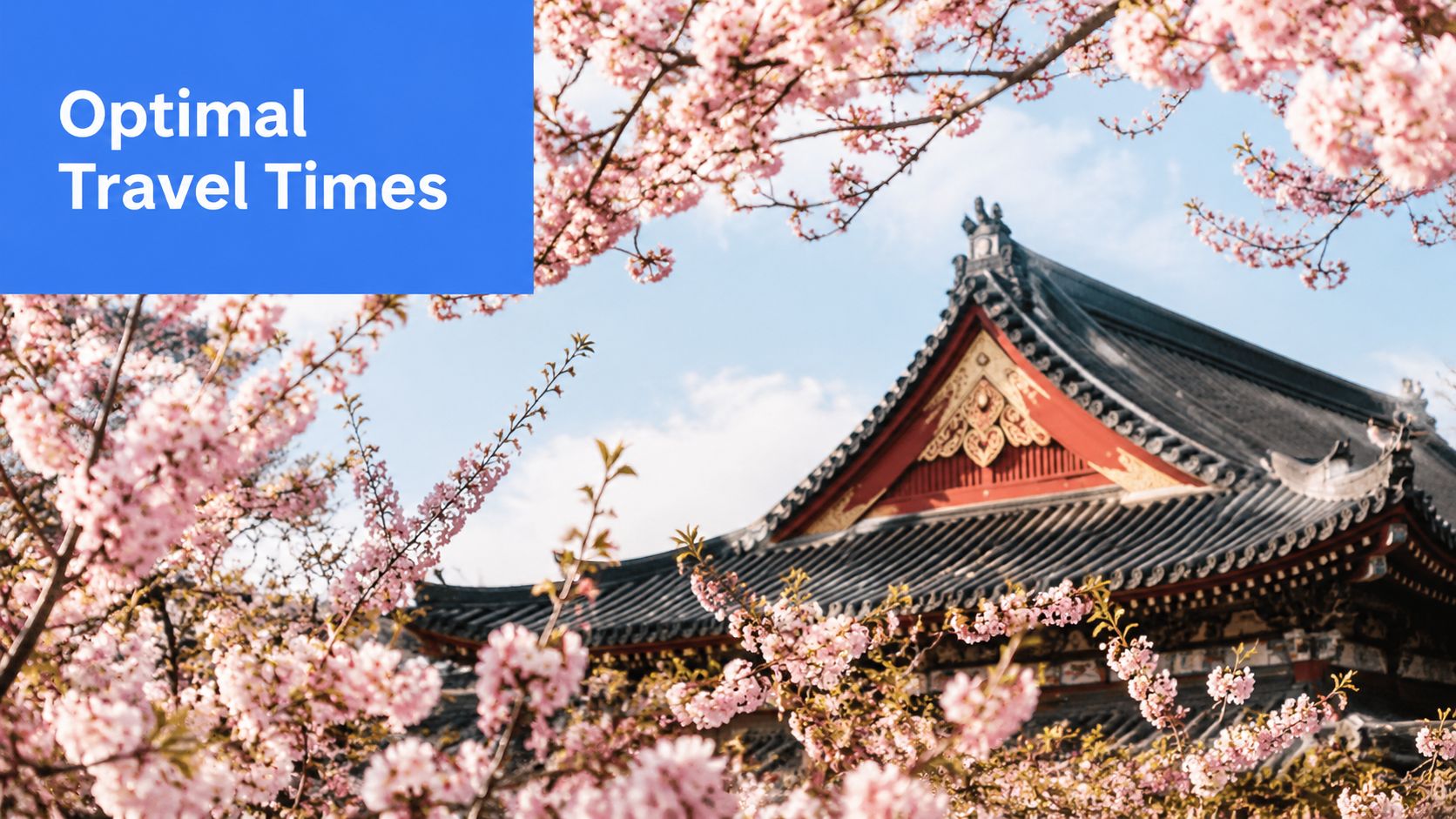
For a luxury trip, timing comes first. China is too large, too popular, and too logistically demanding for a casual approach. The right season depends on what you want to feel on the ground: crisp walking weather in historic cities, clear mountain views, lighter crowd pressure, or a warmer coastal escape. In most cases, spring and autumn deliver the best balance of comfort, pacing, and access.
Choose your season by experience
I advise clients to stop asking for the single best month for China. That question is too broad to be useful. Ask which version of China you want.
| Travel style | Best fit |
|---|---|
| History lover | Beijing and Xi'an in spring or autumn, when long walking days still feel comfortable |
| Urban explorer | Shanghai, Shenzhen, and Hong Kong outside major public holiday peaks, with strong dining and hotel access |
| Nature seeker | Guilin, Zhangjiajie, and Yunnan in shoulder seasons for better scenery, softer pacing, and fewer tour bottlenecks |
| Balanced first trip | One heritage city plus one modern or scenic destination, planned in a single weather-friendly window |
That last option is usually the right call. A well-paced first trip feels polished. A rushed cross-country circuit feels expensive and tiring.
What to avoid if you care about comfort
China rewards precision and punishes sloppy timing. The worst mistakes are easy to spot. National holiday periods. Overambitious routing. Iconic sites scheduled at the most obvious hours. Hotels chosen for points instead of position.
Flagship attractions are busy year-round, and peak domestic travel periods can turn even top-tier plans into a grind. If you want the Great Wall, the Forbidden City, or major river and mountain destinations at their best, protect the trip with early booking, private guiding, and carefully timed entries. Privacy in China is rarely accidental.
International air planning matters too. If you are comparing gateways, reducing connection stress, and trying to arrive with your energy intact, this resource on INVOLUNTARY REROUTE flight timing is a smart starting point before the rest of the itinerary is fixed.
What to expect on the ground
Expect scale. Expect movement. Expect some of the world's most memorable cultural and visual experiences, provided the trip is structured properly.
China works best when you keep your geography tight and your standards high. Pairing too many regions in one journey creates airport friction, wasted transfer days, and a trip that feels operational instead of indulgent. Clients planning a wider luxury journey through Asia do especially well when China is treated as a focused chapter, not an oversized add-on.
My recommendation is simple. Pick the season first. Limit the number of bases. Build around access, pacing, and insulation from crowds. That is how China feels refined instead of overwhelming.
China's Regions for the Luxury Traveler
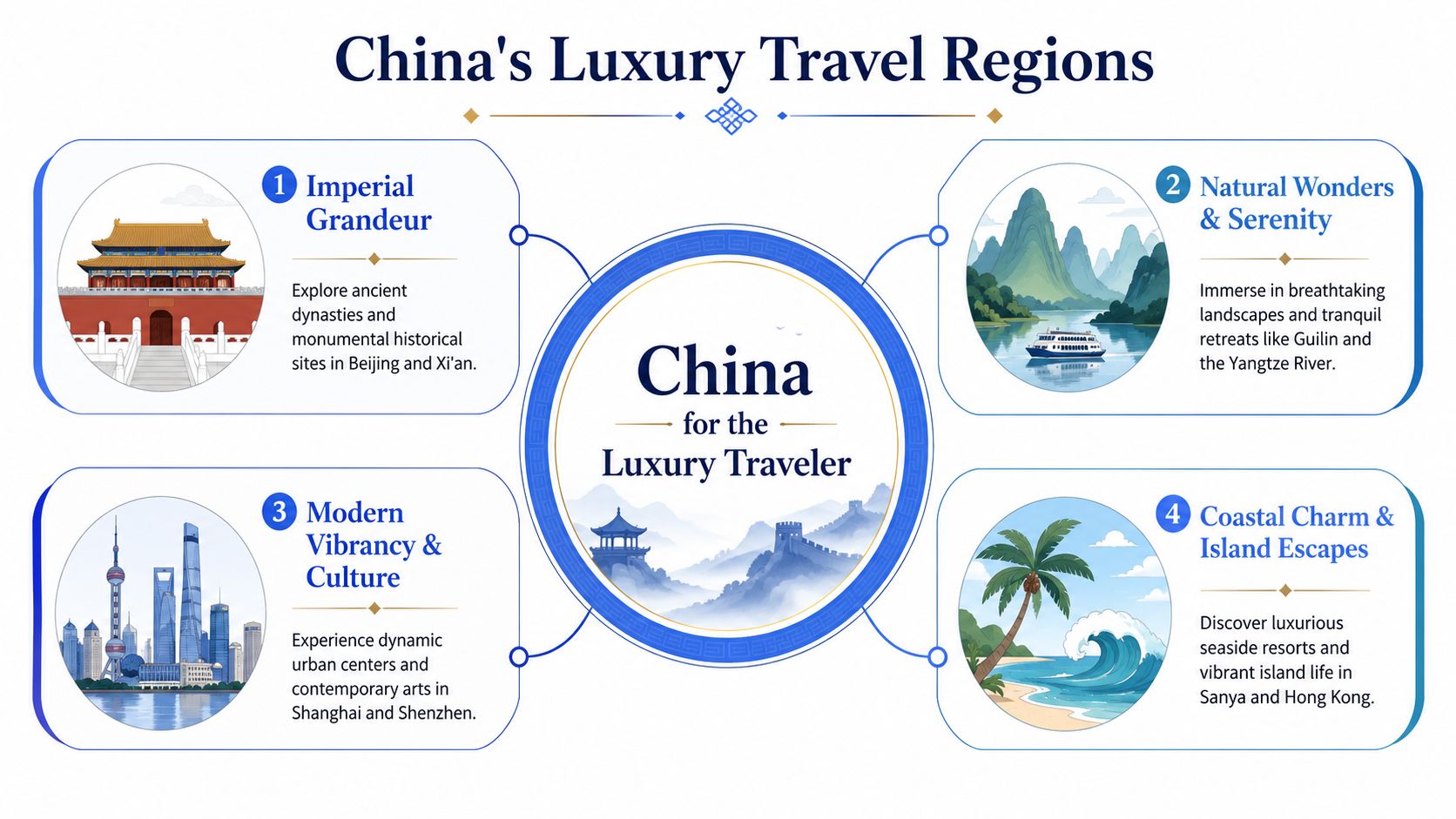
The right trip to China depends on what kind of traveler you are. I don't build China around city count. I build it around mood, interests, and tolerance for movement. That's how you end up with an itinerary that feels elegant instead of overstuffed.
A strong regional strategy also respects the country's scale. China has 59 UNESCO World Heritage Sites, and the Great Wall spans 21,196 km, according to this overview of tourism in China. You are not “covering” China on one trip. You are curating your version of it.
Imperial grandeur
This is for the traveler who wants scale, symbolism, and cultural weight. Beijing gives you imperial planning, grand avenues, courtyards, and some of the most recognizable heritage in Asia. Xi'an deepens the story with ancient walls, archaeological significance, and a more grounded historical rhythm. If imperial architecture is your favorite part of city travel, my Istanbul landmarks and luxury guide offers another destination to weigh.
The key here is insulation from chaos. You want expertly timed site visits, polished guiding, and a hotel that acts as a sanctuary after heavy sightseeing. These itineraries work best for travelers who care less about nightlife and more about context, architecture, and private access.
A good imperial route usually works because it's edited. Beijing and Xi'an together can feel thoroughly satisfying without trying to bolt on two extra cities just to say you did more.
Modern vibrancy and culture
Some clients don't want solemn heritage from morning to night. They want contemporary China. They want skyline views, design-led hotels, exceptional shopping, serious cuisine, and neighborhoods with creative energy. That's where Shanghai shines, with Shenzhen and Hong Kong working well depending on your broader route and priorities.
This version of China feels fast, glossy, and cosmopolitan. It suits clients who split their interests between culture and comfort. One day might include architecture and galleries. The next might be private shopping support, a chef-led culinary experience, or a river-facing suite where the city does the work for you.
For travelers considering a wider regional itinerary, luxury travel through Asia is often the right planning framework because China pairs especially well with other high-touch stops when the routing is coherent.
Some travelers need a history trip. Others need a city trip with cultural depth. China can do both, but they should not be planned the same way.
Natural wonders and serenity
This is the antidote to overexposure. Guilin's karst scenery, Zhangjiajie's dramatic peaks, and parts of Yunnan offer a quieter, more cinematic experience. If you've already done major global capitals and don't need another museum-heavy trip, this is often the better use of your time.
These itineraries reward slower pacing. You trade monument density for atmosphere. Scenic cruising, mountain views, minority culture, tea, walking, and retreat-style hotels all come into play. The luxury here is not only in the room category. It's in the pace.
Travelers who choose this lane usually come back saying China felt far more peaceful than they expected. That's because they weren't trying to outmaneuver the crowds every day.
Coastal charm and island escapes
For some travelers, especially those layering business, family time, or a broader Asia itinerary, coastal and island combinations make more sense than an inland-heavy route. Hong Kong can work as a polished gateway. Sanya can appeal to travelers who want rest built into the trip rather than tacked on at the end.
This category works well for clients who want China but don't want the entire journey to feel intensely structured. Done well, it softens the edges.
Sample Bespoke Itineraries Crafted for You
A bespoke trip to China should never read like a template with nicer hotels. It should solve for a specific traveler, a specific pace, and a specific definition of luxury. Here's what that looks like in practice.

The honeymoon that feels private
For a couple, I'd keep the emotional arc in mind. Start with Beijing for gravitas, major heritage, and a few unforgettable private experiences. Then leave the intensity behind and move into Guilin or the Li River region for scenery, suite time, and romantic breathing room.
This pairing works because it gives you contrast. You get the grandeur people dream about when they think of China, then you pivot into beauty and calm. The trip ends feeling soft, not depleted.
The family itinerary that doesn't exhaust everyone
Family travel in China only works if the days are properly balanced. Adults may want historic depth. Children need motion, interaction, and meals that don't become a daily negotiation. Xi'an tends to work well here, especially when cultural experiences are active rather than passive.
A strong family route often includes:
- Interactive culture: Hands-on experiences such as dumpling-making or movement-based activities
- Managed transit: Private transfers so luggage and timing never become the story
- Suite strategy: Hotels with enough space to reset after full sightseeing days
- Pacing discipline: No stacking of marquee sites back to back just because they're famous
The solo journey with style and structure
Discerning solo travelers often want access without feeling over-managed. Shanghai is especially strong for this, particularly when paired with a second destination that shifts the emotional tone. Think modern art, architecture, tea, wellness, and one-on-one guiding that leaves room for independent time.
The point isn't constant escorting. It's selective support. Private transfers, excellent hotel positioning, and curated cultural moments create freedom because the framework is secure.
Practical rule: Solo luxury travel works best when the invisible details are overplanned so the visible experience feels spontaneous.
The multi-city discovery done properly
Some travelers do want Beijing, Shanghai, and Chengdu or another third stop. That can be excellent, but only if the logistics are disciplined. China's size punishes casual sequencing. Domestic transport has to serve the itinerary, not dominate it.
High-speed rail is often the smartest option between certain city pairs because it removes airport friction and can feel more civilized door to door. In major cities, one travel guide notes that metro fares are typically about 2 to 5 CNY per ride, with trains arriving every few minutes, as described in this practical guide to getting around Chinese cities. That's helpful for understanding efficiency, but luxury planning still comes down to minimizing avoidable last-mile hassle.
Traveler content also repeatedly highlights the need for pre-trip setup such as travel insurance, eSIMs, and digital payment readiness, which is why a serious planner builds a travel-ready checklist before departure, as noted in this China travel prep video. For a more customized, privately guided approach, see a private tour of China.
The Art of Effortless Travel Navigating China in Style
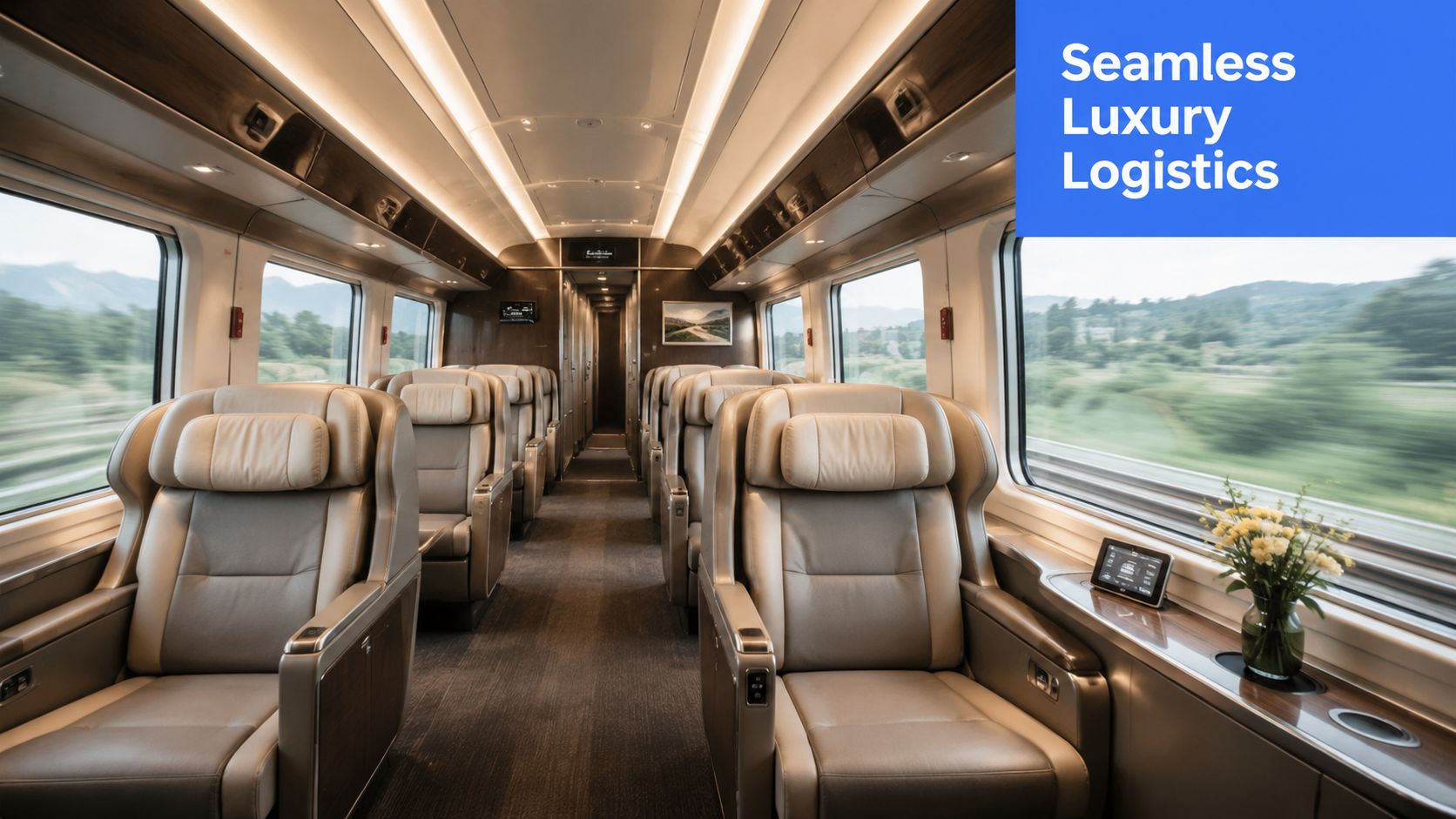
Luxury in China is mostly logistical. The car is waiting. The rail seats are right. The guide meets you at the correct entrance. You don't waste your best energy on line management, wayfinding, or trying to decipher what should have been resolved before you left home.
Choose transport by friction level
For long-haul arrival, premium cabin comfort matters because China itineraries often begin with immediate movement. If you land tired and then ask your body to handle major sightseeing or a same-day domestic connection, the whole first phase of the trip suffers.
Inside China, I'd think about transport in layers:
| Option | Best use | Main advantage |
|---|---|---|
| Business or premium international air | Long-haul arrival and departure | Better recovery and less fatigue |
| High-speed rail | Major city pairs with efficient station access | Smooth, punctual, less airport friction |
| Private car and driver | Every city stay | Control, comfort, and easy transitions |
| Private air arrangements | Complex or highly customized routes | Time savings on select itineraries |
Private cars are essential for high-end travel here. I don't say that lightly. They're what keeps the trip from becoming operationally messy.
Pack for movement, not just aesthetics
China trips can involve multiple hotel changes, station transfers, and highly worthwhile days that still require practical gear. A smart wardrobe matters, but so does intelligent luggage. If you're refining your packing setup before a multi-stop itinerary, this guide to approved carry on bags is a useful starting point for choosing luggage that won't complicate rail and air transfers.
Shorter, more mobile packing makes a noticeable difference when you're moving through large stations, urban hotel arrivals, and quick turnarounds.
Why pre-planning wins
China's scale makes on-the-fly travel less charming than people imagine. As noted earlier, the country's heritage footprint is massive, and logistics need to match that scale. Good planning means:
- Hotels near the right nodes: Not just a beautiful property, but a useful one
- Realistic day design: No fantasy routing that looks fine on a map and fails in traffic
- Correct transfer buffers: Enough margin without dead time
- Right-fit guiding: Strong enough to enrich the destination, restrained enough not to overtalk it
A luxury trip feels effortless only because someone worked very hard before you boarded the plane.
Staying Connected Prepared and Secure
Most travelers underestimate the digital side of a trip to China. That's a mistake because modern friction in China is often technological, not scenic. If your connectivity, payment setup, email access, or authentication tools aren't sorted before departure, the trip can start with avoidable headaches.
Set up your digital life before takeoff
A university travel advisory recommends setting up VPN access before departure because downloading or configuring it in-country may not be possible, and it also advises backup email access and two-factor authentication workarounds in advance, according to this China technology advisory. This is not optional for travelers who rely on familiar work tools, cloud platforms, or standard communication apps.
You should also prepare for a highly digitized payment environment. That means getting comfortable with mobile payment workflows and arriving with backup methods in place rather than assuming your usual habits will transfer smoothly.
For travelers comparing options for seamless connectivity for China travel, it's worth reviewing eSIM planning well before departure so your phone is functional as soon as you land.
Use common sense on safety and support
China should be approached with the same disciplined awareness you'd use anywhere else. Safety conditions can change, and travelers should check official government advisories and local guidance before departure. Situational awareness still matters, even on highly curated trips.
What helps is structure. Vetted drivers, polished guides, strong hotels, and clear pre-arranged logistics reduce uncertainty. They do not eliminate risk, but they do reduce unnecessary exposure to confusion and poor decision-making.
The clients who enjoy China most do one thing right
They prepare before they go.
Not obsessively. Just intelligently. They have connectivity handled, backup access sorted, payment tools considered, and realistic expectations about how digitally different the experience can feel on arrival. That preparation protects the trip.
The Explore Effortlessly Difference Your Bespoke China Journey
A luxury trip to China needs more than hotel suggestions. It needs curation, sequencing, and judgment. That's where working with a dedicated advisor changes the experience.
The process is straightforward. It starts with a consultation to define the trip properly. Not just where you want to go, but how you want it to feel. Then the itinerary is built around your pace, your priorities, and the practical realities of moving well through China. Flights, hotels, private transfers, guides, and touring are coordinated as one connected experience, not as separate bookings hoping to cooperate.
Clients also benefit from preferred partner perks and VIP amenities at select luxury hotels, along with trusted in-destination partners who support on-the-ground delivery while the itinerary and logistics are handled before departure. If you want a fully customized planning process, start with bespoke travel experiences.
Karrah is a Circle of Excellence Advisor. Top 5 percent at Nexion, and a CLIA Accredited Cruise Counselor. She works with clients nationwide through virtual consultations.
The best China trips aren't just beautiful. They're composed.
Author bio
Hi, I'm Karrah, owner, founder, and lead travel advisor at Explore Effortlessly, a luxury award winning travel agency based in Miami.
I specialize in designing bespoke, high touch itineraries to bucket list destinations around the world. Every trip is curated with intention, insight, and smooth logistics from start to finish.
From luxury cruises and private villas to honeymoons, safaris, and once in a lifetime journeys, my role is to simplify the planning process while elevating every detail.
Frequently Asked Questions About a Luxury Trip to China
How far in advance should I plan a luxury trip to China
Earlier is better, especially if you want strong suites, premium flight options, and preferred timing at major sites. China is a high-planning destination, and the best itineraries depend on getting the sequence right before availability tightens.
Do I need private guides in every city
Not always, but you do need them where context and navigation materially improve the experience. In Beijing and Xi'an, private guiding is usually worth it. In more relaxed destinations, you may prefer a lighter touch.
Is high-speed rail actually comfortable for luxury travelers
Yes, on the right routes. It can be one of the most efficient and civilized ways to move between major cities, especially when station transfers are handled well and your seats are booked in the appropriate cabin.
Should I try to see Beijing, Shanghai, Xi'an, and more on my first trip
Usually not. Most first-time travelers enjoy China more when they focus on fewer regions and travel at a measured pace. You will remember the quality of the experience more than the number of pins on the map.
Are luxury hotels in China at an international standard
Yes, in the right cities and with the right selection. The key is choosing hotels for service, location, room category, and how they fit the rhythm of your itinerary, not just for brand recognition.
What is the biggest mistake travelers make
They underestimate the operational side of the trip. Bad timing, too many stops, weak hotel locations, and poor digital preparation can drain the experience quickly.
If you're ready for a China itinerary that feels polished from the first flight to the final transfer, plan my luxury trip with Explore Effortlessly. For more destination insight and travel inspiration, join the newsletter through Explore Effortlessly's mailing list.