You're probably staring at a notes app full of cities that sound fabulous together and chaotic in practice. Tokyo. Kyoto. Bangkok. Singapore. Bali. Maybe Vietnam. Maybe Bhutan. Then reality hits. Flight paths don't line up neatly, weather windows clash, visa rules change, and a trip that looked glamorous on Instagram starts to resemble a project plan.
That's exactly why travel through asia should be designed as a flow, not a checklist. The best journeys across Asia aren't the ones with the most stops. They're the ones where every transfer makes sense, every hotel suits the rhythm of the trip, and every destination earns its place.
For high-net-worth travelers, luxury isn't only the suite or the private guide. It's the absence of friction. No wasted nights in transit. No poorly timed monsoon detours. No landing in a new country only to discover your mobile plan doesn't work and your transfer instructions are buried in an inbox.
Key takeaways
- Start with routing, not bucket lists. The smartest Asia itineraries are built around geography, seasonality, and flight logic.
- Timing matters more than people think. Cherry blossom demand, holiday periods, and regional weather patterns can reshape the entire trip.
- Connectivity is not a minor detail. In multi-country Asia travel, the wrong mobile setup creates immediate friction.
- Overland luxury is underrated. High-speed rail and private car transfers often beat another short-haul flight.
- The right accommodation changes the pace. A city hotel, ryokan, villa, and wellness retreat each serve a different purpose.
- Safety planning should be quiet but deliberate. That means vetted drivers, trusted local partners, and sensible routing.
- Professional planning pays off most on complex trips. Asia rewards precision.
The Art of Timing Your Multi-Country Asia Itinerary
Multi-country Asia trips fail when travelers treat the region as one season, one flight grid, and one pace. It isn't. Japan in spring behaves differently from Thailand in late summer. Bali asks for a different rhythm than Tokyo. Vietnam changes character from north to south.

The demand side is only getting more intense. Eastern Asia and Southeast Asia are projected to command 31.7% of global international travel demand in early 2026, and Japan's search velocity is projected to rise by 25 to 30% in Q1 due to cherry blossom seasonality, according to Mabrian's early 2026 travel demand outlook. If you want a polished spring itinerary through Japan and onward into Southeast Asia, last-minute planning is a bad strategy.
Route by climate, not by wish list
I'm opinionated about this. Don't start by saying, “We want Japan, Thailand, Vietnam, and Bali in two weeks.” Start by asking what weather pattern you want to follow.
That approach changes everything. A strong route might begin in Japan during a major seasonal draw, then move south into a city-and-island sequence where the climate supports slower days and fewer weather disruptions. Another trip might skip a famous stop entirely because it compromises the whole flow.
For travelers who want extra nuance on northern China and shoulder-season planning, this guide on when to visit China in 2026 is useful background reading before you lock dates.
Practical rule: If one stop forces three awkward flight connections, a rushed border day, and weather compromises at the next destination, cut it.
Pace matters as much as season
Busy professionals often underestimate transit fatigue. Asia looks compact on a map. In reality, airport transfers, immigration, lounge time, and late arrivals can eat an entire day.
I prefer itineraries with a clear cadence:
- Begin strong: Start in a major gateway where you can land, reset, and settle into the time zone.
- Build complexity in the middle: Add cultural touring, regional flights, or overland moves once you're already in rhythm.
- End soft: Finish with a beach resort, wellness retreat, or villa stay rather than another urban sprint.
That last choice is where many luxury travelers get it wrong. They put the most restorative part of the trip in the middle, then end with one more city because it seemed efficient on paper. It rarely feels efficient in real life.
Timing windows worth respecting
Some travel periods deserve special handling because they drive availability pressure, crowding, and pricing.
| Travel moment | Why it matters | Smart move |
|---|---|---|
| Cherry blossom season in Japan | Demand surges and premium inventory tightens | Lock hotels and top dining early |
| Major festival periods in Southeast Asia | Transfer times and room inventory shift fast | Build in buffer nights |
| Multi-country holiday travel windows | Regional air demand gets messy | Use fewer stops, better flights |
The best travel through asia itineraries feel effortless because they were disciplined at the planning stage. Restraint is part of luxury. A cleaner route almost always beats a more ambitious one.
Seamless Logistics Visas Health and Connectivity
Luxury travel falls apart on boring details. Not the glamorous ones. The boring ones. Entry forms, arrival timings, airport handoffs, medication storage, roaming failures, and whether the driver can reach the hotel entrance during city traffic restrictions.
Visas need sequencing, not guesswork
If you're moving through several countries, documentation should be reviewed as one chain. Entry timing in one country can affect the next segment. Passport validity, blank pages, visa lead time, and arrival airport all matter.
I don't recommend DIY-ing this across multiple tabs and assuming the details will sort themselves out. They won't. The cleanest itineraries build visa practicality into the route itself. That's especially important when one destination is more logistically specific, such as luxury package tours to Bhutan, where timing and structure matter far more than travelers expect.
Health prep should be discreet and deliberate
No one wants a lecture. They want a trip that feels easy.
That means handling the practical side in advance:
- Discuss your physician's advice early: Especially if your route includes altitude, remote areas, long touring days, or significant climate changes.
- Keep transit days realistic: A red-eye flight followed by a full-day private tour sounds efficient. It feels awful.
- Plan around your comfort level: Some clients want spa recovery days built in after long-haul arrivals. That's smart, not indulgent.
- Pack with access in mind: Medications, chargers, and travel documents shouldn't disappear into checked luggage.
A little language effort also smooths the experience. Even if you're using guides and drivers, learning a few basics before departure helps with confidence and cultural ease. This traveller's guide to Mandarin is a good example of practical prep that goes beyond sightseeing.
Poor planning turns small issues into travel-day problems. Good planning makes them invisible.
Connectivity is part of the itinerary
This one gets ignored constantly, and it shouldn't. Asia's telecommunications heterogeneity means multi-country mobile plans fail 30% more often due to incompatible network settings, while region-specific eSIM strategies can reduce downtime by 80% compared with physical SIM swaps on arrival, according to Simology's Asia travel data comparison.
That's not a tech footnote. That's the difference between stepping off a plane and having your transfer details immediately, or standing in arrivals trying to connect to weak airport Wi-Fi.
I strongly prefer destination-specific or region-specific eSIM planning over hoping one generic global plan will behave well in every country. The higher the trip value, the less tolerance there should be for digital friction.
A few hotel choices matter here too. In-city business hotels, luxury urban properties, and serious wellness resorts vary widely in how reliable their in-room connectivity feels. For clients who need to stay reachable, I plan that into the hotel mix from day one.
Navigating Asia in Style Transport and Accommodations
Most travelers overuse flights because they assume flights are automatically the premium option. They aren't. Sometimes the most elegant move is a private airport transfer and a high-speed train seat with space, calm, and no repeated security theater.

China's high-speed rail network exceeds 45,000 km, and luxury HSR bookings are seeing 30% year-over-year growth, creating more efficient links between major hubs and secondary cities that bypass airport hassle, as noted in this analysis of underused overland opportunities in Asia. That matters because the right overland segment can improve the whole trip's mood.
Choose transport by experience, not status
A private jet charter sounds glamorous. In the right scenario, it is. On every route, it isn't necessary.
This is how I think about transport choices:
- Commercial premium cabins: Best for major city pairings with strong nonstop service and sensible schedules.
- High-speed rail: Ideal for routes where station-to-station convenience beats airport process.
- Private car and driver: Non-negotiable for many arrivals, scenic day moves, and rural transitions.
- Private charters: Best reserved for time-sensitive itineraries, hard-to-reach islands, or clients who value privacy above all else.
The right answer depends on terrain, timing, and what kind of day you want to have. A three-hour rail journey with excellent service and city-center arrival can feel far more luxurious than two airport transfers and a short flight.
Match the hotel to the purpose of the stop
One of the most expensive mistakes in luxury travel through asia is choosing every property the same way. Not every stop needs the grandest hotel in the destination. It needs the right one.
| Type of stay | Best use | What it adds |
|---|---|---|
| Urban luxury hotel | Major cities like Tokyo, Singapore, Bangkok | Access, dining, polished service |
| Ryokan or heritage stay | Cultural stops in Japan or quieter regions | Texture, ritual, a sense of place |
| Private villa | Beach destinations and family travel | Space, privacy, tailored pacing |
| Wellness retreat | End-of-trip recovery or reset | Slower rhythm, spa and movement |
A city stay should shorten the distance between you and your priorities. If you're in Tokyo for dining and shopping, location matters more than bragging rights. If you're in Phuket or Bali, villa layout, service style, and privacy usually matter more than a flashy lobby.
The most expensive room in the wrong location is still the wrong room.
Don't stack too many one-night stays
People often sabotage an otherwise beautiful itinerary. They keep adding “just one night” in transit cities because it seems efficient. It isn't. It fragments the trip, increases unpacking, and weakens the sense of arrival.
For most high-end Asia itineraries, I prefer fewer bases with stronger day design around them. Move less. Arrive better. Enjoy more.
Sample Itineraries For The Discerning Traveler
The best way to understand travel through asia is to see how a route feels when it's built properly. These aren't rigid templates. They're examples of how style, logistics, and personal interests can work together instead of competing.
Travelers who want a professionally arranged version of this style of journey can explore luxury Southeast Asia tours for a more customized planning starting point.
Japan to South Korea for culture and design
Start in Tokyo. Not because it's obvious, but because it works. The city handles long-haul arrivals well when you choose the right neighborhood and keep the first day intentionally light. Think excellent dining, precise service, and enough stimulation to remind you why you came.
From there, move to Kyoto for a change in tempo. Fewer meetings, more ritual. Private guiding matters here because the city rewards context. After Kyoto, continue onward to South Korea, where Seoul delivers a sharper contemporary edge. Good hotels, strong dining, and stylish neighborhoods make it an excellent final urban chapter.
This route works for couples, food lovers, and clients who like cultural depth without sacrificing polish.
Singapore, Thailand, and Laos for contrast
This itinerary begins with order. Singapore is superb for that. You land in a place that's easy to get around, architecturally striking, and good for easing into the region.
Then shift into Thailand. The right Thai stop depends on your taste. Some travelers want Bangkok first for energy and private temple touring. Others want to go straight into a resort or yacht-based island stay and save the city for later. Both can work if the sequence is disciplined.
Finish in Laos for softness. Slower mornings, calmer streets, and space to exhale. This is an excellent route for burned-out professionals who want variety without sensory overload.
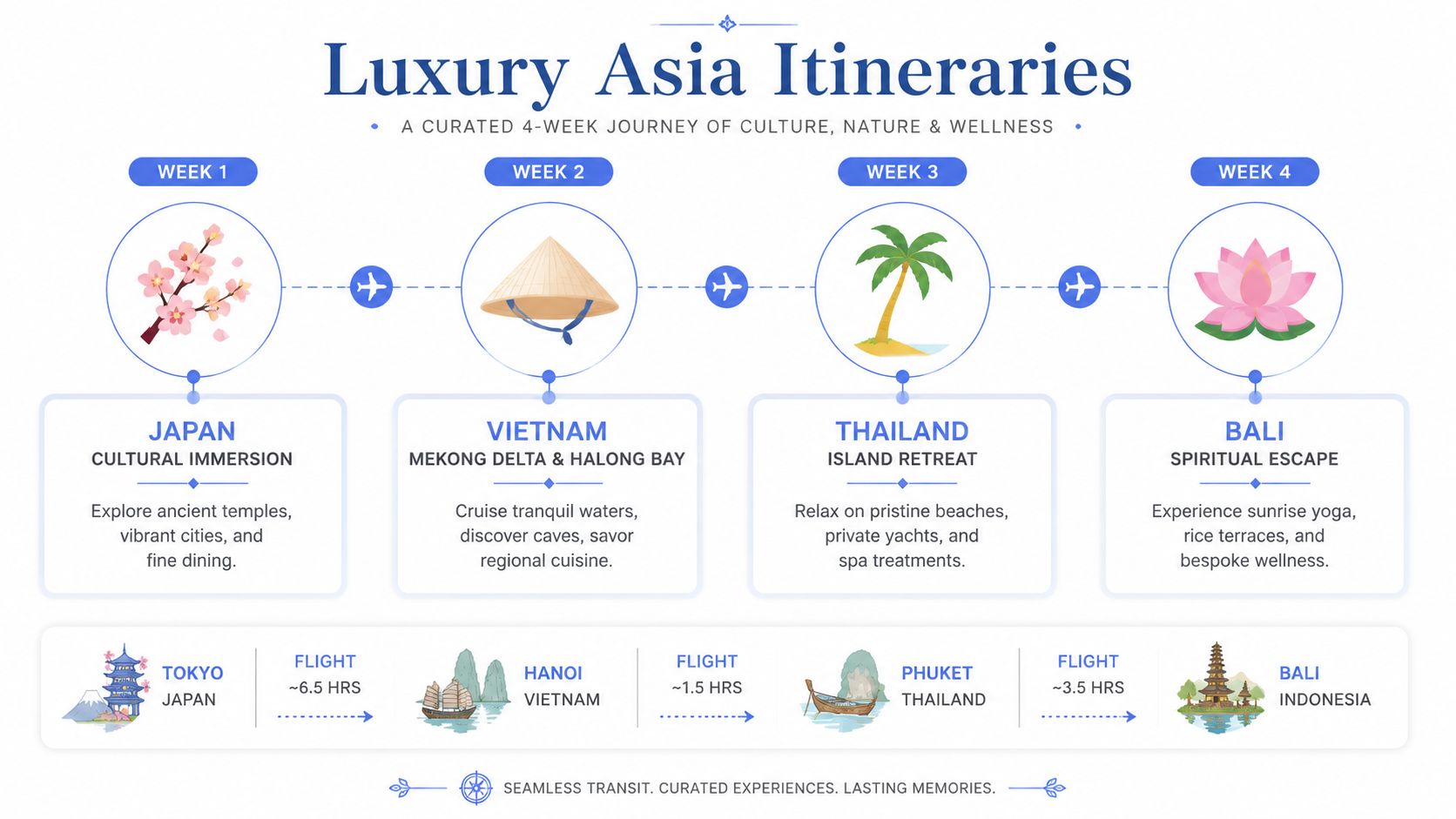
Japan, Vietnam, Thailand, and Bali for a grand arc
This is the high-impact itinerary many travelers want, and it can absolutely work if you don't overbuild it.
A good version looks like this:
- Japan first for city culture, dining, and seasonal atmosphere.
- Vietnam next for contrast. Urban energy in Hanoi or Ho Chi Minh City, then a more scenic or quieter extension.
- Thailand after that for either beach recovery or a mix of city and resort.
- Bali last for wellness, privacy, and a gentle landing before home.
This order matters. Japan asks more of your energy. Bali asks less. That's why Bali makes a strong final stop and a poor opening one for many clients.
If a four-country trip doesn't have a clear emotional arc, it will feel expensive but disjointed.
A more restrained option is often better
Some of the best itineraries only use two countries. Travelers often assume more stamps mean more value. Usually the opposite is true.
A two-country Japan and Thailand trip can feel richer than a five-stop rush through Asia because it leaves room for private guiding, meaningful meals, rest, and spontaneous adjustments. The point isn't to cover Asia. The point is to experience it well.
Beyond the Obvious Curated Experiences by Region
The difference between luxury and generic travel isn't thread count. It's access, timing, and context. A standard sightseeing day can be pleasant. A well-curated private experience can become the reason you remember the trip for years.

Japan is a perfect example. Many travelers “do” Japan by moving between famous districts and major temples. That's fine, but it barely scratches the surface. A better approach layers in quieter access, specialist guides, and accommodations that support the experience. Travelers considering a deeper cultural journey should look at luxury tours to Japan with room for private guiding and pacing that isn't rushed.
What makes an experience feel exclusive
It usually comes down to four things:
- Access: Private entries, limited-capacity visits, or hard-to-secure reservations
- Context: A guide or host who adds meaning instead of reciting facts
- Pacing: Enough time to absorb the place without being pushed along
- Fit: The experience suits the traveler rather than checking a famous box
That's why a private market visit with a culinary host can be more memorable than a heavily advertised “must-do” excursion. The value is in how it's arranged and who shapes it.
Regional examples that actually elevate a trip
In Japan, I like experiences that offset the obvious urban energy. A beautifully handled ryokan stay, a private cultural guide in Kyoto, or a specialized food experience can shift the trip from impressive to personal.
In Vietnam, food and natural scenery are often the key. Not generic group touring. Better options include carefully paced regional dining, private cruising formats, or hands-on cultural experiences hosted by people who aren't performing tourism for a busload of strangers.
In Thailand, exclusivity is often about privacy and timing. Private long-tail or yacht days, elegant island transfers, and villas with the right staffing model matter more than a crowded “VIP” excursion that still feels mass market.
In Bhutan, meaning matters more than spectacle. The right guide transforms the experience because the destination rewards interpretation, ceremony, and thoughtful pace.
Great luxury travel doesn't feel staged. It feels unusually well considered.
Avoid the fake-VIP trap
A surprising amount of “luxury” in Asia is just standard tourism with nicer transport. I'm not impressed by that, and you shouldn't be either.
Use this filter:
| If it offers | Ask this |
|---|---|
| “VIP tour” language | How many people are actually on it? |
| “Exclusive” access | Exclusive to whom, and at what time? |
| Premium transport | Does the rest of the day match that standard? |
| Famous photo stop | Is the experience memorable beyond the photo? |
The best curated experiences don't announce themselves loudly. They're better designed.
The Effortless Advantage How We Simplify Your Journey
You land in Bangkok after an overnight flight, connect onward to Chiang Mai, and arrive to find your driver waiting at the wrong terminal, your room isn't the category you expected, and the next morning's departure cuts straight through breakfast and recovery time. On paper, the trip looked excellent. In practice, the friction was built in from the start.
That is the difference between booking a series of luxury travel components and designing a journey that works as one complete system.
A multi-country Asia itinerary asks for more than taste. It asks for control. Flight timings, border formalities, baggage handling, hotel locations, guide quality, check-in flexibility, and pacing all affect each other. If one decision is off, the rest of the trip feels less refined.
What expert planning removes
Expert planning removes the hidden inefficiencies that wear down an otherwise beautiful trip. The connection that requires an airport change no one flagged. The resort with stunning photos and poor access to everything you wanted to do. The extra stop that sounds prestigious but adds another packing cycle and costs you a full day in transit.
This is the work clients should never have to manage themselves.
An advisor-led itinerary should cover:
- Route logic: A sequence that respects geography, seasonality, and your energy across the full trip
- Accommodation fit: The right hotel, the right room category, and the right location for how you plan to spend your time
- Transport coordination: Flights, rail, private drivers, airport support, and realistic transfer windows that protect the day
- Experience design: Private touring, dining, wellness, and cultural access chosen to suit the destination and the traveler
- Pre-departure clarity: One clear plan, with every confirmation, contact, and timing decision aligned
Why one point of coordination matters
The value is simple. One person or team sees the whole picture.
That means your arrival hour informs dinner reservations and next-day pacing. Your villa location determines whether a boat day feels effortless or inconvenient. Your departure from Kyoto affects whether Tokyo should be two nights or three. Strong planning is not a stack of reservations. It is judgment applied across the entire journey so every piece supports the next.
I'm Karrah, owner, founder, and lead travel advisor at Explore Effortlessly, a luxury travel agency based in Miami.
I design high-touch, personalized itineraries for clients booking milestone trips, private villas, luxury cruises, safaris, honeymoons, and complex journeys across multiple countries. My role is to simplify decisions, refine the logistics, and protect your time so the trip feels polished from the first departure to the final return.
I work with clients nationwide through virtual consultations.
Frequently Asked Questions About Luxury Asia Travel
How many countries should I include in one trip?
Start with the route, not the map. If a trip asks you to clear immigration every few days, repack constantly, and lose prime sightseeing hours to airport transfers, the itinerary is too ambitious.
For most luxury travelers, two to four countries is the right range. That gives you enough variety without turning the trip into a procession of check-ins and departures. Asia rewards depth and smart sequencing. I would rather see you do Japan, Singapore, and Thailand well than squeeze in six countries and spend your best hours in transit.
What's the best way to handle safety on a luxury Asia itinerary?
Use structure. Use vetted people. Use current information.
Check official government advisories before departure and stay alert on the ground, but do not treat safety as an afterthought. A well-run trip lowers friction and reduces avoidable problems. Private airport support, trusted drivers, hotels with strong service standards, and local partners who know the destination well create a more controlled experience than piecing everything together stop by stop.
Is solo luxury travel through Asia realistic?
Yes, and often it works exceptionally well.
Solo travel in Asia succeeds when the itinerary is designed around confidence and flow. That means a proper airport meet-and-greet after a long-haul arrival, hotel choices in the right neighborhoods, and private guides where context improves the day. It also means protecting independent time, because luxury solo travel should feel freeing, not overly managed.
How should I pack for a multi-country trip?
Pack for movement across climates, dress codes, and cultural settings. Asia can take you from a humid city to a cool mountain region, from temple visits to resort dinners, within the same trip.
I recommend:
- Lightweight layers: Useful for changing weather and heavily air-conditioned interiors
- One polished evening look: Enough for fine dining and hotel bars without overpacking
- Comfortable, elegant day shoes: You will wear them constantly
- A well-organized carry-on: Keep documents, medication, chargers, and arrival essentials with you
- A modest option for sacred sites: Covered shoulders and longer hemlines save time and avoid awkward adjustments
How far in advance should I plan?
Earlier than you think.
The best suites, private guides, rail inventory, and top tables disappear first, especially during cherry blossom season, festive periods, school holidays, and winter sun months. For a multi-country Asia trip with strong hotels and well-timed connections, I recommend starting at least six to nine months ahead. For festive travel or highly specific villa and suite requests, start sooner.
Is it better to book one big grand tour or split Asia into several trips?
Split it unless you have enough time to do a longer journey properly.
A grand tour can be outstanding, but only if the pacing is generous and the route is intelligently built. Asia is not one uniform experience. Tokyo, Bali, Bhutan, and Bangkok demand different energy, wardrobes, transfer strategies, and recovery time. Several well-designed regional trips usually deliver more enjoyment than one oversized itinerary trying to cover everything at once. If the trip is also a wedding celebration, I would sort out guest travel first; my guide to planning a luxury destination wedding explains the decisions that shape it.
What makes a luxury Asia trip feel polished from start to finish?
Consistency.
Anyone can book a beautiful suite or one memorable dinner. The actual test is whether the arrival after a midnight landing is handled well, whether the transfer times protect the day, whether the room category fits the purpose of each stop, and whether every handoff between countries feels easy. That is the difference between a trip with expensive parts and a trip that feels fully considered.
If you're ready to turn a complex idea into a polished itinerary, Explore Effortlessly can design and coordinate your luxury journey through Asia with the right routing, accommodations, and on-the-ground execution. And if you'd like more destination insight and planning inspiration, join the newsletter through this newsletter sign-up page.