You're probably in the same place most smart travelers end up with the Southwest. You know the parks are iconic. You've seen the standard loop. Grand Canyon, Zion, Bryce, Arches, maybe Canyonlands if you can squeeze it in. Then the planning starts and the whole thing begins to look exhausting.
That's because the usual version of this trip is built for mileage, not enjoyment. It's optimized for saying you “did” the parks, not for experiencing them well. If you care about privacy, comfort, pacing, and access, that approach is the wrong one.
The best national parks Arizona and Utah itinerary is not the one with the most stops. It's the one that gives you the best hours of the day in the right places, with the right lodging, and none of the frantic backtracking that ruins the mood. For couples who would rather pair privacy with a celebration, my favorite luxury honeymoon itinerary ideas show how pacing changes the trip.
Redefining Your Southwest Adventure Beyond the Checklist
Utah gives travelers a tempting trap. The state is home to five national parks, the Mighty 5 of Arches, Bryce Canyon, Canyonlands, Capitol Reef, and Zion, and together they draw over 10 million visitors annually according to Utah's national parks overview. That sounds like an invitation to do all five in one sweep.
I don't recommend that for most luxury travelers.
When people talk about national parks Arizona and Utah, they usually default to a big loop with too many hotel changes and too much windshield time. It looks efficient on paper. In reality, it turns a remarkable region into a checklist. You spend your best energy unpacking, repacking, driving, waiting, and managing crowds.
A more intelligent trip starts with restraint. Pick a cluster. Stay longer. Build around light, natural scenery, and recovery time.
For Arizona, that often means pairing the Grand Canyon with a polished desert base and a few carefully chosen experiences rather than forcing a marathon circuit. If you want context before narrowing your route, these curated places to visit in Arizona are a useful starting point.
What luxury means here
Luxury in the Southwest isn't chandeliers in the middle of nowhere. It's access and timing.
- Better pacing: Fewer one-night stops, more meaningful time in each area.
- Protected comfort: Strong lodging choices matter more here than people expect because desert travel is physically demanding.
- Crowd avoidance: Sunrise, sunset, and off-peak sequencing change the entire feel of these parks.
- Private interpretation: A knowledgeable guide can turn a scenic stop into a genuine experience.
The mistake isn't choosing too few parks. The mistake is trying to see too many of them badly.
The route I prefer
For most discerning travelers, the right answer is a curated Grand Circle, not a conquest. That usually means one of two approaches:
| Approach | Best for | Why it works |
|---|---|---|
| Utah-focused journey | Couples, active travelers, repeat park visitors | Keeps travel compact and lets you experience Zion, Bryce, and the Moab region with intention |
| Arizona and southern Utah pairing | First-time visitors, milestone trips, families | Balances the emotional scale of the Grand Canyon with refined desert stays and fewer logistical headaches |
That's the difference between a trip that feels cinematic and one that feels like a very pretty errand run.
Signature Experiences in the Grand Circle's Icons
The best trips through national parks Arizona and Utah aren't built around park names. They're built around moments. The right one stays with you far longer than a rushed collection of viewpoints.
Grand Canyon done properly
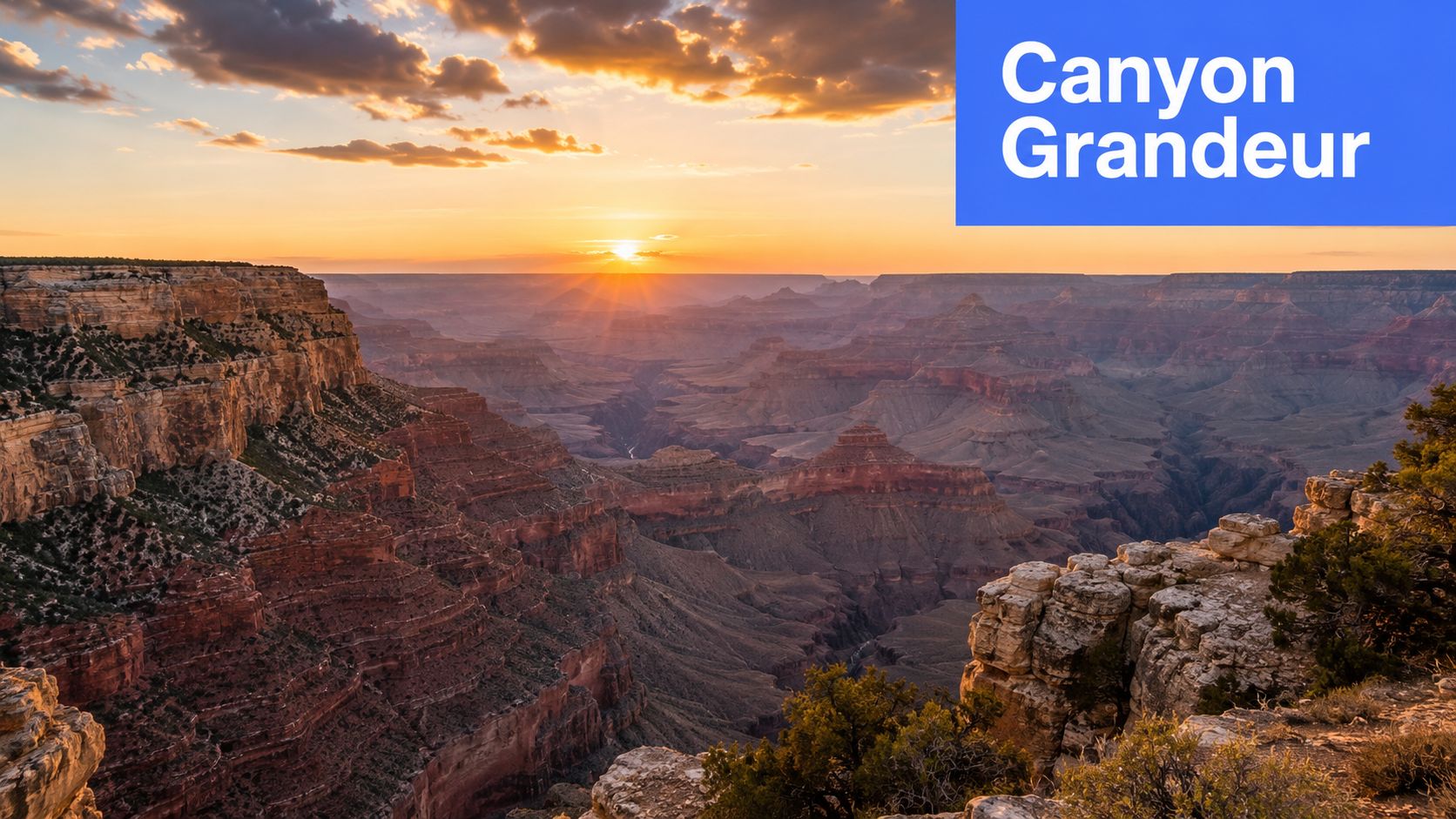
Grand Canyon National Park is still the anchor. It covers 1,218,375 acres and recorded 4,919,163 recreational visits in 2024 after 4,733,705 in 2023 and 4,732,101 in 2022, according to the National Park Service visitation statistics. Those numbers tell you exactly why casual planning fails here. Demand is relentless.
For a high-end trip, I don't advise treating the canyon as a quick roadside stop. Give it room.
A few ways to do that well:
- Choose a strategic base: South Rim convenience works for many first-time visitors, but travelers who want a quieter atmosphere often prefer a less congested positioning strategy.
- Add an aerial perspective: A helicopter experience changes your understanding of the canyon's scale in a way viewpoints never can.
- Protect the best light: Sunrise and late afternoon are worth planning around, not improvising.
If you're curious how regional operators package premium canyon sightseeing from Nevada, this overview of VIP Grand Canyon experiences from Vegas gives helpful context on what higher-touch access can look like.
Zion for travelers who hate crowds
Zion is one of the most visually dramatic parks in the region, and it rewards travelers who stop trying to do it like everyone else. Skip the “arrive mid-morning and see what happens” approach. It's a guaranteed way to feel herded.
The better move is to structure Zion around one serious guided outing and one scenic, restorative day. For some clients, that means a private canyoneering experience outside the most crowded rhythms of the main corridor. For others, it means a naturalist guide who can adjust the day based on pace, interest, and comfort level.
Zion is at its best when it feels immersive, not transactional.
Bryce Canyon for contrast, not just a photo stop
Bryce is often treated unfairly as the park people “fit in” between bigger names. That's a mistake. Its hoodoos, amphitheaters, and sharp shifts in mood from daylight to dusk make it one of the strongest overnight additions in the entire region.
Bryce works particularly well for travelers who want:
- A shorter scenic stay with less physical strain
- Stargazing-focused evenings
- A visual contrast to Zion's enclosed canyon energy
A single night can work. Two is better if you want breathing room.
Moab and the double-header advantage
Moab is where rushed itineraries usually collapse. People underestimate how much there is to do, then overstuff the schedule. Don't.
This area works because Arches National Park contains more than 2,000 sandstone arches, while nearby Canyonlands gives you a completely different sense of scale and space, as noted in this Southwest parks planning overview. Staying in one polished base and sequencing your park time carefully is far smarter than trying to cram it all into a single overextended day.
A strong Moab stay often includes:
- A private sunset guide in Arches: Better pacing, better positioning, better interpretation
- An astrophotography outing: The desert sky is part of the product here
- One half-day reserved for Canyonlands: Enough time to absorb it without burning out
For travelers who want to understand how outdoorsy visitors often map this region before elevating it into a more refined itinerary, these must-see Utah camping sites offer useful geographic context.
If you're still deciding which Utah cluster suits your style, these places to visit in Utah can help you narrow the right combination.
The Art of Timing and Seamless Logistics
The biggest planning mistake in national parks Arizona and Utah is assuming weather is the only timing question. It isn't. Crowd pressure matters just as much, sometimes more.
Peak season versus shoulder season
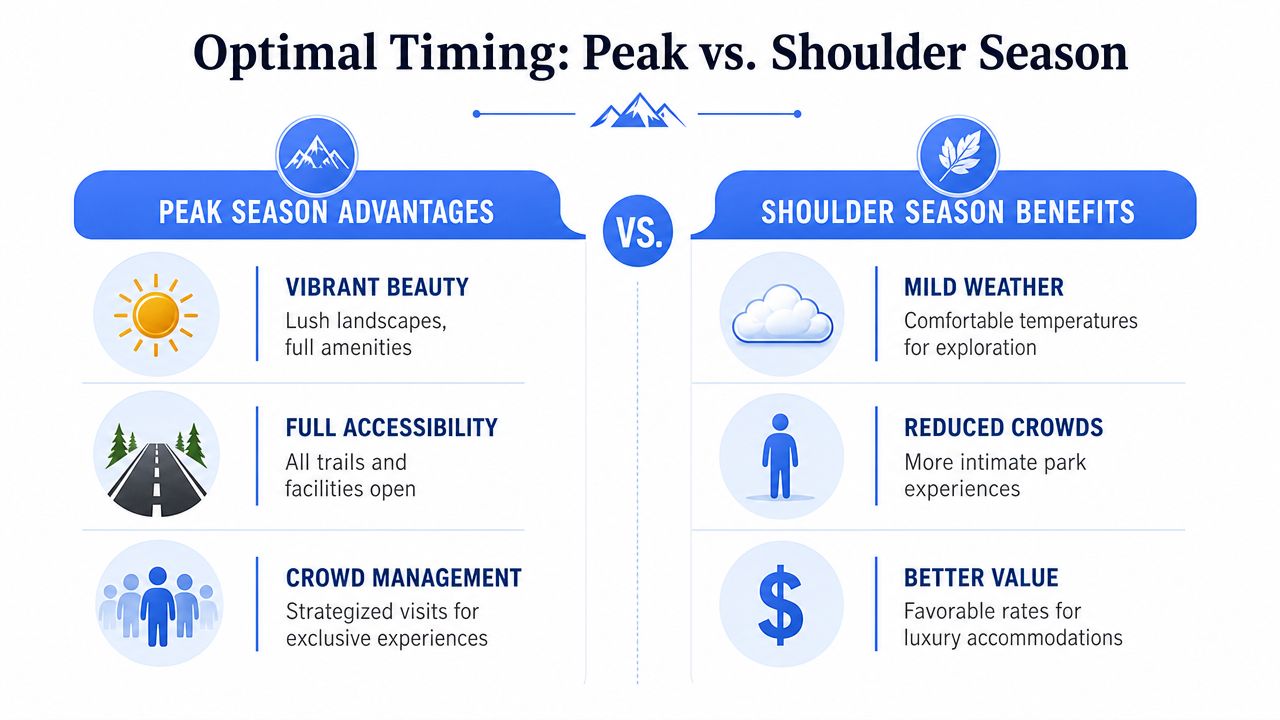
Peak periods bring energy, broad access, and a full-service feel. They also bring friction. Roads fill, viewpoint areas get busy, and spontaneity disappears.
Shoulder season is often the sweet spot for travelers who want a more composed experience. The weather can be more comfortable, and the atmosphere usually feels less strained. But shoulder travel still needs precision. Some experiences have narrower operating windows, and some routes require more active planning.
Here's the practical difference:
- Peak season: Best if your priorities are maximum access and polished resort operations
- Shoulder season: Best if your priorities are quieter park time and a more relaxed rhythm
Zion is the perfect example of why logistics matter
The National Park Service notes that parks use operational controls to manage pressure, and in Zion the Scenic Drive is closed to private vehicles from April to late October, requiring use of the park shuttle during peak season, as outlined by the National Park System overview.
That's not a minor detail. It affects your entire day.
If you don't plan around it, you lose time at exactly the point you should be enjoying the canyon. If you do plan around it, Zion becomes dramatically easier.
Practical rule: In the Southwest, logistics are part of the luxury. A seamless transfer, a timed arrival, and a protected dinner reservation matter as much as the suite itself.
What smart trip design looks like
A well-built itinerary in this region should account for:
Arrival sequencing
Don't land late, drive too far, and expect to enjoy your first stop. Start with a manageable first night.Geographic clustering
Keep your route tight. The more you bounce around, the more the trip starts feeling administrative.Private ground transport when useful
For many travelers, not having to drive every leg is a major upgrade.Buffer time
Desert travel looks simple until heat, fatigue, and access windows start working against you.
A rushed itinerary can make iconic parks feel crowded and chaotic. A thoughtful one makes the same natural settings feel calm, deliberate, and exclusive.
Exclusive Retreats and Elevated Dining
Where you stay in this region changes the trip more than most travelers realize. The terrain is dramatic, dry, bright, and physically demanding. A great hotel isn't a bonus. It's part of the recovery plan.
The desert sanctuaries worth considering
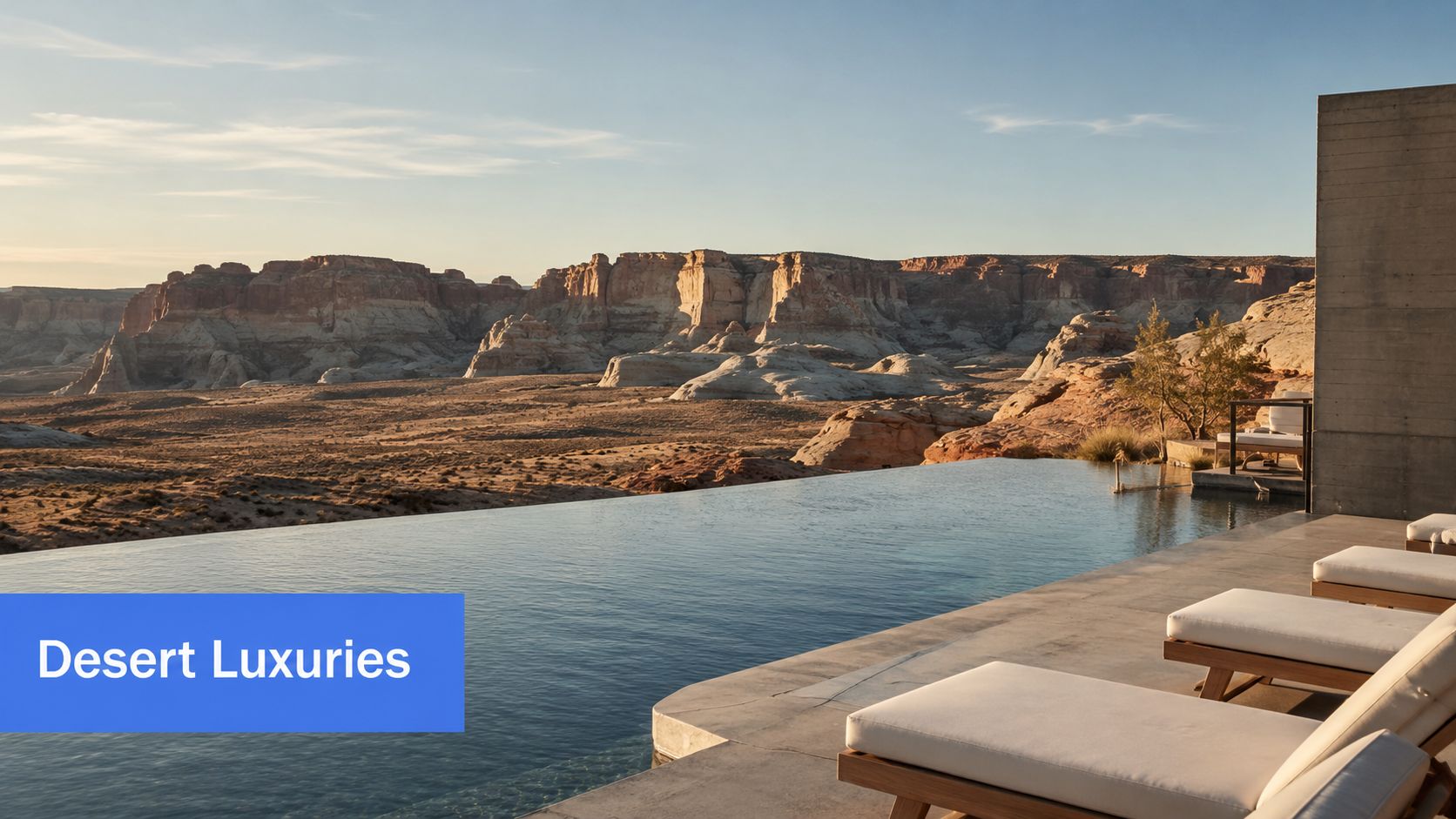
Amangiri is the obvious headline property for this region, and for good reason. It works best for travelers who want privacy, design, stillness, and a desert experience that feels fully intentional. It's not just somewhere to sleep. It reshapes the pace of the trip.
Enchantment Resort in Sedona is excellent when you want red rock access with a softer landing. It suits couples, milestone travelers, and clients who want hiking and scenery balanced with spa time and stronger wellness programming.
L'Auberge de Sedona fits a different mood. It's more intimate, more romantic, and often the better fit for travelers who want a refined forest-and-creek atmosphere before or after the grander canyon vistas.
Sorrel River Ranch near Moab gives you the right type of distance from the busiest day-tripper flow. That matters. Moab can feel hectic if you stay in the wrong place. A more upscale retreat changes the tone completely.
What these properties actually do for the trip
The value isn't just aesthetics. It's function.
- They reduce transit fatigue: Better positioning means less exhausting movement.
- They improve recovery: Spa access, quiet dining rooms, and strong service matter after dusty, active days.
- They support customization: Some properties are better bases for private guides, scenic drives, and personalized outings.
Dining should match the landscape
I'm opinionated about this. Don't spend your days in some of the most extraordinary scenery in North America, then settle for an afterthought dinner every night.
The strongest itineraries build in:
- one celebratory dinner with a view,
- one relaxed but polished meal close to your base,
- and at least one evening where you do almost nothing except enjoy the setting.
You don't need nonstop activity in the Southwest. You need a beautiful room, a proper meal, and enough margin to absorb where you are.
Luxury Itinerary Blueprints From 7 to 14 Days
The right blueprint depends on whether you want depth or breadth. Most travelers should choose depth. The natural features in national parks Arizona and Utah are too powerful to rush past.
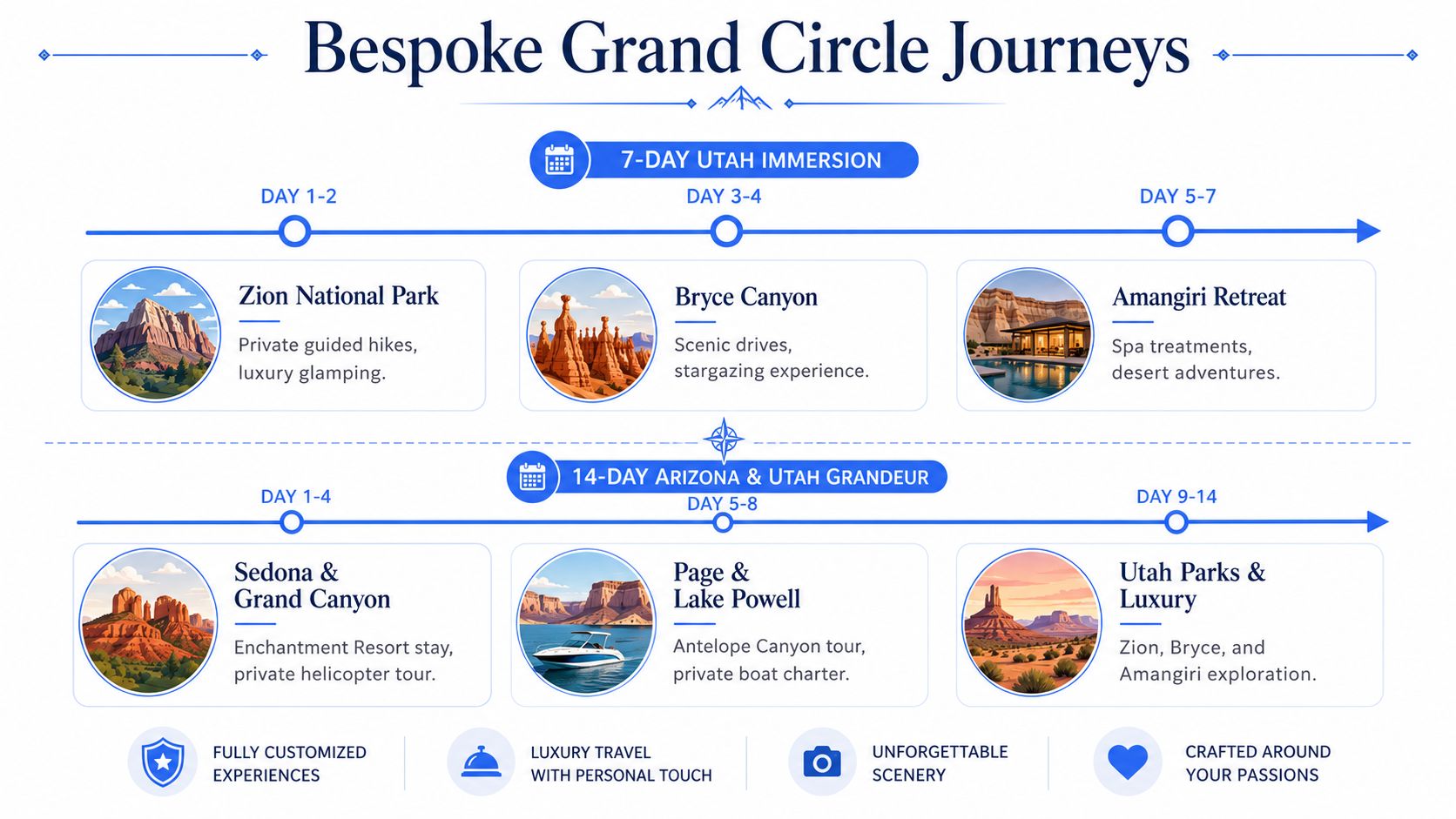
A seven-day Utah immersion
This is the route I like for couples who want strong scenery, manageable movement, and a trip that still feels restorative.
A polished version often looks like this:
| Days | Focus | Style of experience |
|---|---|---|
| 1 to 3 | Zion | Guided hiking, scenic drives, quiet early starts, high-end base nearby |
| 4 to 5 | Bryce Canyon | Hoodoo viewpoints, lighter exploration, night-sky focus |
| 6 to 7 | Southern Utah retreat | Spa time, desert landscapes, one signature guided outing |
This works because it doesn't pretend every park deserves the same amount of time. Zion usually benefits from deeper investment. Bryce adds contrast without requiring a frantic pace. The retreat portion protects the ending, which is what is often overlooked.
A fourteen-day Arizona and Utah grand circle
This one suits first-time visitors who want both the emotional impact of the Grand Canyon and the sculptural desert formations of Utah, without turning the trip into a sprint.
A strong flow could look like:
Begin in Arizona
Ease in with a refined desert stay. Recover from travel. Get acclimated.Move to the Grand Canyon
Give it enough time for a signature viewing experience and an unhurried evening.Continue through the Page area
This is the natural transition point between canyon country and southern Utah.Shift into Utah's icons
Zion and Bryce pair well if you keep expectations realistic and don't overload every day.Finish with a retreat-driven finale
End somewhere calm, design-forward, and very comfortable.
The reason this route works is geology and access. The region's terrains sit on fragile rock systems, and Zion spans about 229 square miles of steep-walled canyon terrain while the Moab area includes more than 2,000 natural arches, conditions that create natural choke points and narrow access windows, as noted in this AAA Southwest parks article. A slower route isn't indulgent. It's practical.
My strongest recommendation
If you have one week, don't force the Grand Canyon and the Mighty 5 into the same trip.
If you have two weeks, you can combine Arizona and Utah beautifully, but only if you accept that some places deserve more than a drive-by.
That's what good itinerary design does. It edits.
Your Custom Southwest Journey with Explore Effortlessly
You arrive in the Southwest expecting dramatic scenery and easy glamour. Then the friction starts. The wrong airport adds hours. The wrong hotel leaves you far from sunrise access. The wrong pacing turns a beautiful trip into a long series of check-ins, parking lots, and compromises.
A well-designed itinerary fixes that before you ever leave home.
The difference is not more activity. It is better decisions. Smart park order, the right number of hotel changes, private touring where it improves the day, and dining plans that respect long drive times and limited options inside park corridors all shape whether this trip feels polished or exhausting. If you want that level of planning, start with these personalized travel itineraries.
Karrah works with clients nationwide through virtual consultations and brings the level of judgment this region demands. She is a Circle of Excellence Advisor, Top 5 percent at Nexion, and a CLIA Accredited Cruise Counselor. For travelers who care about privacy, comfort, and thoughtful execution, that matters.
The goal is simple. You should spend your time watching first light hit canyon walls, settling into a remarkable lodge, and enjoying the trip at your own pace. Your itinerary should do the hard work for you.
Frequently Asked Questions for Your Luxury Park Adventure
How do you tailor this kind of trip for a honeymoon versus a family vacation
Start with the travel style, not the park list.
For a honeymoon, I recommend fewer hotel changes, stronger privacy, slower mornings, one or two signature experiences, and room choices that feel special the moment you walk in. For a family or multigenerational trip, I structure the itinerary around suite layouts, shorter drive days, easy access viewpoints, and activities that work for different ages and energy levels.
Arizona and Utah do both beautifully. The common mistake is giving both trips the same pacing and expecting the same result.
Are these parks workable for travelers with mobility concerns
Yes, if you plan for comfort from the beginning.
Many of the best moments in this region do not require strenuous hiking. Scenic drives, well-positioned lodges, accessible overlooks, and private touring can deliver a rich park experience without turning every day into a physical test. If uneven trails are not a fit, change the plan early and build around what will feel enjoyable, not performative.
That is how you protect the trip.
How far in advance should we plan
Earlier than many travelers expect.
The best rooms, strongest guides, and smartest timing windows go first, especially for spring and fall. If this is a milestone trip, plan well ahead so you get the route, pacing, and room category you want instead of settling for what is left.
The Southwest may look rugged and spontaneous in photos. The best luxury trips are carefully built behind the scenes.
What should we budget for a fully managed luxury trip
Budget based on the choices that change the experience, not on a vague nightly average.
The biggest cost drivers are usually hotel quality, how often you change properties, whether you add private guiding, and how much comfort you want in your transfers. Spending more only matters if it removes friction, improves access, and gives you a calmer, better-paced trip.
That is where smart planning earns its keep.
Is a self-drive still worth it for luxury travelers
Sometimes. Often, no.
A self-drive works for travelers who enjoy desert roads, do not mind long stretches between services, and want complete flexibility. Private transport is the better call if you value ease, want to enjoy dinner without worrying about the drive back, or do not want every day to begin and end with logistics.
Choose based on how you want to feel by day five, not day one.
What's included when working with Karrah
You get a trip built around your standards, not a generic loop with upgraded hotels dropped on top.
That can include:
- Hotel selection: Properties chosen for location, privacy, service, and overall fit
- Routing strategy: Smarter sequencing with less backtracking and fewer wasted hours
- Experience planning: Private guides, scenic touring, and special-occasion touches
- Travel coordination: Flights, transfers, and key reservations handled as one plan
- Support before departure: Trusted in-destination partners and clear coordination throughout the planning process
Author bio
Hi, I'm Karrah, owner, founder, and lead travel advisor at Explore Effortlessly, a luxury award winning travel agency based in Miami.
I specialize in designing bespoke, high touch itineraries to bucket list destinations around the world. Every trip is curated with intention, insight, and smooth logistics from start to finish.
From luxury cruises and private villas to honeymoons, safaris, and once in a lifetime journeys, my role is to simplify the planning process while improving every detail.
If you're ready to trade a rushed park loop for a polished, custom-designed journey, Explore Effortlessly can help you plan it with the right hotels, the right pacing, and the right experiences from the start. You can also join the newsletter for more curated travel inspiration through this newsletter signup.