You're already in the moment where the glossy promise of private aviation meets the messy reality. The flight is urgent, the calendar's tight, and the last thing you want is to waste time comparing vague quotes, chasing an empty-leg bargain that may disappear, or wondering whether the operator is even legitimate. If you want to book private jet travel with confidence, the winning move is simple, verify first, compare intelligently, and only then put down a deposit.
Key takeaways
- Private jet booking is a charter decision, not a seat purchase.
- The best quote starts with precise trip details, not a vague destination.
- Broker, operator, and marketplace bookings each carry different trust risks.
- “All-in” pricing only works when you normalize every fee line by line.
- Empty legs can look cheap, but they're usually the least predictable option.
- The smartest luxury travelers use an advisor to handle verification and logistics.
Why Private Jet Booking Is Nothing Like Airline Ticketing
The first mistake affluent travelers make is assuming a private jet works like a first-class ticket with better champagne. It doesn't. You aren't buying a seat, you're chartering the entire aircraft, and that single detail changes everything about how the trip gets priced, confirmed, and managed.
A traveler calls with a same-day meeting in New York, a family departure to Aspen, or a villa transfer in the Caribbean, and suddenly the rules of airline booking disappear. There's no public booking engine for this. The process runs through an operator or broker, and the aircraft has to fit the mission, not the other way around. In many cases, a jet can be confirmed within 2 to 4 hoursaccording to industry guidance, which is exactly why private aviation is such a different animal from commercial premium travel. If the aircraft is taking you to a private stay, my guide to a villa with a private chef helps you think through what happens after arrival.

Why speed changes the whole booking mindset
Because the timeline is compressed, hesitation costs you. If the aircraft is available, the crew is available, and the airport works, the decision can move fast. If one piece is off, the whole quote can fall apart.
That's why I tell clients to stop thinking in terms of browsing and start thinking in terms of mission control. For a private charter, the right question isn't “What's the cheapest jet?” It's “What aircraft gets this exact trip done cleanly, legally, and without last-minute drama?”
Practical rule: if you're booking private aviation, treat it like a logistics brief, not a shopping cart.
Gathering the Right Trip Details Before Requesting a Quote
A clean quote starts with clean inputs. If you give an operator vague details, you'll get a vague proposal, and vague proposals are where travelers get burned. The more complete your trip brief, the faster you get a realistic price and the fewer surprises appear after the deposit.

The information you need before you ask for pricing
At minimum, have your departure and destination airports ready, or at least the metro area if you don't know the exact field yet. Add the flight date, your desired departure time or a flexible window, the number of passengers, and a real luggage summary. If you're traveling with pets, skis, golf clubs, medical equipment, special catering, or ground transport needs, mention it immediately.
Those details matter because they can change the aircraft recommendation, the airport choice, and the handling plan. A family with bulky luggage may not fit comfortably on the jet that looks perfect in photos. A pet itinerary can affect cabin setup. Even catering preferences can change the timing and logistics.
A strong operator will also run an internal feasibility review before offering the flight. That review covers aircraft availability, crew availability, airport restrictions, and regulatory requirements. So if a trip feels “simple” to you but still isn't coming back quickly, the delay may have nothing to do with price. It may be operational.
Avoid this mistake: underreporting baggage or special requests to get a faster quote usually backfires later, because the aircraft choice and handling plan have to be rebuilt.
For travelers who frequently move between cities or cross borders, this guide to booking international flights is a useful companion when you're coordinating private aviation with the rest of the trip.
Choosing Between Brokers Operators and Marketplaces
Most buyers get fuzzy, and fuzziness is expensive. A broker, an operator, and a marketplace can all get you on a jet, but they do not give you the same level of control, transparency, or accountability. If you're booking a high-value trip, you should know exactly which model you're using and why.
Broker, operator, or marketplace
A broker aggregates inventory and negotiates on your behalf. That can save time and widen your options, especially when you need multiple aircraft types or a difficult routing. The trade-off is that there's another layer between you and the airplane, which means you need to be extra disciplined about what's included.
A direct operator gives you the most direct line to the aircraft and the crew, plus clearer visibility on the tail number and the fleet. That's useful when consistency matters. The downside is obvious, you're limited to that operator's inventory, which may not be the best fit for every route.
A marketplace or app is fast, and speed is seductive. But speed doesn't automatically equal clarity. You still need to confirm who holds the operating authority and who is responsible if something changes.
What to verify before you share payment details
For U.S. charter flights, ask for the FAA Part 135 certificate. For international flying, look for the equivalent authority, such as EASA or another national AOC. Then ask for independent safety validation, such as ARGUS Gold or Platinum, Wyvern Wingman, or IS-BAO. Those are not decorative badges. They're part of the basic trust check.
If the seller can't clearly tell you who operates the aircraft, who holds the certificate, and what safety program backs the operation, keep looking.
This is also where a strong advisor earns their keep. They don't just find an aircraft, they help you sort signal from noise. For clients who want a broader planning umbrella, Explore Effortlessly's bespoke travel agent service fits naturally into a trip that also includes hotels, transfers, and destination logistics.
Decoding All-In Quotes and Comparing Proposals
A private jet quote is only useful if you know what you're looking at. On paper, two proposals can look similar and still be miles apart in real value. One may hide positioning time. Another may bury fees. Another may sound cheaper because it assumes a different aircraft location or a looser cancellation policy.
What belongs in a real comparison
Start by checking whether the quote is based on occupied time or includes positioning hours. Then look for fuel excise tax, FBO fees, de-icing policy, and cancellation terms. Those are the lines that often change the cost of the trip.
You should also make sure the Part 135 certificate holder and the tail number match the contract before you sign and place a deposit. If that's not clean, stop. The final trip sheet should lock the departure time, the airport and FBO address, and the handler contacts before wheels-up. That's not paperwork fluff, that's what keeps the trip from drifting into confusion on the day of departure.
Proposals also typically specify the aircraft type, registration, cabin configuration, passenger capacity, departure and arrival airports, flight time, and quote validity period. Use that data to compare aircraft against mission, not brand against brand. The smartest match is usually the smallest aircraft that safely covers the route and baggage profile.
| Private Jet Quote Comparison Checklist | What to Verify | Common Hidden Cost |
|---|---|---|
| Aircraft location | Is the jet already near departure? | Positioning hours |
| Flight time basis | Occupied time or deadhead included? | Reposition charges |
| Taxes and fees | Are fuel and airport items itemized? | Fuel excise tax, FBO fees |
| Weather policy | Is de-icing clearly spelled out? | Cold-weather add-ons |
| Contract details | Do certificate holder and tail number match? | Wrong operator, re-quote |
| Cancellation rules | What happens if plans change? | Deposit loss or penalties |
A useful comparison mindset comes from other luxury charters too. If you've ever priced premium yacht time, you know the headline rate is rarely the full story. For context on a related luxury transport market, 2026 yacht rental costs Dubai shows the same principle, the quote only makes sense once you understand what's included and what's not.
When Empty Legs and Flexibility Save Money
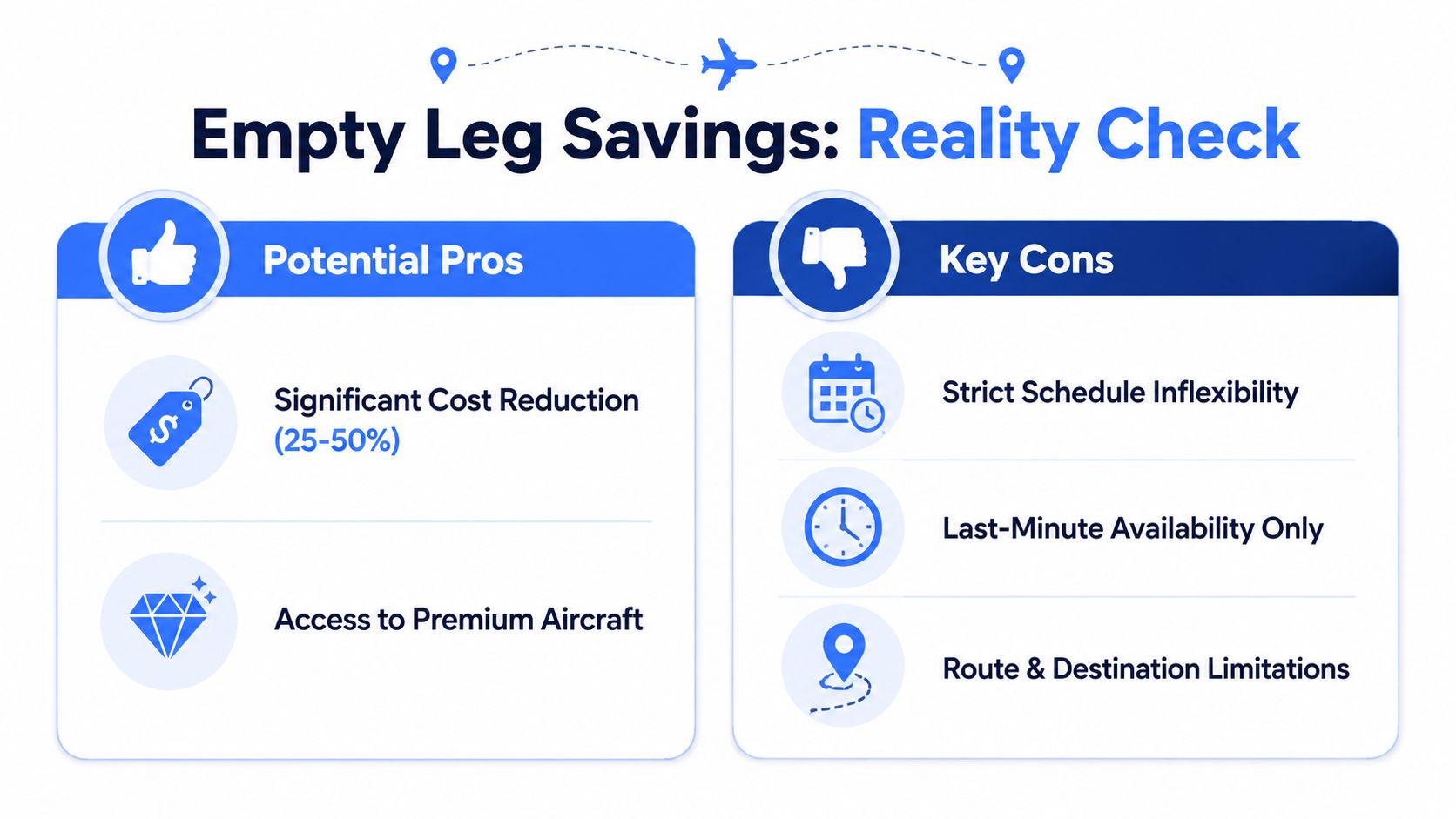
Empty legs get too much glamour for how awkward they can be in real life. They can be attractive, but they are not the default smart choice. The cheapest option is often the least reliable one, because it depends on someone else's repositioning itinerary, not your schedule.
Where flexibility helps and where it hurts
If your plans are loose and your route happens to line up with available inventory, an empty leg can make sense. If your timing is fixed, or your arrival matters, it usually turns into a deal that looks better on paper than it works in practice. Empty legs depend on a specific aircraft moving for someone else's schedule, so schedule control is limited and cancellation risk is higher.
That is why the question is not whether you can save money. It is whether the savings are worth the friction, the uncertainty, and the time you give up to get them. In major markets, private jet booking is often a same-day or next-day decision. Forbes reported that 44% of clients made reservations on the same day they inquired, 20% booked within 24 hours, and 90% secured a booking within one week of the initial inquiry, with the fastest recorded turnaround at 61 minutes and 44 secondsin its private jet booking report. Stratos later summarized similar behavior, saying 37% decide the same day, 30% the next day, and 25% within 2 to 7 daysin its industry summary.
The market matters too. North America accounts for 72% of private jet activity, far ahead of Europe at about 16%, with the rest split across smaller regions as summarized in regional activity data. In absolute terms, there were about 5 million private jet flights in 2022, up from 3.3 million in 2021, and the United States alone accounted for 3.3 million departures in 2022 as summarized in regional activity data. That scale explains why the fastest quoting and widest aircraft choice show up in the most liquid markets, while less concentrated regions need more lead time and tighter routing discipline.
Bottom line: empty legs are a tool, not a strategy. Use them when the itinerary can bend, not when the itinerary must hold.
Letting Your Travel Advisor Handle Every Detail
The richest travelers don't win because they know every aircraft model. They win because they refuse to waste time on guesswork. A good advisor handles the noise before it reaches you, and that starts with verification, quote cleanup, and logistics that never should've been your problem in the first place.
What gets managed behind the scenes
The work includes aircraft selection, operator verification, quote normalization, ground transport, catering, and FBO logistics. It also includes checking the route for practicality, because a good private charter plan often needs to coordinate with onward transfers, hotel check-in timing, or a cruise embarkation. If you've ever handled something as specific as airport to river transfers, you already know the value of getting the handoff right the first time.
For travelers who want a cleaner planning experience, the advisor's role is to simplify the process while keeping standards high. That means no chasing multiple operators, no guessing which quote is all-in, and no hoping the aircraft detail matches the contract. It also means your preferences carry forward, so the next trip starts from a smarter baseline.
If you want a single point of coordination for private aviation and the rest of the journey, Explore Effortlessly's luxury travel concierge is built for that exact kind of planning.
High-end travel should feel deliberate, not improvised. If the charter part of the trip is messy, the whole experience starts to wobble.
Plan your private jet trip with a luxury advisor who knows how to verify operators, decode quotes, and coordinate the full journey without the usual friction. Visit Explore Effortlessly to start your request, and use the contact page to plan my luxury trip with confidence. Join the newsletter at Explore Effortlessly updates for more high-touch travel insight, smart planning tips, and refined trip ideas.