A lot of people come to me with the same idea in mind. They're tired of airport chaos, tired of unpacking every three days, and tired of vacations that feel rushed the moment they begin. They want to go farther, stay longer, and travel with more depth.
That's exactly where long term cruises start to make sense.
Done well, an extended voyage is not just a holiday. It's a moving residence with a serious travel agenda. You wake up somewhere new, keep the same suite, keep the same staff around you, and trade constant logistics for rhythm. Done poorly, it's an expensive lesson in why cabin choice, route design, medical planning, connectivity, and documentation matter more than glossy brochures suggest.
If you're considering months at sea, you need more than a booking. You need a strategy.
What Exactly Are Long Term Cruises
Long term cruises sit in a category of their own. I'm not talking about a standard week in the Caribbean or even a typical two-week sailing. I'm talking about voyages built for immersion, not quick consumption.
Industry tracking shows that 8% of all global cruise itineraries in 2024 were officially categorized as Grand Voyages, meaning voyages longer than 40 days according to recent cruise itinerary reporting. That matters because it confirms what I've seen firsthand. Serious travelers are no longer satisfied with the greatest-hits version of cruising.
If you're comparing styles of ocean travel, my guide to small ship cruise lines is useful because ship size changes the entire experience on a long voyage.
The four versions that matter
People throw around terms like world cruise, grand voyage, repositioning sailing, and residential yachting as if they mean the same thing. They don't.
- Grand Voyages are long regional or multi-region journeys. They go deep rather than wide. Think more time across South America, Asia, or polar regions instead of trying to tick every continent.
- World Cruises are the marathon version. These are the classic globe-spanning sailings that can become a major chapter of your year.
- Repositioning Cruises are the sleeper pick for the right traveler. These follow a ship's operational move from one seasonal region to another, often with more sea days and less conventional routing.
- Residential Yachts are not really cruises in the traditional sense. They're a lifestyle product for clients who want private-residence-style living with maritime mobility.
What they feel like onboard
Marketing language often gets sloppy. A world cruise sounds glamorous, but daily life matters more than the route map.
A Grand Voyage often feels the most balanced. There's enough time to settle in, enough port variety to stay stimulated, and usually a clearer narrative to the itinerary. Repositioning sailings attract travelers who enjoy sea days and don't need constant entertainment. Residential yacht life is for the client who wants continuity, privacy, and a more residential social culture.
Practical rule: If you care more about living well onboard than saying you “did a world cruise,” start with the ship and suite, not the itinerary title.
The real definition I use with clients
If your cruise is long enough that you need to think about prescriptions, laundry rhythm, digital life, visa sequencing, and whether the suite will still feel good after several weeks, you're in long term cruise territory.
That's the threshold that matters.
Is an Extended Voyage Right for You
Long term cruises are fantastic for the right traveler and miserable for the wrong one. I'd rather tell you that upfront than sell you a romantic fantasy.
If you need constant novelty every hour, hate routine, or get irritated by other people's habits quickly, months at sea may not be your ideal format. Extended voyages reward travelers who like structure, curiosity, and the luxury of staying put while the world changes around them.
The people who usually thrive
I see a few profiles do especially well on these sailings.
- Active retirees who still want substance. They don't want to sit still, but they also don't want a trip that feels like work.
- Professionals on sabbatical who want one large, meaningful journey instead of several fragmented vacations.
- Writers, creatives, and founders who value uninterrupted thinking time and changing scenery.
- Empty nesters who finally have scheduling freedom and want to use it well.
The common trait isn't age. It's temperament. Good long-voyage travelers know how to build a satisfying daily life.
Questions I'd ask you before I'd ever recommend one
Use this as a blunt self-test.
| Question | If your answer is yes | If your answer is no |
|---|---|---|
| Do you enjoy sea days? | You may love an extended voyage. | You'll likely feel trapped. |
| Can you handle a recurring routine? | Ship life will feel calming. | It may feel repetitive. |
| Do you value depth over speed? | A long itinerary fits. | Land travel may suit you better. |
| Are you comfortable socializing selectively? | You'll manage shipboard community well. | The onboard social scene may wear on you. |
The happiest long-cruise clients don't treat the ship like a hotel they happen to sleep in. They treat it like home for a season. If a full season feels like too much to commit to, I would compare December cruises for a shorter escape first.
The social side is real
You are not anonymous for long on an extended voyage. Staff know your coffee order. Other guests recognize you. Tables, lectures, lounge rituals, and shore days create a genuine community.
Some clients adore that. Others want more distance.
That's why I care so much about ship fit. On some sailings, the onboard culture is polished and private. On others, it's more social and clubby. Neither is wrong. But choosing the wrong social environment for months is a mistake you'll feel quickly.
A World of Possibilities and Itineraries
The best long term cruises don't feel like a string of ports. They feel like a storyline.
A short sailing can get away with being scattershot. An extended voyage can't. It needs pacing, contrast, and operational logic. The strongest itineraries move with purpose. One climatic zone yields to another. One cultural thread hands off to the next.
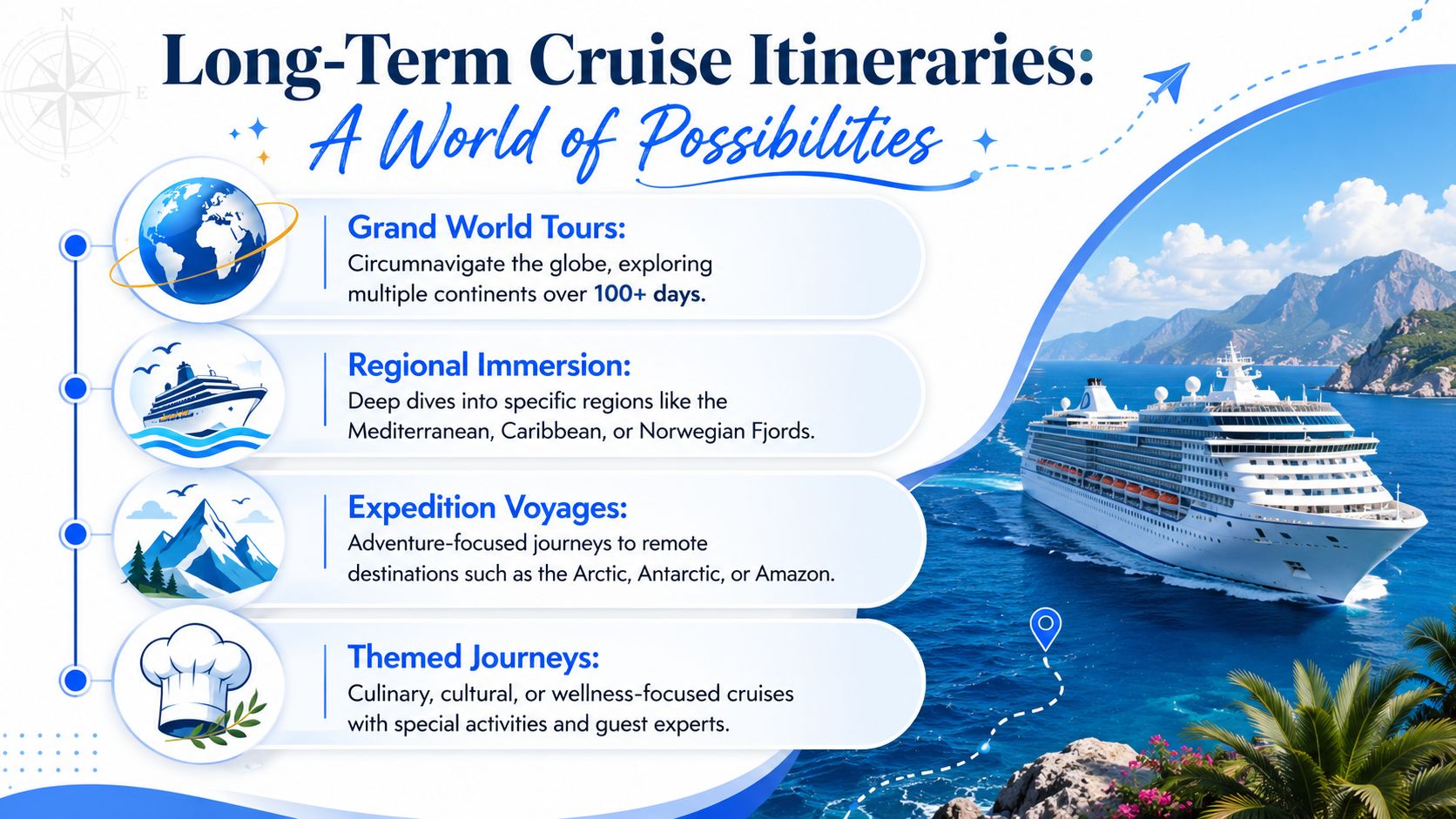
For clients drawn to Europe, I often start with Mediterranean cruise itineraries because that region shows how dramatically route design changes the quality of the trip.
Why these routes aren't simple round trips
Very long voyages are often operationally closer to maritime migrations than classic cruises. That's especially true once you cross the 100-night threshold.
For example, the Ultimate World Cruise spans 274 days across 60+ countries and is best understood as a one-way logistical movement across multiple ocean basins, not a neat circular vacation route, as outlined in Royal Caribbean's Ultimate World Cruise overview.
That sounds technical, but it changes everything. Port sequencing, provisioning, weather patterns, immigration rules, and boarding logistics all become part of the design.
What different itinerary styles actually deliver
Grand world tours
These are the statement pieces. They give you scale, bragging rights, and extraordinary geographic variety. They also demand stamina and a very deliberate cabin strategy.
Good for the traveler who wants one sweeping experience rather than several smaller ones.
Regional immersion voyages
This is often my favorite category for luxury clients. You stay in one broad part of the world long enough to understand it. A Mediterranean deep dive feels very different from an Asia arc or a South Pacific crossing.
These voyages usually offer better cultural continuity and less fatigue.
Expedition-focused long sailings
These appeal to travelers who care more about access than onboard spectacle. Remote destinations, changing conditions, enrichment-led programming, and a stronger sense of purpose define the experience.
You choose these for the places, not just the ship.
Pacing matters more than people think
A smart itinerary alternates stimulation and recovery. Several high-energy port days in a row sound appealing on paper. In real life, they can become draining by week three.
That's why I like voyages with breathing room.
- Sea days give you time to reset, enjoy the suite, and use the ship properly.
- Overnights or longer port windows create a more civilized destination experience.
- Logical geography reduces the feeling of being dragged around a map.
A long itinerary should have tempo. If every day looks the same, the route isn't refined enough.
Understanding the Investment for Your Grand Voyage
Let's talk about money the way adults should.
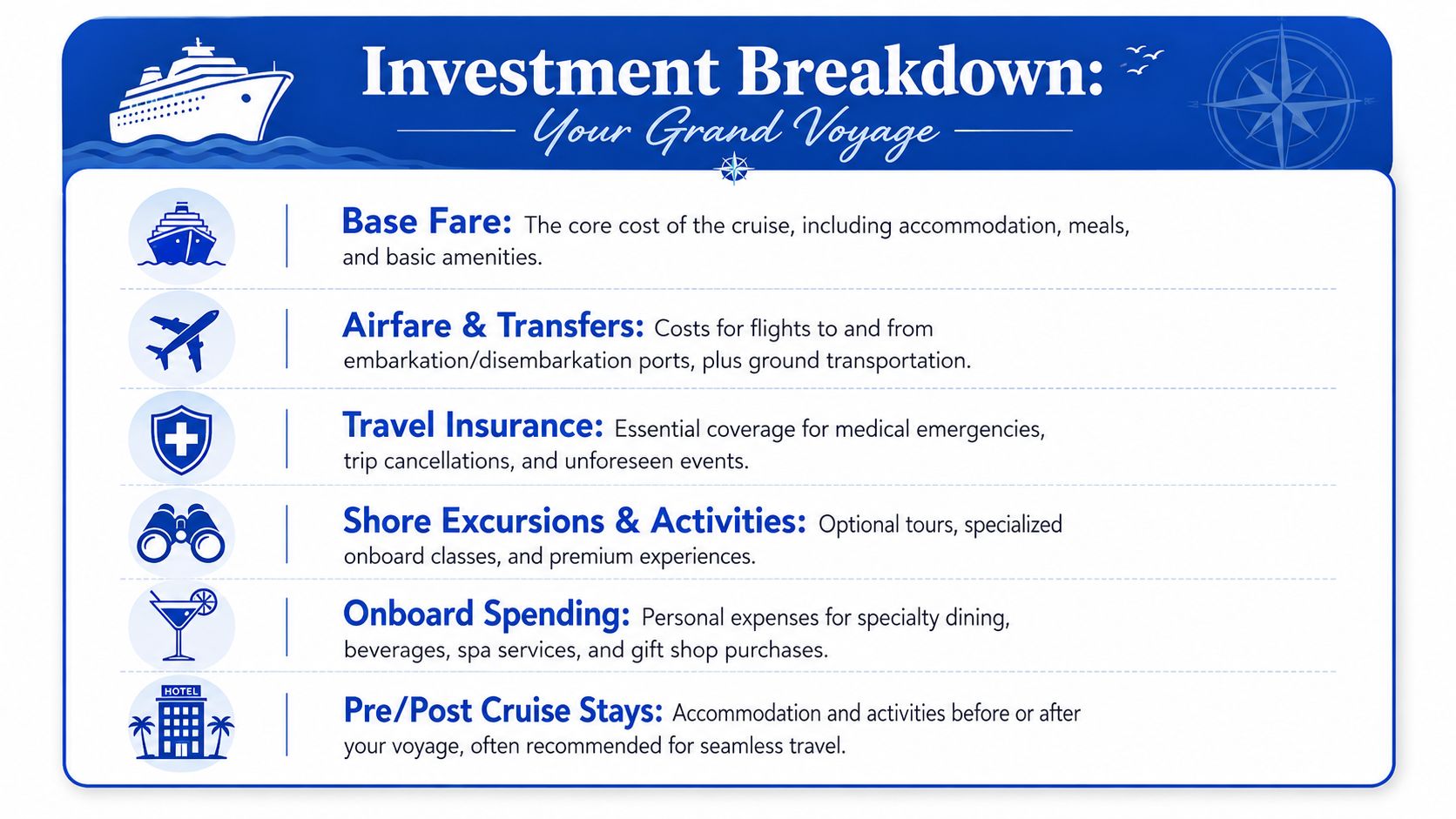
Long term cruises can deliver remarkable value, but only when you understand the total investment. Looking at cruise fare alone is how travelers end up surprised, annoyed, or overspending in all the wrong places.
Public commentary on extended sailings notes a wide pricing spread, from under £100 per person per night to above £500 per person per night, and some voyages aren't publicly priced at all until you inquire, which is exactly why value comparison gets messy without expert guidance, as discussed in this analysis of long-voyage pricing.
What the fare usually covers
A luxury client should care less about the headline price and more about what that fare replaces.
| Cost area | Usually included in fare | Often separate |
|---|---|---|
| Accommodation | Your suite or stateroom | Upgraded categories and premium locations |
| Dining | Main dining and standard venues | Specialty restaurants on some sailings |
| Onboard programming | Lectures, entertainment, enrichment | Private classes or premium events |
| Basic service | Housekeeping and standard onboard service | Spa, boutique purchases, some beverages on some lines |
The right sailing can replace months of hotel nights, a huge amount of local transportation, and much of the friction that usually comes with multi-country travel.
Where clients misjudge the budget
The expensive mistakes usually happen outside the fare.
- Air planning: Open-jaw or long-haul premium flights can become a major line item.
- Pre- and post-cruise stays: I often recommend them, especially when embarkation or disembarkation is far from home.
- Private touring: Luxury travelers often spend gladly and wisely, as it changes the destination experience.
- Insurance and documentation: Not glamorous, absolutely necessary.
- Onboard lifestyle choices: Specialty dining, spa time, upgraded beverages, and shopping can add up.
Advisor perspective: The cheapest fare is often the most expensive choice if the cabin is wrong, the air schedule is punishing, and the inclusions don't match how you actually travel.
My recommendation on value
Don't compare long cruises by price per night alone. Compare them by friction removed, quality of living, itinerary design, and how much planning burden they eliminate.
For some clients, a premium suite on a better-planned sailing is the clear smarter buy over a lower published fare that requires constant add-ons and compromises. For others, a more modest base fare leaves room for exceptional private experiences ashore. The right answer depends on how you want to live during the voyage, not just what you want to spend.
Navigating the Complexities We Handle for You
This is the part glossy cruise content usually ignores.
A long voyage is sold as romance and destination access. Fair enough. But if you're going away for months, practical life doesn't disappear. It follows you onboard. That's why the difference between a simple cruise booking and real trip management becomes obvious fast.
Independent commentary on full-time ship life points to a major gap in most coverage. Articles often skip basics like continuous mail, long-term medical access, and reliable digital connectivity, even though those issues are central for affluent travelers considering multi-month voyages, as noted in this discussion of living on a cruise ship year-round.
The questions serious travelers ask me
They're rarely about the buffet.
They ask how to handle prescriptions across a long timeline. They ask what happens if they need a specialist once they're midway through an itinerary. They ask whether the ship's internet is good enough for occasional work calls, banking, and family contact. They ask how many formal nights there are, where laundry fits into life onboard, and how to avoid dragging too much luggage across multiple climate zones.
Those are the right questions.
What actually needs planning
- Medical continuity: Enough medication, documentation, and a realistic backup plan.
- Visa sequencing: Some long itineraries involve a complicated patchwork of entry requirements.
- Connectivity expectations: “Wi-Fi available” and “Wi-Fi useful” are not the same thing.
- Mail and financial admin: Clients often need systems in place before departure.
- Home management: Staff, pets, property, and household obligations still need oversight.
Why this matters more on luxury bookings
High-net-worth travelers usually have more complexity, not less. There may be staff schedules to coordinate, business matters to maintain, family obligations, philanthropic commitments, or multiple homes. Long term cruises work beautifully when those realities are accounted for before departure.
If a voyage is long enough to disrupt your normal life, planning has to cover your normal life.
That's the part most booking engines can't do. They can issue a reservation. They can't think through your routines.
Planning Your Effortless Extended Voyage
A successful long voyage starts long before embarkation day. It starts with matching the right traveler to the right ship, the right suite, the right route, and the right pace.
That matters even more now because the category is expanding. The expedition cruising segment grew by 22% in 2024, and total cruise passenger volumes are projected to reach 37.7 million in 2025, according to this cruise sector outlook. More demand means better options, but it also means more noise. Not every long sailing deserves your time or money.

If you're building out your packing strategy, my guide on what to bring on a cruise is a useful starting point for extended sailings.
What I prioritize first
I don't start with the brochure headline. I start with how you want to live onboard.
Suite selection
On a short cruise, you can tolerate a merely acceptable cabin. On a long voyage, that's a bad decision. Storage, natural light, bathroom layout, seating, walkability to key venues, and noise exposure all matter more over time.
Ship personality
Some ships feel serene and residential. Others are entertainment-forward. Some reward independent travelers. Others depend heavily on organized social programming. Matching your temperament to the onboard culture is as important as choosing the route.
Shore strategy
I rarely recommend trying to “do everything” in every port on a long sailing. That's how clients burn out. The smarter move is a curated mix. A few marquee private experiences. Some light independent days. Some ports where you stay onboard and enjoy the ship.
The planning stack I recommend
A proper long-voyage plan usually includes:
- Air and transfer logic: Smart arrival timing, realistic connections, and backup margin.
- Documentation review: Passports, visas, travel insurance details, and entry requirements.
- Lifestyle planning: Laundry rhythm, dress-code strategy, and internet expectations.
- Destination curation: Which ports deserve private guides and which don't.
- Pre-departure organization: A working packing and document checklist is helpful when you're juggling multiple borders, climates, and embarkation logistics.
Where an advisor changes the outcome
I'm a Circle of Excellence Advisor. Top 5 percent at Nexion and a CLIA Accredited Cruise Counselor. I work with clients nationwide through virtual consultations, and my role is not to flood you with options. It's to narrow the field intelligently.
For long term cruises, that usually means evaluating cabin inventory, weighing itinerary tradeoffs, coordinating air and land pieces, and shaping the voyage around how you travel. In practical terms, that may include preferred partner perks, VIP amenities where available, and a much tighter pre-departure plan than most travelers build on their own. Explore Effortlessly handles trip design and booking coordination for clients who want that process managed properly.
Author bio
Hi, I'm Karrah, owner, founder, and lead travel advisor at Explore Effortlessly, a luxury award winning travel agency based in Miami.
I specialize in designing bespoke, high touch itineraries to bucket list destinations around the world. Every trip is curated with intention, insight, and smooth logistics from start to finish.
From luxury cruises and private villas to honeymoons, safaris, and once in a lifetime journeys, my role is to simplify the planning process while elevating every detail.
FAQs about long term cruises
How long does a cruise need to be to count as a long term cruise
If you need to think about sustained living logistics rather than just vacation packing, it qualifies in practical terms. Industry reporting specifically identifies Grand Voyages as sailings longer than 40 days in the source cited earlier.
Are long term cruises only for retirees
No. I see interest from retirees, professionals on sabbatical, creatives, and empty nesters. The better predictor is lifestyle fit, not age.
Is it realistic to live on a cruise ship for months
Yes, but it requires planning. Medical access, mail, connectivity, laundry, documentation, and budgeting all need attention before departure.
Are long term cruises good value
They can be, but only if you compare total experience and total cost, not just the fare. The right voyage can replace a large amount of independent trip planning and on-the-ground friction.
Should I book a long voyage on my own
You can. I don't recommend it for most affluent travelers. The longer and more complex the itinerary, the more expensive small planning mistakes become.
If you're considering a Grand Voyage, a world cruise, or a multi-month expedition, the smartest next step is a planning conversation. Use Plan my luxury trip to start the process.
If you'd like more luxury cruise insights and curated travel ideas, join the Explore Effortlessly newsletter.