You're coordinating a trip that looks elegant on paper and chaotic in practice: several cities, important meetings, premium flights, multiple hotels, and no appetite for spending your evenings comparing schedules. The problem isn't finding each individual reservation. It's making every reservation work with the next one.
A multi-stop journey planner should do more than place destinations on a map. It should choreograph the route, pacing, transport connections, visa requirements, luggage movement, hotel arrivals, and recovery options when the world disrupts the plan. For affluent travelers, that distinction matters. Your most expensive resource is often your time, not the fare difference between two flights.
Why a Multi Stop Journey Planner Matters for Busy Travelers
A founder flying London to Singapore to Sydney to San Francisco in eleven days may have three client meetings and a wedding in the same itinerary. The flights can be booked. The hotels can be beautiful. Yet one missed connection can unravel the entire sequence, affecting the meeting schedule, check-in timing, luggage, and recovery time.
That's why I treat complex travel as choreography rather than calendar management. Every city has a role. One may carry the business obligations, another the celebration, and another the recovery period that makes the entire trip tolerable. The route has to respect transport links, immigration procedures, visa windows, local traffic, and the simple fact that a traveler arriving after a long-haul flight may not be ready for a packed day.
A consumer mapping tool can show you the order of destinations, but it usually doesn't understand the cost of a failed connection or the friction hidden between reservations. Baggage recheck requirements, airport transfers, hotel check-in alignment, and jet-lag windows can turn an attractive route into an exhausting one. For multi-city travel, even the research burden grows quickly. Travelers in the United States reportedly spend nearly 18 hours researching, comparing prices, finding packages, and booking vacations, with 60% using search engines and 54% using online travel agency sites during planning, according to this overview of multi-city flight itineraries. If several legs rely on road transfers, I would review private driver services for luxury travel before locking the hotel sequence.
Advisor perspective: If your schedule has professional consequences, a milestone event, or several international borders, the itinerary needs a recovery path before you need one.
A dedicated planning process consolidates those moving pieces. The purpose isn't to remove every possibility of disruption. No planner can do that. The purpose is to make the route coherent, protect your time, and ensure that someone has already decided what happens next if a connection fails.
Setting the Spine of a Complex Multi Stop Itinerary
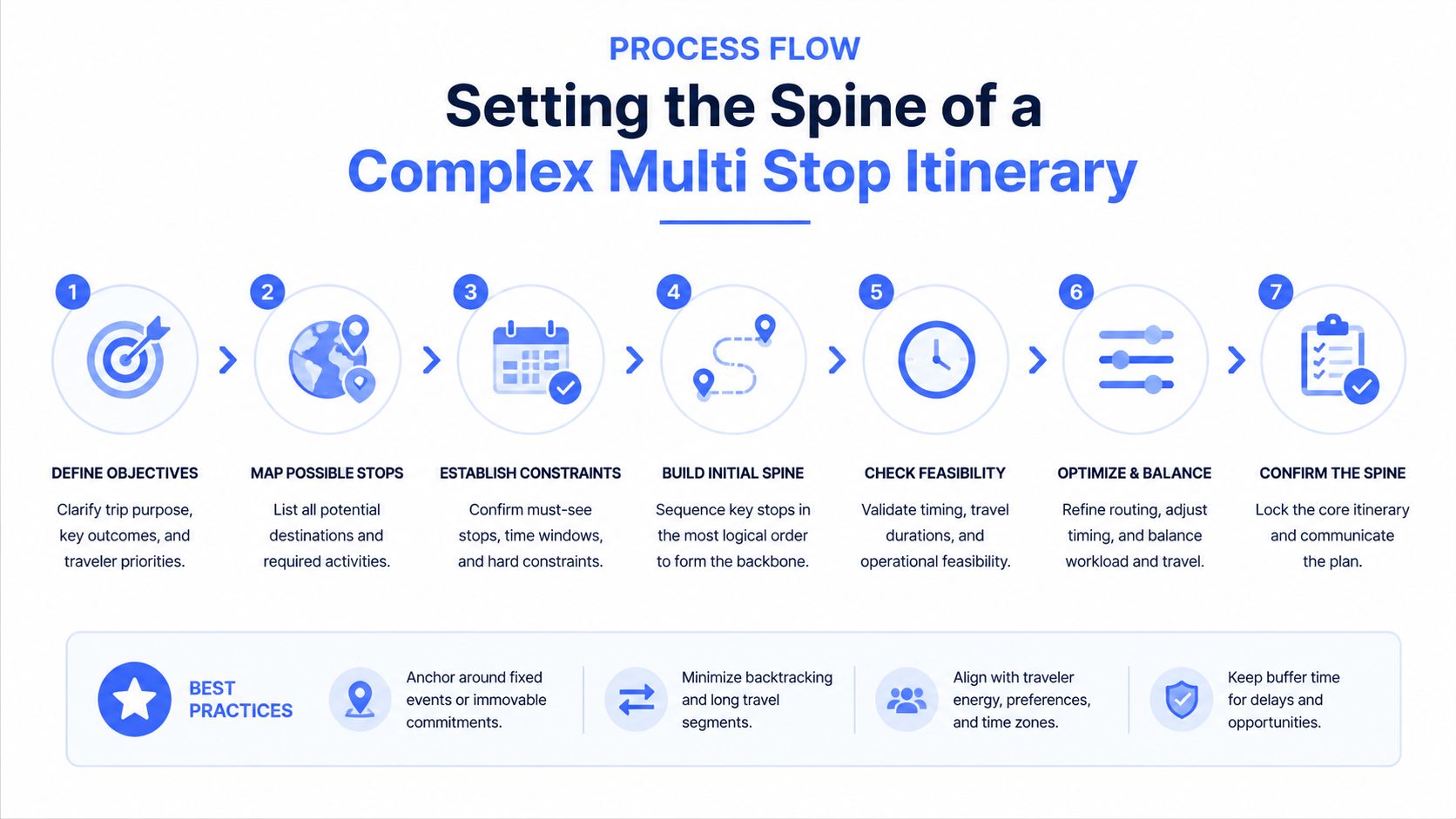
Start with the route shape, not the hotel search. Write the cities in sequence on one page and ask whether the direction makes geographic and practical sense before you look at room categories or excursions. A route that appears luxurious can still waste hours through unnecessary backtracking.
Build the itinerary in the right order
First, define the pacing windows. Give long-haul arrivals enough time for sleep, adjustment, and schedule recovery. I generally prefer at least two nights for a transcontinental hop, especially when the stop includes a meeting, celebration, or time-sensitive experience. That isn't a guarantee of comfort, but it creates a more credible rhythm than treating every arrival day as a full sightseeing day.
Next, choose anchor stays. One flagship property in each city should serve as the base for nearby excursions and appointments. Moving hotels every night creates additional packing, transfers, check-in coordination, and opportunities for luggage to fall behind. A well-selected anchor stay often delivers more luxury than a longer list of addresses.
Then, weight the purpose of each stop. Business, leisure, family time, and recovery should each receive space on the calendar before you add restaurants, tours, or shopping appointments. If you fill every open block with activity, the itinerary has no capacity to absorb a delayed flight or a client meeting that runs long.
Keep one controlling document
Before anything becomes final, create a one-page summary listing dates, cities, the purpose of each stop, transport mode, hotel, key contacts, and the contingency plan. Your full itinerary can include every confirmation and address, but the summary should answer the urgent question quickly: where am I going, why am I going there, and what happens if this connection changes?
A peer-reviewed model for multi-city travel frames itinerary optimization around total trip cost, a finite time horizon, stop durations, and fixed-departure transport schedules. That approach reflects how I plan in practice. Sequencing, time allocation, and transport feasibility must be considered together, not in separate booking windows. See the peer-reviewed multi-city itinerary optimization model for the underlying methodology.
Choosing the Right Routing Strategy for Your Trip
The correct routing pattern depends on your priorities. A traveler carrying formalwear for a wedding needs a different structure from an executive visiting regional offices or a family using one resort as a base.
Compare the main patterns
| Pattern | Best Use | Time Cost | Example |
|---|---|---|---|
| Linear | Regional touring with a clear direction | Moderate, with little backtracking | Paris to Geneva to Milan |
| Open-jaw | Point-to-point travel across a region | Lower when returning to the origin would waste time | Fly into London and depart from Rome |
| Hub-and-spoke | One principal base with day trips or short hops | Lower relocation burden | Base in Tokyo for Kyoto and Hakone |
| Chain with a pivot | Trips built around a required mid-route meeting | Depends on the pivot and connection timing | Paris to Zurich for meetings, then onward to Milan |
A linear route is straightforward, but it can force an inconvenient return to the original airport. An open-jaw itinerary, flying into one city and home from another, often removes that unnecessary leg and can recover a meaningful portion of a travel day. A hub-and-spoke plan minimizes hotel changes, which makes it particularly useful when comfort and predictability matter more than checking off another address.
The hybrid pattern deserves more attention. If one city is fixed because of a board meeting, wedding, or family gathering, place it deliberately as the pivot rather than forcing the leisure portion to dictate the entire route. I'll then assess the best direction of travel, the luggage burden, and the number of times you need to pass through a major hub.
For readers who want to understand the technical side of sequencing stops, Waymap's explanation of vehicle routing algorithm solutions offers useful background. The same logic can inform travel planning, although a luxury itinerary also has to account for sleep, service quality, fixed reservations, and personal priorities.
For complex air travel, review my guide to the best way to book multi-city flights before treating a collection of one-way tickets as a finished plan.
Flights, Trains, Transfers, and Luggage Across Multiple Stops
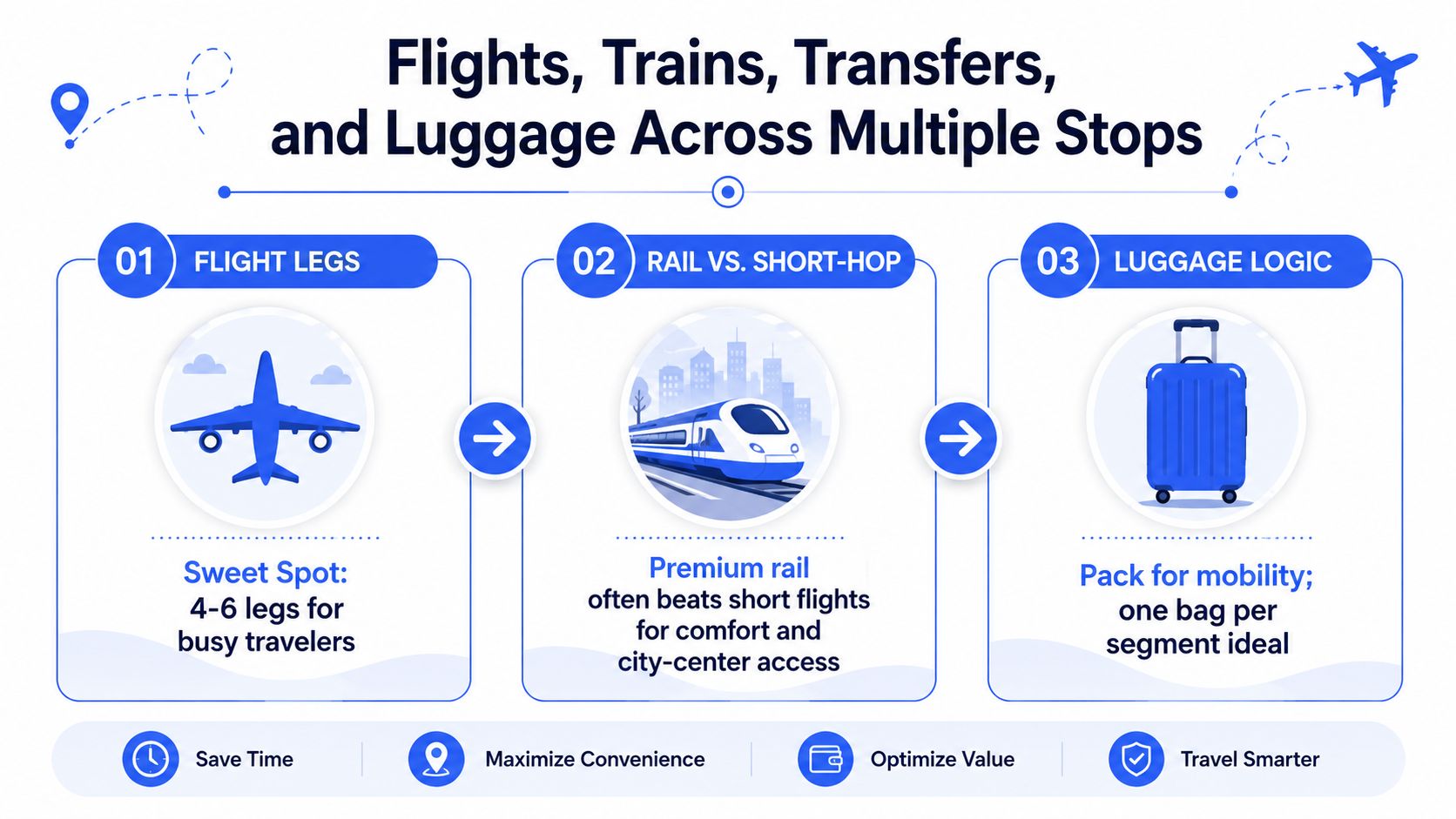
Transport is where attractive itineraries most often become impractical. For many busy travelers, four to six flight legs is the workable range, but the right number depends on geography, meeting obligations, and how much recovery time the schedule allows. Every additional segment adds another departure process, another potential delay, and another handoff between airlines, airports, drivers, and hotels.
Premium rail often beats a short-hop flight when it connects city centers. London to Paris, Tokyo to Kyoto, and Zurich to Milan can be more comfortable by rail because the journey may reduce airport transfers and make luggage handling simpler. I compare total door-to-door time, not just the scheduled duration printed beside a flight.
Private aviation can make sense on a third or fourth leg when fatigue, remote access, or a fixed event changes the value equation. That isn't about showing off. It's about deciding whether a transfer-heavy commercial itinerary is worth the strain when the next day carries professional or personal importance.
Choreograph the handoffs
Arrange airport greeters and fast-track services where they reduce friction. At private terminals, keep the car file pre-cleared so the transfer doesn't begin with a hunt for the driver. For rail, time the hotel-to-station handoff around local traffic, not the optimistic drive time shown on a quiet map.
My firm rule is simple:
Connection rule: Never book a connection under ninety minutes at a foreign hub unless fast-track and lounge access are confirmed.
Luggage deserves its own strategy. Pack for seven to ten days, use hotel laundry, and consider forwarding a soft suitcase ahead by courier when a tight turn makes the airport carousel a liability. Photograph every bag and its contents, and tag every piece with current contact details. One bag per segment is an ideal target, but the broader goal is mobility, not a heroic attempt to travel with less than your itinerary requires.
For practical planning around payment logistics, seamless spending abroad advice can help you think through access to funds while moving between countries. For broader air-travel considerations, use my guide to booking international flights as part of the preparation process.
Visas, Documents, Budget, and Contingency Planning
Readiness is one integrated exercise. A visa that arrives late can invalidate flights, a missing certificate can interrupt an otherwise flawless itinerary, and an unplanned medical event can change the route entirely. I review these items together because they affect the same calendar.
Audit entry requirements early
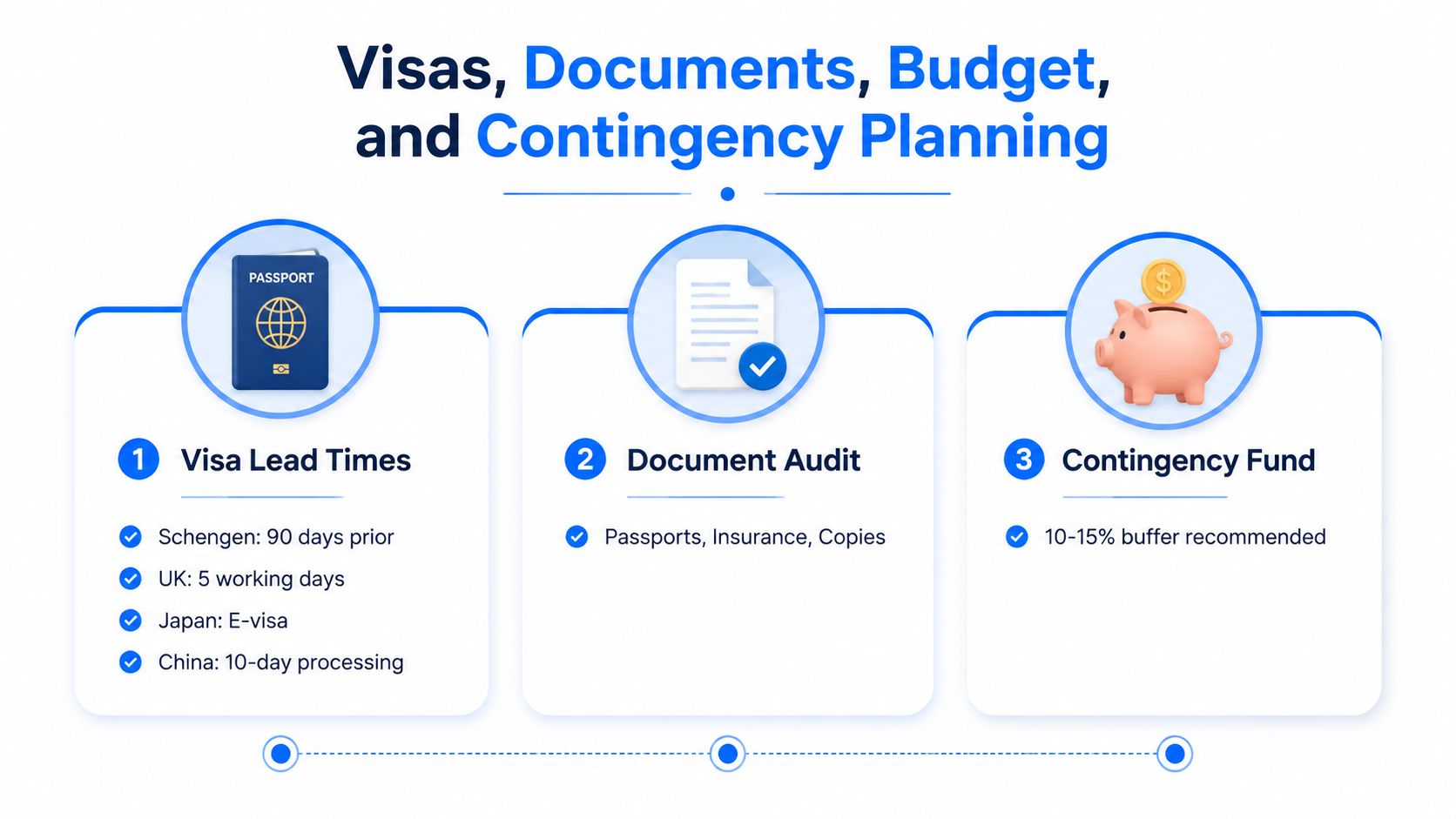
Build a destination-by-destination document matrix. Depending on the itinerary, that may include Schengen applications filed ninety days ahead, UK processing of five working days, a Japan e-visa, and China processing of ten days, as outlined in the planning brief. Requirements can change, so verify current rules with official government sources before departure.
Keep document copies in encrypted cloud storage and a separate phone wallet. Add the items travelers often overlook:
- Health documentation: Confirm whether a yellow fever certificate applies to your route.
- Special permissions: Check drone permits before packing equipment.
- Medication records: Carry prescription letters, translated where required.
- Exit evidence: Keep proof of onward travel available when an authority or carrier requests it.
Set financial and recovery guardrails
Set a per-night ceiling before flights are finalized. That protects the trip from becoming a collection of beautiful but disconnected upgrades. Hold an in-trip float of 10%, and pre-wire concierge funds to hotels in jurisdictions where card rules or processing can create delays.
The main failure modes are predictable: a missed connection, a medical event, or political disruption. Mitigation should be equally concrete. Keep backup flight options identified, choose travel insurance with evacuation benefits that fit the itinerary, save embassy contacts, and approve a written reroute plan before departure.
If your itinerary includes a pet, review how to travel internationally with a dog early. Requirements can involve documents, timing, carriers, and destination rules, so this cannot be left to the final packing week.
My final readiness call checks passport validity, entry requirements, transport confirmations, hotel arrival notes, insurance, emergency contacts, and the first recovery option for every critical leg. Conditions can change, so travelers should also review official government advisories and local guidance before leaving and remain aware of their surroundings throughout the trip.
When a Luxury Travel Advisor Becomes Your Multi Stop Journey Planner
A luxury travel advisor earns their place in a multi-stop itinerary by managing relationships and consequences, not by forwarding a list of links. On a four-city trip, the work can include coordinating inventory across multiple booking channels, reconciling property-specific benefits, sequencing arrivals so each hotel knows who is coming, and keeping the plan legible across time zones.
You gain a single point of accountability when the schedule changes. That may mean coordinating a new transfer after a delayed arrival, informing the next property, protecting a celebration reservation, or deciding which part of the itinerary should move first. A stochastic travel-itinerary model that accounts for traffic uncertainty improved worst-case itinerary reliability by almost 40% against two benchmark models, according to this comparative study. The lesson is practical. A plan that acknowledges uncertainty is stronger than one that assumes every transfer will run perfectly.
There's an honest tradeoff. Advisor fees apply, you'll need to share preferences openly, and last-minute impulse changes become harder once suppliers and timed services are coordinated. In exchange, busy travelers can reclaim substantial planning time, access preferred partner perks where available, and avoid becoming the project manager for their own vacation.
I work with clients nationwide through virtual consultations. My credentials include Circle of Excellence Advisor, Top 5 percent at Nexion, and CLIA Accredited Cruise Counselor. For a detailed look at advisor-led planning, see custom trip planning.
My threshold is clear. If the trip exceeds three cities, crosses more than one visa regime, or carries professional stakes such as a board meeting, milestone celebration, or multigenerational family gathering, self-planning usually delivers diminishing returns.
A Sample Advisor Workflow and Final Planning Checklist
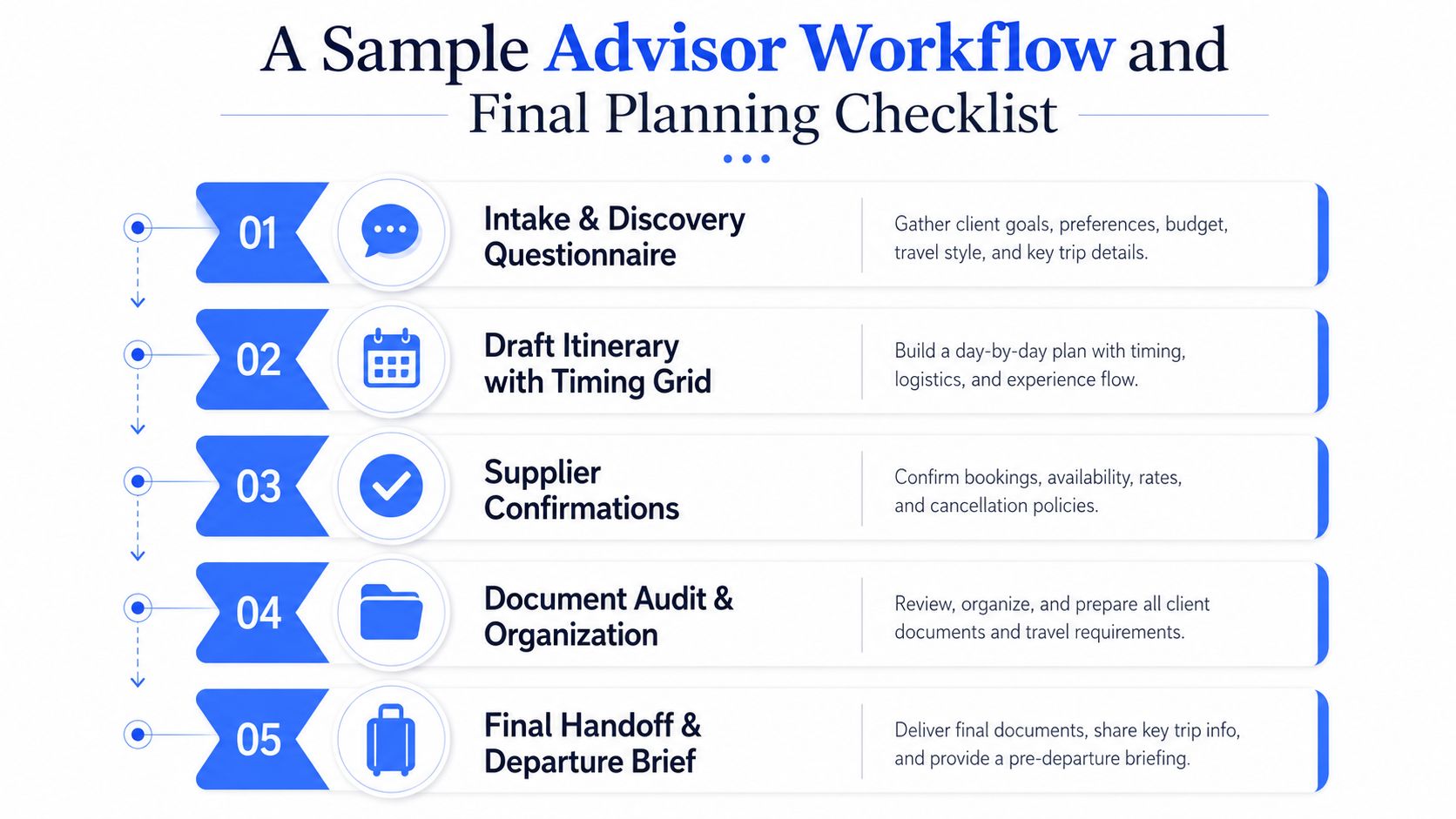
The process starts with a discovery questionnaire and conversation. I need to know what the trip must accomplish, which moments are essential, how you sleep after long-haul travel, what you refuse to compromise on, and where you're willing to trade time for privacy or convenience.
The first draft is a timing grid, not just a list of reservations. It shows departure windows, airport or station transfers, hotel check-in, meeting commitments, recovery space, and the contact responsible for each handoff. After you approve the shape, I coordinate confirmations, review documents, and prepare the final departure brief.
Save this planning checklist
- Define the purpose: Mark business, celebration, family, leisure, and recovery stops.
- Draw the route: Choose linear, open-jaw, hub-and-spoke, or a hybrid pivot.
- Protect the rhythm: Allow realistic arrival recovery before important commitments.
- Select anchor stays: Reduce unnecessary hotel changes and luggage transfers.
- Confirm transport: Compare flights, premium rail, private transfers, and any private aviation requirement.
- Audit entry rules: Verify visas, passports, certificates, permits, prescriptions, and onward-travel evidence.
- Prepare luggage: Photograph bags, tag every piece, plan laundry, and arrange forwarding if appropriate.
- Approve contingencies: Identify responses to missed connections, medical events, and political disruption.
- Complete the handoff: Carry the one-page summary, full confirmations, emergency contacts, and final timing grid.
This checklist works best as a guided handoff, not as an invitation to manage every detail alone. Explore Effortlessly includes day-by-day schedules, transport details, booking confirmations, drivers, guides, and hotel information in the planning file, then coordinates the moving pieces before departure. The agency works with clients nationwide through virtual consultations.
Karrah is the owner, founder, and lead travel advisor at Explore Effortlessly, a luxury award-winning travel agency based in Miami. She specializes in bespoke, high-touch itineraries to bucket-list destinations, including luxury cruises, private villas, honeymoons, safaris, and once-in-a-lifetime journeys, with planning focused on thoughtful design and smooth logistics from start to finish.
Explore Effortlessly designs and manages complex multi-stop journeys with coordinated flights, hotels, private transfers, guides, and contingency planning, so your time stays focused on the experience rather than the logistics. Visit Explore Effortlessly to begin a virtual consultation, and contact the advisor to plan your luxury trip. Join the Explore Effortlessly newsletter for future travel guidance.