You've probably done this already. It's late. Your workweek ran long. You finally sit down to plan the trip you've been promising yourself for months, maybe your honeymoon, maybe a milestone anniversary, maybe the family vacation that has to go right because nobody's calendars will line up again soon.
Then the tabs multiply.
One hotel looks beautiful but is in the wrong part of town. Another has polished photos and weak logistics. Transfers don't line up. The villa that seemed perfect is too isolated. The cruise itinerary looks elegant until you realize the pacing is punishing. What should feel exciting starts feeling like unpaid project management. For a villa stay, I would look at planning a villa with a private chef before comparing properties.
That's exactly why personalized vacation planning matters. For busy professionals, it isn't an indulgence. It's a way to protect your time, your money, and the quality of a trip you may only take once.
Key takeaways
- Personalized vacation planning is design work: It's not just reserving hotels and flights. It's building a trip around how you travel.
- AI can help, but it can't replace judgment: Technology is useful for inspiration and drafting. Human oversight is what catches timing problems, weak supplier choices, and poor fit.
- Luxury travel gets expensive when the plan is wrong: A badly chosen hotel, a missed transfer window, or an overstuffed itinerary costs more than expert planning.
- The right advisor saves time and reduces decision fatigue: You stop sorting through noise and start making a few smart, curated decisions.
- The value is measurable in experience: Better pacing, stronger room selection, smoother logistics, and access to preferred partner perks all change the trip.
Your Time Is Your Most Valuable Asset
A successful client once described trip planning to me this way. “I can run a company meeting with eight stakeholders, but I cannot spend another Sunday comparing Greek islands.”
That's the core issue. High-income travelers aren't short on ideas. They're short on trustworthy filtering. They don't need more options. They need someone to eliminate the wrong ones fast, then build the right trip cleanly.
The hidden cost of doing it yourself
DIY planning usually fails in the same places:
- Too many choices: Beautiful properties, vague reviews, and endless opinions create decision fatigue.
- Poor sequencing: A lovely itinerary on paper falls apart when flights, ferries, check-in times, and touring windows don't connect.
- Wrong-fit bookings: Clients choose a hotel because it's fashionable, then realize it's not ideal for privacy, family needs, recovery time, or access.
- No quality control: Nobody pressure-tests the plan before money is committed.
Practical rule: The more expensive and complex the trip, the less sense it makes to rely on scattered online research.
Why this matters more for luxury travel
Luxury travel has higher stakes. A premium room category, a private driver, a suite on a cruise, or a villa stay can be extraordinary when chosen well. They can also be overpriced disappointments when chosen badly.
That's why I'm direct about this. Personalized vacation planning is an investment in outcome, not just convenience. You're not paying to avoid clicking around online. You're paying to avoid expensive mistakes, wasted time, and a trip that looks good on a confirmation email but feels clumsy in real life.
If your schedule is already full, your vacation shouldn't become another job.
What Personalized Vacation Planning Really Means
Personalized vacation planning isn't an old-fashioned booking service with a fresh coat of paint. It's closer to hiring an architect than buying a floor plan from a catalog. One gives you a structure designed around your life. The other gives you something generic and asks you to make it fit.

It's not about booking more. It's about designing better.
A bespoke trip starts with questions many travelers overlook when planning their own journeys.
Do you want energy or quiet? Do you recover best with three nights in one place or by moving often? Do you care more about a grand suite, a legendary spa, a private guide, or an effortless family setup with connecting accommodations and realistic transfer times?
That's the architecture of the trip. The right destination matters, but so do pacing, room category, daily rhythm, local partners, dining cadence, and how much friction you're willing to tolerate.
If you want to see what that kind of high-touch design looks like in practice, bespoke travel experiences are built around those details from the beginning rather than patched together after booking.
AI is useful. It is not enough.
Travelers are already using AI heavily for planning. In 2025, approximately 40% of global travelers actively used AI-based systems to create itineraries, over 60% expressed openness to trying them, and 62% of Millennials and Gen Z travelers in key markets were already using generative AI for trip discovery and planning, according to this roundup of 2025 travel AI adoption data.
That doesn't surprise me. AI is fast. It can surface ideas, suggest neighborhoods, organize rough itineraries, and help narrow style preferences.
But many travelers make the wrong leap. They assume a polished draft equals a viable trip.
The key challenge in modern trip planning is not a lack of options, but a lack of expert validation. While consumers are using AI for inspiration, the most successful and seamless itineraries combine automation with human oversight to quality-check logistics, timing, and supplier reliability for complex, high-stakes trips, a gap that pure technology cannot yet fill.
That point from Touring and Cruises on bespoke vacation planning is exactly right.
Where human judgment still wins
Human judgment matters when the trip has consequences. Honeymoons. Milestone birthdays. Multi-country Europe. Expedition cruises. African safaris. Family trips with multiple ages and very little flexibility.
AI can suggest “stay in the countryside for peace.” A real advisor asks whether that countryside property creates punishing transfer times, weak dinner options, or too much isolation for the way you like to travel.
For inspiration, broad destination resources can still be useful. If you're considering a romantic Central European escape, this guide to romantic Slovenian getaways shows the kind of destination texture people often want before in-depth curation begins. But inspiration is only the first step. Turning ideas into a smoothly executed luxury trip is another skill entirely.
The Four Phases of a Bespoke Travel Experience
Luxury travel should feel effortless for the client because someone else is doing the detailed work. That work usually follows four distinct phases. When it's done properly, each phase protects the next one.
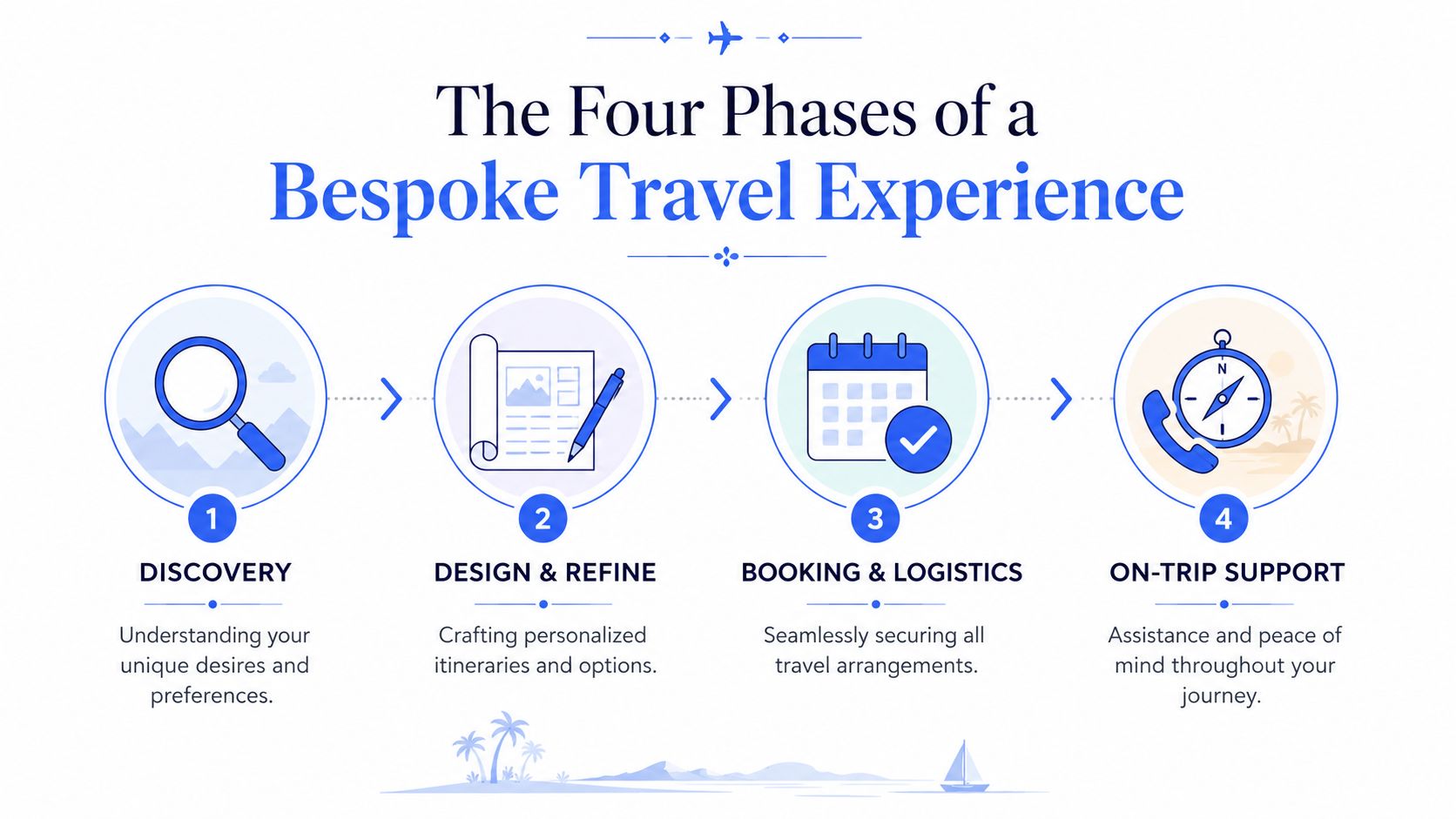
Discovery
The first phase is not “Where do you want to go?”
It's deeper than that. A good advisor asks how you like to travel, how much structure you want, what usually frustrates you on trips, what standard of hotel service you expect, whether privacy matters more than scene, and how much movement feels energizing versus exhausting.
This is also where practical constraints surface. School breaks. Work blackout dates. Nonstop flight preferences. Mobility concerns. Dining priorities. Spa time. Suite requirements. Private touring versus independent time.
A well-run discovery phase saves everyone time because it eliminates options that were never right for you.
Design and refine
At this stage, the trip takes shape.
A thoughtful proposal doesn't dump dozens of choices in your lap and ask you to do the final sorting. It narrows the field. It presents a coherent direction with strong-fit options, clear tradeoffs, and sensible pacing.
You should expect refinement here, not chaos. Maybe the city stay needs one less night. Maybe the beach portion deserves the better suite because that's where you'll spend time. Maybe a rail segment looks elegant but a private transfer is the smarter call after a long-haul arrival.
A good itinerary doesn't just fit your wishlist. It respects your energy.
Booking and logistics
Once the design is right, execution matters.
This phase includes securing accommodations, transportation, cruise components when relevant, private transfers, touring, special requests, and the details that clients often underestimate until they go wrong. Arrival strategy matters. So does room category. So does whether your transfer requires a meet-and-greet versus a simple driver dispatch.
For more complex travel, technology can help behind the scenes. A strong planning system often pulls data from sources like GDS, OTAs, POI databases, and user-generated content into a layered recommendation structure that supports dynamic itinerary building and real-time responsiveness, as described in this guide to AI trip-planning app architecture. Useful, yes. Still not a substitute for taste or judgment.
Pre-departure and on-trip support
Here, a good plan leads to a calm departure.
Final documents should be clear. Arrival flow should be obvious. Timing should be realistic. Reservation details should be confirmed. Any destination-specific considerations should be addressed before you leave, not discovered in an airport queue.
During travel, trusted in-destination partners and suppliers provide on-the-ground support while I coordinate the planning and logistics before departure. That model is what serious travelers want. They don't need generic reassurance. They need a well-built trip with reliable people attached to it.
DIY Planning vs An Expert Advisor for Luxury Travel
Let's make this simple. DIY planning feels cheaper because the research is invisible. But your time has value, and mistakes in luxury travel are expensive.
The side-by-side reality
| Aspect | DIY Planning | Expert Advisor (Explore Effortlessly) |
|---|---|---|
| Time commitment | Hours of research spread across nights and weekends | Curated options reduce your decisions to the ones that matter |
| Hotel selection | Based on reviews, photos, and guesswork | Based on fit, location logic, room category strategy, and supplier vetting |
| Itinerary pacing | Easy to overbook or under-plan | Built around energy, transfer times, and real travel flow |
| Problem prevention | You usually find issues after booking | Weak links are caught before confirmation |
| Value | Publicly visible offers may look fine but lack nuance | Planning can include preferred partner perks and smarter allocation of budget |
| Support | You manage changes and disruptions yourself | A professional coordinates the moving parts with trusted partners |
Why bespoke beats generic
The closest comparison is tailoring. Anyone can buy a jacket off the rack. The difference with bespoke is proportion, fit, fabric, and finish. If you appreciate that in clothing, you already understand why customized travel matters. This piece on expert insights on custom suits makes the point well. Precision changes the end result.
Travel works the same way. Two clients can spend in the same general range and have completely different outcomes based on pacing, room selection, airport strategy, and whether the itinerary was built around their actual preferences.
If you're weighing the tradeoff more directly, this page on working with vacation travel agents is a practical next step.
What clients usually regret
They rarely regret having an expert handle a major trip.
They regret the hotel that looked serene online but sat too far from everything. They regret the connection that was technically possible but miserable in practice. They regret turning a celebratory vacation into a spreadsheet exercise.
“I don't need more options. I need someone to tell me which option is right for this trip.”
That's the sentence I hear most often from busy clients once they've tried doing it alone.
The Investment and Return on Your Vacation
Planning fees make some travelers pause. Good. They should. You should understand what you're paying for.
But if you focus only on the fee, you miss the larger math. The return on personalized vacation planning shows up in three places. Time saved, value gained, and trip quality protected.

Financial return
A strong advisor doesn't magically make luxury travel cheap. That's not the point.
The point is using your budget well. Sometimes that means directing spend toward the suite or villa category that will materially improve the trip. Sometimes it means avoiding overspend on a property that's fashionable but not well suited to your priorities. Sometimes it means securing preferred partner amenities that improve value without changing the base trip structure.
That matters because traveler preferences are getting more specific. A 2025 survey found that a third of travelers prioritize personalized bundle deals and flexible booking, with over 40% planning romantic or family trips that demand deeper customization than standard packages provide, according to Zeta Global's 2025 travel trends survey.
Time return
This is the part busy professionals underestimate.
The trip itself may last ten days. The planning can consume weeks of scattered attention if you do it alone. Not because each task is huge, but because every decision creates three more. Which room category. Which region. Which transfer. Which daily rhythm. Which backup if weather changes. Which property matches the photos.
Delegating that work is rational. If your time is valuable in business, it's also valuable at home.
Experiential return
The fee often pays for itself emotionally.
Take a two-week Italian honeymoon. On paper, it sounds easy. Rome, Florence, countryside, Amalfi Coast. In reality, this trip can become messy fast if arrival timing is wrong, rail segments are poorly chosen, hotel locations create friction, or the pacing leaves no room to enjoy what you've paid for.
A good advisor shapes the experience so the trip breathes. The right number of nights. The right transfer strategy. The right balance between private touring and free time. The right hotel in the right neighborhood, not the one with the loudest marketing.
If you want a direct breakdown of the value question, is a travel agent worth it is worth reading before you commit to another DIY plan.
Questions to Ask Your Luxury Travel Advisor
You should absolutely vet the person planning your trip. A serious advisor won't be offended by smart questions. They'll expect them.
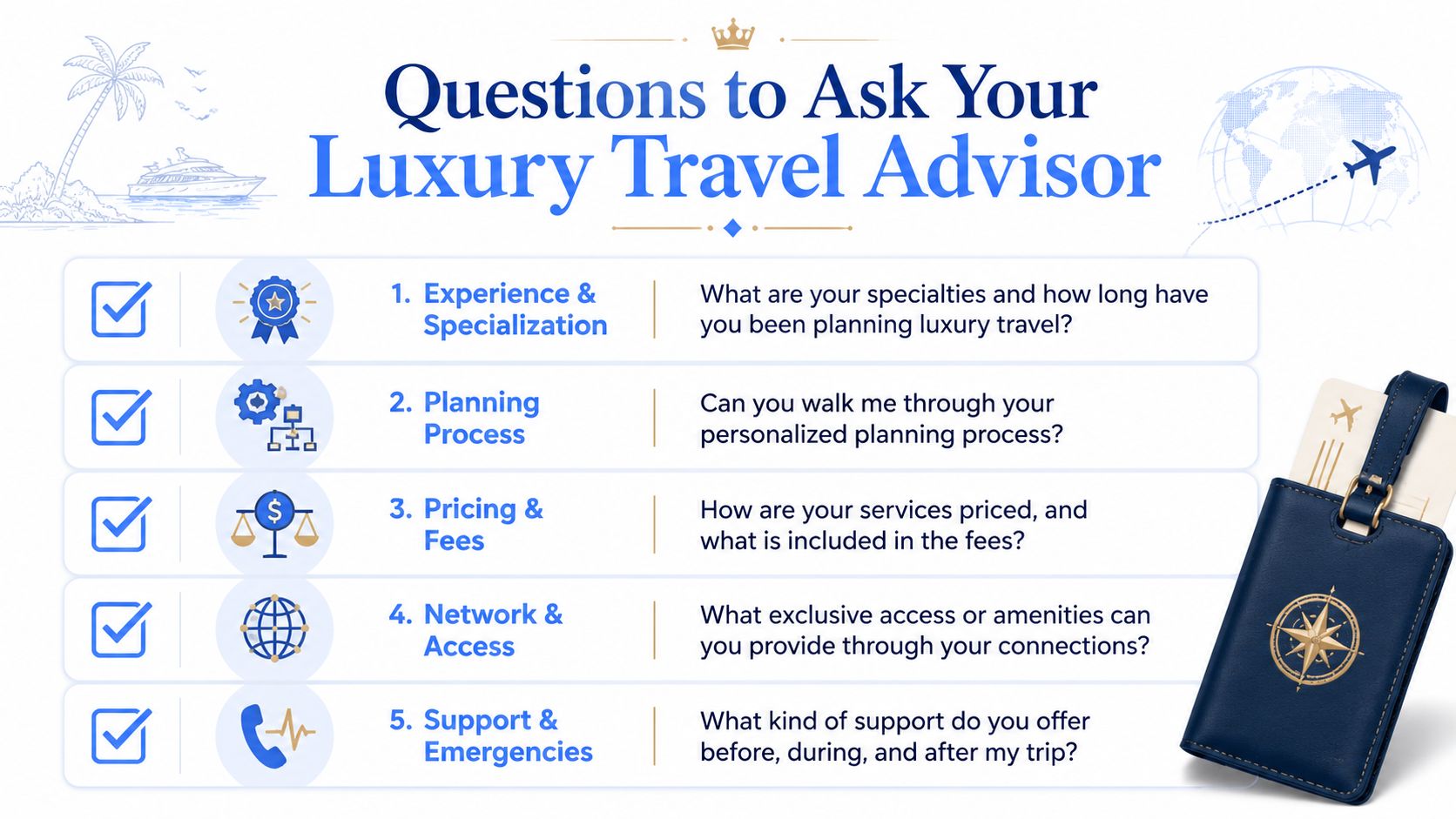
Ask these before you hire anyone
- What kinds of trips do you specialize in: You want someone who understands your style of travel, not just someone who can place bookings.
- What does your planning process look like: If they can't explain how they go from discovery to final documents, that's a problem.
- What do your fees include: Clarity matters. You should know what's handled, what's curated, and where the boundaries are.
- How do you vet hotels, guides, and local partners: Taste matters, but so does supplier reliability.
- What support structure is in place before and during travel: You want to know how issues are escalated and who handles what.
Look for credentials, yes. Then look for judgment.
I'd also tell you to look for proven professional standards. Circle of Excellence Advisor. Top 5 percent at Nexion. CLIA Accredited Cruise Counselor. Those signals matter because they reflect depth, not just enthusiasm.
Frequently Asked Questions About Personalized Planning
Is personalized vacation planning only for very complicated trips
No. It's most valuable when the trip matters. That could be a simple beach escape with high expectations or a multi-stop journey with many moving parts.
Can AI replace a luxury travel advisor
No. AI is useful for ideas and rough drafts. It doesn't reliably validate pacing, supplier quality, room strategy, or trip logic for high-stakes travel. Research from MIT showed that combining LLMs with a constraint solver achieved a 90% pass rate for valid travel plans, compared with less than 10% for baseline methods, which tells you something important. Travel planning works better when ideas are checked against real constraints, as outlined in MIT News coverage of AI trip-planning research.
Do I lose control if I work with an advisor
Not at all. You gain structure, filtering, and better options. You still make the key decisions. You just won't have to make all of them from scratch.
Do advisors only help with hotels
No. A real planning relationship can include overall itinerary design, flights, cruises, private transfers, touring, pacing, special requests, and coordination details.
Do you work only with local clients
No. Karrah works with clients nationwide through virtual consultations.
If you're done wasting evenings on travel tabs and want a trip designed around your time, priorities, and standards, you can plan my luxury trip with Explore Effortlessly. If you'd like more advisor-led travel insight before you inquire, join the Explore Effortlessly newsletter.
Author bio
Hi, I'm Karrah, owner, founder, and lead travel advisor at Explore Effortlessly, a luxury award winning travel agency based in Miami.I specialize in designing bespoke, high touch itineraries to bucket list destinations around the world. Every trip is curated with intention, insight, and seamless logistics from start to finish.
From luxury cruises and private villas to honeymoons, safaris, and once in a lifetime journeys, my role is to simplify the planning process while elevating every detail.