You’re probably doing what most busy travelers do when southeast asia tours first move from dream to actual plan. You open tabs for Thailand, Vietnam, Cambodia, Laos, and Singapore. Then you realize every choice affects the next one. Flight timings, border rules, hotel locations, guide quality, weather patterns, dining reservations, room categories, transfer times, and whether your “relaxing” trip now looks like a second job.
That’s the problem with Southeast Asia. It’s not hard because the region lacks options. It’s hard because it has too many, and the good ones don’t always announce themselves loudly online.
An Introduction to Effortless Southeast Asia Travel
Most online content about southeast asia tours still leans in one of two directions. Budget backpacking advice or generic group itineraries. That leaves a major gap for travelers who want privacy, polish, smart pacing, and someone to make the moving pieces work together without friction.
That gap matters because Southeast Asia is not a niche destination anymore. It’s a major luxury growth region. The Southeast Asia travel and tourism market is projected to grow from USD 39.52 billion in 2026 to USD 67.41 billion by 2031 at an 11.27% CAGR, with growth supported by visa reforms and infrastructure upgrades, according to Mordor Intelligence’s Southeast Asia travel market analysis. More interest is flowing in. More premium product is coming online. More travelers are competing for the best guides, suites, river itineraries, and private access.
Luxury in this region isn’t just a five-star hotel and a nice airport transfer. It’s a trip that flows. It’s landing in Bangkok and not wasting two days recalibrating because every transfer was scheduled badly. It’s seeing Angkor without feeling herded. It’s choosing the right bay in Vietnam, the right island in Thailand, the right suite on a Mekong sailing, and the right balance between iconic sites and breathing room.
Practical rule: In Southeast Asia, the most expensive mistake usually isn’t the hotel. It’s poor sequencing.
That’s where bespoke planning changes the experience. The right itinerary turns a chaotic, multi-country puzzle into one smooth story. You don’t feel the mechanics. You just enjoy the trip.
I’m Karrah, and this is how I think about southeast asia tours for clients who want the region done properly. With taste, with strategy, and without wasting precious vacation time.
Key Takeaways For Your Luxury Southeast Asia Tour
If you only read one section before deciding how to approach southeast asia tours, read this one.
A tour and a bespoke journey are not the same thing. A standard tour prioritizes easy packaging. A luxury journey prioritizes pace, privacy, and the details that matter to you.
Multi-country travel works best when the route is edited hard. More stops do not make a trip more impressive. They usually make it more tiring.
The best luxury format depends on how you travel. Some clients want a fully private itinerary. Others prefer a refined small-group structure with private add-ons before or after.
Logistics are part of the luxury. The right flights, airport support, private drivers, room categories, and realistic transfer times matter as much as the resort itself.
Southeast Asia rewards specialization. Thailand, Vietnam, Cambodia, Laos, and Singapore can work beautifully together, but only if someone understands how the pieces connect in real life.
Romance, family travel, food-focused trips, and cruises all need different design logic. Copy-paste itineraries don’t hold up for high-touch travel.
The internet is good at inspiration, bad at curation. Most travelers can find beautiful places. Fewer can build a trip that feels effortless from start to finish.
The best southeast asia tours don’t try to show you everything. They show you the right things, in the right order, at the right tempo. If Europe is next, I apply the same pacing test to a Budapest, Vienna, and Prague journey rather than treating three cities as a checklist.
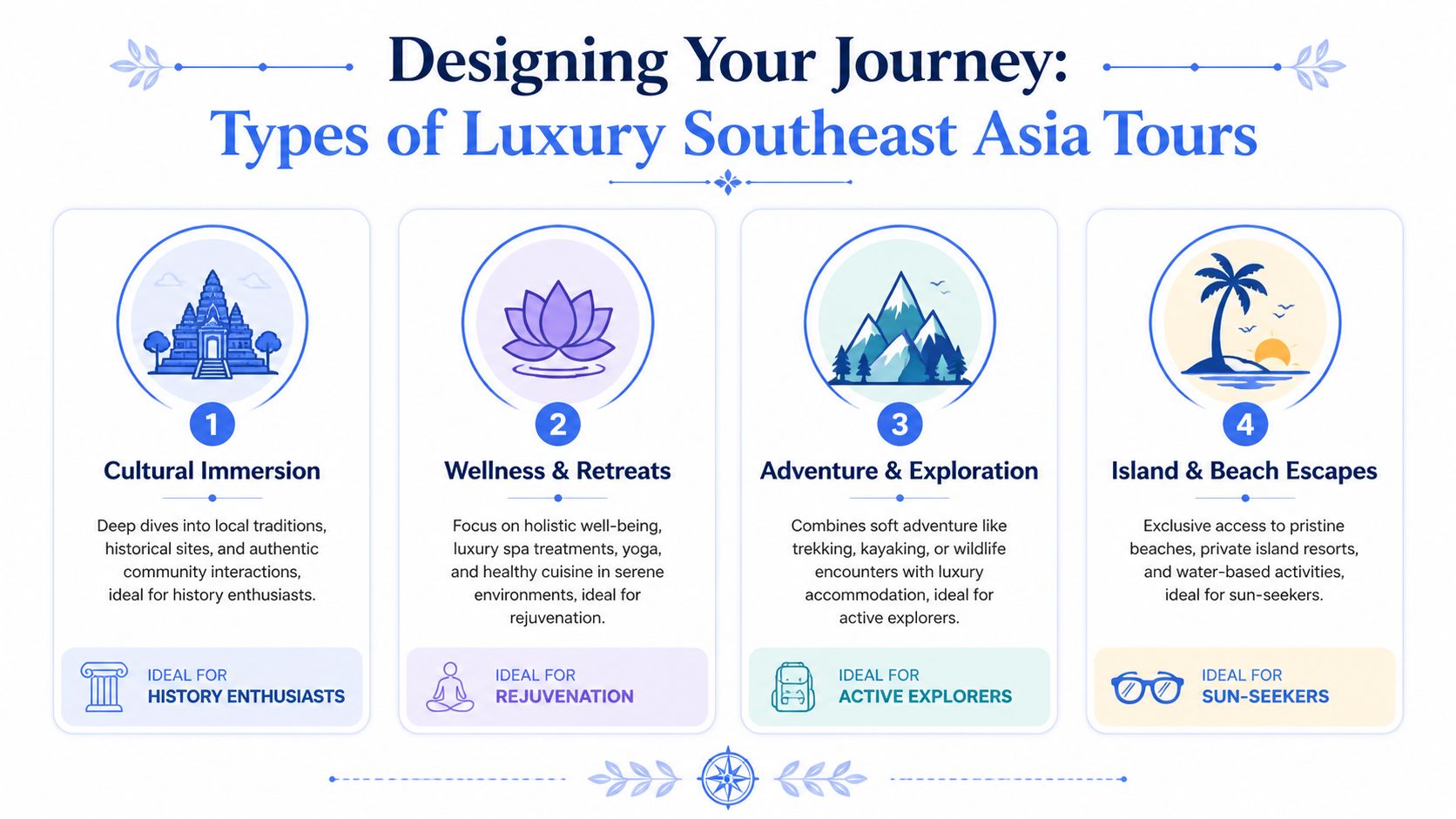
Designing Your Journey Types of Luxury Southeast Asia Tours
There’s no single correct way to do Southeast Asia in style. There is, however, a wrong way. Booking a trip shape that doesn’t match how you like to travel.
Private bespoke journeys
This is the best fit for travelers who want control, privacy, and flexibility. You have your own guides, your own drivers, and a route built around your interests instead of a departure calendar.
If you care about private temple access at quieter hours, villa stays, culinary reservations, custom pacing, or mixing city, jungle, river, and beach without feeling rushed, this is the format I’d recommend first. It’s also the strongest option for milestone travel, honeymoon trips, and travelers who don’t want to spend their vacation compromising with strangers.
For a closer look at how high-touch itineraries come together, explore bespoke travel experiences.
Refined small-group tours
Not every client wants fully private travel. Some like the social energy of a group but still want standards. In that case, small-group formats can work very well, if the operator, pacing, and add-on planning are right.
The numbers here are clear. Data from over 204,000 traveler reviews shows that small-group tours capped at 12 to 16 guests achieve 20 to 30% higher satisfaction rates on authenticity metrics than large-bus tours, according to All Points East’s review-based analysis. That makes sense. Smaller groups move faster, access more interesting places, and avoid the deadening effect of standing around in a cluster with forty other people.
Here’s my opinion. If you’re going to join a group in Southeast Asia, keep it small or don’t bother.
Romance and honeymoon itineraries
Southeast Asia is excellent for couples, but only if the itinerary avoids the usual honeymoon trap. Too much moving, too many early mornings, too many “must-see” stops. Romance needs margin.
A strong honeymoon route might pair a polished city stay in Singapore or Bangkok with a few atmospheric nights in northern Thailand, Siem Reap, or Hoi An, then finish with a beach or private island feel. The room matters. The dining matters. The transfer quality matters even more because nothing kills the mood faster than a clumsy connection day.
Build honeymoon southeast asia tours around mood shifts, not country counts.
Family and multigenerational travel
Families need a different kind of luxury. Not formal. Functional. Interconnecting rooms or private villas, guides who know how to read energy levels, activities with range, and enough downtime that the adults don’t come home needing another vacation.
Thailand and Vietnam are often especially strong here because they offer urban contrast, good resort infrastructure, and experiences that work across generations. Cambodia can be wonderful with the right pacing. Laos is better for families who enjoy a gentler, quieter rhythm.
River and sea-based journeys
Cruising is one of the smartest ways to reduce travel fatigue in the region. The Mekong is especially compelling for clients who want cultural depth without daily repacking. It’s immersive but comfortable, and the scenery does some of the work for you.
For island-focused travelers, pairing a land itinerary with a luxury sailing segment can also create an elegant split. The key is not to force cruise time into the trip just because it sounds elevated. It needs to fit the traveler.
A quick decision guide
| Travel style | Best for | Watch out for |
|---|---|---|
| Private itinerary | Maximum flexibility, privacy, milestone trips | Overbuilding the route |
| Small-group luxury | Social travelers who still want quality | Choosing groups that are too large |
| Honeymoon journey | Couples who want atmosphere and ease | Overpacked schedules |
| Family itinerary | Mixed ages and varied interests | Too many hotel changes |
| River or yacht-based trip | Travelers who value smooth logistics | Poor fit if you want total spontaneity |
Destination Spotlights Curated by Your Travel Advisor
The best southeast asia tours are built around interests, not just map pins. A beautiful trip feels personal because each stop earns its place.
For the culinary traveler
Thailand is electric for food. Bangkok gives you range, from polished tasting menus to fulfilling local meals that don’t need theatrics. Northern Thailand adds a different note, with slower mornings, richer regional flavors, and a more intimate cultural mood.
Vietnam is just as compelling, but in a different register. Hanoi is layered and lively. Hoi An is softer and more romantic. Ho Chi Minh City brings modern energy and a stronger urban edge. For clients who care about food, I usually think in contrasts. One city for street-level flavor and one for refinement, then a resort stop where dining becomes part of the exhale.
Singapore belongs in this conversation too. Some travelers dismiss it because it feels too easy. I disagree. Singapore is fantastic at the front or back end of a longer itinerary because it gives you precision, great hotels, and a polished landing or finish.
For history and culture
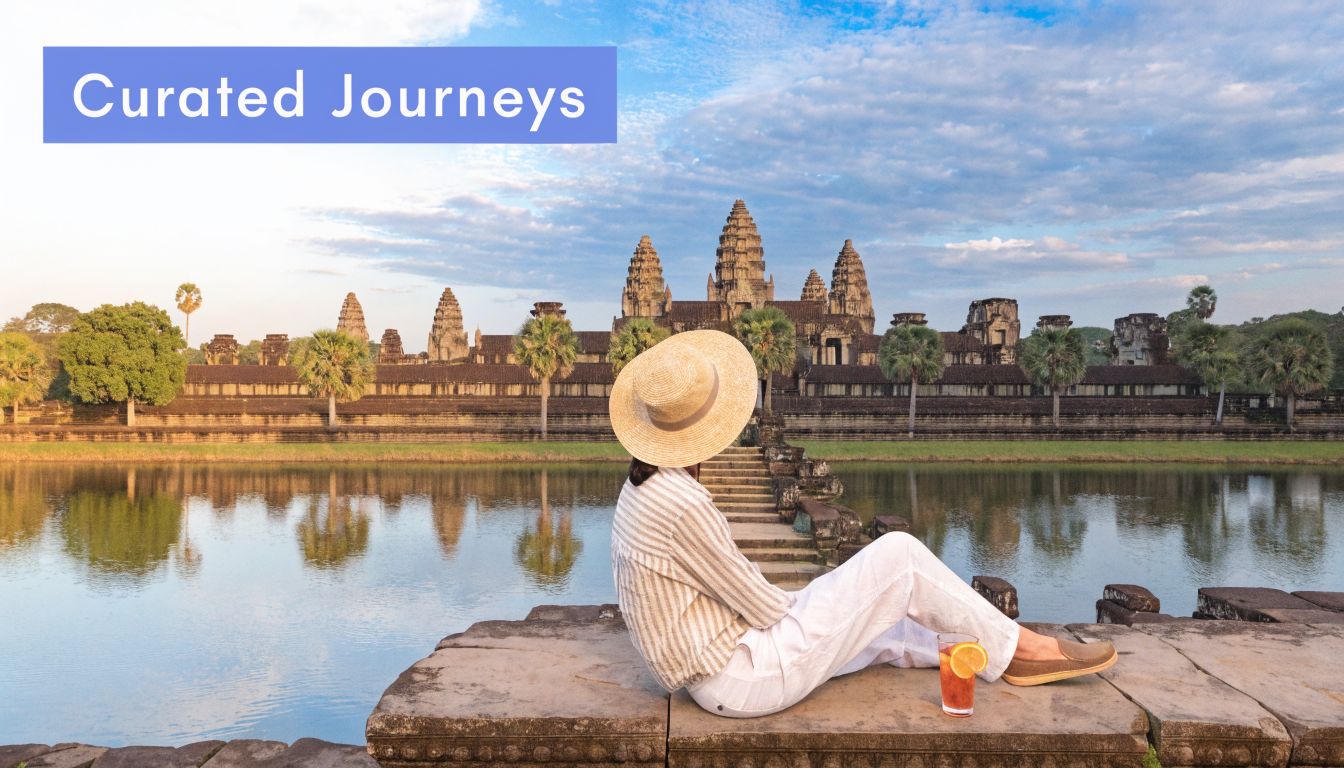
Cambodia is essential if ancient scale and spiritual atmosphere matter to you. Angkor deserves its reputation, but it should be approached intelligently. Timing, guide quality, and where you stay matter more than most travelers realize. A rushed visit turns one of the world’s great cultural sites into a photo stop. That’s a waste.
Laos offers a very different cultural experience. It’s less dramatic in volume, more subtle in tone. Luang Prabang is ideal for travelers who want beauty without noise. It pairs especially well with Cambodia because the contrast sharpens both experiences.
Vietnam can deepen this kind of trip beautifully. The country gives you imperial history, French colonial layers, religious sites, market life, and a stronger sense of movement between past and present. If that combination appeals to you, consider a more personalized Vietnam and Cambodia trip.
Angkor should feel monumental. Luang Prabang should feel unhurried. Vietnam should feel alive. If your itinerary delivers all three in the same emotional tone, it’s not designed well enough.
For beach and island time
Thailand remains the obvious choice for clients who want a strong beach finish. The mistake is assuming every island works for every traveler. Some are social and scene-driven. Some are calmer. Some feel polished. Some feel overexposed.
Vietnam can also deliver coast, but it does so differently. Its luxury beach experience often feels more understated and integrated into a broader cultural trip. That can be a major advantage for travelers who don’t want the trip to end in a generic resort bubble.
For clients who care more about seclusion than seeing famous names, I often favor quieter coastal combinations over the obvious island checklist. Better beach time starts with honesty about what kind of stillness you want.
For urban sophistication
Singapore is the cleanest urban contrast in the region. It’s efficient, stylish, and easy to love if you appreciate service, architecture, and excellent dining. It’s also useful. Starting there can smooth arrival into Southeast Asia. Ending there can give a trip a sharp, polished finale.
Bangkok is more layered and more thrilling. It’s a better fit for travelers who enjoy energy, contradiction, and a city that reveals itself slowly. I’d never treat Bangkok as just a transit stop if the client likes food, design, and culture.
My destination matching approach
- Choose Thailand if you want strong resort options, food, and flexibility.
- Choose Vietnam if you want variety and a trip with real texture.
- Choose Cambodia if Angkor is a priority and you want a culture-led stop.
- Choose Laos if you value calm, spirituality, and slower pacing.
- Choose Singapore if you want urban polish and an easy gateway city.
Crafting the Perfect Flow Sample Multi-Country Itineraries
A strong Southeast Asia itinerary should feel like a film with good editing. Every scene has a purpose. Nothing drags. Nothing feels jammed in because a map said it was nearby.
That matters because the payoff for good planning is measurable. Analysis of over 204,000 reviews shows that expertly managed multi-country Southeast Asia tours deliver a 25% increase in the quality of the experience by cutting transit disruptions by 35% compared with self-planned trips, according to this review-based analysis of multi-country tour performance. I’m not surprised. The more countries you add, the more logistics shape the emotional quality of the trip.
The Indochina arc
This is one of my favorite structures for travelers who want culture first.
Start in Hanoi for atmosphere, history, and food. Then move to central Vietnam for a visual and emotional shift. From there, continue to Siem Reap for Cambodia’s monumental cultural weight. Finish in Luang Prabang, where the pace softens and the trip ends gently instead of ending in a rush.
Why it works:
- The rhythm improves as you go. You begin with urban energy and end in calm.
- The contrast feels deliberate. Vietnam gives motion. Cambodia gives grandeur. Laos gives release.
- The final stop restores you. That’s smart luxury.
The Thailand and Vietnam split
This route suits travelers who want one side of the trip to feel cosmopolitan and one side to feel restorative.
Open in Bangkok. Stay somewhere with a strong sense of place, not just a convenient chain option. Then head north for culture and greener scenery. After Thailand, fly into Vietnam for a combination of city, coast, and food-led experiences, ending at a beach resort or quiet coastal property that feels polished rather than busy.
This format is especially good for couples and clients who want a more stylish contemporary feel without losing substance.
If flight complexity is one of the reasons you keep postponing the trip, my advice on the best way to book multi-city flights will help you understand why the air structure often determines whether the trip feels elegant or exhausting.
The Singapore, Cambodia, and beach finale
Some travelers want fewer moving parts but still want contrast. This itinerary does that well.
Begin in Singapore. It’s an easy arrival city, and it gives you a clean start. Continue to Siem Reap for a culture-heavy centerpiece, then finish with a beach stay in Thailand or Vietnam where the final days are designed for no decisions and very little effort.
The right final stop should absorb your fatigue, not expose it.
What makes these itineraries work
- Flight times are chosen for sanity. Not every available connection deserves a place in your trip.
- Hotel changes are kept under control. Constant repacking is the fastest route to burnout.
- Big sights are buffered with softer days. You need compression and release.
- Arrival order matters. Start with places that welcome jet lag. End with places that reward lingering.
The Advisor's Guide to Seamless Travel Logistics
Luxury travelers don’t need more inspiration. They need fewer avoidable mistakes.
Best time to travel smartly
There is no single perfect month for all of Southeast Asia. The region is too broad for that. The smarter approach is to match your route to the season rather than forcing every country into one rigid plan.
This is even more important now because market conditions aren’t static. In 2025, Southeast Asia reached approximately 139.4 million international arrivals, while across seven key destinations total arrivals were 123.9 million, just 2.1% higher year over year and still 7.6% below 2019 levels, according to The Outbox’s Southeast Asia tourism performance recap. Thailand welcomed 32.97 million international tourists in 2025 but recorded a 7.2% decline from 2024, with a 33% drop in arrivals from China and nearly 9% fewer arrivals from Malaysia. Those shifts tell you something useful. Demand patterns are moving, source markets are changing, and old assumptions about timing and flow don’t always hold.
That’s why I don’t like generic advice such as “just go in winter.” The right answer depends on where you’re going, how you handle heat and humidity, and whether you want your trip centered on cities, culture, beach time, or a mix.
Budgeting for value
The right question isn’t “How cheaply can we do Southeast Asia in luxury?” It’s “Where does spending improve the trip most?”
Usually, the biggest returns come from:
- Better room selection that changes the feel of the stay
- Private transfers that remove friction on moving days
- Excellent guides who can shape access and context
- Fewer hotels with longer stays instead of constant switching
I’d rather see a client book fewer stops and do them well than stretch the budget across too many average choices. Southeast Asia can offer strong value, but value is not the same as cheap.
Visas health and preparedness
Visa rules vary by passport and can change. Health requirements and recommended precautions can also change. That means you should never rely on stale forum advice or a social media clip from someone with a different nationality and a different risk tolerance.
Use official government advisories and embassy guidance before departure. I also recommend reviewing current local entry requirements, medical guidance, and documentation needs well before final payment deadlines.
Safety deserves the same adult approach. No destination is risk-free. I plan trips using vetted drivers, guides, and local partners, but situational awareness still matters everywhere. Check official travel advisories before you go and stay aware of your surroundings just as you would at home.
Pack for transitions
Southeast Asia rewards travelers who pack for variety. City hotels, temples, boats, beach resorts, and regional flights all ask something slightly different of your wardrobe and luggage.
A good packing plan includes light breathable clothing, modest options for cultural sites, footwear that can handle uneven ground, and a carry-on strategy that protects the essentials on transfer days. Don’t overpack “just in case” outfits. Pack for movement.
Why Plan Your Southeast Asia Tour with Explore Effortlessly
Most southeast asia tours online still speak to the wrong traveler. They cater to budget-first planning, broad group departures, or generic destination roundups. That’s exactly why many busy professionals stay stuck in research mode. They can find ideas, but not a coherent, high-touch path forward.
That gap is real. This review of current Southeast Asia tour content reflects how heavily the market leans toward budget options and large-group planning, leaving busy travelers without enough guidance on concierge-level, personalized itineraries.
Here’s what makes the difference when you work with the right advisor:
- You save time. I handle the route logic, hotel matching, transfer planning, and trip flow so you’re not spending nights comparing disconnected options.
- You travel better. I design around your style, whether that means private villas, river cruising, food-led touring, family pacing, or a honeymoon with actual breathing room.
- You gain vetted support. I coordinate the planning and logistics before departure, and trusted in-destination partners handle on-the-ground support.
- You may receive added value. Through established relationships, clients may access preferred partner perks, VIP amenities, and insider rates where available.
I work with clients nationwide through virtual consultations. My credentials include Circle of Excellence Advisor, Top 5 percent at Nexion, and CLIA Accredited Cruise Counselor.
A well-planned luxury trip should feel calm before you leave, not just after you arrive.
Author bio
Hi, I’m Karrah, owner, founder, and lead travel advisor at Explore Effortlessly, a luxury award winning travel agency based in Miami.
I specialize in designing bespoke, high touch itineraries to bucket list destinations around the world. Every trip is curated with intention, insight, and smooth logistics from start to finish.
From luxury cruises and private villas to honeymoons, safaris, and once in a lifetime journeys, my role is to simplify the planning process while elevating every detail.
Frequently Asked Questions About Southeast Asia Tours
How far in advance should I start planning a luxury Southeast Asia trip
Earlier is better, especially for holiday periods, milestone trips, and clients who want top suites, villas, or specific guide availability. For multi-country journeys, I prefer to start before the trip feels urgent so there’s time to build the right route instead of settling for what’s left.
Are southeast asia tours a good fit for honeymoon travel
Yes, if the itinerary is built for romance instead of speed. Honeymoon trips need fewer hotel changes, stronger room categories, excellent transfer handling, and space for spontaneous downtime.
Can dietary restrictions be handled well in the region
Yes, with planning. I flag dietary needs well in advance with hotels, guides, and dining teams, and I build routes that make those requirements easier to manage rather than hoping every stop can improvise perfectly.
Is Southeast Asia too complex for family travel
Not at all. It just needs good pacing. Families do well when the itinerary includes realistic transfer days, flexible activities, and accommodations that support comfort across ages.
Do I need to be highly active for this kind of trip
Usually no. Most luxury itineraries can be customized to your preferred pace. If you want soft adventure, that can be included. If you want cultural access with minimal physical strain, that can also be designed well.
Can I combine a cruise with a land itinerary
Absolutely. In many cases, that creates a better balance. A river cruise or luxury sailing segment can reduce travel fatigue while still giving the trip depth and variety.
If you’re ready to stop researching and start planning, Plan my luxury trip with Explore Effortlessly. I design well-coordinated, high-touch southeast asia tours for busy professionals, couples, families, and milestone travelers who want the trip done properly. You can also join my newsletter for more destination insight and planning tips through the Explore Effortlessly newsletter.