You're looking at one of those trips that sounds easy until you try to book it. The Seven Stars in Kyushu has the fantasy factor everyone wants, but the question is whether you can secure a berth, choose the right route, and build a Kyushu itinerary that feels worthy of the spend. That's where most guides get vague. I'm not going to.
If you want the short version, the Seven Stars in Kyushu is Japan's most famous luxury sleeper train, and it's famous for a reason. It combines old-world rail romance with true scarcity, which means the experience is as much about access and timing as it is about the train itself. For discerning travelers, that scarcity is either the thrill or the dealbreaker.
Practical rule: if a journey sells out through limited applications and tight seasonal windows, you don't “fit it in.” You plan around it.
The Origin and Allure of Japan's Seven Stars
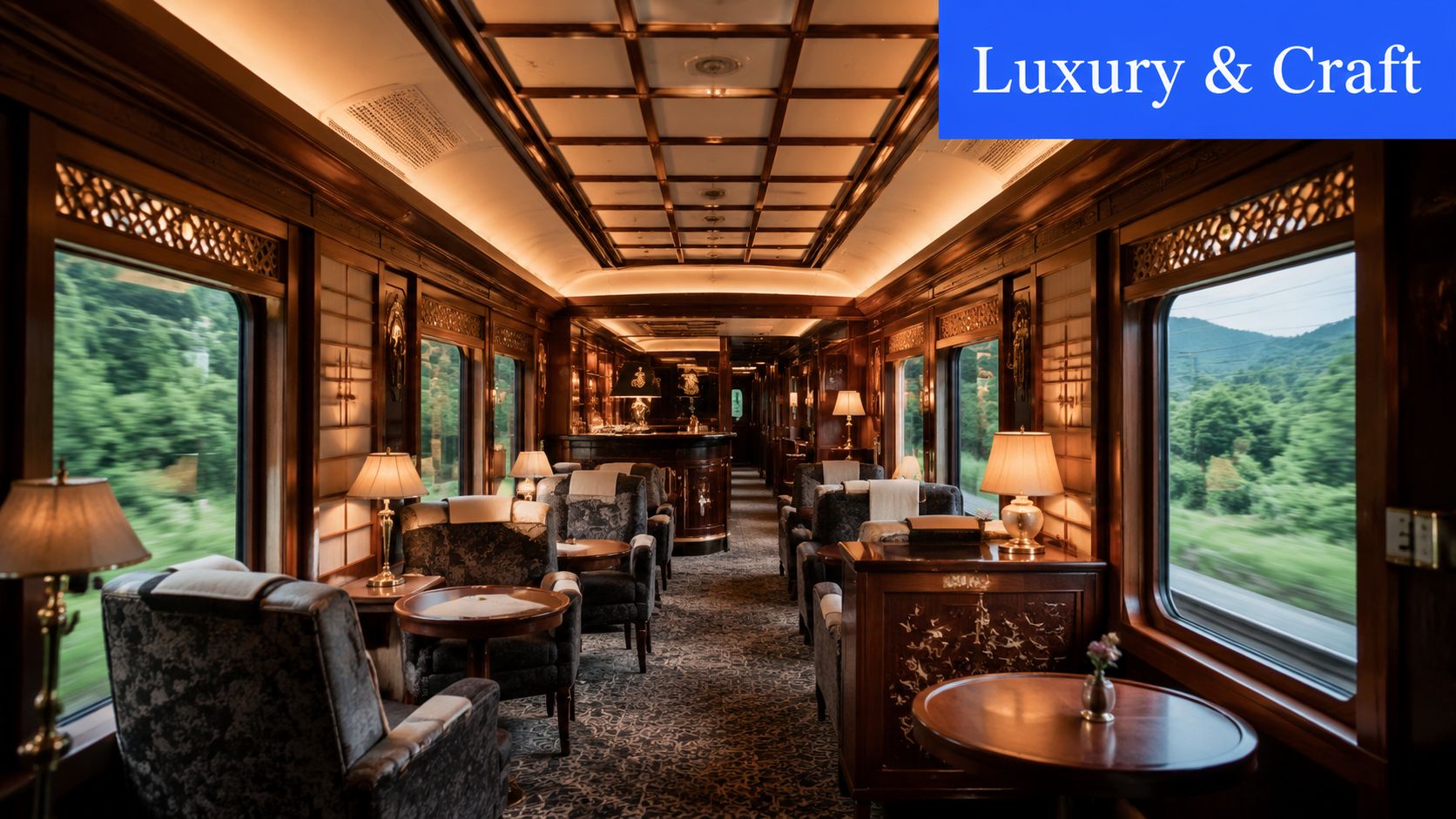
The appeal starts before the train even moves. You step into a space that feels closer to a private club than public transport, with polished wood, intimate lounges, and the kind of measured service that makes rushing feel gauche. On this train, the journey isn't filler between destinations, it is the destination.
That's not marketing fluff. The Seven Stars in Kyushu began operating on October 15, 2013, and it was Japan's first luxury sleeper or “cruise” train, built around the concept of traveling through Kyushu's seven prefectures. Those prefectures are Fukuoka, Saga, Nagasaki, Kumamoto, Oita, Miyazaki, and Kagoshima, which is exactly why the train carries the Seven Stars name. The train has seven carriages and was built at an estimated cost of about 3 billion yen. Seven Stars in Kyushu background and launch details
Why the product feels so different
The biggest mistake travelers make is comparing it to a normal luxury rail route. This is not a straightforward transfer with nicer upholstery. It's a tightly controlled, hospitality-led journey with a deliberately limited guest count, and that scarcity shapes everything from service pacing to the mood onboard.
The train's capacity is part of its identity. Multiple sources report that each departure is limited to about 20 passengers, and one source describes a four-day journey as carrying only 18 to 20 passengers depending on suite configuration. Capacity and pricing overview
That's why the train works so well for seasoned luxury travelers. It has the emotional draw of slow travel, but it also has real operational discipline. If you value privacy, ritual, and scenery that unfolds at human speed, this is the kind of product that justifies its reputation. For station navigation and accessibility context, Waymap's guide to rail transport wayfinding is a useful reference, especially if you're building a broader Japan rail itinerary around a premium departure.
Routes and Sample Itineraries Through Kyushu
The smartest way to think about the Seven Stars is by choosing the pace that fits your travel style. The train runs on a 2-day itinerary and a 4-day itinerary, and the longer route is the one most serious travelers target first. If you want the most immersive version of Kyushu without feeling like you're sprinting between transfers, the four-day, three-night journey is the stronger play.
How the two core journeys differ
The two-day journey is the better fit if you're adding the train to a longer Japan trip and want a concentrated luxury experience rather than a full regional immersion. It's the cleaner choice for travelers who have already seen the major Japan cities and want one elegant rail segment without overcommitting time.
The four-day odyssey is where the train feels fully realized. It gives you more breathing room for scenic movement, curated stops, and the sense that you're being carried through a living portrait of Kyushu rather than just ticking off highlights. The itinerary changes with the season, so the scenery and cultural encounters shift, which keeps repeat travel from feeling repetitive. That seasonal routing flexibility is a big reason the train has such a loyal following.
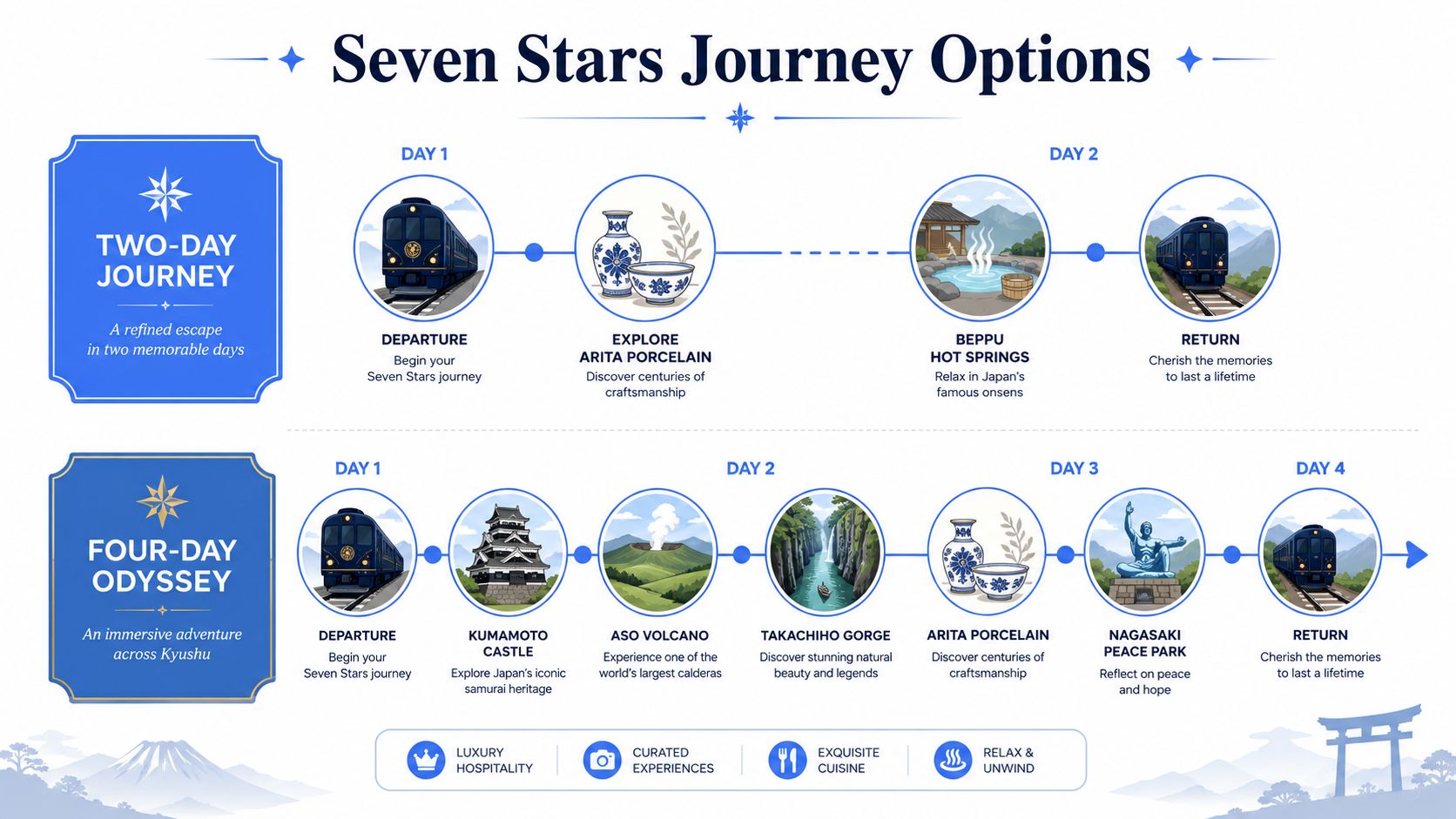
A practical way to frame the route selection is this, if you're making your first serious Kyushu trip, the longer journey is the one I'd push hardest. It gives you enough time to absorb the island's pace, not just photograph it. If you're returning to Japan and already know you prefer highly curated travel over city-hopping, the shorter journey can be a sharp, elegant add-on.
How to match the route to the traveler
- Choose the 2-day journey if you want a luxurious sampler and you're pairing the train with Tokyo, Kyoto, or Osaka.
- Choose the 4-day journey if your priority is regional depth, slower pacing, and a stronger sense of place.
- Choose the longer route if you care more about the train as an experience than the train as a novelty.
For travelers mapping out a broader trip, this is also where a larger Japan plan matters. The best rail journey feels even better when it's connected to the right cities, transfers, and stayovers, which is why I'd pair this with a carefully built Japan itinerary rather than trying to wing it. For broader destination ideas, see luxury places to visit in Japan.
Cabin Types and Onboard Amenities
The Seven Stars is built around exclusivity, so the cabin choice matters more than it would on a standard sleeper train. With only 10 suites reported in current coverage, the onboard inventory is tiny, which means the type you secure affects both your budget and the overall feel of the trip. Current suite count and pricing context
What the onboard experience actually feels like
The train's reported configuration usually includes seven cars, with one lounge, one dining car, and multiple sleeper cars. That layout matters because it keeps the social atmosphere intimate while still giving guests places to linger, drink, and watch the countryside roll by. Car configuration and guest scale
The luxury here is not loud. It's in the materials, the pacing, and the fact that you're on a moving hospitality product that behaves more like a private hotel than a train. The dining experience is central to that identity, and the shared spaces are intentionally small so service stays personal.
How I'd think about suite choice
The best-value cabin is usually the one that matches your actual travel style, not the one with the most bragging rights. If you're the type who spends more time in lounges, on excursions, and at meals, a standard suite can make sense because the onboard common areas already deliver a refined experience. If you care about extra privacy, better sightlines, and a more indulgent sense of space, move up.
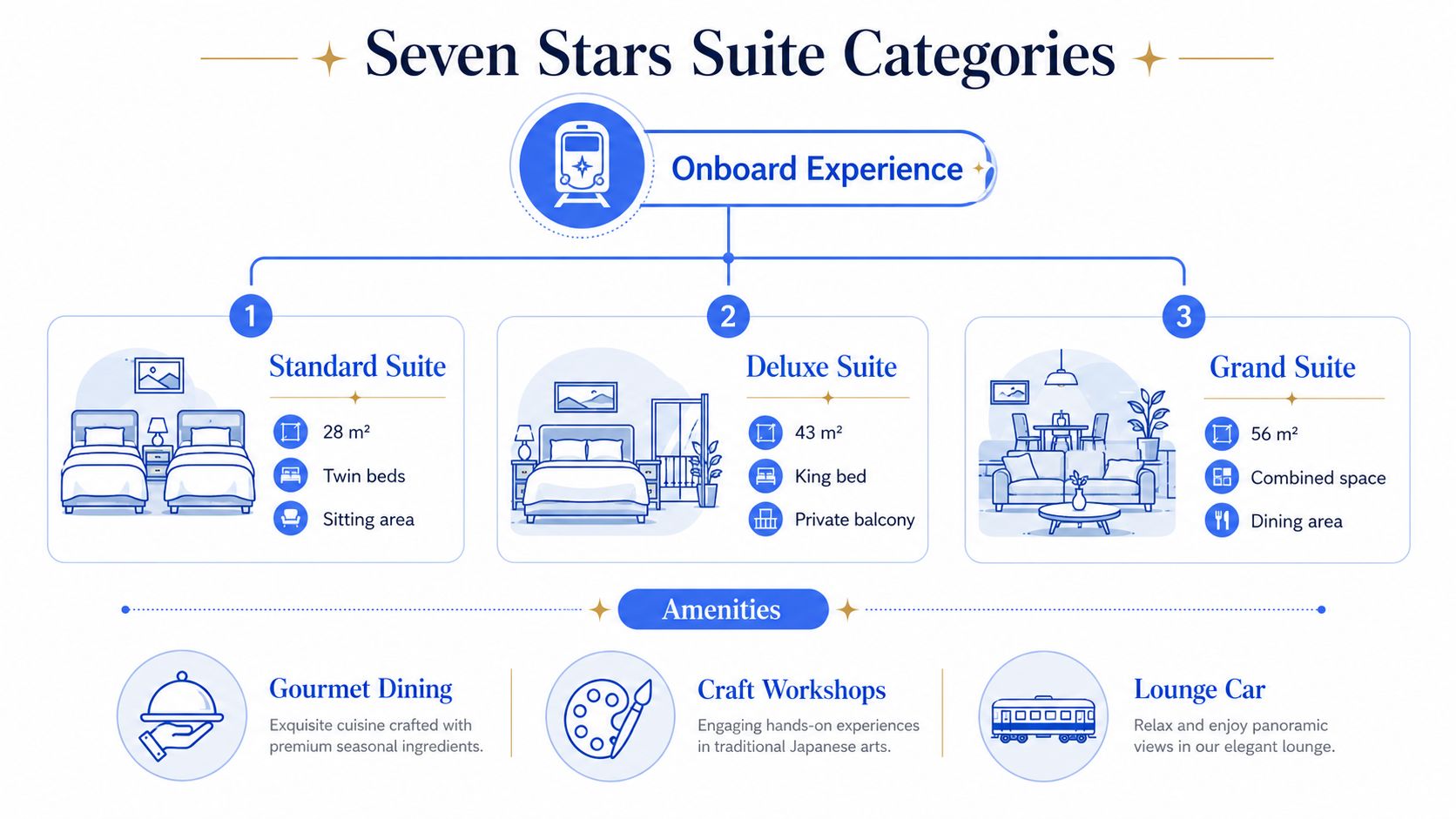
The train is often described as a rolling luxury hotel, and that's fair, but the more useful comparison is this. A great suite on the Seven Stars is less about square footage and more about how gracefully the entire journey unfolds around you. If you want a cabin to sleep in and a public space to inhabit, you don't need to overbuy. If you want the privacy to feel complete, you probably do.
For travelers building a Japan rail-focused itinerary, I'd also strongly recommend considering how the train fits around pre and post nights. If you force the rail segment into the middle of an otherwise rushed trip, you waste the whole point.
Pricing and How to Secure Your Booking
The dream becomes reality on the Seven Stars. This luxury train is expensive, limited, and not booked like a normal hotel room, which is exactly why so many travelers get stuck. You need to know the fare range, but you also need to understand that the booking process itself is part of the exclusivity.
The pricing reality
Early reporting in 2013 said a suite for two on a four-day, three-night trip cost about $11,500 total, or roughly $5,750 per person, with the price later rising to about $7,835 per person for double occupancy. Historical and later fare reporting
More recent guides list fares such as ¥650,000 for a two-day journey and ¥1,150,000 for a four-day journey in regular suites, while another guide says the 3-night/4-day trip can start around ¥855,000 double occupancy. Recent fare examples and booking pressure The newer reporting from The Japan Times also notes pricing now starts around ¥680,000 per person, rising to ¥2,770,000 for a deluxe solo suite on the longest route. Current pricing context
What the booking process really looks like
Bookers don't get free rein over dates. The service operates in two seasonal windows, roughly April to August and September to February, and applicants must enter for a specific period rather than choosing any departure they want. Available itineraries are typically split into a 2-day and a 4-day journey. Seasonal booking windows and itinerary structure
That structure matters because it changes your strategy. You're not “checking availability” in the casual sense. You're competing for a scarce product, often through application or lottery-style allocation, and your odds improve when your travel dates, suite expectations, and backup plans are all sorted in advance.
Best practice: decide whether the 2-day or 4-day route matters more before you apply. Flexibility helps, but indecision kills good applications.
| Seven Stars in Kyushu Pricing Overview | Itinerary | Approximate Fare Per Person |
|---|---|---|
| Seven Stars in Kyushu Pricing Overview | Two-day journey | About ¥650,000 |
| Seven Stars in Kyushu Pricing Overview | Four-day journey | About ¥1,150,000 |
| Seven Stars in Kyushu Pricing Overview | Three-night, four-day journey | Around ¥855,000 to ¥2,770,000 depending on suite and occupancy |
If you miss out, don't treat that as the end of the plan. It's often the point where a luxury travel advisor adds the most value, because the key win is not winning one lottery slot. It's building a second-choice itinerary that still feels rare, effortless, and worth the time.
Best Times to Travel and Seasonal Considerations
Kyushu rewards travelers who respect seasonality. The train's operating windows already shape what's possible, but the weather and scenery inside those windows change the mood of the journey completely. If you care about natural beauty, comfort, and the kind of light that makes rail travel sing, you should be deliberate about timing.
Choosing the window that suits your travel style
Spring gives you softer temperatures and the visual lift of cherry blossom season in many parts of Japan, which makes the rail experience feel especially celebratory. Summer brings lush countryside and a more vibrant regional energy, but it can also feel heavier and more humid, so it's not the best choice for everyone.
Autumn is often the easiest season to recommend for luxury rail because the scenery turns richer and the air is more comfortable. Winter has its own appeal, especially for travelers who love hot springs and a quieter, slower mood. That's where Kyushu shines, since the region's onsen culture pairs naturally with a high-end rail trip.
The route itself changes by season, so you're not just picking weather. You're picking the version of Kyushu you want to see. That's why the “best” date is usually the one that matches your priorities, not the one that appears on a booking window.
How I'd advise clients to think about timing
- Pick spring if you want your trip to feel bright, romantic, and visually classic.
- Pick summer if you prefer greener scenery and don't mind warmer conditions.
- Pick autumn if you want the most balanced mix of comfort and atmosphere.
- Pick winter if you're pairing the train with hot springs and quieter cultural time.
Travel advisor insight: the rail segment is only one part of the experience, so the smartest travelers build a buffer around it. A pre-night in the departure city and a post-night somewhere restful can make the whole trip feel far more luxurious.
You also need to think about flight timing and regional movement. Kyushu works beautifully when it's stitched into a broader Japan itinerary, but it feels clumsy if you try to rush down, ride the train, and leave immediately. The luxury is in the breathing room.
Designing a Bespoke Kyushu Journey Around the Train
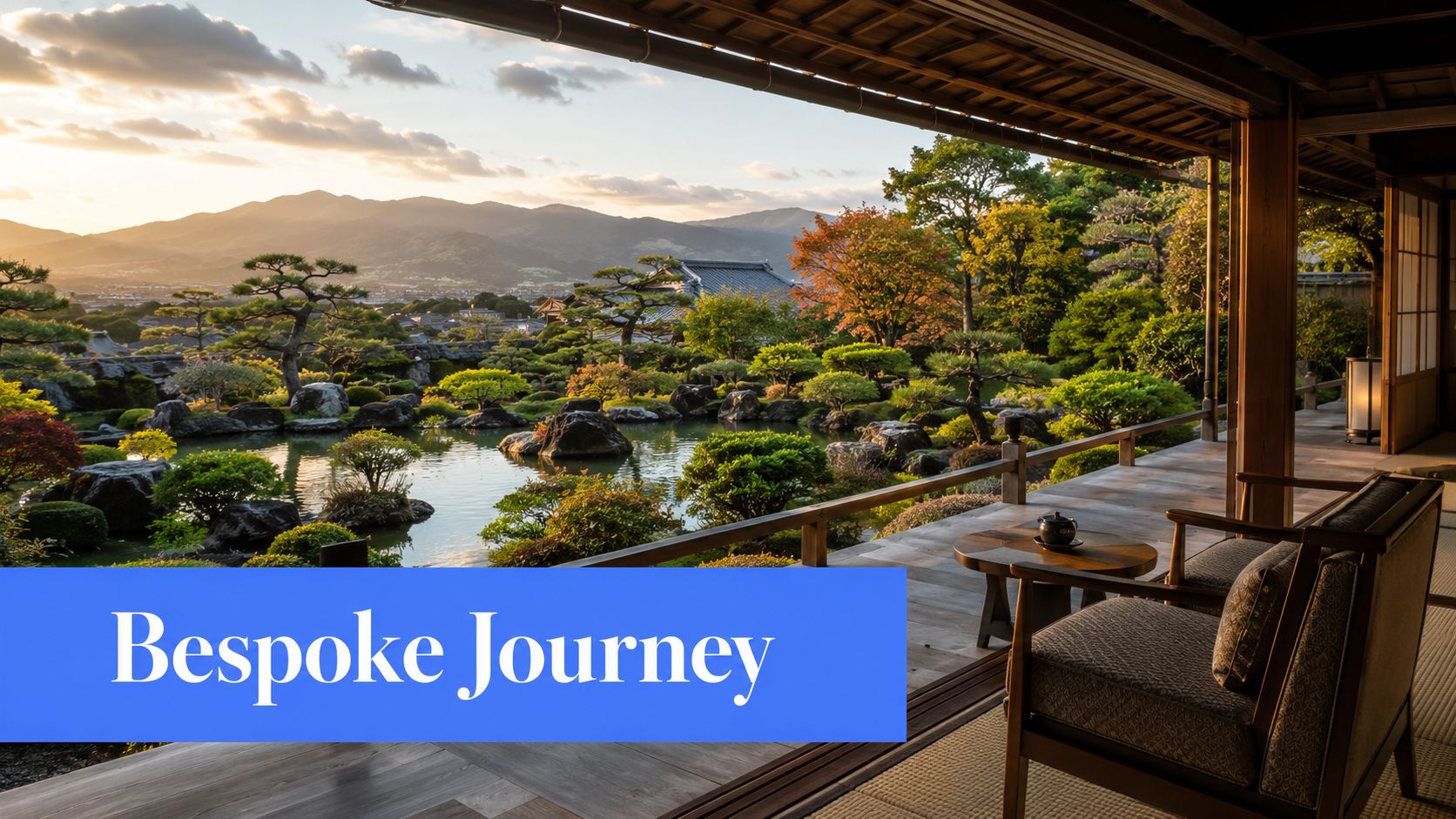
The Seven Stars is strong enough to anchor a trip, but it's even better when it sits inside a carefully designed Kyushu itinerary. That's where the experience stops being “we rode the train” and becomes “we had a week in southern Japan that felt almost impossibly smooth.” The train should be the center, not the whole plan.
What a strong luxury itinerary looks like
I'd build around a pre-train stay in Fukuoka or Nagasaki, then add a post-train retreat in a ryokan or onsen resort where the pace drops even further. That gives the train a proper sense of arrival and release, instead of forcing it to do every job at once. For travelers who want cultural depth, Kyushu also lends itself to private pottery experiences, tea rituals, and slow dining with actual regional context.
The logic is simple. A luxury rail journey becomes more valuable when the ground logistics are invisible. Private transfers, luggage handling, and well-timed check-ins matter more than most travelers realize, especially after a premium overnight segment where you want the transition off the train to feel smooth and uninterrupted.
Why advisor planning matters here
The hard part isn't finding things to do. It's sequencing them properly. A bad plan wastes the train by making the surrounding nights too generic or too rushed, while a strong plan gives you a clean emotional arc, city, rail, retreat.
For travelers who want a more complete Japan trip, luxury tours to Japan are where this gets easier, because the train can be matched with the right hotel rhythm, transfer timing, and regional pacing. That's the advisor value, turning a difficult booking into a curated itinerary that feels intentional from the first transfer to the last night.
If you're the kind of traveler who notices the difference between a decent trip and a polished one, the polish comes from not more activities, but better connections between them.
Luxury Alternatives When Seven Stars Is Fully Booked
If you don't get the Seven Stars, don't force the issue. The wrong backup plan can dilute the trip, and I'd rather see a client do the right luxury itinerary than chase one famous train. Kyushu and the wider Japanese rail network still offer compelling options.
One strong alternative is a curated ryokan-hopping itinerary through Kyushu's hot spring towns, especially if your priority is deep relaxation, onsen culture, and exceptional service. Another is a premium rail experience elsewhere in Japan, but I'd judge those options by their overall fit, not by their name recognition alone. For some travelers, a private driver-led route through Kyushu may be the best use of time because it lets you control pacing and overnight stops more precisely.
If your instinct is to pair the land journey with another premium travel format, you can also build a Japan experience around a high-end cruise framework, which is why luxury cruises to Japan can be a smart comparison point for travelers deciding where to invest. The key is choosing the format that matches your personality, not the one with the loudest reputation.
The Seven Stars is rare, but rarity isn't automatically superiority. Sometimes the best trip is the one that gives you more freedom, more spa time, or a better overall Japan arc. That's the part a good advisor should say out loud.
If you want a Kyushu journey that fits your dates, your preferences, and your tolerance for booking complexity, Explore Effortlessly can design it from the ground up and handle the moving parts that make this trip either smooth or maddening. I work with clients nationwide through virtual consultations, and I'm happy to help you decide whether the Seven Stars, a ryokan-led alternative, or a broader Japan itinerary is the smartest investment.
Join the newsletter for more luxury Japan planning ideas and high-touch travel insight: Explore Effortlessly newsletter