Wednesday night, the kitchen table has become mission control. You've got two laptops open, a grandmother asking about her seat on the long-haul flight, a teenager sending links to a Kyoto hotel, and a spouse tracing a route that still doesn't connect cleanly. Everyone wants a memorable family trip. Nobody wants to own the spreadsheet.
That's where family vacation planners earn their place. The right advisor doesn't take decision-making away from you. They turn a complicated family holiday into a series of clear choices, protect the pace of the trip, coordinate the moving parts, and stay accountable when an airline changes a schedule or a property can't deliver what was promised.
Why More Affluent Families Are Hiring Family Vacation Planners
Affluent families aren't hiring an advisor because they can't find a hotel. They're hiring one because a family trip rarely consists of a hotel alone. It includes flights, room configurations, transfers, dietary requests, excursions, school calendars, grandparents' mobility, children's attention spans, and the small operational details that determine whether everyone arrives excited or exhausted. For a trip centered on a grandparent's milestone, start with my 60th birthday celebration travel ideas before mapping everyone's needs.
A planner can also bring access that isn't always visible in public booking channels. Through established preferred-partner relationships, an advisor may arrange room upgrades, resort credits, early check-in, and late checkout, sometimes at the same published rate as booking directly, with the hotel compensating the advisor rather than the traveler, as explained in this independent hotel-booking guide. These benefits aren't guaranteed, so I present them as opportunities, never promises.
What changes after you hire the right advisor
The biggest change is accountability. One person understands the whole trip, from the villa layout to the airport transfer to the private guide meeting your family after breakfast. That continuity matters when a supplier needs to be replaced or a family member's needs change.
I've seen this play out in practical ways. A Tuscany villa became unavailable after flooding shortly before arrival, so the itinerary required a property swap without sacrificing the preferred location, bedroom arrangement, or chef service. On another trip, a Galápagos booking was held on a courtesy basis while a family worked through competing school and work calendars. Those decisions require relationships, judgment, and fast communication, not another evening of searching.
For destination-specific research, a resource such as Los Angeles family trip planning can help you understand local possibilities before an advisor turns them into a custom itinerary. The distinction is important. Inspiration is useful. Coordination is the service you're paying for.
Family travel demand remains strong. The 2025 Family Travel Survey found that 92% of parents are likely or very likely to travel with their children in the next 12 months, while 81% plan to increase or maintain domestic travel spending. The same survey reported average family travel spending of about $8,052 in 2024, roughly 20% more than the prior year, while 73% of parent respondents still viewed affordability as a challenge.
The answer isn't to hand over every decision. It's to let a planner absorb the logistical load while you remain the person deciding what the family values most.
How to Decide If a Planner Is Worth It for Your Family
Start with a time audit, not a destination list. Estimate the hours you'll spend comparing flights, checking room layouts, coordinating relatives, reading cancellation terms, arranging transfers, and monitoring changes. Then compare that total with the value you place on your own time and the advisor's fee structure.
A simple test works well:
- Count the moving parts. A single resort stay with straightforward flights is easier to manage than a villa, several transfers, private guides, and multiple room types.
- Identify the consequences of failure. A milestone birthday, multigenerational reunion, or school-holiday trip carries more pressure than a flexible weekend away.
- Check the family variables. Mobility concerns, allergies, connecting rooms, infant equipment, and different sleep schedules all increase planning complexity.
- Review the financial architecture. Ask how deposits, cancellation terms, payment schedules, and advisor fees will be handled before committing.
I won't pretend there's a universal price threshold that makes an advisor worthwhile. A simpler trip with a generous budget may still be easy to plan independently, while a modestly priced trip with three generations can demand serious coordination. The better question is whether the trip has enough complexity and consequence to justify professional oversight.
Practical rule: If you're already avoiding the planning because it feels mentally expensive, that's useful information. The friction is part of the cost.
Affordability deserves an honest conversation. The Family Travel Association reporting states that 38% of parents had used a travel advisor to book at least one family trip during the previous three years, and 71% were willing to use one in the future. That doesn't mean every family needs an advisor. It does show that professional help has become a mainstream option for families managing complicated travel.
Pets can add another layer, particularly when airlines, documentation, destination rules, and accommodation policies intersect. Families traveling with an animal may find this resource on pet travel logistics help useful as they prepare their questions.
For a broader view of the cost-benefit decision, read is a travel agent worth it. Then ask yourself: Do I have the time, patience, and backup plan to manage this trip myself? If the answer is no, a named advisor may be the more efficient choice.
The Four Types of Family Vacation Planners Compared
Not all planning support works the same way. The label “concierge” can describe a highly personal relationship, a rotating service team, or a polished intake form. Compare the model, not the branding.
| Planning Model | Personalization | Perks & Upgrades | Accountability | Typical Fee Structure |
|---|---|---|---|---|
| Independent research | High if the family does the work | Limited to what's publicly available | The family owns every problem | No advisor fee, but substantial time cost |
| Concierge platform | Moderate, depending on the assigned team | May have access through business relationships | Shared across a service desk | Membership, service, or booking-related fees |
| Host agency | Varies by named advisor | Often supported by broader supplier access | Named advisor with agency backup | May include planning fees and supplier-paid compensation |
| Independent advisor | Deepest when the relationship is strong | Strong potential for preferred-partner benefits | One person owns the relationship | Usually transparent planning fees, with possible supplier compensation |
Independent research
DIY planning offers maximum control over the budget and every selection. It can work beautifully when the route is simple, dates are flexible, and one person is happy to monitor the details. It becomes less attractive when several households need to agree on flights, rooms, activities, and payment timing.
Concierge platforms
A platform can be convenient when you want support without developing a long-term relationship with one advisor. The trade-off is familiarity. A rotating team may know the reservation but not the family's tolerance for early mornings, the grandmother's walking limitations, or the teenager's refusal to share a bathroom.
Host agencies and independent advisors
A host-agency model can combine a personal advisor with wider operational support. An independent advisor may offer even more direct attention and deeper customization, especially when they've built strong supplier relationships in the destinations you're considering.
My recommendation is straightforward: for a trip with genuine stakes, choose a named advisor who owns the relationship. A faceless platform may answer quickly. A trusted advisor should understand why the answer matters.
The First Conversation Questions That Reveal Real Fit
The introductory call is a two-way interview. You're evaluating the advisor's process, and the advisor is learning whether they can design the trip your family wants.
Ask questions in four buckets. Strong answers will include specifics, follow-up questions, and a clear explanation of how decisions are made. Weak answers sound scripted, vague, or focused only on closing the booking.
| Question Bucket | Example Question to Ask | Strong Answer Signals | Weak Answer Signals |
|---|---|---|---|
| Trip logistics | Which destinations and suppliers do you know well for this kind of family trip? | The planner explains relevant experience and asks about your priorities | Generic destination enthusiasm without practical detail |
| Family profile | How do you handle allergies, mobility needs, room configurations, and different ages? | The advisor asks precise follow-up questions and explains documentation | “The hotel can handle it” without verification |
| Pacing and trip style | How do you balance guided activities with downtime? | The planner discusses morning energy, rest windows, and backup options | A dense itinerary presented as the default |
| Post-booking support | Who coordinates changes, rebooking, and local assistance if something shifts? | Clear roles, escalation steps, and named in-destination partners | Unclear ownership after payment |
Questions worth asking directly
- Logistics: How do you structure your planning fees? Which suppliers and local partners do you trust for this itinerary? What happens if a property or flight changes?
- Family profile: How will you document dietary requirements? What room arrangement would you recommend for our group? How do you plan for a traveler with limited mobility?
- Pacing: How many major activities would you schedule in a typical day? Where would you place rest time? Which experiences deserve private arrangements rather than shared excursions?
- Support: Who handles urgent supplier communication? What are your rebooking procedures? Which trusted in-destination partners provide on-the-ground support?
A strong advisor won't just answer. They'll ask why your children dislike long drives, how grandparents manage stairs, and which parts of the trip you want to keep spontaneous.
After the call, compare notes as a family. Weight responsiveness, curiosity, and listening as heavily as credentials. I'm a Circle of Excellence Advisor and Top 5 percent at Nexion, as well as a CLIA Accredited Cruise Counselor, but credentials should support a good relationship, not replace one.
Sample Itineraries for Different Family Profiles
Pacing is the most underrated variable in family travel. The destination may be extraordinary, but too many early starts can turn a beautiful itinerary into a group endurance exercise.

These working drafts show how I think about different family profiles. The details change after the intake conversation, but the pacing logic stays useful.
A Tuscany villa week for younger children
A seven-night villa stay suits a family of four who wants privacy, a home base, and flexible mornings.
- Night one: Arrive, settle in, and have dinner at the villa. No ambitious sightseeing.
- Night two: Slow breakfast, pool time, and a private chef dinner.
- Night three: Truffle hunting with a relaxed lunch and an unstructured afternoon.
- Night four: Villa day, with a short nearby outing if everyone feels rested.
- Night five: Florence food walk, planned around the children's energy rather than a checklist of museums.
- Night six: Family cooking experience or countryside drive, followed by pool time.
- Night seven: A final chef-prepared dinner and an easy morning before departure.
This works for parents who want adult pleasures, including wine, food, and architecture, without making the children endure an adult itinerary every day.
A Mediterranean luxury cruise for mixed ages
A seven-night cruise is ideal when relatives want different activity levels and nobody wants to repack every morning.
The first night is for embarkation and orientation. The second pairs a sea day with the children's club and a quiet adult lunch. The third uses a private shore excursion with a shorter walking route. The fourth keeps the schedule light, with pool time and a flexible dinner. The fifth adds another curated port day, while the sixth gives each generation room to choose its own rhythm. The final night stays intentionally easy, with luggage and transfers confirmed before dinner.
I evaluate the quality of the kids' club, supervision policies, dining flexibility, suite configuration, and private excursion options. “Family friendly” is too broad to be useful without those specifics.
London, Paris, and Provence for three generations
A ten-night Europe loop can work when the family accepts that every city needs breathing room.
London receives three nights, with one guided highlight, an easy arrival day, and an afternoon rest. Paris receives three nights, again with one major guided experience and time for café stops or a hotel reset. Provence receives four nights, allowing the family to slow down after the city transitions.
Train logistics deserve careful attention. I prefer transfers that minimize station confusion, luggage stress, and unnecessary early departures. The itinerary should protect afternoon downtime, use one meaningful guided experience per city, and leave room for the family to discover something without a scheduled start time.
For a practical planning framework, use this family vacation itinerary template as a starting point, then let an advisor adjust it around real flight times, room categories, and transfer conditions.
A Realistic Timeline and Budget Checklist
Great family trips get built backward from the departure date. The first call should establish the destination direction, the family's must-haves, and a budget ceiling, not just a wish list.
I won't invent a percentage split across lodging, flights, experiences, and ground logistics because those proportions change dramatically by destination and travel style. A villa trip may place more weight on accommodation and private services. A cruise may bundle more of the daily experience. A complex Europe itinerary may require closer attention to rail, transfers, and room changes.
Six to nine months before departure
Hold the intake call, identify destination options, and confirm the maximum comfortable spend. Decide which travelers are committed before deposits are placed. This is also the point to flag passports, school calendars, mobility needs, and preferred cabin or suite configurations.
Four to six months before departure
Confirm the school calendar and begin placing deposits on the core components, such as a villa, cruise, flights, or high-demand accommodations. Ask the planner to explain cancellation terms in plain language. A beautiful itinerary is not useful if the payment schedule creates unnecessary pressure.
Two to four months before departure
Finalize hotels, excursions, dining reservations, and private guides. Review passport validity and visa requirements for every traveler, rather than assuming one person's documentation applies to the group. This is when I also pressure-test transfers, arrival times, luggage volume, and rest periods.
One month before departure
Review final documents, packing lists, gratuities, travel insurance decisions, and any in-destination cash needs. Confirm special requests again, including dietary notes, celebrations, adjoining rooms, and child equipment.
One week before departure
Review the weather forecast, reconfirm key arrangements, and distribute emergency contacts. Conditions can change, so travelers should remain aware of official guidance and check relevant government travel advisories before departure. Vetted local drivers, guides, resorts, and partners support service quality, but situational awareness still belongs to every traveler.
Families planning specialized ocean activities can also review these manta and blackwater dive tips while deciding how much adventure belongs in the itinerary.
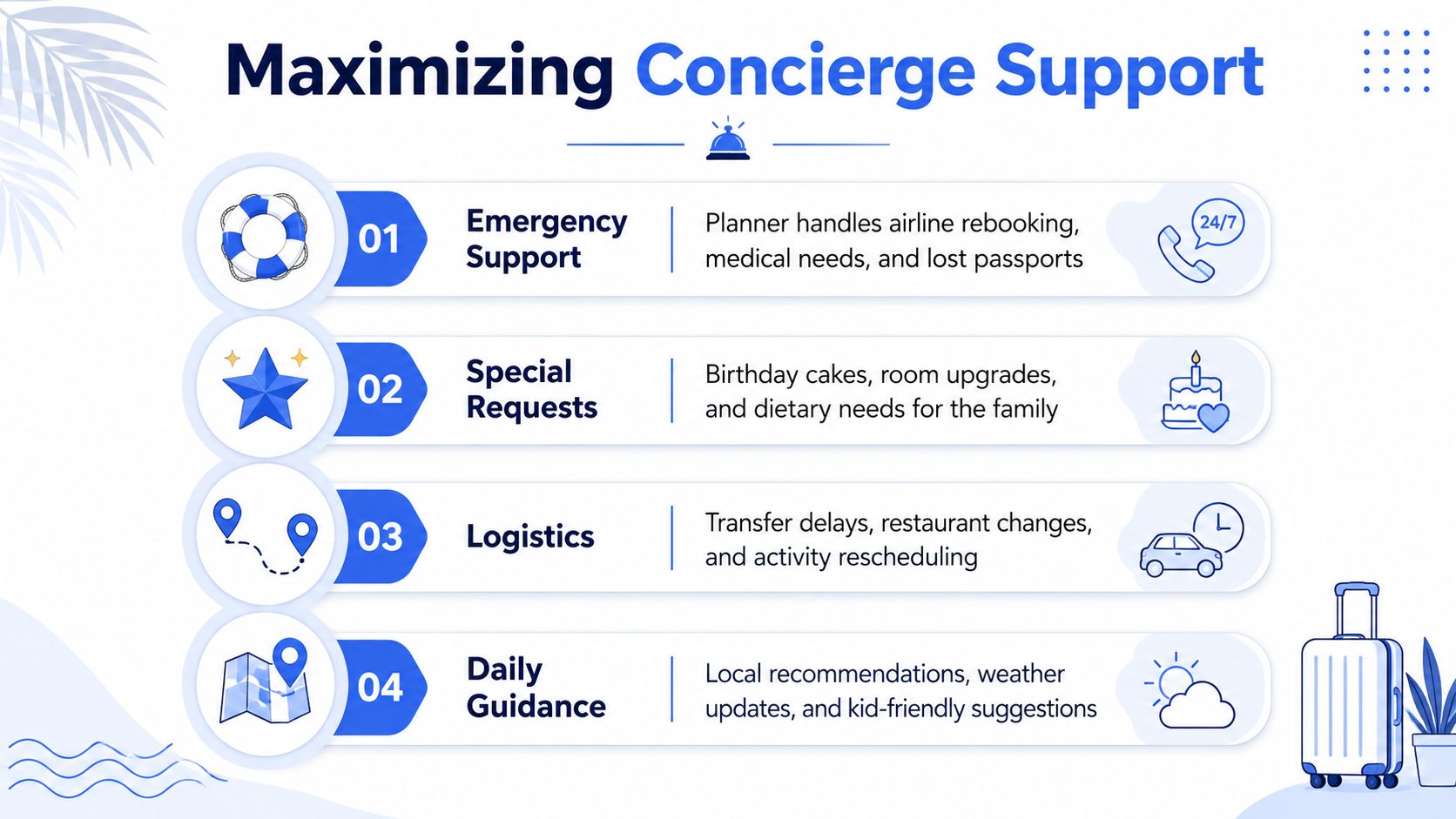
Your job is to weigh in on the experiences, room style, pace, and priorities. Your planner's job is to surface the operational consequences of those choices before they become expensive surprises.
Getting the Most From Concierge Support Without Losing the Plot
Concierge support should feel like collaboration, not a hand-off. The best family vacations combine expert orchestration with parental intuition. An advisor can manage airline rebooking, medical coordination, restaurant trade-offs, transfer delays, and supplier communication. Parents should still own bedtime rituals, surprise reveals, sibling diplomacy, and the decision to spend an afternoon doing absolutely nothing.
Create one shared document or group chat before departure. Keep the final itinerary, traveler details, allergies, room assignments, emergency contacts, and open requests in one place. Agree on response expectations before the trip, especially for routine questions versus urgent issues.
Give the planner the right problems
Ask for direct involvement when:
- A flight changes: Let the advisor coordinate the airline response and protect the onward transfer.
- A medical issue arises: Use trusted in-destination partners and local providers for support, while following professional medical guidance.
- A reservation needs to move: Allow the planner to trade a restaurant, excursion, or transfer rather than trying to solve every piece separately.
- A special moment matters: Share birthdays, anniversaries, and surprises early enough for the advisor to coordinate them discreetly.
Keep ownership of the parts that make the trip yours. A planner can arrange a private family experience, but they can't replace the parent who knows when a child needs a snack, a swim, or ten quiet minutes.
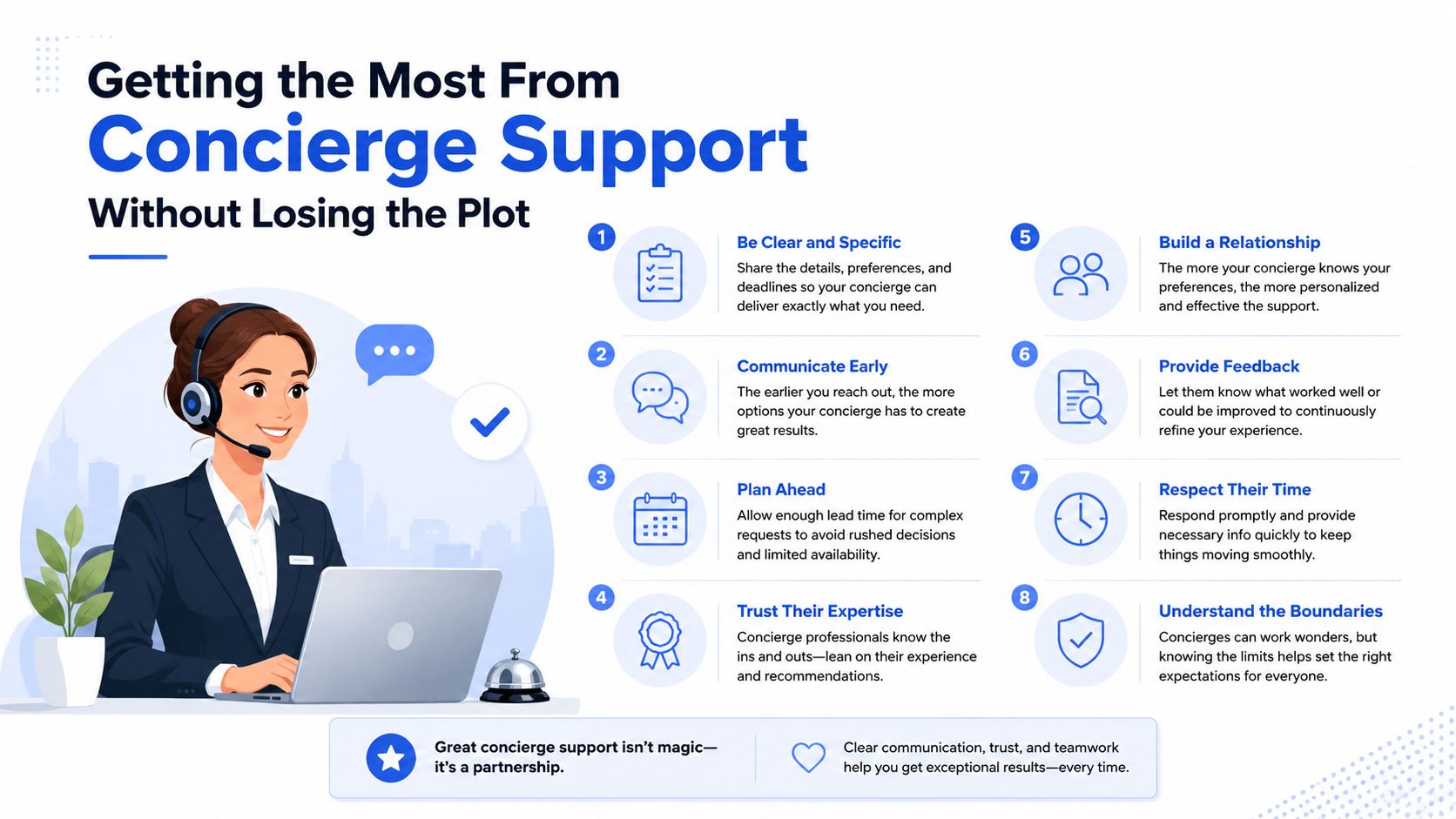
For trips with complex logistics, learn how luxury travel concierge support can fit into your planning style. Ask what's included, what requires an additional fee, and which trusted in-destination partners handle on-the-ground support. Don't assume that “concierge” means every request receives the same level of urgency.
Affluent families increasingly value expert curation over endless internet research. A 2025 luxury travel report cited by TravelAge West found that 84% of affluent respondents considered a trusted travel advisor more valuable than spending time on internet research. The leading motivations included exclusive experiences, curated itineraries, reduced planning stress, preferred benefits, and help when problems arise.
The first conversation remains the clearest test of fit. It costs nothing to ask thoughtful questions, and it can save weeks of second-guessing.
I design bespoke family vacations, multigenerational journeys, luxury cruises, private villa stays, and complex itineraries for clients nationwide through virtual consultations. Visit Explore Effortlessly to start a conversation about a family trip with the right pace, logistics, and support, and join the newsletter for practical luxury travel guidance.