A complimentary upgrade is most likely when you combine loyalty status, low-demand timing, and a concise check-in ask. Targeted pre-arrival offers can also be worthwhile, with an average acceptance rate of 16% and an optimal ask price near 30% of the fare difference between room categories, according to a hotel upsell benchmark summarized by Reisehacks.
You're standing at the front desk after a long journey, hoping the room assigned to you has somehow become a suite with a balcony, a view, and enough space to unpack without negotiating with the luggage. The usual advice says to smile, mention your anniversary, and ask nicely. That advice is incomplete.
Hotels don't distribute premium rooms by charm alone. They balance occupancy, loyalty value, booking channels, cancellations, and the commercial opportunity attached to every room category. If you want to understand how to get hotel upgrades, start before check-in and treat the request as a small piece of travel strategy, not a lucky exchange at reception.
Unlocking the Reality of Hotel Room Upgrades
The most common mistake I see is waiting until arrival and assuming the desk agent can create an upgrade from thin air. A courteous request is useful, but it works best when the hotel already has a reason to consider you and the inventory can support the decision.
Premium rooms are managed carefully because they can be sold, offered to loyal guests, used to resolve operational issues, or held for high-value reservations. The front desk sees only part of that picture. Reservations, revenue management, guest relations, and housekeeping all influence what can be assigned when you arrive.
Why politeness isn't the strategy
Politeness matters because hotel employees have discretion, but it isn't a substitute for direct booking, recognized loyalty, flexible dates, or a relevant preferred relationship. A busy Saturday at a landmark property leaves little room for favors. A quiet mid-week stay in a shoulder season creates a different operating environment.
The supply side matters, too. Hotel development, luxury renovations, and conversions are reshaping room inventory, so upgrade availability can depend on refurbishment schedules and newly opened categories as much as on guest behavior. That's one reason the same request can succeed at one property and fail at another.
Practical rule: Ask once, ask gracefully, and make it easy for the team to say yes without promising something they can't deliver.
For travelers arranging a short city stay around a flight, it can also help to consider corporate airport hotel options when the priority is a polished room, efficient arrival, and dependable logistics rather than a dramatic category leap. The best upgrade strategy begins with choosing a property and itinerary where the room matters, then giving the hotel a sensible opportunity to improve it. If the destination matters more than a better room category, I would start with hidden gem travel destinations for luxury travelers instead.
Building Your Foundation with Direct Booking and Status
Your booking channel establishes the baseline. Independent guidance on hotel upgrade behavior consistently points to booking directly with the hotel or its loyalty program as a stronger route than using a third-party online travel agency. Direct reservations give the property a clearer relationship with you, make loyalty recognition easier, and keep the reservation connected to the hotel's own guest records.
That doesn't mean a direct booking guarantees anything. It means you haven't weakened your position before the hotel has even reviewed the reservation.
Establish the right signals
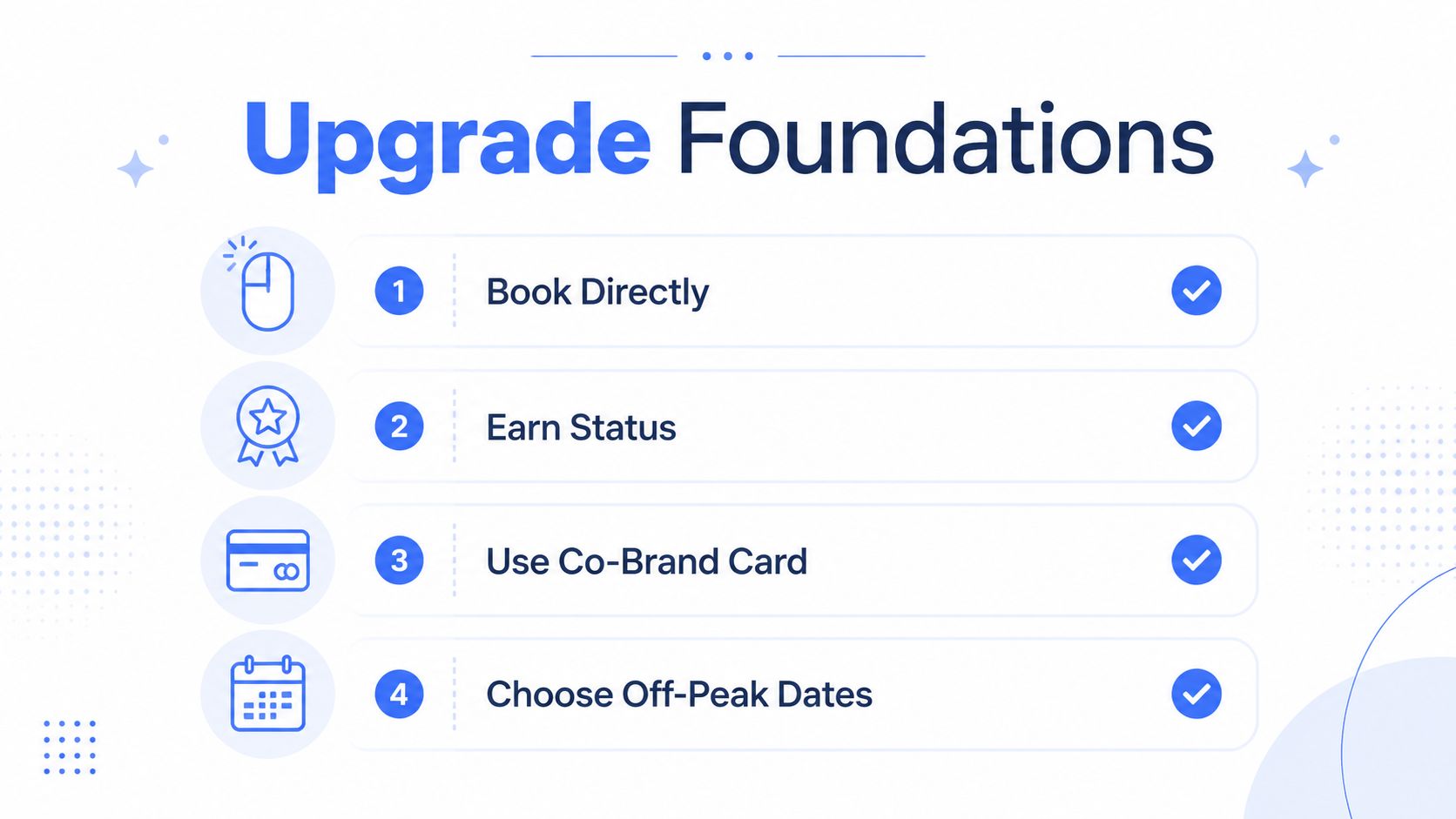
Start with the room category you can happily keep. Never book a basic room you'd dislike because you're hoping for a suite. Then make sure your loyalty number is attached correctly and review the program's published benefits before arrival.
Marriott, for example, explicitly names an “Enhanced Room Upgrade” among elite benefits, alongside a separate “Get 50% more points” earning perk on its member benefits page. The wording matters. It distinguishes a defined benefit from the vague assumption that every member receives a complimentary suite.
Use this sequence:
- Book through the hotel's direct channel: Keep the reservation visible to the property and connected to your loyalty profile.
- Add your status correctly: Confirm that your membership number and eligible benefits appear on the reservation.
- Choose dates with flexibility: Mid-week and lower-demand periods usually give the hotel more room to maneuver.
- Keep the stay simple: Shorter stays can be easier for a property to place into a higher category because they create fewer inventory complications.
If you're comparing accommodation approaches for a trip with pets or unusual lodging needs, Global Pet Sitter's accommodation guide offers useful planning context. For rate strategy, my guide to getting better hotel rates covers the broader value equation, because a lower room rate isn't automatically better if it removes benefits or flexibility you need.
The Operational Logic Behind Premium Room Allocation
Hotels treat upgrades as a revenue-management decision. A premium room can produce more revenue when sold, but an empty premium room produces nothing after the night passes. Research summarized by INFORMS found that hotels can increase annual revenue by as much as 35% by monetizing frequently unused premium rooms.
That finding explains the apparent contradiction travelers encounter. A hotel may have attractive rooms visible in the building, yet decline an upgrade because management expects late bookings, needs to protect a category for operational reasons, or has priced the room to capture a last-minute buyer. Availability isn't the same as assignable availability.
What the hotel weighs
Revenue and reservations teams watch demand patterns, booking pace, cancellations, length of stay, and the mix of room categories. Housekeeping then affects the practical picture. A room may be physically empty but unavailable because it hasn't been serviced, inspected, or released for arrival.
The hotel also considers the value of preserving premium inventory. Giving a better room to a guest who booked a standard category can be sensible during a soft period, particularly if the upgrade improves satisfaction and supports future business. During a compressed period, selling that room or reserving it for a higher-paying booking may be the better commercial choice.
Why timing changes everything
Low-demand and shoulder-season stays tend to create more flexibility, while peak dates place every room under pressure. A mid-week arrival often gives the property a cleaner inventory position than a high-demand weekend, though the actual outcome depends on the hotel and destination.
Hoteliers also face information constraints. Independent hospitality research reported by Revinate found that nearly 50% of hoteliers struggle to access critical data. That helps explain why upgrade decisions can feel inconsistent. Different teams may be working from different information, and a request that reaches the right person at the right moment can be more effective than a generic note sent too early.
A hotel upgrade is usually a solution to an inventory problem, not a reward for asking beautifully.
Comparing Loyalty Rewards and Paid Upgrade Offers
Points and paid offers solve different problems. Loyalty redemption can make an upgrade practical when cash pricing is unattractive, while a targeted offer lets the hotel monetize an available premium category and lets you decide whether the added space is worth the cost.
A 2024 HSMAI Academy report found that 69% of surveyed loyalty-program members would redeem points for a hotel room upgrade, while 63% would redeem points for hotel add-on services. Among guests who had already experienced those services, willingness rose to 88% for room upgrades and 85% for add-ons, as reported in this summary of the HSMAI Academy data. The report also noted that over half of travelers are willing to use points rather than cash for upgrades or add-ons.
A useful comparison
| Method | Best For | Success Probability |
|---|---|---|
| Loyalty upgrade | Guests with eligible status or a strong points balance | Depends on status, inventory, and program rules |
| Points redemption | Travelers who value flexibility and want to avoid a cash supplement | Depends on award space and category availability |
| Pre-arrival paid offer | Guests who want a defined room category before arrival | The benchmark cited an average acceptance rate of 16% |
| Check-in request | Flexible travelers willing to accept any better available room | Highly dependent on occupancy and timing |
| Advisor-arranged preferred benefit | Travelers who want the request incorporated before arrival | Subject to availability and property terms |
A paid offer deserves analysis, not an automatic yes. Compare the proposed amount with the difference between your booked room and the available category. The same benchmark indicated an optimal ask price around 30% of that fare difference. A flat fee can look reasonable until you calculate what the room category would have cost if booked originally.
Points deserve the same discipline. Use them when the redemption fits your priorities, especially for a milestone stay where space, privacy, or a better view materially changes the experience. Don't burn a valuable balance for a minor distinction you won't use.
Mastering the Timing of Your Upgrade Request
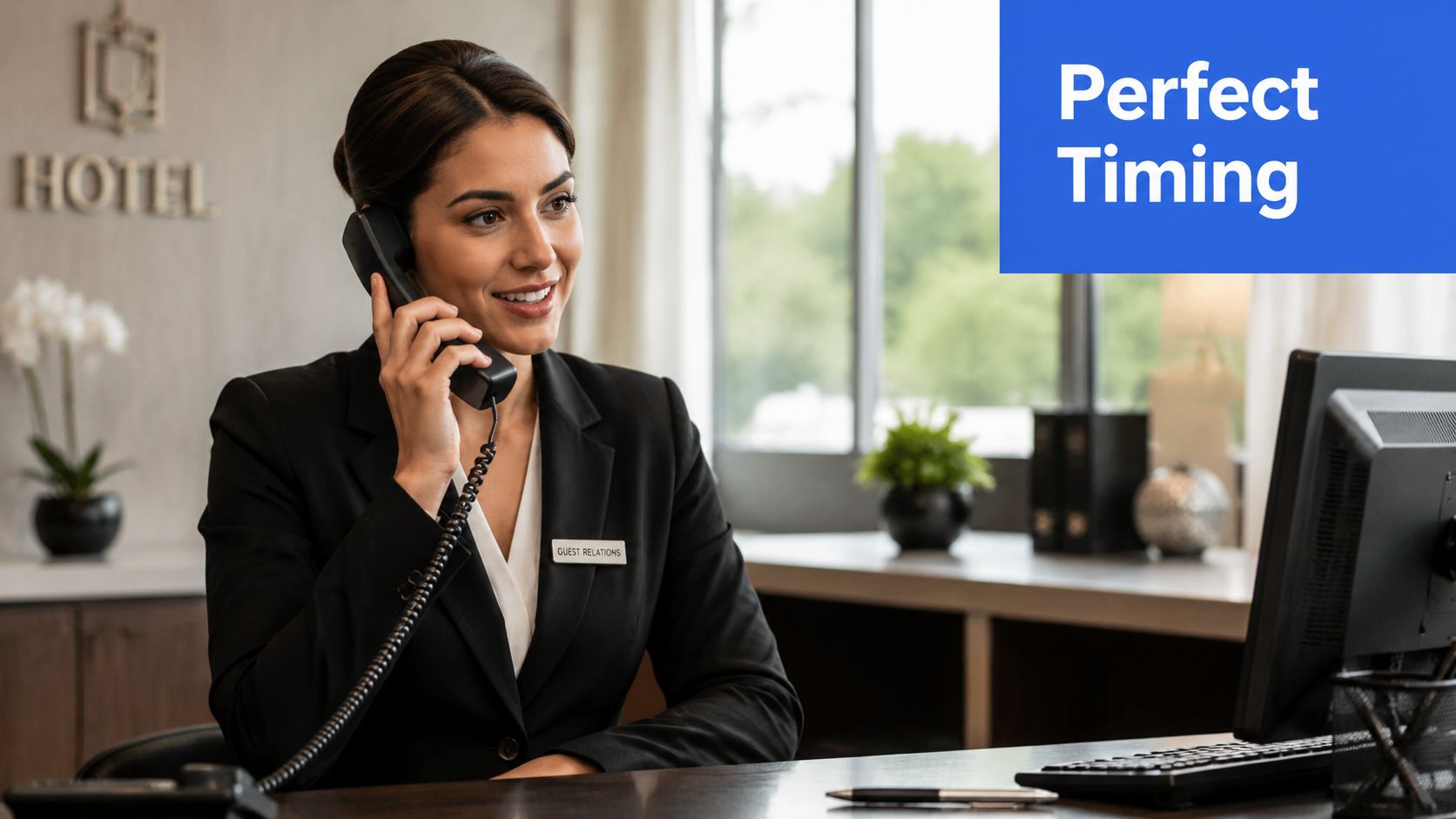
The most effective outreach window is 48 to 72 hours before check-in, according to a published hotel-upgrade guide focused on Guest Relations timing. At that point, the hotel has a clearer view of cancellations and upcoming demand, while room assignments may still be flexible.
Contact Guest Relations or Reservations rather than sending a long emotional note to a general inbox. Include your reservation name, arrival date, confirmation reference, booked category, and one concise request.
Use a clean request
A strong message sounds like this:
“We're looking forward to arriving for our anniversary. If a preferred room or upgrade becomes available, we'd be grateful for your consideration. We understand everything is subject to availability.”
That wording works because it gives the team context without creating an obligation. Mention a genuine celebration once, but don't manufacture an occasion. A hotel can note a honeymoon, birthday, or anniversary, yet those details don't override sold-out inventory.
Ask again at the right moment
If no offer has appeared, make one brief check-in request. Say, “If anything higher is available, I'd be very grateful for your consideration.” Then accept the answer.
For travelers using an IHG-related upgrade rule, The Points Guy's explanation of the advance-request window notes that eligible upgrade space may be requested within 14 days of arrival, provided the call occurs at least 24 hours before check-in. The cited rule also describes confirmation of an entry-level suite or premium room for up to five nights, when space is available.
Don't arrive demanding a particular suite unless your benefit explicitly supports it. Flexibility gives the hotel more ways to help, and your gracious response to a refusal protects the relationship for the rest of the stay.
Elevating Your Strategy with a Luxury Travel Advisor
The strongest upgrade strategy isn't a clever sentence at reception. It's having someone review the entire reservation before the hotel begins final room allocation.
A luxury travel advisor can evaluate the property, room categories, season, length of stay, and available preferred-partner benefits before you commit. Where established relationships apply, the booking may include preferred partner perks, VIP amenities, or upgrade consideration, always subject to availability and the hotel's terms. That's a more refined approach than booking the cheapest room and hoping the desk solves the rest.
The advisor also knows when an upgrade isn't the right objective. A confirmed room with a terrace may be more valuable than an uncertain suite request. A connecting-room plan may matter more than a higher floor for a family. On a honeymoon, privacy, arrival logistics, and a thoughtful welcome can outweigh a category change.
Explore Effortlessly works with clients nationwide through virtual consultations, coordinating luxury hotels, cruises, villas, private drivers, and complex itineraries. Karrah is a Circle of Excellence Advisor and Top 5 percent at Nexion, as well as a CLIA Accredited Cruise Counselor. Her guide to whether a travel agent is worth it explains the broader planning value behind this kind of support.
Your Roadmap to Effortless Luxury Travel
The practical answer to how to get hotel upgrades is simple, but not simplistic. Choose a direct booking path, attach legitimate loyalty recognition, select dates with breathing room, monitor pre-arrival offers, and contact Guest Relations during the 48 to 72-hour window. At check-in, ask once with warmth and flexibility.
The strategic answer goes deeper. Hotels allocate premium inventory around demand, revenue, housekeeping, and imperfect information. Your chances improve when your request aligns with the hotel's operating reality rather than treating an upgrade as an entitlement.
A luxury travel advisor can place that work where it belongs, before departure. Read about what a luxury travel concierge does and consider which details you'd rather have handled by an experienced professional, from room strategy to transfers and the final confirmation of every moving part.
Hi, I'm Karrah, owner, founder, and lead travel advisor at Explore Effortlessly, a luxury award winning travel agency based in Miami. I work with clients nationwide through virtual consultations, designing bespoke, high touch itineraries with smooth logistics from start to finish. From luxury cruises and private villas to honeymoons, safaris, and once in a lifetime journeys, my role is to simplify the planning process while elevating every detail.
Explore Effortlessly plans and manages luxury hotel stays with room strategy, preferred benefits, and arrival details considered from the beginning. If you want an upgrade request woven into a larger, carefully managed journey, visit Explore Effortlessly to start the conversation, and join the newsletter for future luxury travel guidance.