You're probably in the exact place most busy couples land. You want the wedding to feel intimate, beautiful, and worth the investment, but you do not want a second full-time job coordinating room blocks, airport arrivals, contracts, and a ceremony in a place you may not know well.
My short answer is yes. A destination wedding is a good idea if you want a smaller, more intentional celebration and you're comfortable trading maximum attendance for a better overall experience. It is not automatically cheaper, and it is not the right fit for every family. The smart question isn't “Are destination weddings cheap?” It's which destination wedding format fits your priorities, your guests, and your time.
I look at this as a travel strategy decision as much as a wedding decision. Comfort, pacing, access, and guest logistics matter just as much as flowers and photos. That's where couples usually get stuck. They can picture the setting, but they can't tell if the plan will work.
Is a Destination Wedding Right for You at a Glance
I think destination weddings work best for couples who want the wedding and the trip to feel like one experience. If you're imagining welcome drinks, a slower pace, quality time with the people who matter most, and a celebration that doesn't feel like a giant production line, this path makes sense.
If your priority is getting as many people there as possible, I'd be blunt and say a destination wedding probably isn't your best option.
Destination weddings aren't a fringe idea anymore. They've grown into a substantial category, with independent 2026 market estimates putting the global destination wedding market at about USD 36.4 billion by year-end, with a projected rise to USD 67.7 billion by 2036 at a 6.4% CAGR, according to Future Market Insights' destination wedding outlook. That matters because it means couples now have a deeper planning ecosystem. There are more specialized venues, planners, and travel support options than there were a decade ago.
The couples I usually say yes to
A destination wedding is a strong fit when these points sound like relief, not compromise:
- You want intimacy: You'd rather have fewer people who are fully present than a larger room of obligation invites.
- You value time together: You like the idea of turning the celebration into a multi-day gathering instead of a single rushed evening.
- You want decision support: You don't have time to compare dozens of destinations, venues, and flight patterns on your own.
- You care about pacing: You want the location, transfers, and guest flow to feel manageable.
If you're still sorting out the basics, this guide on how destination weddings work is a helpful starting point.
My take: A destination wedding is a good idea when the experience matters more than the headcount.
What often makes the decision easier
Sometimes couples don't need more inspiration. They need better filters. Start with guest travel tolerance, not the mood board. A beautiful place that is difficult to reach can create a tiring weekend fast.
For couples considering Canada, this practical Harrison wedding rentals guide is useful because it grounds the conversation in actual on-the-ground setup considerations, not just aesthetics.
How Destination Weddings Compare to Hometown Celebrations
A hometown wedding and a destination wedding don't optimize for the same outcome. That's the part many couples miss.
A hometown wedding usually favors convenience and turnout. People can attend for one evening, transportation is simpler, and the social expectation is easier to meet. A destination wedding favors immersion. Guests commit more time, more travel, and usually more money, so the event naturally becomes smaller and more selective.
The cost comparison people often get wrong
The big myth is that destination automatically means cheaper. That only holds up in some formats.
Recent data shows the average hometown wedding in the U.S. is $32,600, while domestic destination weddings average $41,700 and international destination weddings $43,700, according to The Knot's average wedding cost analysis. So no, destination is not always the lower-cost path for couples planning a full-service, highly designed event.
That's why I push couples to separate three very different models:
| Wedding format | What it usually prioritizes | Where it can go wrong |
|---|---|---|
| Hometown wedding | Turnout, familiarity, simpler logistics | Can feel rushed and less immersive |
| All-inclusive destination | Convenience, contained planning, predictable structure | Less personalization if the couple wants a very specific design |
| Custom destination celebration | Distinct setting, multi-day experience, stronger atmosphere | Higher cost and more moving parts |
What each option feels like in practice
A hometown wedding often works better for large extended families, older relatives, and couples who want minimal travel friction.
A destination wedding tends to work better for couples who want the guest list to narrow naturally. If you're drawn to the idea of a smaller group in one place for several days, that trade can feel very worthwhile.
Some of the best destination wedding decisions come from couples who stop asking “How do we get everyone there?” and start asking “Who do we most want to share this with?”
If you're leaning smaller by design, VIVARA's small wedding guide offers a useful perspective on how intimate destination formats can create a stronger atmosphere without requiring a huge production.
Honest Pros and Cons Every Couple Should Weigh
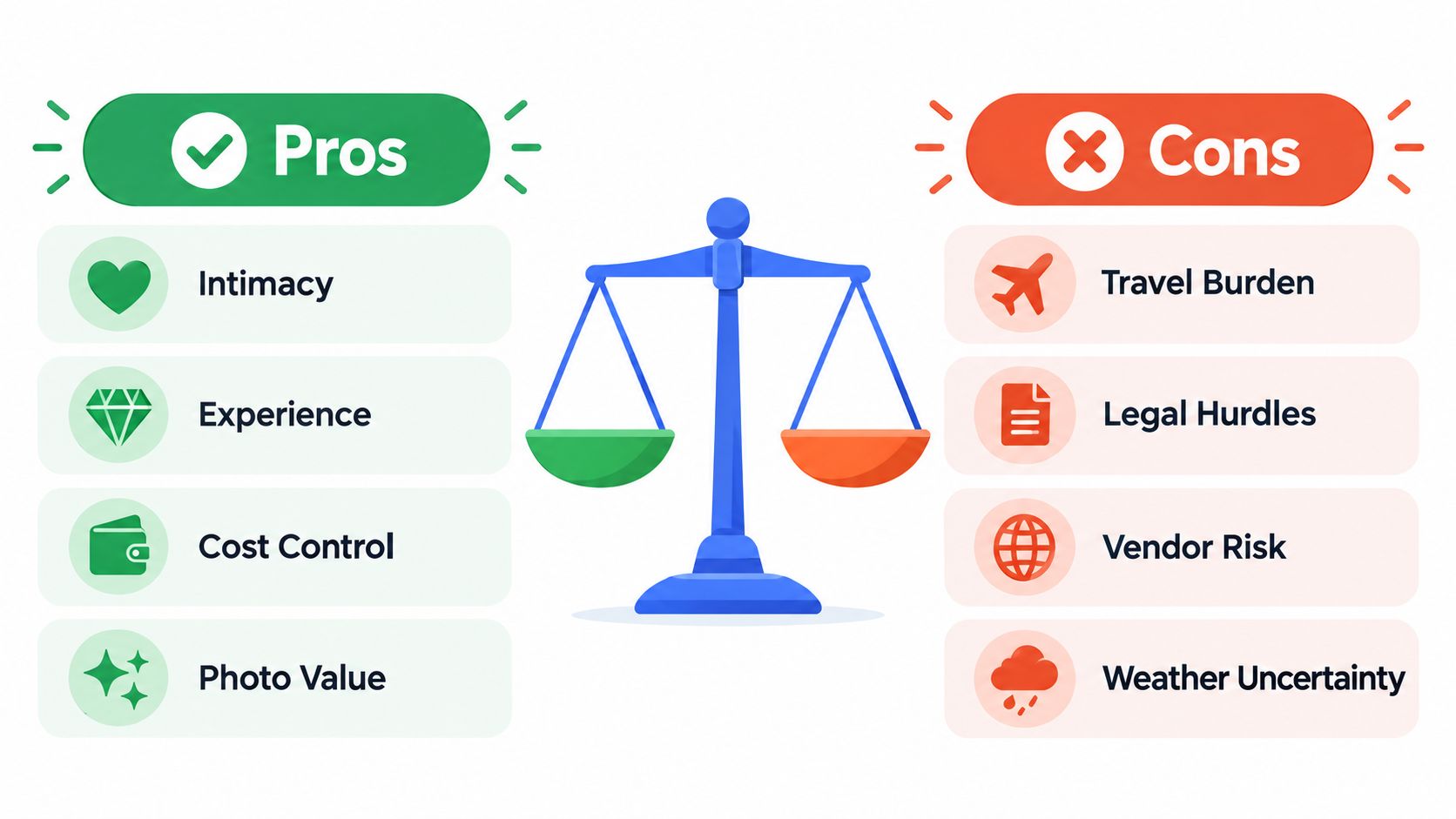
Destination weddings have real advantages. They also ask more of your guests. I would never gloss over that.
What makes destination weddings appealing
Industry summaries report an average all-inclusive destination wedding package of USD 5,000 to USD 15,000 for the couple, while a fully customized celebration with all vendors can average around USD 39,000. The same summary notes a typical destination wedding guest list of about 50 to 70 guests, compared with roughly 116 guests for a traditional wedding, according to Sci-Tech Today's wedding industry statistics.
That smaller size is often the point.
- Better quality of time: You're not trying to greet a massive room in five hours. You get time with people.
- Stronger atmosphere: When guests travel in, they arrive with intention. The energy is usually more engaged.
- Cleaner budget choices: A smaller guest list can free up room for meaningful upgrades like better accommodations, a private dinner, or a more scenic venue.
- Higher visual payoff: Destination settings often do some of the design work for you. Good views, stronger architecture, and a cohesive guest experience matter.
Where couples underestimate the downside
The downside is rarely the ceremony itself. It's the travel burden around it.
If your guests have to coordinate flights, time off, childcare, and multiple nights away, some people won't come. Others will feel stretched. That doesn't mean the wedding is a bad idea. It means the event has to feel worth the effort.
Worth remembering: Guests don't evaluate destination weddings only by beauty. They evaluate them by how manageable the trip feels.
Here's where I see couples misjudge fit:
- They assume package price equals total cost: It doesn't. Flights, extra events, outside vendors, and upgrades change the picture quickly.
- They choose a hard-to-reach location: Long transfers can sour the mood before the weekend even starts.
- They over-invite: A destination wedding works better when you're honest about who is realistically likely to attend.
- They treat it like a local wedding in another place: That's a mistake. Guest communication, rooming, airport timing, and schedule spacing matter much more.
My direct recommendation
Choose a destination wedding if you want intimacy, atmosphere, and more meaningful time with guests.
Skip it if your top priorities are maximum attendance, minimal family friction, or an event format that asks very little of your guests.
Those aren't minor distinctions. They are the whole decision.
Key Considerations That Determine Success
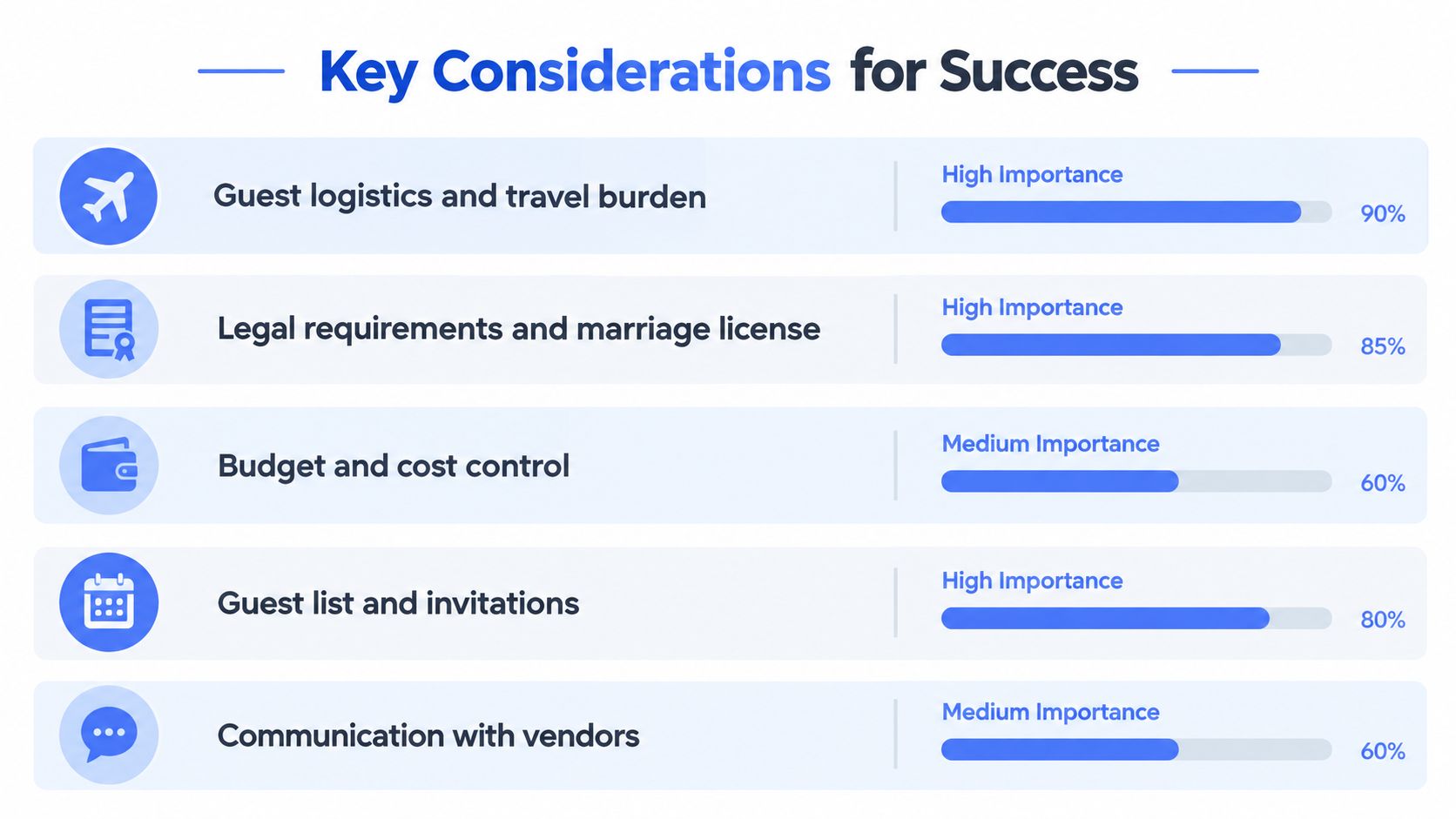
A destination wedding succeeds or fails long before the ceremony. It happens in the planning choices that affect comfort, legal clarity, and how much effort guests need to spend just getting there.
Guest logistics decide more than couples expect
The first question I ask is not “Which beach?” It's “How easy is this trip for your guests?”
A short nonstop plus a quick transfer feels very different from a connection, a ferry, and a late-night arrival. The second version may still be worth it, but only if the couple understands the attendance trade and builds enough recovery time into the itinerary.
The room block also matters more than people think. If your venue has steep minimums or your destination has limited inventory, poor timing can corner you into awkward compromises on budget or location.
For couples comparing wedding formats and investment expectations, this overview of the average cost of a destination wedding can help frame what belongs in the budget discussion.
Legal marriage requirements are not a footnote
Many countries require destination-wedding couples to provide a valid passport, a birth certificate, and proof of residency or single status, and some destinations also require local registration after the ceremony, according to FindLaw's destination wedding legality guide.
That's why I'm very practical here. If the destination has more involved legal steps, many couples prefer to handle the legal marriage at home and keep the destination event ceremonial. It can be the cleaner choice, especially when timing is tight or document requirements are changing.
The most romantic plan is often the one with the fewest administrative surprises.
Venue type changes the whole experience
Not all destination weddings operate the same way. The venue model shapes the pace, privacy, and planning load.
- All-inclusive resorts: Best for couples who want one contained setting with accommodations, dining, and event structure in one place.
- Private villas: Strong for intimacy and private-house atmosphere, but they usually require more coordination around staffing, rentals, and transport.
- Historic estates or standalone venues: Great visual impact, though guest movement and lodging may be less coordinated.
Seasonality and transfer time matter more than décor
I'd put transfer time ahead of tablescapes every single time. A beautiful property can lose its appeal fast if guests arrive exhausted, miss key moments, or spend too much of the weekend in transit.
My advice is simple:
- Pick the easiest destination that still feels special.
- Protect arrival day with light scheduling.
- Keep the wedding day itself logistically simple.
- Confirm paperwork requirements early, not after the venue is held.
Karrah Kazravan has traveled to more than 65 countries across all seven continents, and that perspective matters here. Places that look equally beautiful online do not feel equally easy in real life. That difference is what busy couples need help judging.
Your Destination Wedding Timeline and Planning Checklist
Most destination wedding stress comes from late decisions. Not hard decisions. Late ones.
The attendance pattern is different from a local event. Industry guides cite attendance in the roughly 40% to 60% range, and if 120 invitations are sent, planners commonly budget for about 50 to 70 guests to attend, according to Bridebox's beginner's guide to destination weddings. That's why the timeline has to start with realistic attendance assumptions, not your invitation list.
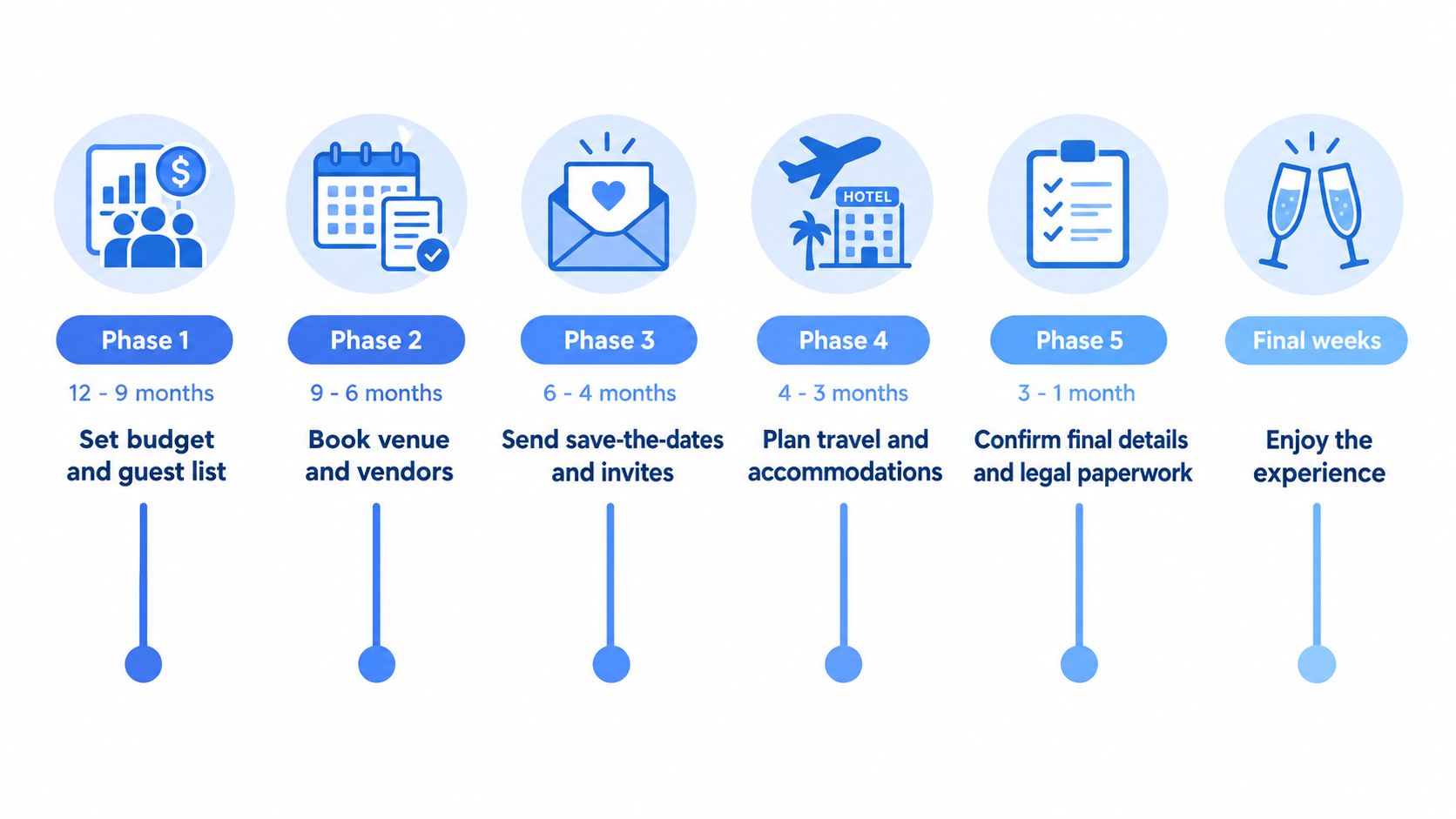
Twelve to nine months out
Start with the big filters.
- Set the budget: Include the wedding events, your own travel, and the guest experience standards you care about most.
- Choose the destination based on access: Flight patterns, transfer ease, and lodging options should lead the decision.
- Draft the guest list early: You need a realistic count to evaluate venues and room blocks properly.
Nine to six months out
This is your commitment phase. Once you hold the venue, the rest gets easier.
- Secure venue and key vendors: Especially if you want a specific date or property style.
- Outline the weekend flow: Welcome event, ceremony day, departure rhythm.
- Share save-the-dates promptly: Guests need time to plan work schedules and travel.
Six to four months out
Now you move into travel execution.
If the destination requires extra connectivity planning for guests, practical resources can help. For example, couples hosting events in the Indian Ocean may want to share guidance like this affordable Maldives data plan so guests aren't figuring out phone access after landing.
If you want a more detailed planning sequence, this destination wedding planning timeline is a useful companion.
Planning rule: Your guests should know where to stay, when to arrive, and what to book before they need to ask.
Four to one month out
This phase is all about tightening the plan.
- Confirm RSVPs and room pickup against your expected attendance band.
- Finalize legal paperwork or ceremonial setup, depending on your route.
- Recheck transfer plans, arrival windows, and event timing.
- Review contingency plans for delays and missed connections.
Final weeks
Do less. Confirm more.
This is when couples tend to overcomplicate things with added décor, extra activities, or last-minute changes. I'd much rather see you protect the guest experience. Clear arrival instructions, sensible event timing, and enough breathing room will do more for the weekend than another layer of production.
One practical option some couples use is advisor-led travel coordination. Explore Effortlessly offers destination wedding planning support that can include consultation, guest travel strategy, room block coordination, and itinerary management before departure, with in-destination partners supporting the on-site experience.
Smart Alternatives If a Full Destination Wedding Is Not the Fit
You do not have to choose between a giant local wedding and a full international production. There's a middle ground, and for many couples that middle ground is the smartest answer.
A 2025 survey in Australia reported an average of 55 guests for destination weddings, while an India industry report found destination weddings averaged 280 guests versus 420 for local weddings and that nearly 90% were hosted domestically, according to this EventFAQs coverage of the WedMeGood annual wedding report. The takeaway is simple. Couples are often using destination formats to manage guest count while staying closer to home.
Three formats I recommend often
| Option | Best for | Main benefit |
|---|---|---|
| Domestic destination wedding | Couples who want getaway energy without passport friction | Better attendance potential and simpler planning |
| Elopement plus hometown reception | Couples who want a meaningful ceremony and easier celebration later | Lower travel burden for guests |
| Multi-day local weekend | Couples who want immersion without long-haul logistics | Stronger experience with less transportation complexity |
My opinion on the best compromise
For many affluent busy couples, domestic destination weddings are the sweet spot. You still get the shift in setting, the hotel weekend feel, and the intimacy of a smaller event. But you reduce document issues, long-haul fatigue, and some of the family resistance that comes with an overseas wedding.
If your dream is a destination feeling, not necessarily an international stamp in a passport, domestic often gives you the better balance.
An elopement plus a separate reception is another very good answer when the couple values privacy but still wants to celebrate broadly. It's not a fallback. For the right pair, it's the most elegant solution.
Deciding With Confidence and Planning Effortlessly
If you're still asking, “Is destination wedding a good idea?” use this decision filter.
Ask yourselves these five questions
- Do we want intimacy more than turnout? If yes, destination moves up the list.
- Can our budget flex for travel-driven logistics? If no, keep the format simpler.
- Will our closest guests realistically travel well? Be honest about age, childcare, mobility, and work demands.
- Do we want a wedding that unfolds over days, not hours? That's where destination shines.
- Do we have the time to coordinate details properly? If not, you'll want structured planning support.
My opinion is straightforward. A destination wedding is a good idea for couples who want a more intentional guest list, a stronger sense of place, and a wedding weekend that feels like quality time instead of a sprint. It is a poor fit for couples who need broad attendance or who choose a destination without thinking seriously about travel friction.
I'm Karrah Kazravan, owner and lead travel advisor at Explore Effortlessly, an award winning Miami agency serving clients nationwide. I design custom journeys for busy travelers who want confident recommendations and thoughtful coordination. I have traveled to more than 65 countries across all seven continents and am a Nexion Circle of Excellence Top 5% advisor, ASTA Verified Travel Advisor, Certified Travel Associate, and CLIA Accredited Cruise Counselor.
If you want ongoing travel insight beyond this article, you can also join my newsletter.
If you want help deciding between a domestic resort weekend, an island celebration, or a more complex international format, Explore Effortlessly offers advisor-led planning for couples who want clear recommendations, realistic logistics, and a wedding trip that feels well paced from the start. If that sounds like your style, start planning your trip through the inquiry form and we'll see if the fit is right.