You've opened the calendar, compared flight options, and discovered the usual problem: fitting Rome, Florence, and Venice into one trip looks easy on paper, then starts to feel like a logistics exercise. The standard seven-night route can be done, but for a premium trip, “possible” isn't the right benchmark. You want the Colosseum without watching the clock, a Tuscan lunch that doesn't end with a station sprint, and a Venetian arrival that feels like part of the experience.
This Rome Florence Venice itinerary is built for busy couples who value elegant hotels, private guiding, high-speed rail, and breathing room. My recommendation is nine to ten nights, with four nights in Rome, three in Florence, and two or three in Venice. That pacing protects the trip's most valuable asset, your time.
Why the Classic Three City Trip Deserves a Slower Build
A seven-night Italy itinerary usually gives each city two nights, sometimes less once arrival and departure logistics are counted. In practice, that means checking in, orienting yourself, squeezing in one major sight, packing again, and returning to a railway station just as you've started to understand the neighborhood. It's efficient, but it rarely feels luxurious. If seven nights is the limit and you are weighing destinations, my seven-day Peru itinerary for travelers shows a different approach to time on the ground.
The better structure is four nights in Rome, three nights in Florence, and two to three nights in Venice, a baseline also reflected in recent itinerary guidance for first-time travelers (Rail Pass Guide's Italy by train planning overview). The extra nights aren't indulgent padding. They absorb jet lag, protect your museum reservations, and give each city a genuine arrival evening and a signature experience.
My planning rule: If a destination deserves a long-haul flight, it deserves enough nights to be experienced without apologizing to the clock.
Rome benefits most from the longer stay. It's geographically broad, historically layered, and demanding on foot. Florence is compact, but its art requires appointments and attention, not a rushed pass through the Uffizi before a train. Venice rewards early mornings, unplanned canal walks, and evenings after day-trippers have left.
What a slower pace buys you
- Better hotel selection: You can choose a property for atmosphere, views, service style, or gardens instead of choosing whatever is closest to the station.
- More useful context: A private guide can connect ancient Rome, Renaissance Florence, and Venetian history rather than reducing each city to a checklist.
- Protected dining plans: Coveted tables and tasting menus fit naturally when your days aren't overloaded.
- A recovery window: Jet lag, delayed luggage, and the occasional slow morning stop being trip-threatening problems.
Italy remains a core part of the country's travel economy. ISTAT-based 2024 figures record 42,705,319 overnight stays in Rome, 13,290,973 in Venice, and 9,192,960 in Florence, confirming the scale and enduring appeal of this three-city combination (Tourism in Italy, with ISTAT-based data). That popularity is precisely why premium travelers need a considered plan. The landmarks are not difficult to identify. The challenge is giving them the time and access they deserve.
Rail Logistics and the 2026 Venice Access Fee
Build the rail plan before selecting hotels. Rome, Florence, and Venice sit on a remarkably practical high-speed corridor. Rome to Florence is about 230 kilometers and takes roughly one hour and thirty minutes on high-speed services, while Florence to Venice is about 255 kilometers and usually takes around two hours (Rome to Florence and Venice rail guide).
Frecciarossa and Italo both serve the major city pairs. For couples, I favor a two-seat configuration across from one another when available. Choose Business or Executive on the longer journey, or Prima 1 and its closest equivalent when the schedule and seating layout are more appealing. The point isn't merely comfort. It's avoiding airport transfers, security queues, distant terminals, and the wasted edges of a short-haul flight.
Book early when your dates are fixed. Italy's advance ticket sales have been extended through December 2026, and fares can range from early-booking levels around €19 to €30 to substantially higher same-day or flexible fares (Italy rail ticket sales through December 2026). Your confirmation should be checked for the exact station, departure time, passenger names, seat assignments, and fare conditions. A polished itinerary still fails if the traveler boards at the wrong station or assumes a flexible ticket is refundable.
High-Speed Rail Segments at a Glance
| Route | Duration | Recommended Class | Notes |
|---|---|---|---|
| Rome to Florence | About 1 hour 30 minutes | Business or Executive | The most abundant and flexible leg |
| Florence to Venice | About 2 hours | Business, Executive, or Prima 1 | Fewer departures, so fixed dates deserve earlier planning |
| Rome to Venice direct | About 3 hours 45 minutes to 4 hours | Business or Executive | Useful when Florence isn't a priority stop |
Venice adds one more planning detail in 2026. The access fee applies on selected dates, mainly Fridays through Sundays and some public holidays, during the daytime window from 8:30 AM to 4:00 PM. Outside those hours, access is free (official Venice access-fee information). The day-tripper contribution is €5 per person when booked at least four days in advance, rising to €10 per person when booked less than four days before the visit (Venice day-tripper fee guidance).
Overnight guests should verify the applicable exemption process with their accommodation and keep the required documentation accessible. I'd still build Venice around a hotel arrival, not a day trip. A private water taxi from Venezia Santa Lucia to the hotel turns the final transfer into a memorable first view of the Grand Canal.
Rome in Four Nights With a Luxury Hotel Anchor
Rome should begin gently. After a long flight, skip the Colosseum on arrival night, settle into the hotel, and let the city reveal itself over an unhurried dinner or a rooftop aperitivo.
For a polished central base, I'd consider Hotel de la Ville, the Hassler, or the St. Regis Rome. Hotel de la Ville suits couples who want rooftop energy and a contemporary Roman mood. The Hassler delivers the classic Spanish Steps address and a traditional sense of occasion. The St. Regis Rome is the choice for grand classical interiors and a more formal hotel experience.
A four-night rhythm
Arrival evening: Private airport transfer, check-in, and a low-pressure dinner near the hotel. Don't schedule a major monument. Your first night should restore your pace, not test it.
Day two: Pair the Vatican Museums and St. Peter's Basilica with early-access or private after-hours timing where available. A private guide makes the art more legible and lets you move through the complex with purpose rather than drifting between crowded rooms. The practical details behind what to see in Rome matter here, especially timed entry and the sequence of the visit.
Day three: Give ancient Rome its own day. Walk the Forum and Palatine Hill with a private guide, then visit the Colosseum without trying to add half the historic center afterward. The Forum's uneven surfaces and exposed areas reward comfortable shoes, water, and a realistic end time.
Day four: Slow the tempo. Visit the Borghese Gallery, stroll through Villa Medici's gardens, and reserve time for an aperitivo with a view. Dress for dinner at Imàgo or Aroma, where the evening can feel like an occasion rather than a recovery meal.
Rome's four-night structure creates room for a missed reservation, a preferred shopping appointment, or an extra hour over coffee. It also keeps the rail departure toward Florence from becoming an early-morning punishment. That's the difference between seeing Rome and completing Rome.
Florence in Three Nights With a Tuscan Excursion
Florence works best when you stay put. Choose one hotel, unpack properly, and let the city's compact scale work in your favor.
The Four Seasons Hotel Firenze offers a walled garden, frescoed suites, and a resort-like pause within the city. The St. Regis Florence brings riverside service, a more ceremonious atmosphere, and a strong concierge presence. Choose the Four Seasons for greenery and retreat. Choose the St. Regis for classic hotel theater and proximity to the Arno.
Three nights, with Tuscany included
Your first full day should begin with private early access to either the Accademia or the Uffizi. Don't attempt both at speed. Follow the museum with a relaxed Duomo visit, ideally timed for the warmer light of late afternoon, then keep the evening open for a graceful walk across the historic center.
The second day belongs to the countryside. A chauffeured half-day into Chianti can include a private vineyard tasting at Castello di Ama or a comparable estate, followed by lunch overlooking the vines. This is the kind of experience that disappears from a seven-night itinerary because travelers treat Florence as a rail connection instead of a destination.
On the final Florence day, visit leather ateliers, spend a quiet hour at the Brancacci Chapel, and reserve Cibrèo or Enoteca Pinchiorri. Keep the schedule intentionally light before the next transfer. My Florence planning guide is useful for shaping the day around interests rather than collecting landmarks.
For the Venice hand-off, confirm the departure from Firenze Santa Maria Novella, including the taxi lane, porter arrangements, and any available lounge access. Florence's station is central, but a professional transfer plan still matters when you're carrying formalwear, museum purchases, and luggage selected for a longer journey.
Venice in Two or Three Nights Around the Access Fee
Venice should be the final chapter, not a rushed prize at the end of the trip. Two nights is the right core for first-time visitors who want St. Mark's, the Doge's Palace, a water taxi ride, and time to wander. Add a third night for private Murano glass appointments, a slower Burano visit, or the pleasure of seeing Venice after the day crowds recede.
Check the rolling 2026 access-fee calendar before confirming flights and hotel dates. The fee is designed for day-trippers on selected daytime dates, so overnight guests should verify the exemption process with their hotel and retain the relevant confirmation. San Polo and Grand Canal locations often provide a more atmospheric base than choosing solely for proximity to the busiest stretch of San Marco.
The Aman Venice offers palazzo-scale intimacy, elegant water access, and a residential mood. The Belmond Hotel Cipriani trades central immersion for garden seclusion and a private vaporetto ride. I'd choose Aman for couples who want to wake inside Venice's architectural story. Cipriani suits travelers who value space, gardens, and a retreat-like finish.
A deliberate Venetian finale
Day nine: Walk St. Mark's Square at sunrise, enter the Doge's Palace with skip-the-line access, and return to the hotel for a late lunch on the terrace. Leave the afternoon open. Venice is best understood on foot, by accident, and without a second major appointment.
Day ten: Arrange a private water taxi loop, then join a cicchetti crawl with a local host. Finish with dinner in a Michelin-starred dining room away from the square. For a lighter morning between reservations, this guide to coffee shops recommended by Madeira Remote offers a useful starting point.
The city's rail arrival is especially graceful because Venezia Santa Lucia sits directly on the Grand Canal. A private water taxi can deliver you to the hotel's landing point without forcing you to cross bridges with luggage.
Venice 2026 Access Fee Quick Reference
| 2026 Date Window | Day-Tripper Contribution | Key Exemptions |
|---|---|---|
| Selected Fridays, Saturdays, Sundays, and some public holidays, 8:30 AM to 4:00 PM | €5 per person when booked at least four days ahead | Overnight guests should verify the accommodation-based exemption process |
| Selected fee dates booked less than four days before arrival | €10 per person | Confirm documentation requirements before visiting |
| Outside the published daytime window | No access fee | Access is free outside the operating hours |
For a more detailed two-night structure, use this two days in Venice itinerary. The right plan makes Venice feel intimate, not like a final exam.
Time Saving Logistics and Luxury Upgrades
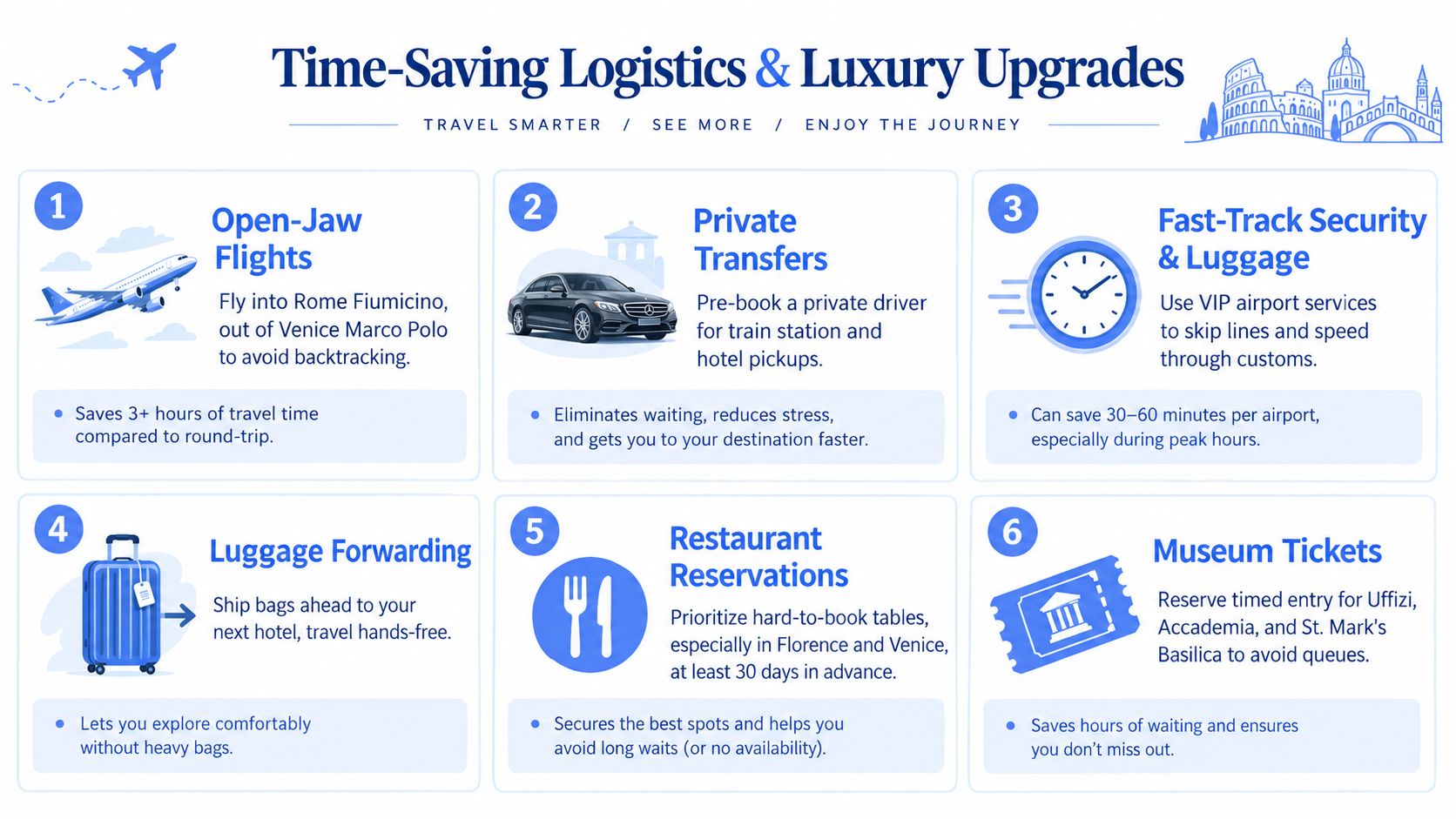
The smoothest Italian itinerary is won in the margins. Open-jaw flights into Rome Fiumicino and out of Venice Marco Polo remove the need to backtrack, while private airport transfers keep the first and final days controlled. Add fast-track arrival services where available, especially after an overnight flight.
Reserve high-speed rail around your preferred departure windows rather than forcing the entire day around the cheapest seat. Trenitalia Business Class and Italo Executive Class are sensible choices for couples who want more space and a calmer boarding experience. Prime departures around 10:00 AM can be in demand, so reserve as soon as your travel dates are firm. Station porter service in Florence and Venice is particularly worthwhile because luggage and bridges are a poor combination.
The details that elevate the trip
- Preferred hotel benefits: Ask your advisor to pursue room upgrades on arrival, breakfast inclusion, and late checkout in writing where available. These are preferred partner perks, not guarantees.
- One communication channel: Use a single mobile concierge contact for itinerary questions, while trusted in-destination partners handle local operational support.
- Calendar discipline: February and early March can offer a generous weather window before Easter crowds, while September brings warm light without the humidity associated with August. Conditions vary, so plan around your priorities rather than chasing a perfect forecast.
- Pre-cleared access: Reserve timed museum entries for the Uffizi, Accademia, Vatican Museums, and St. Mark's Basilica before arrival.
- Travel essentials: Arrange travel insurance, confirm mobile connectivity or SIM provisioning, and keep passport and payment details organized.
Small luxury, major relief: Have luggage collected at the hotel before the train departure. You'll enjoy the station, the ride, and the next arrival without dragging your trip behind you.
For a stylish practical accessory, travelers who enjoy well-made mechanical pieces may appreciate this guide to Swiss travel watches for men. It's a small detail, but a dependable watch is useful when rail departures, museum entries, and private drivers all operate on different clocks.
Planning Your Trip With a Luxury Travel Advisor
A well-designed Rome Florence Venice itinerary isn't a stack of reservations. It's a coordinated sequence in which the hotel, rail seat, guide, driver, restaurant, and museum entry support the same pace.
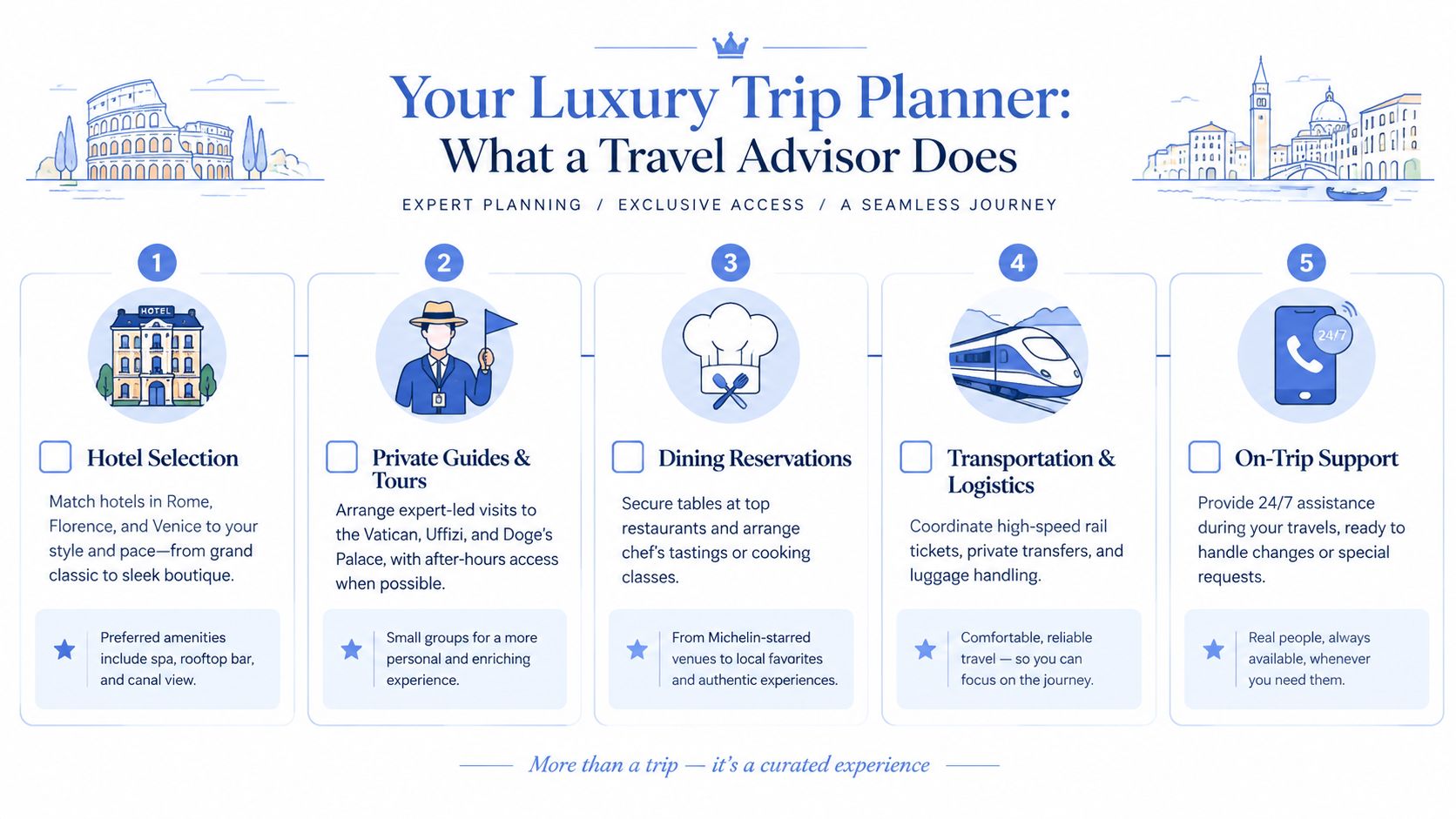
A luxury advisor can match hotels across the three cities to your preferences, whether that means a rooftop in Rome, a garden in Florence, or direct water access in Venice. The advisor can also secure Frecciarossa or comparable high-speed rail seats in Executive or Business class, arrange private cars at each city arrival, and coordinate station assistance for luggage.
What I would coordinate
- Hotel selection: Compare room categories, location, atmosphere, and preferred partner amenities instead of choosing by star rating alone.
- Private guiding: Arrange timed or skip-the-line visits to the Vatican, Uffizi, Accademia, and Doge's Palace, with after-hours access where available.
- Countryside and water access: Build the Tuscan excursion around the museum calendar and arrange Venetian water transfers around the 2026 access-fee dates.
- Flight architecture: Consolidate open-jaw flights into FCO and out of VCE so the itinerary ends where it should.
- Trip management: Keep confirmations, transfer details, dining plans, and special requests in one coordinated itinerary.
Advisor relationships may also provide access to programs such as Virtuoso, Marriott Stars, and Belmond Bellini amenities, including breakfast, room upgrades, and late checkout where available. Benefits vary by property, rate, availability, and program terms, so they should be confirmed before departure rather than assumed.
I work with clients nationwide through virtual consultations. Explore Effortlessly can plan, book, and manage the flights, hotels, private transfers, rail tickets, dining reservations, and experiences that make this itinerary feel cohesive, while trusted in-destination partners provide on-the-ground support during the trip. My credentials include Circle of Excellence Advisor, Top 5 percent at Nexion, and CLIA Accredited Cruise Counselor.
The right advisor doesn't add more to your itinerary. The right advisor removes the friction around what matters most.
Explore Effortlessly designs high-touch Rome, Florence, and Venice journeys around your preferred pace, hotel style, rail comfort, and private experiences. If you're ready to replace a rushed seven-night checklist with a thoughtfully managed nine- to ten-night escape, start with Explore Effortlessly and request a consultation. You can also plan your luxury trip with one advisor coordinating the details from departure through your return.
Join the Explore Effortlessly newsletter for curated luxury travel ideas, planning guidance, and destination inspiration.
Author
Hi, I'm Karrah, owner, founder, and lead travel advisor at Explore Effortlessly, a luxury award-winning travel agency based in Miami.
I specialize in designing bespoke, high-touch itineraries to bucket-list destinations around the world. Every trip is curated with intention, insight, and logistics from start to finish.
From luxury cruises and private villas to honeymoons, safaris, and once-in-a-lifetime journeys, my role is to simplify the planning process while elevating every detail. I work with clients nationwide through virtual consultations.