Vietnam is on your list for good reason. It’s cinematic, layered, and far more complex to plan well than it might seem.
Most travelers start the same way. They open a dozen tabs, save Hanoi, Ha Long Bay, Hoi An, and Ho Chi Minh City, then hit the wall. One guide says go north first. Another says skip the cities. A third insists the beach is the point. Then the practical questions show up. How many stops are too many? Which cruise is worth it? When does the weather fall apart? Who’s handling transfers when one flight lands late and the ship is waiting?
That’s where tours in vietnam separate into two categories. Trips that look good on paper, and trips that run smoothly in real life.
Vietnam isn’t obscure anymore. In 2019, Vietnam welcomed 18 million international visitors, making it the fifth most visited country in the Asia-Pacific region, and projections aimed for 21.2 million visitors in 2025 after a major rebound, according to Vietnam tourism data. Popularity is great for access and infrastructure. It also means more noise, more crowded routes, and more mediocre operators selling “luxury” that isn’t remotely luxury.
An effortless Vietnam journey depends on design, not luck. The right pacing. The right regional pairing. The right cruise length. The right room category. The right guide for your personality. The right handoff between airport, hotel, driver, and boat.
Small details matter here. A lot. Even something simple like taking a few minutes to learn basic Vietnamese words changes how you move through markets, hotel arrivals, and local interactions. It won’t make you fluent. It will make you more comfortable, and that always improves a trip.
Your Expertly Curated Vietnam Journey Starts Here
The best Vietnam trips don’t try to do everything. They choose the right version of Vietnam for you.
Some travelers want old-world glamour and polished private touring. Others want rice terraces, active days, and a little edge. Some want one exceptional anniversary trip with just enough structure to feel cared for, but not scheduled to death. Families usually want all of that at once, which is why family planning in Vietnam gets messy fast if nobody is making hard decisions early.
What a well-planned trip actually looks like
A strong itinerary has three traits:
- Clear regional logic: You’re not zigzagging across the country just because a blog listed everything in one article.
- Pacing with intention: Two nights somewhere may be elegant. It may also be rushed. It depends on transfers, not optimism.
- A service standard that stays consistent: Private airport arrival, excellent guides, smart hotel choices, and realistic transition days.
Practical rule: If a Vietnam itinerary looks exciting but ignores transfer fatigue, it’s probably not a luxury itinerary. It’s a checklist.
Vietnam rewards travelers who like contrast. Hanoi feels cerebral and textured. Ha Long Bay shifts the pace completely. Central Vietnam can turn romantic and coastal. The south brings energy, food, and river life. The magic comes from sequencing those moods well.
Why bespoke beats generic
Group tours can work for travelers who care most about price or broad coverage. That is not the same thing as traveling well.
The higher-end version of tours in vietnam should solve problems before you ever see them. You shouldn’t be thinking about whether your guide will meet you airside, whether your domestic luggage transfer was coordinated correctly, or whether your overnight cruise cabin is on the wrong deck near engine noise. You should be choosing between a morning market walk and a slower breakfast.
That’s the difference. Not “luxury” as a buzzword. Luxury as friction removed.
Finding Your Vietnam Matching a Tour to Your Travel Style
Most Vietnam planning goes wrong at the identity stage. People pick places before they pick a travel style.
That’s backwards.

For the luxury traveler
If you care about comfort, privacy, and high service standards, your Vietnam tour should be built around smooth transitions and selective depth.
That usually means fewer hotel changes, better room categories, private guides who know when to talk and when to step back, and experiences with breathing room around them. A rushed “best of Vietnam” trip is the fastest way to turn a premium budget into an exhausting vacation.
For these travelers, I usually favor a structure like this:
- Start in Hanoi well: Give the city enough time to settle in with excellent dining, architecture, and measured private touring.
- Choose your bay experience carefully: An overnight cruise can be wonderful. The wrong vessel, route, or cabin can feel mass-market very quickly.
- End with softness: That may be Hoi An, a beach stay, or a quieter finale with spa time and less movement.
Luxury in Vietnam is not about excess. It’s about editing.
For the adventure-minded traveler
Adventure here should feel curated, not chaotic.
Vietnam can absolutely deliver dramatic scenery, active days, and a stronger sense of discovery. But “adventure” doesn’t need to mean questionable vehicles, loose planning, or rolling the dice on operators. It can mean trekking with a vetted guide, kayaking from a polished cruise, or building in a mountain or countryside segment that contrasts with the cities.
The right question isn’t “How much can we fit in?” It’s “What kind of adventure still feels good on day eight?”
A good active itinerary often includes:
- One urban base for food, history, and rhythm
- One scenic immersion such as the bay or the mountains
- One recovery stop where the pace intentionally comes down
For honeymoons and romance
Vietnam works beautifully for couples, but only when privacy is protected.
I don’t like overly ambitious honeymoon routes here. Romance disappears when every other day starts with packing. Better to choose a few standout places and do them properly. Think atmospheric city moments, an elegant cruise, a suite worth lingering in, and dinners that don’t require logistical gymnastics.
The best honeymoon itineraries in Vietnam leave space for spontaneity. If every hour is programmed, the trip starts to feel managed instead of romantic.
Couples also need different things than sightseeing-driven travelers. A honeymoon should include late starts, easy room service days, and hotels that feel like destinations in themselves.
For families and multi-generational trips
Expert planning matters most.
A common problem in multi-generational tours is balancing teenagers who want adventure, parents who want culture, and grandparents who need accessibility. Thoughtful planning fixes that by designing integrated itineraries with strategic activity splits, so one part of the family can do something more active while others enjoy a gentler cultural experience, as noted in this Vietnam family travel overview.
What works best is not forcing everyone into one identical day.
Instead, I like this model:
- Shared anchors: Family dinners, private heritage touring, one standout cruise or market experience
- Split blocks: Younger travelers peel off for something more energetic while older family members take a slower track
- Smart accommodations: Connecting rooms, villas, or properties with enough space for togetherness and retreat
Teenagers don’t need the same Vietnam your parents want. That’s normal. Good planning accepts it instead of fighting it.
Crafting Your Itinerary A Land of Contrasts
Vietnam works best when you treat it like a story with distinct chapters. North, Central, and South each deliver a different mood, and trying to flatten them into one generic country experience is a mistake.
Northern Vietnam
The north gives you depth first.
Hanoi is the intellectual and emotional anchor for many trips. It’s layered, energetic, and best experienced with context. Here, architecture, history, food, and daily street life start to click. From there, travelers often pair the city with Ha Long Bay or another scenic northern extension.
Northern Vietnam suits travelers who want atmosphere over polish. It’s less about easy beach downtime and more about texture.
Central Vietnam
Central Vietnam changes the tone entirely.
In this setting, many trips become softer, more romantic, and more visually graceful. Hoi An usually appeals because it’s pretty, yes, but also because it slows people down. Hue adds imperial history and structure. Coastal stays in this part of the country can also create the breathing room that a longer itinerary needs.
If your trip feels too packed on paper, Central Vietnam is often where I fix it.
Southern Vietnam
The south is bigger, faster, and more commercial in feel, but it’s excellent when used intentionally.
Ho Chi Minh City brings momentum. It’s compelling for food, modern energy, and history. The Mekong adds a different cadence altogether, with river-based experiences and a more rural contrast. This part of the country works especially well at the end of an itinerary if you want a stronger urban finish.
Sample Vietnam itinerary frameworks
The right length depends on how much movement you’ll tolerate. Here’s the version I use when helping travelers decide whether they’re planning a highlights trip or a fuller country journey.
| Duration | Focus | Sample Itinerary Flow | Ideal For |
|---|---|---|---|
| 7 days | High-impact introduction | Hanoi, Ha Long Bay, Hoi An | First-timers, couples, travelers short on time |
| 10 days | Balanced classic route | Hanoi, Ha Long Bay, Hoi An, Ho Chi Minh City | Most luxury travelers who want variety without overload |
| 14 days | Deeper regional contrast | Hanoi, Ha Long Bay, Central Vietnam, Ho Chi Minh City, Mekong | Families, milestone trips, travelers who want pace and depth |
If you’re considering extending beyond Vietnam or building a broader regional itinerary, I’d look at a thoughtfully paced Vietnam and Cambodia trip rather than cramming every major stop into one country run.
A good itinerary isn’t the one with the most stops. It’s the one where each stop feels justified.
The Art of Timing When to Visit Vietnam
Vietnam does not have one neat “best time to visit.” Anyone who tells you otherwise is flattening a long country into one weather forecast.
Read the country by region
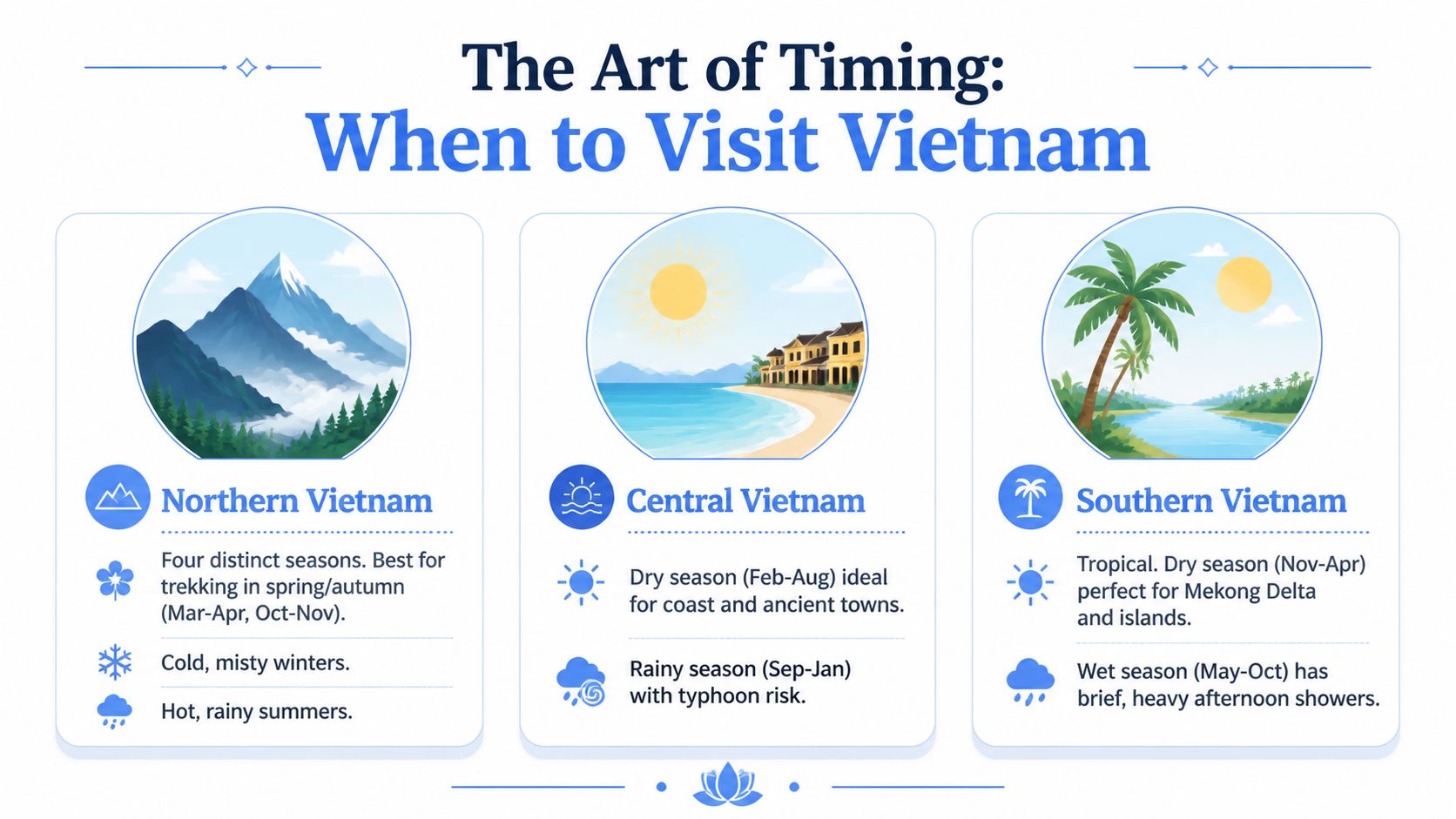
The north, center, and south behave differently enough that timing should shape your route.
- Northern Vietnam: Four seasons, with spring and autumn often preferred for trekking and more comfortable sightseeing
- Central Vietnam: Stronger coastal appeal during its dry stretch, which makes it appealing for beach extensions and old-town stays
- Southern Vietnam: Tropical and easier to use for winter sun, with wet-season afternoons that can still work if you build the days correctly
This is why I often design Vietnam trips around one primary weather winner and one acceptable supporting region, rather than forcing a countrywide sweep that compromises the whole trip.
Shoulder season is often the smartest choice
Peak windows attract everyone. That means stronger demand, tighter availability, and a more crowded version of the same experience.
Shoulder periods can be more elegant if you know where to lean in and where to avoid overcommitting. You may not get perfect weather every day, but you often get a far better travel rhythm. Better tables. Better guiding flexibility. Better energy overall.
For packing, fabrics matter more than most travelers expect. Humidity, temple dress requirements, and polished dining all pull in different directions. I like Arrisco's advice for Vietnam travelers as a useful starting point for thinking through lightweight layers and respectful coverage.
Tet changes the trip
Tet can be beautiful and culturally rich. It can also complicate operations.
The atmosphere is special, but availability tightens, local movement spikes, and some services shift around the holiday period. I only recommend Tet travel for clients who understand the trade-off and want the cultural experience enough to accept the added planning complexity.
If you want calm, smooth logistics, pick another window. If you want a holiday atmosphere and don’t mind a more strategically built itinerary, Tet can work beautifully.
Seamless Logistics The Unseen Work of a Perfect Trip
The trips that feel effortless usually have the most work behind them.
Vietnam is not difficult in a dramatic sense. It is difficult in an accumulation-of-details sense. That’s what catches DIY planners. One small miss doesn’t ruin the trip. Five small misses in a row absolutely do.
The visa is the easy part
Vietnam’s e-visa system typically has a 96-hour turnaround and a $25 fee, but that’s only one piece of the puzzle, as noted in this guide to Vietnam travel logistics and e-visa planning.
A key task is integrating that visa timing into the rest of the itinerary. Flight schedules, arrival airports, domestic positioning, cruise embarkations, hotel sequencing, and buffer time all need to align. A visa approval doesn’t guarantee a smooth trip. It just gets you to the starting line.
Domestic movement is where trips either glide or wobble
Vietnam rewards travelers who pre-arrange the obvious pain points.
I strongly prefer:
- Private airport transfers instead of figuring things out after a long-haul arrival
- Vetted drivers for regional or intercity moves where timing matters
- Smart domestic flights when they save energy, not just time on paper
- Protected connection logic between flight arrivals and cruise or hotel commitments
A badly timed transfer can wreck a day. So can choosing the cheapest possible domestic flight if it leaves you stranded with awkward check-in gaps and no useful support.
DIY travelers often focus on the flight cost. Advisors focus on the full day cost. Those are not the same thing.
Good logistics preserve mood
That’s the point people miss. Logistics are emotional.
If you arrive rested, meet the right person immediately, and move into a beautiful suite without friction, the country opens up differently. If you’re dealing with payment confusion, transfer uncertainty, and a missed handoff, your patience shrinks and the trip starts to feel harder than it should.
Luxury tours in vietnam should create a chain of confidence from one stop to the next. That chain needs to be built before departure, not improvised in real time. If Europe is next, I would apply that same route-first approach to Prague Vienna and Budapest tours.
Decoding Your Investment What a Bespoke Vietnam Tour Includes
A bespoke Vietnam trip costs more for one simple reason. Someone is paying attention.
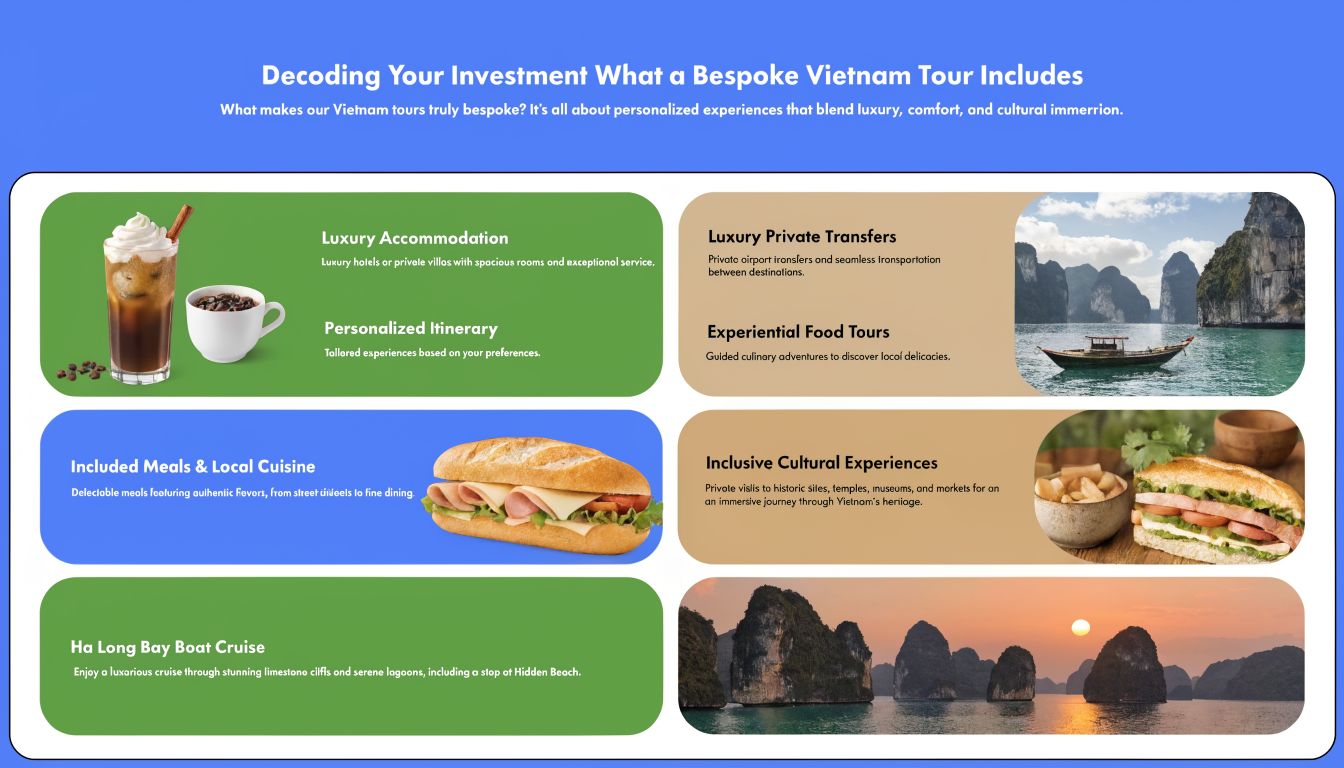
What you’re actually buying
You’re not just buying hotel nights and transfers. You’re buying filtration.
A stronger investment usually provides:
- Better hotels in better locations
- Higher room categories that improve the stay, not just the bragging rights
- Private guiding instead of generic sightseeing
- Cleaner transfer design with fewer rough edges
- Experiences chosen for fit, not volume
The difference is especially visible on cruises, city touring, and family travel. A standard product gets you there. A bespoke one changes how it feels to be there.
Where I tell clients to spend more
Not every line item deserves a splurge.
If you want the trip to feel more luxurious, prioritize the pieces with outsized impact:
- Arrival hotel and first room category
- Bay cruise quality
- Private guides in the cities that need context
- Drivers and transfer support on movement-heavy days
That’s where the trip either starts polished and stays polished, or slowly frays.
I’d rather see a client do fewer stops at a higher standard than chase a “grand tour” with too many average pieces. If your travel style leans highly customized, bespoke travel experiences are the right lens for thinking about Vietnam from the start.
Why Your Choice of Tour Operator Matters Most
This is the part I’m blunt about. The wrong operator can damage the entire trip.
Vietnam has excellent guides and excellent ground partners. It also has a huge amount of online noise. Polished photos do not mean legitimate operations. Charming messaging does not mean legal licensing. “Luxury” on a website means nothing until someone checks the details.
Licensing is not optional
Only 20 to 30% of tour operators in Vietnam hold the mandatory International Tourism License required to legally serve foreign clients, and 15 to 20% of post-pandemic tourist complaints were tied to non-compliant companies, according to this report on booking tours in Vietnam responsibly.
That should change how you shop for tours in vietnam.
If an operator isn’t properly licensed, the risk isn’t theoretical. It can show up as canceled services, poor guide quality, weak accountability, or shaky safety standards. And by the time a traveler discovers that, they’re already in-country.
What proper vetting looks like
I care less about flashy branding and more about operational discipline.
A credible in-country partner should have:
- Valid inbound licensing
- Proper insurance and legal compliance
- Guides who are polished, punctual, and suited to premium travelers
- Vehicles and drivers that match the standard being sold
- Clear emergency protocols and strong communication
If you can’t tell who is actually operating your tour on the ground, you’re taking on more risk than you think.
Why this matters even more for premium travelers
Luxury travelers have less tolerance for failure. Rightfully so.
You may be traveling with children, aging parents, or on a milestone trip with a tight calendar and high expectations. If one moving part fails, the ripple effect is bigger because the trip is more structured and the impact of any misstep is more significant. That’s why I recommend working with a professional who has already sorted through the operator quality issue instead of asking you to do that homework yourself. If you want expert help sorting those variables, a strong vacation travel agent is not a nice extra here. It’s the control point.
Frequently Asked Questions About Planning a Vietnam Tour
Do I need to carry cash, or can I rely on cards?
Carry both. In top hotels and many polished restaurants, cards are usually straightforward. Smaller shops, local markets, and more casual purchases are easier with cash. I advise clients to arrive prepared for a mixed-payment environment and not assume every stop will be card-friendly.
What should I pack for a luxury Vietnam itinerary?
Pack for heat, humidity, temple etiquette, and polished dinners all at once. That means breathable clothing, comfortable walking shoes, a light layer for air-conditioned interiors, and pieces that cover shoulders or knees when needed. Vietnam is not the place for a suitcase full of heavy fabrics and difficult shoes.
Can Vietnam work for a solo luxury traveler?
Yes, very well, if the trip is structured properly. One key gap in mainstream advice is the tension between authentic immersion and stronger security preferences for affluent solo travelers. Bespoke planning can bridge that with vetted female guides, private villa stays in secure compounds, and pre-trip cultural briefings, as discussed in this perspective on solo Vietnam travel planning.
Is Vietnam a good destination for dietary restrictions?
Usually, yes, but it requires communication before arrival, not just at the table. High-touch planning helps because guides, hotels, and restaurants can be briefed in advance. That matters more than travelers expect, especially when moving between cities and styles of accommodation.
How far in advance should I plan tours in vietnam?
Earlier than generally assumed, especially for peak-season suites, premium cruises, and complex family trips. Vietnam can be flexible on the ground, but the best version of Vietnam is not last-minute. The strongest guides, room categories, and route combinations tend to go first.
If you’re ready to stop piecing this together across twenty browser tabs, Plan my luxury trip with Explore Effortlessly. Karrah works with clients nationwide through virtual consultations to design high-touch, meticulously personalized journeys that handle the intricate planning behind a smooth trip. From cruise selection and hotel strategy to private transfers, family pacing, and milestone travel design, through these services, Vietnam starts feeling effortless instead of overwhelming.
Author Bio
Hi, I’m Karrah, owner, founder, and lead travel advisor at Explore Effortlessly, a luxury award winning travel agency based in Miami.
I specialize in designing bespoke, high touch itineraries to bucket list destinations around the world. Every trip is curated with intention, insight, and smooth logistics from start to finish.
From luxury cruises and private villas to honeymoons, safaris, and once in a lifetime journeys, my role is to simplify the planning process while elevating every detail.
Join the newsletter for more destination insight and luxury travel planning inspiration through Karrah’s newsletter.