A lot of senior travelers want the same thing. They want the grandeur of Yellowstone, the red rock drama of Utah, or the stillness of Acadia, but they do not want to wrestle with parking lots, guess which lodge has accessible rooms, or spend the day recovering from an itinerary that looked good on paper and felt exhausting in real life.
That disconnect is exactly why national park trips for seniors need better planning. Not more planning. Better planning.
I’m Karrah, and I design effortless luxury travel for clients nationwide through virtual consultations. My view is simple. A national park trip should not feel like a compromise between comfort and wonder. It should feel polished, paced, and enduringly memorable. You can have the iconic views, the wildlife, the scenic drives, the private guides, the right room, and the right pacing. You just need a trip built around how you exactly want to travel.
Beyond the Bus Tour Envisioning Your Perfect National Park Journey

The old stereotype is that national park vacations are rugged, improvised, and slightly uncomfortable. That’s outdated. The best senior park trips are curated around comfort, access, and timing. They include the right entrance strategy, the right lodging mix, and enough breathing room that the trip feels restorative instead of demanding.
The appeal is obvious. National parks remain one of the most rewarding ways to see extraordinary scenery without leaving North America, and they continue to resonate with older travelers. The America the Beautiful Senior Pass costs $20 annually or $80 for a lifetime for U.S. citizens and permanent residents age 62+, grants access to over 2,000 federal sites, and Baby Boomers reported a 90% satisfaction rate with recent park trips in National Park Service visitor research.
What makes a luxury park trip different
A luxury national park trip isn’t about removing nature from the experience. It’s about removing friction.
That means choosing a park based on your energy level, not just its fame. It means pairing a scenic drive day with a proper lunch and a comfortable afternoon break. It means knowing when a historic lodge adds charm and when it is inconvenient. It means arranging transfers and touring so you spend your energy on the views, not on logistics. For travelers who prefer private touring and dramatic scenery without changing hotels daily, my Iceland day trips from Reykjavík offer another option to consider.
Practical rule: If a trip requires you to be “easygoing about the details,” the details probably haven’t been planned well enough.
Key takeaways
- Choose for fit, not prestige. The best park for you may not be the one everyone talks about most.
- Pacing matters as much as destination. One great excursion a day is often better than three rushed ones.
- Accessibility has to be verified, not assumed. A pretty room description tells you nothing useful about real comfort.
- Altitude and mobility need advance planning. They should shape the itinerary from day one.
- Private transport changes everything. It reduces strain, simplifies timing, and makes crowded parks feel calmer.
- The right advisor turns a complex trip into an elegant one. That’s the difference between “we survived it” and “we loved every minute.”
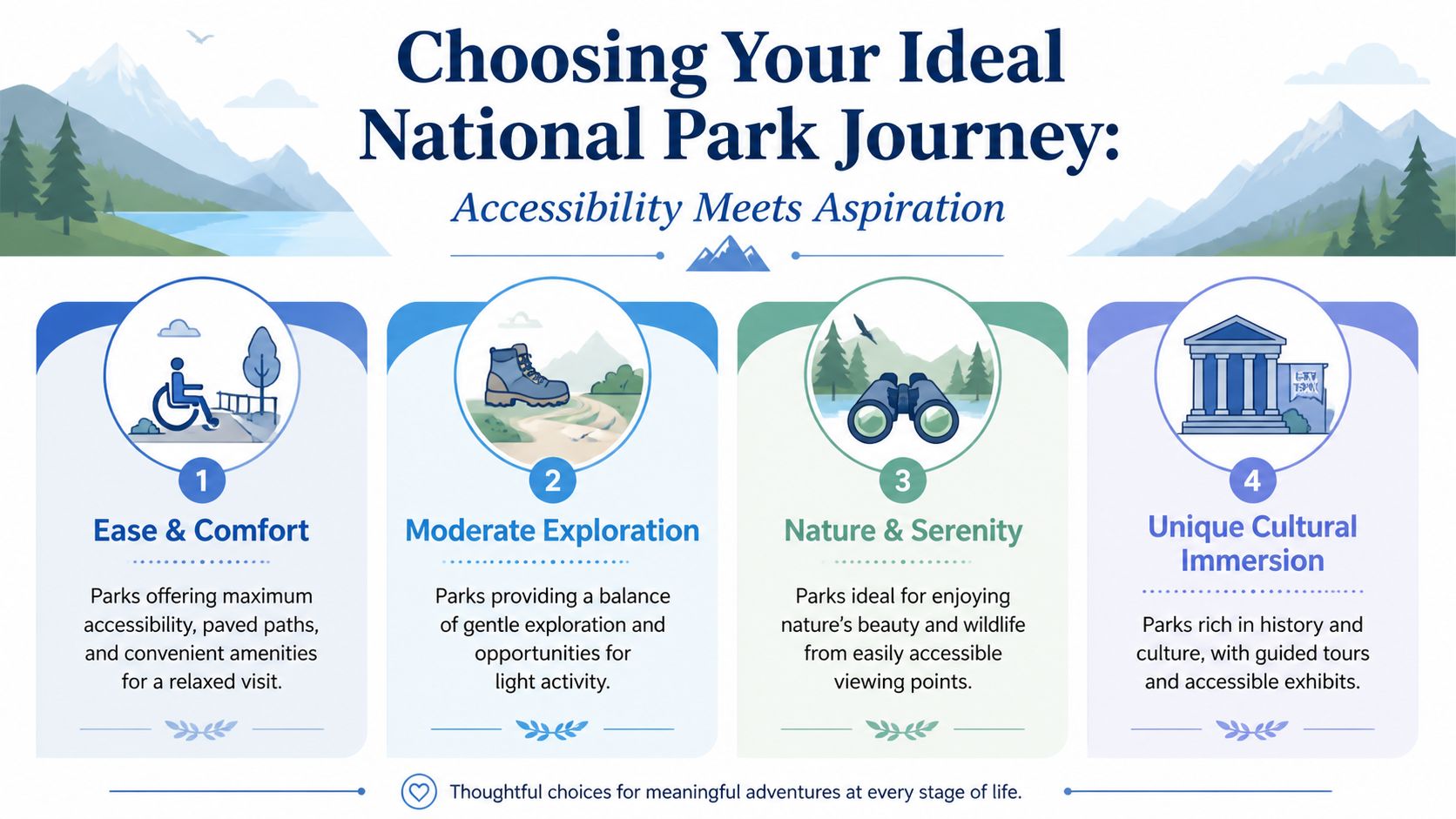
Choosing Your Ideal Park Accessibility Meets Aspiration
Some parks are ideal for scenic drives. Some are best for wildlife. Some deliver major visual payoff without asking much physically. The mistake I see most often is choosing based on fame alone.
For national park trips for seniors, I recommend matching the park to the style of experience you want to have each day.
Best parks for scenic comfort
If you want striking views with minimal physical strain, start with parks that reward you from the road, from overlooks, or from short, well-managed walks.
Great Smoky Mountains National Park works well for travelers who want scenery without feeling pinned to rigid touring windows. Scenic drives are the main event here, and shuttle-supported planning can help reduce walking where needed.
Acadia National Park is one of my favorite choices for seniors who want coastal beauty, manageable sightseeing, and polished lodging options nearby. It feels refined without feeling fussy.
Zion National Park is better for travelers who want drama and geology, but it needs smarter strategy. You can’t treat Zion like a casual walk-in destination and expect a relaxing experience.
If Utah is on your list, my guide to the best places to visit in Utah is a helpful starting point for pairing parks with a more comfortable broader itinerary.
Best parks for wildlife and iconic landscapes
Yellowstone is the obvious headline park, and for good reason. The geothermal features, wildlife viewing, and sweeping scenery are hard to match. But it’s not a park I’d ever recommend doing casually. It needs excellent pacing, carefully chosen touring windows, and realistic expectations about distance.
Grand Teton pairs beautifully with Yellowstone because it softens the trip. The scenery is spectacular, but the mood is calmer and more elegant. For many senior travelers, that balance is what makes the overall journey feel complete.
Senior-Friendly National Park Comparison
| National Park | Best Season for Seniors | Accessibility Highlights | Luxury Lodging Proximity |
|---|---|---|---|
| Acadia | Shoulder seasons | Scenic viewpoints, easier sightseeing rhythm, accessible-focused planning potential | Strong nearby luxury and boutique stay options |
| Yellowstone | Shoulder seasons | Wildlife viewing from roads and overlooks, private touring can limit strain | Best when paired with carefully selected lodges and transfer planning |
| Zion | Shoulder seasons | Shuttle-based access can reduce walking, geology with high visual payoff | Good when paired with premium lodging outside the busiest core |
| Great Smoky Mountains | Year-round with smart timing | Scenic drives and lower-exertion sightseeing options | Best with upscale stays positioned for easy in-and-out access |
Don’t limit yourself to the U.S.
Most articles about national park trips for seniors stay firmly domestic. I think that’s lazy.
Some clients want the American West. Others want the same sense of awe with a more globally styled experience. That’s where international parks become interesting. Banff offers wheelchair-accessible gondolas, and Kruger offers luxury lodges with private game drives. That broader approach is often missed, even though safari bookings for travelers 55+ rose 18%, as noted in this overview of national park travel inspiration.
The right park isn’t the one with the loudest reputation. It’s the one that lets you enjoy the experience at your natural pace.
My opinionated shortlist
If you want my blunt advisor take:
- Choose Acadia if you want polished, scenic, and manageable.
- Choose Yellowstone and Grand Teton if you want iconic natural scenery and wildlife, but only if the trip is built around comfort.
- Choose Zion if you love geologic drama and are willing to let timing dictate the day.
- Choose Banff or Kruger if you want a park experience with a more international, refined feel.
Health Safety and Mobility Planning with Confidence
Many guides become useless in this regard. They tell seniors to “check with your doctor” and “wear comfortable shoes,” then move on. That isn’t enough.
Health and mobility planning should shape the trip itself. It should determine where you stay, how long you drive, how high you go, when you pause, and what equipment gets arranged before you ever leave home.

Altitude is manageable if you respect it
A lot of people either dismiss altitude or panic about it. Both reactions are unhelpful.
The better approach is preparation. The CDC reports that 15% of seniors over 65 experience acute mountain sickness symptoms above 8,000 feet, and that’s why pacing, hydration, physician-vetted plans, and in some cases oxygen-equipped private vehicles matter, as noted in this article on national park tours and altitude planning for seniors.
If you have COPD, heart concerns, diabetes, or know that elevation affects your energy, I build the trip around that reality. Lower first-night elevations, lighter first-day touring, slower ascents, and strategic rest windows are not “nice extras.” They are the plan.
Mobility support should be practical, not performative
A property can call itself accessible and still be a poor fit. A trail can be marketed as easy and still have the exact type of uneven surface that ruins your day.
That’s why I care less about vague labels and more about specifics. How far is the room from the lobby? Are there stairs hidden between check-in and the restaurant? Does the vehicle have a comfortable step-in height? Is the viewing area easy to reach?
For travelers considering a scooter, there’s useful expert advice for travel mobility that can help you think through portability and real-world travel use before the trip.
My preferred approach for lower-stress touring
I strongly prefer this setup for seniors:
- Private vehicle days: Less walking from distant parking areas. Less waiting. Less confusion.
- Layered sightseeing: One marquee stop, one optional light stop, then back for proper rest.
- Verified room requests: Ground-floor access, walk-in shower preferences, elevator proximity, and manageable property layout.
- Built-in flexibility: Weather changes. Energy changes. Good planning leaves room for that.
Situational awareness still matters everywhere. Parks are not risk-free just because they are beautiful, and conditions can change quickly. I always recommend checking official government advisories and local guidance before departure.
The Art of Pacing Sample Luxury National Park Itineraries
The fastest way to ruin a park trip is to overfill it. The second-fastest way is to copy a road trip itinerary built for younger travelers who think “quick stop” means forty-five minutes of uphill walking.
Luxury pacing is not code for doing less. It means doing the right things, at the right time, in the right order.

A refined five-day Zion and Bryce journey
Day one should be simple. Arrive, settle into a premium hotel with easy access, enjoy a proper dinner, and stop there. No one needs to “make use of the evening” after a travel day.
Day two belongs to Zion, but not at peak chaos. An advisor can use NPS visitor-use models and real-time data to sidestep overcrowding, which matters because parks saw record visitation in 2024, according to the NPS transportation and visitor-use review. That translates into early or later touring windows, lower-stress access points, and fewer energy-sapping bottlenecks.
A good Zion day for seniors often looks like this:
- Scenic entry timed to avoid the crush
- A private guided orientation instead of wandering
- One accessible or low-exertion viewpoint sequence
- A long midday break
- Sunset viewing with minimal physical demand
Day three shifts to Bryce Canyon at an unhurried pace. The contrast between the parks keeps the trip visually interesting, and Bryce often works well as a scenic-drive and overlook day.
Day four should leave room for a choice. Some travelers want one more scenic outing. Others want a spa treatment, a leisurely lunch, and a beautiful terrace with a view. Both are valid. Luxury means the itinerary serves you, not the other way around.
A seven-day Yellowstone and Grand Teton journey
This is the trip people most often underestimate.
Yellowstone is enormous, and the distances matter. The right way to do it is to divide the region into zones and avoid the amateur mistake of zigzagging across the park in one day. That burns hours and patience.
A well-built week might flow like this:
| Day | Focus | Why it works |
|---|---|---|
| 1 | Arrival near Jackson or a gateway town | Easy entry and recovery from travel |
| 2 | Grand Teton scenic touring | Beautiful introduction with gentler rhythm |
| 3 | Wildlife-focused private outing | Morning is often better for sightings and calmer roads |
| 4 | Transfer into Yellowstone with limited stops | Transit day, not a marathon sightseeing day |
| 5 | Geyser basin touring | Concentrated visual payoff with strategic pacing |
| 6 | Canyon and wildlife areas | Distinct scenery without repeating the prior day |
| 7 | Leisurely departure | No final-day scramble |
Good pacing protects the mood of the trip. Once travelers get overtired, every small inconvenience starts to feel bigger than it is.
What senior travelers usually appreciate most
Not the biggest checklist. Not the most stops.
They remember the quiet breakfast with a mountain view, the guide who handled the details, the lodge that was comfortable in all the ways that mattered, and the feeling that the day never got ahead of them.
That’s the difference between seeing a national park and enjoying it.
Logistics Mastered Accommodations Transport and Packing
The practical side of national park trips for seniors is where luxury either proves itself or falls apart.
A room can look charming online and still be a terrible fit. A drive can look scenic on a map and still feel draining in real life. Good logistics are not glamorous, but they are what make the glamorous parts enjoyable.
Where to stay without sacrificing comfort
Historic park lodges can be wonderful. They can also be noisier, more compact, less convenient, and more variable than travelers expect. Sometimes that trade-off is worth it for location and atmosphere. Sometimes it isn’t.
I usually compare two paths.
First, a classic in-park or near-park lodge for access and character.
Second, a higher-touch resort or refined boutique property outside the busiest zone, where the room, dining, and common spaces feel more restorative after a day of exploring.
That distinction matters because data shows seniors sometimes overspend on lodging that doesn’t fully meet their accessibility needs, and injury rates from uneven terrain are higher in this demographic, which is exactly why accommodation choice and proper preparation matter, as discussed in this national parks by the numbers overview.
If you’re comparing trip styles, my page on a national park trip planned with advisor support shows what a more effortless approach can look like.
Why private transport wins
If you’re deciding between self-driving and pre-booked private transport, here’s my opinion. Private transport is often worth it.
You avoid hunting for parking, navigating unfamiliar park systems, and ending the day more tired than you should be. You also gain the freedom to adjust pace on the fly. Stay longer when a viewpoint is quiet. Leave sooner when a stop feels crowded or underwhelming.
For many senior travelers, that flexibility is what makes the trip feel elegant.
The Magic of a Private Guide
A private tour isn't just about seeing the sights; it’s about truly understanding the landscape around you. It transforms a passive trip into an active, educational adventure.
Packing list that actually helps
A senior-focused park packing list should be short, practical, and honest.
- Supportive footwear: Bring shoes with real traction. This is not the trip for flimsy “travel sneakers.”
- Medication organization: Keep daily medications, prescriptions, and a clear backup plan in your carry-on.
- Light layers: Park temperatures can shift quickly between morning and afternoon.
- Sun protection: Wide-brim hat, sunglasses, and sunscreen belong in your day bag every day.
- Mobility aids: Walking poles, a foldable cane, or pre-arranged scooter support if needed.
- Documents: Identification, park pass details, insurance information, and a printed summary of key reservations.
- Hydration basics: A reliable water bottle you’ll find easy to carry.
- Small comfort items: Lip balm, hand cream, and any personal items that make long scenic days easier.
A luxury trip still needs sensible gear. Good taste does not protect ankles on uneven ground.
The Effortless Advantage How a Travel Advisor Elevates Your Trip
This is the part many travelers underestimate until they try to do it themselves.
A senior park itinerary involves more than picking a destination and booking a room. It involves permit timing, room category selection, access questions, routing logic, dining reservations, transfer coordination, realistic daily pacing, and contingency planning when conditions shift. DIY planning tends to miss the details that matter most once you’re on the ground.
If you’ve been casually browsing RV or camper options for family travel, resources like the RVupgrades.com camper guide can be useful for understanding the overall context. For my clients, though, the goal is usually the opposite. Less self-management, more polish.
What working with an advisor changes
When I plan a luxury park vacation, I focus on the pieces travelers usually don’t have the time or patience to sort through properly.
- Right-fit destination selection: Based on mobility, pace, and travel style
- Thoughtful lodging choices: Not just beautiful, but practical
- Private transfers and vetted touring: So the day flows
- Dining and down-time balance: Because every park trip needs proper recovery windows
- Complex logistics handled in advance: Before they become your problem
I’m a Circle of Excellence Advisor. Top 5 percent at Nexion and a CLIA Accredited Cruise Counselor. I work with clients nationwide through virtual consultations, and my role is to make complicated travel feel effortless, enhanced, and personal.
If you want support from a professional who handles layered itineraries for discerning travelers, you can learn more about my work as a luxury vacation travel advisor.
The best luxury travel is the kind that feels easy to the traveler because someone competent handled the complexity behind the scenes.
Frequently Asked Questions About Senior National Park Travel
Is the America the Beautiful Senior Pass worth it
Yes. If you qualify, it’s one of the best-value travel tools available for U.S. park travel. It costs $20 annually or $80 for a lifetime for U.S. citizens and permanent residents age 62+, and it covers access to over 2,000 federal sites. If you expect to visit more than one park or federal recreation area, I’d get it.
Can seniors use mobility scooters or e-bikes in national parks
Often yes, but the practical question is where and how comfortably they can be used. The park’s terrain, path type, shuttle system, and lodging layout matter more than the headline rule. I always recommend checking the park’s current accessibility guidance and matching equipment to the actual trip plan.
Are national park trips good for multigenerational families
Absolutely, if the itinerary is designed properly. National parks are excellent for grandparents traveling with adult children and grandchildren because everyone can share the same setting in different ways. The key is not forcing every traveler into the same pace all day.
How far in advance should I book a luxury national park trip
Earlier than often assumed. Premium rooms, the best guides, and the most convenient transport arrangements go first. If you want a polished, high-touch trip during a preferred season, start the conversation as early as possible.
If you’re ready for a national park journey that feels comfortable, luxurious, and expertly paced, I’d love to help. Plan my luxury trip with Explore Effortlessly. I work with clients nationwide through virtual consultations and design well-coordinated itineraries that take the stress out of complex travel. You can also join my newsletter for more luxury travel insight and inspiration here.
Author bio
Hi, I’m Karrah, owner, founder, and lead travel advisor at Explore Effortlessly, a luxury award winning travel agency based in Miami.
I specialize in designing bespoke, high touch itineraries to bucket list destinations around the world. Every trip is curated with intention, insight, and smooth logistics from start to finish.
From luxury cruises and private villas to honeymoons, safaris, and once in a lifetime journeys, my role is to simplify the planning process while elevating every detail.