Most advice about luxury trip planning is backwards. People are told to “just research carefully” and book it themselves, as if more tabs, more reviews, and more comparison shopping will somehow produce a better trip.
Usually, it produces fatigue.
If you've ever tried to plan a safari, a multi-country Europe itinerary, a milestone honeymoon, or a villa stay with transfers, dining, and private touring layered in, you already know the problem. The internet gives you endless options, but it doesn't give you judgment. It doesn't tell you which suite category is worth it, which connection is too tight, which resort feels polished on paper but flat in person, or which itinerary pacing will leave you exhausted by day four. For couples considering a safari honeymoon, I would start with luxury honeymoon destinations in Africa before narrowing the route.
That's where a travel advisor comes in. Not as a glorified booking tool. As a strategist, designer, and advocate.
The Overwhelming World of Travel Planning
Luxury travel should feel exciting before you leave, not like a second job.
Yet that's what happens for a lot of busy professionals and high-income families. They start with a simple idea. Italy in summer. A festive river cruise. A honeymoon in the Indian Ocean. Then the decision tree explodes. Which route makes sense? Which hotel has the right feel? Which transfers are efficient? Which room category is worth the difference? Which experiences are private, polished, and worth your time?
By the time you've read a pile of conflicting reviews and compared too many options, your “dream trip” starts to feel suspiciously like project management.
A modern travel advisor solves that by removing friction and replacing guesswork with structure. For travelers planning around pets, for example, even a niche resource like Passpaw's pet travel agent guide shows how fast logistics become specialized once the trip gets more complex.
Key shift: A luxury trip isn't improved by having more options. It's improved by having the right options, filtered by someone who understands how the pieces fit together.
If you want a deeper look at the practical upside, my guide to the benefits of using a travel agent breaks that down further.
What clients actually gain
- Clarity: You stop sorting through endless properties and start looking at a short list that matches your travel style.
- Better design: Routing, pacing, room choice, and transfer planning get handled as one connected experience.
- Less risk: You avoid many of the expensive mistakes that come from booking pieces in isolation.
- More value: The right advisor often adds tangible benefits and access you won't secure on your own.
- Accountability: When something needs adjusting, you have a person who knows your trip.
A well-designed itinerary feels calm because someone already handled the decisions that usually create stress.
If you've been wondering what is a travel advisor, the short answer is this: someone who turns a complicated travel puzzle into a smooth, high-touch journey.
The Modern Travel Advisor Redefined
The old stereotype is outdated. A travel advisor is not someone sitting behind a desk issuing generic bookings. In luxury travel, the role is far more technical and far more valuable.
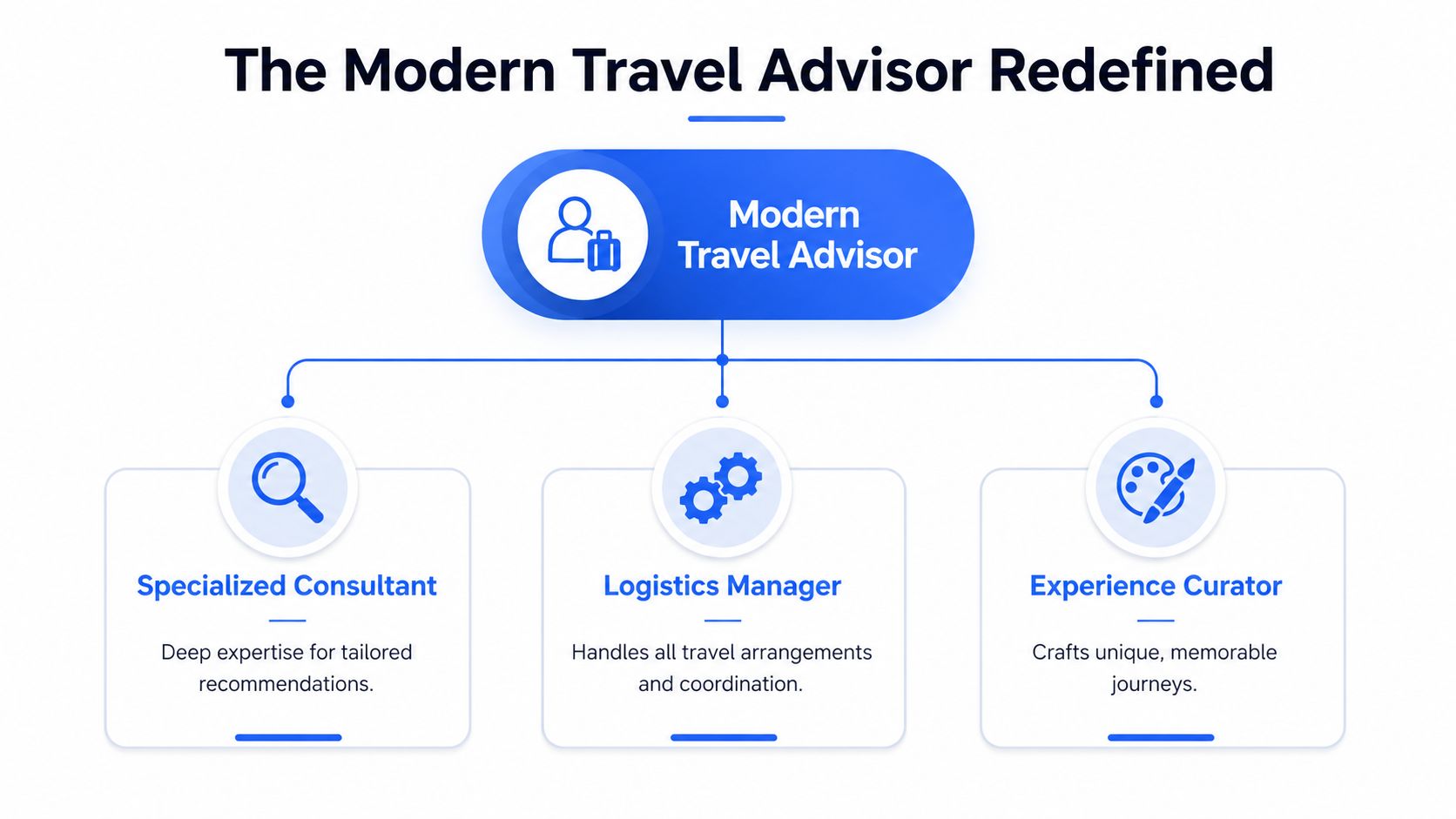
A modern advisor works across three lanes at once. She acts as a consultant who understands destinations and product fit. She manages logistics, especially when flights, transfers, cruises, villas, and touring all have to connect cleanly. She also curates the emotional side of the trip, making sure the experience feels polished, personal, and worth the spend.
That distinction matters because the profession has changed. The travel advisor role is not fading. It's moving further into complex and luxury planning. A Phocuswright study cited by WorldMetrics travel advisor industry statistics says luxury travel is the second-largest advisor specialty at 74% of advisor focus, following family travel at 90%.
What separates an advisor from a booking engine
An algorithm can sort inventory. It cannot assess nuance.
A real advisor looks at things like:
- Itinerary flow: whether your route is elegant or annoying
- Product fit: whether a resort is romantic, family-friendly, social, or too sterile for your taste
- Operational detail: flight timing, transfer windows, and room categories that affect the experience more than the headline rate
- Partner relationships: who to contact so your preferences are seen before arrival
That's also why credentials matter. This is a profession with standards, not a side hobby. I believe clients should ask about specialization, cruise knowledge, destination familiarity, and professional training. Credentials like CLIA Accredited Cruise Counselor and Circle of Excellence Advisor. Top 5 percent at Nexion signal that the advisor takes the work seriously.
For destination events and celebratory travel, even adjacent specialists matter. If you're planning an island wedding weekend, it helps to explore wedding planners in Mauritius alongside your travel strategy so guest logistics and event design don't operate in separate silos.
For a broader view of what falls inside the role, you can also review the core services of a travel agency.
Advisor Expertise vs The Anonymous Internet
There's a simple difference here. When you book alone, you're buying inventory. When you work with an advisor, you're hiring judgment.
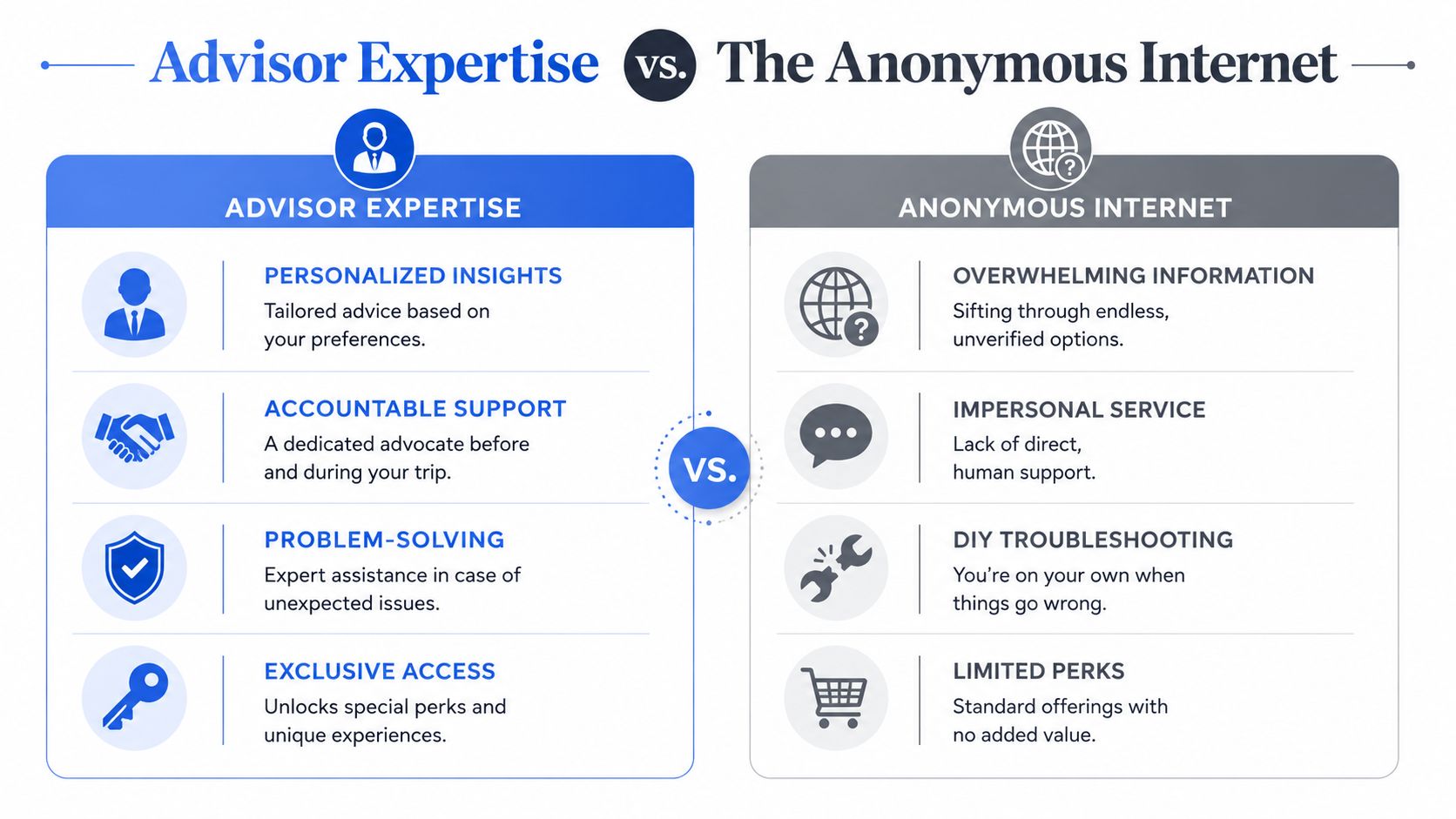
The anonymous internet is noisy. Reviews are inconsistent. Photos are selective. Descriptions often flatten important differences between properties that look similar on paper but feel entirely different on arrival.
What DIY planning usually misses
When affluent travelers try to do this themselves, the mistakes are rarely dramatic. They're subtle. And expensive.
| Decision area | Anonymous booking | Advisor-led planning |
|---|---|---|
| Hotel selection | Overreliance on ratings and polished photos | Selection based on fit, service style, and trip goals |
| Transfers | Booked as isolated pieces | Timed around flights, ferry schedules, and arrival realities |
| Room category | Chosen by headline price or vague labels | Chosen for layout, view, privacy, and actual value |
| Support | Generic service channels | Personal accountability and coordinated follow-through |
A luxury travel advisor also functions as a logistics architect. According to SHMS on how to become a luxury travel advisor, the role involves optimizing routing, timing, and seat preferences, securing preferred partner perks, and designing bespoke travel well beyond standard package booking. That description is accurate. Good luxury planning is technical.
The internet is useful for inspiration. It is a poor substitute for accountability.
Why human accountability matters
If a traveler tells me they want “a beautiful beach hotel,” that's not enough. I need to know whether they want privacy or buzz, whether they'll tolerate a long transfer, whether they care more about spa quality or dining, and whether they'll use the oversized suite they're eyeing.
Those details are where money is either spent well or wasted.
This is also where a firm, relationship-based process helps. Explore Effortlessly works with clients nationwide through virtual consultations to plan custom trips with vetted hotels, cruise partners, and in-destination operators. That model gives travelers one coordinated plan instead of a patchwork of separate reservations.
Unlocking a World of Exclusive Benefits
The financial case gets very clear.
Luxury travel advisors provide benefits that aren't usually available through public booking channels. That can mean complimentary daily breakfast, priority room upgrades, and resort credits, as noted in this overview of VIP benefits through a luxury travel advisor.

That matters more than people think. On a short luxury stay, breakfast alone changes the value equation. Add a resort or spa credit, priority for an upgrade, and property-level recognition, and the advisor relationship stops looking like a “nice extra” and starts looking financially rational.
What preferred partner access actually does
The best advisors don't just submit a reservation. They place it correctly.
A booking connected to an established preferred partner program can flag the reservation for amenities and internal recognition that a standard booking doesn't receive. Some hotel groups handle this through invitation-only advisor networks. That's why two guests paying similar rates can have very different arrival experiences.
Typical benefits may include:
- Breakfast included: especially useful in resorts and city hotels where breakfast pricing adds up quickly
- Property credits: often applied to spa treatments or dining
- Priority for upgrades: not a guarantee, but meaningful consideration
- Early check-in or late check-out: when operationally possible
- VIP recognition: preferences and occasion notes are more likely to be seen and acted on
Practical rule: If you're booking a luxury hotel stay without advisor access, you're often leaving value on the table.
The experiential return is just as important
Perks are the visible part. The deeper value is the way an advisor shapes the trip around your priorities.
For some clients, that means pairing a city stay with the right suite category so they have proper space after overnight flights. For others, it means selecting a resort with a calmer beach, stronger kids' programming, or better villa privacy. For celebratory trips, it means coordinating arrival notes, dining timing, and experience pacing so the trip feels cohesive instead of improvised.
If Dubai is on your list and you want inspiration beyond standard sightseeing, this guide to luxury Dubai experiences is a useful example of how premium travel is really about curation, not just reservation volume.
Your Seamless Journey from Concept to Completion
A good advisor relationship should feel organized from the first conversation. No mystery. No chaos. No wondering who's handling what.
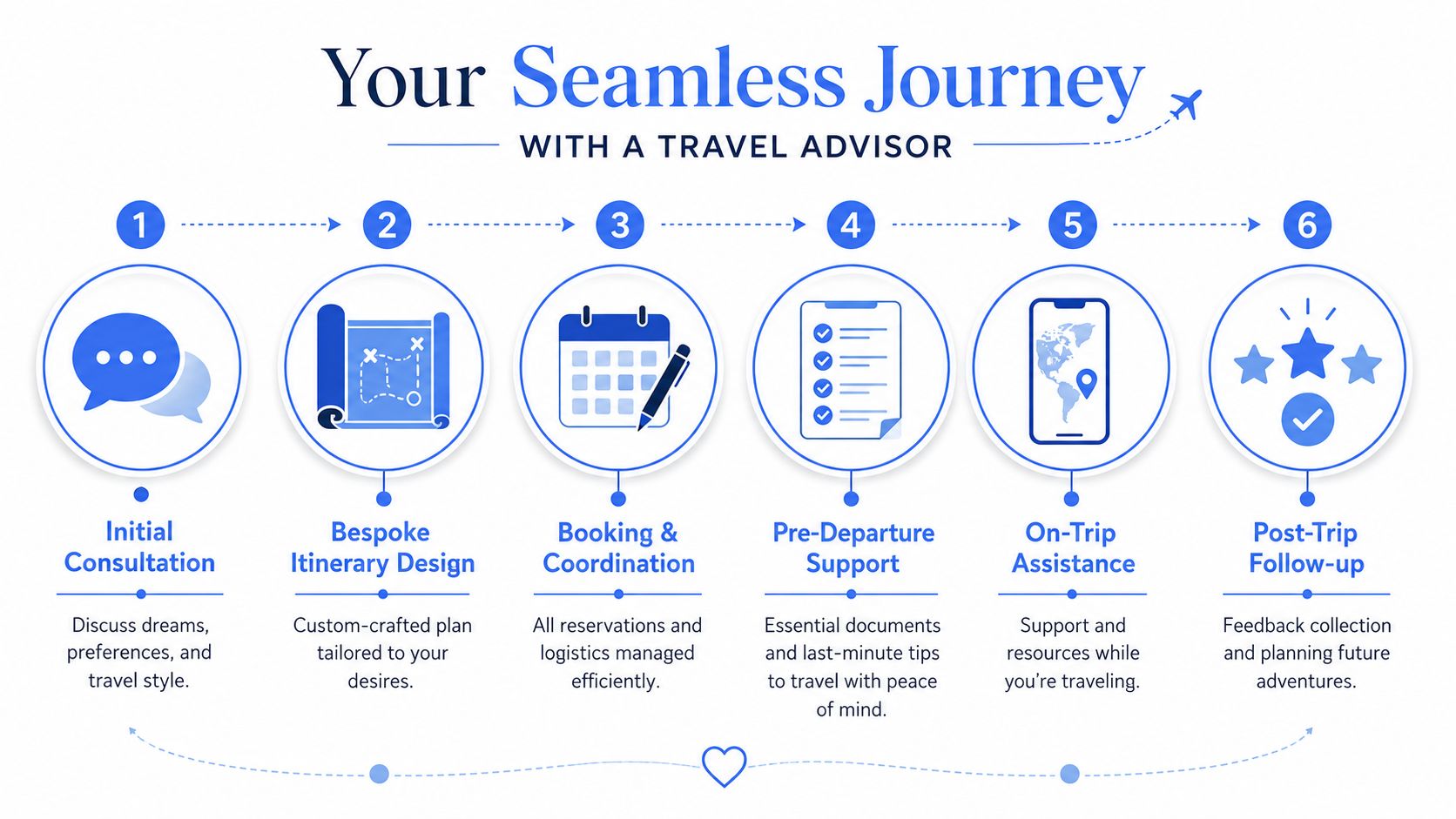
How the process works
Initial consultation
We start with your travel goals, style, priorities, and constraints. It is here I learn whether you want restorative downtime, active touring, celebratory moments, family functionality, or some mix of all three.Bespoke itinerary design
I build the first version around the right destinations, property mix, room categories, transportation flow, and pacing.Refinement
This is the editing stage. We trim, swap, and sharpen. The final itinerary should feel like your trip, not a template.
Where expertise shows up behind the scenes
Some of the most valuable work is invisible.
An expert-level advisor needs destination knowledge, hotel familiarity, and a strong network. Indeed's overview of luxury travel advisor roles notes that credibility in the high-end market depends on luxury planning experience, site visits, collaboration with hotel teams, and access to fellow advisors and local partners for specialized regions. That's exactly how strong trips get built.
For complicated journeys, I'm looking at the chain reaction of every choice. A late arrival can affect dinner timing. A poorly placed hotel can make private touring inefficient. A glamorous-looking connection can become miserable if it creates too much friction with luggage, children, or jet lag.
Support before departure and during travel
Once the itinerary is finalized, bookings are managed, confirmations are organized, and your documents are prepared in a clear format. Before departure, you should know where you're staying, how you're getting there, what matters operationally, and where flexibility exists.
During the trip, trusted in-destination partners and suppliers provide on-the-ground support while I coordinate the planning and logistics behind the scenes. That structure is important. It keeps support local when immediate action is needed, while preserving one central planner who understands the full trip.
The best travel planning feels smooth because someone thought about the handoffs before you ever had to.
Understanding Fees and Return on Investment
Let's address a question clients frequently wonder about. Does using a travel advisor cost more?
Often, no.
Most luxury travel advisors are paid through supplier commissions for hotel, cruise, and other travel bookings, which means the client's price is often the same as booking online, but with added VIP perks, as explained in this discussion of how luxury travel advisors are typically compensated.
When fees apply
For simple hotel bookings, many advisors don't charge a separate planning fee.
For custom work, they often should. A multi-stop honeymoon, safari, expedition cruise add-on, or complex Europe itinerary can involve deep research, supplier coordination, timing decisions, room analysis, and revision rounds. That is professional service work, not a free hobby.
One common model in the luxury space is a hybrid structure where custom itinerary planning includes an upfront planning fee while hotel bookings remain complimentary, according to Future Market Insights on travel agency services. The logic is sound. You're paying for expertise where expertise does the most work.
The return wealthy travelers should care about
ROI isn't just “saving time.” That's too simplistic.
It's spending your travel budget more intelligently. It's avoiding weak-fit hotels, bad routing, wasted nights, and underwhelming experiences. It's receiving benefits and recognition that improve the stay. It's having someone filter the noise so you don't overpay for the wrong version of luxury.
If you're weighing that decision now, my article on is a travel agent worth it gets even more direct about when advisor support makes financial sense.
Frequently Asked Questions
Is a travel advisor only for very complicated trips
No. A travel advisor is just as useful for a single luxury hotel stay if you care about the right fit, preferred partner perks, and being treated like a valued guest before you arrive.
Do I pay more for the hotel if I book through an advisor
Usually not. For many luxury hotel bookings, you pay the same public rate and receive added benefits, stronger room placement requests, and better communication with the property.
What is a travel advisor compared with a travel agent
A luxury travel advisor does far more than place reservations. The role includes strategy, hotel and destination matching, itinerary design, supplier coordination, and advocacy if something goes wrong.
Can you help if I'm not based in Miami
Yes. I work with clients nationwide through virtual consultations.
What kinds of trips are the best fit
Honeymoons, milestone celebrations, premium cruises, villas, safaris, multi-country itineraries, and high-budget trips where poor choices get expensive fast.
Luxury travel is full of expensive mistakes disguised as good options. The right advisor helps you spend well, avoid weak-fit properties, and get benefits that improve the trip in ways booking sites rarely can.
If you want that level of judgment and access, start with Explore Effortlessly.
Author bio
Hi, I'm Karrah, owner, founder, and lead travel advisor at Explore Effortlessly, a luxury award winning travel agency based in Miami.
I specialize in designing bespoke, high touch itineraries to bucket list destinations around the world. Every trip is curated with intention, insight, and smooth logistics from start to finish.
From luxury cruises and private villas to honeymoons, safaris, and once in a lifetime journeys, my role is to simplify the planning process while improving every detail.
If you'd like more luxury travel planning insight, join the newsletter here.