You land in Arusha after a long flight, and within 48 hours the trip can either feel polished and well judged or already off balance. The difference is rarely the suite. It is the plan.
Tanzania rewards travelers who book with intent. A honeymoon needs privacy, slower pacing, and camps that feel romantic rather than performative. A family safari needs short transfer days, guides who are good with children, and rooms that work for parents and kids. Photographers need the right region at the right time, guides who understand light, and vehicles set up for shooting, not just sightseeing. For the bigger decisions beyond Tanzania, use my guide to planning an African safari before settling on dates and camps.
That is why this guide is organized by how you travel, not by who has the prettiest website. Booking platforms are good at showing room photos. They are poor at explaining whether one night at Ngorongoro is enough, when a mobile camp is worth it, how many flights are too many, or why two Serengeti camps with similar rates can produce completely different trips.
Serengeti and Ngorongoro are still the core of the best Tanzania safaris. Start there. Then build around your priorities, your tolerance for movement, and your budget. If you are planning early, use a practical safari packing list for Tanzania and beyond now, because luggage limits, regional flights, and camp style affect what you should bring.
My advice is simple. Choose the trip style first. Choose the operator second. Choose the lodge last.
That order saves money, avoids wasted transit time, and gives you a safari that feels personal instead of generic.
1. A Bespoke Safari with Explore Effortlessly
You land in Arusha after a long-haul flight, then lose half a day to a poorly timed connection, a camp in the wrong part of the Serengeti, and a routing plan that looked tidy on paper but wastes your best safari hours in transit. That is the problem bespoke planning solves.
Explore Effortlessly is best used as a planning approach, not a packaged safari. The job is to match the trip to the traveler, then build the logistics around that brief. A honeymoon needs privacy and a slower rhythm. A family trip needs short transfer days and camps that work for children. A photography safari needs time in the right ecosystem, not a rushed circuit with attractive lodge names.
The bespoke planning approach
Tanzania punishes generic itineraries. Two camps can sit in the same broad region, charge similar rates, and deliver completely different experiences depending on access, wildlife patterns, guide quality, and how many flights or drives it takes to connect them.
That is why I plan from the ground up. Start with your travel style, then choose the regions, then the camps. If the brief is romance, I bias toward privacy, fewer camp moves, and better suite categories. If the brief is family, I cut unnecessary transitions and prioritize private vehicles, flexible meal timing, and room setups that do not create daily friction. If the brief is wildlife intensity or photography, I add nights where sightings justify them and remove stops that look good in a brochure but dilute the trip.
Practical rule: In Tanzania, routing decisions shape the safari as much as the lodge itself.
Who benefits most
This approach suits travelers who want clear judgment before they commit serious money. It works especially well for:
- Honeymooners: Better pacing, stronger room selection, and camps that feel intimate rather than staged
- Families: Smarter logistics, age-appropriate guiding, and private arrangements that keep the trip flexible
- Photographers: Correct seasonal timing, stronger guide matching, and enough nights in each area to shoot properly
- Time-poor travelers: Fly-in itineraries with fewer wasted hours and tighter coordination from arrival to departure
It also prevents expensive mistakes. In Tanzania, those mistakes are predictable: too many one-night stops, the wrong Serengeti zone for the season, baggage that does not work on bush flights, or an itinerary that looks luxurious but feels tiring by day three. Once dates are set, use this safari packing list for Tanzania bush flights and camp stays to avoid the luggage problems that catch first-time safari travelers.
Pros and cons
Clearer fit: The itinerary is built around your priorities, not around lodge inventory or a preset route.
Better use of time: Flights, drive times, and camp changes are handled with the safari day in mind.
Stronger for milestone trips: Honeymoons, anniversaries, and family celebrations benefit from tighter planning and better pacing.
One decision-maker: You are not trying to piece together advice from multiple camps, transfer teams, and booking staff.
It starts with a consultation: This is for travelers who want expert planning, not a click-and-book workflow.
Early planning wins: The best camps, best guides, and best room categories go first in peak periods.
2. Singita The Pinnacle of Private Luxury
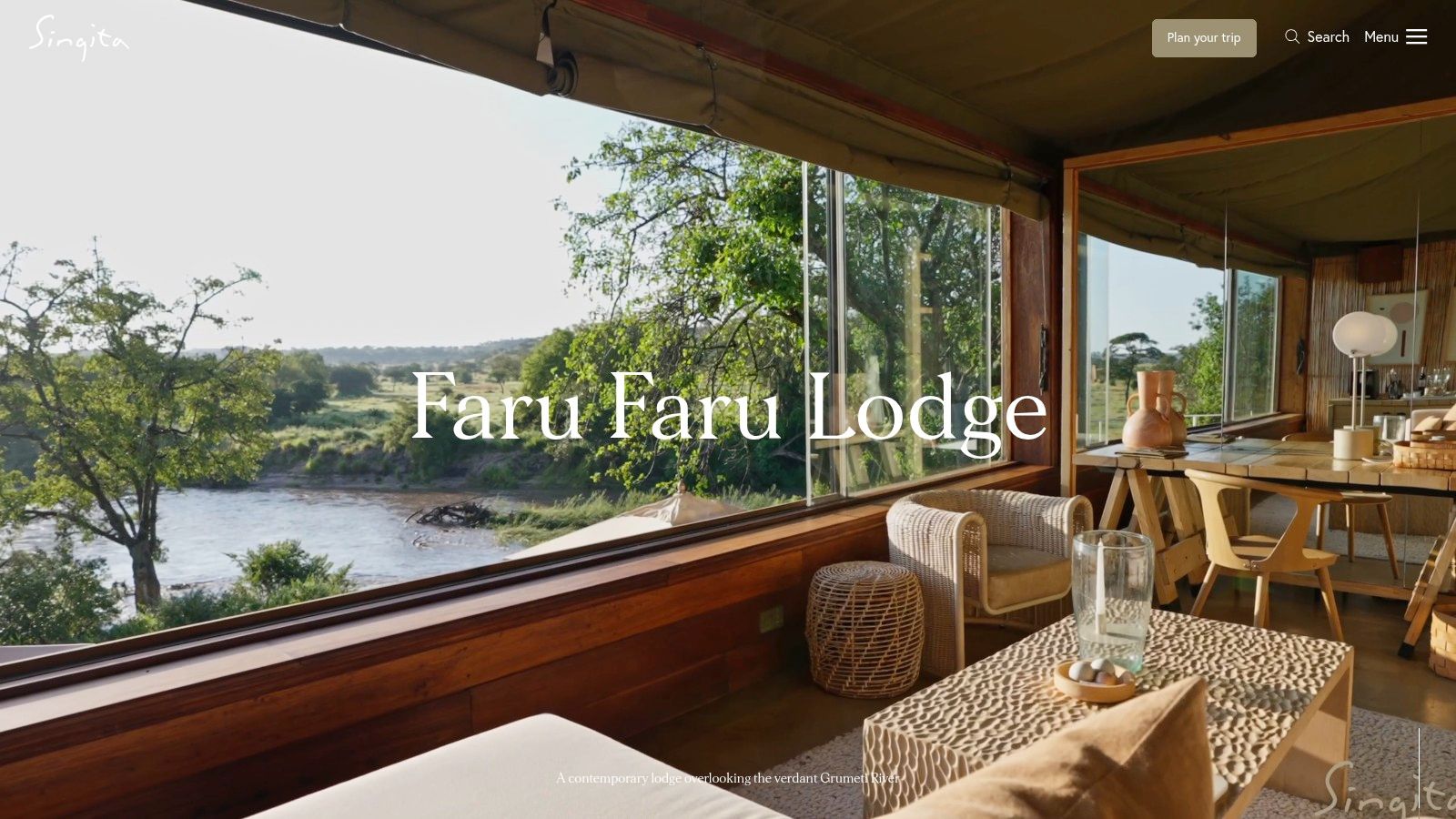
You arrive in northern Tanzania, skip the crowded-camp circuit, and settle into a safari that feels calm from the first hour. That is Singita's appeal. I recommend it to clients who care as much about space, privacy, and service standards as they do about the game drives themselves.
The main draw is Grumeti in the western Serengeti. This is not just a luxury lodge booking. It is a different style of safari, with more room around you, fewer vehicles at sightings, and a quieter daily rhythm that suits honeymooners, private family trips, and anyone marking a major occasion. Browse the collection through Singita Faru Faru Lodge.
What makes Singita different
Singita works best for travelers who want control and privacy built into the experience. The service is polished, but the actual advantage is how the safari feels on the ground. Sightings are less crowded. The pace is more relaxed. The overall mood is more residential than social.
That makes it a strong fit for high-net-worth travelers who do not want a lodge full of shared schedules and communal energy. If your priority is maximum wildlife volume at the lowest price, look elsewhere. If your priority is an exceptional private-luxury safari with strong conservation credentials and consistently refined execution, Singita earns its place near the top of the list.
It is also one of the clearest examples of why travel style matters more than brand name alone. For a honeymoon, I would choose Singita over many famous Serengeti camps because privacy changes the whole trip. For a family taking over a villa, it gives you the space and flexibility that standard lodge setups often lack.
The happiest Singita clients are usually the ones who want fewer compromises, not more sightings squeezed into the day.
Best for
- Honeymooners who want privacy first
- Multi-generational families booking exclusive-use villas
- Travelers who want conservation tied closely to the stay
- Luxury guests who prefer private reserve energy over busier national park sightings
Pros and cons
Private reserve atmosphere: More exclusivity and more freedom than many standard Serengeti stays.
Outstanding service: Consistency is a major strength.
Strong combinations: Easy to pair with other top properties without losing the overall level of the trip.
Very expensive: This sits at the top end of the Tanzanian luxury market.
Needs early booking: The best dates and room categories go quickly.
3. Asilia Africa Prime Locations and Conservation Focus
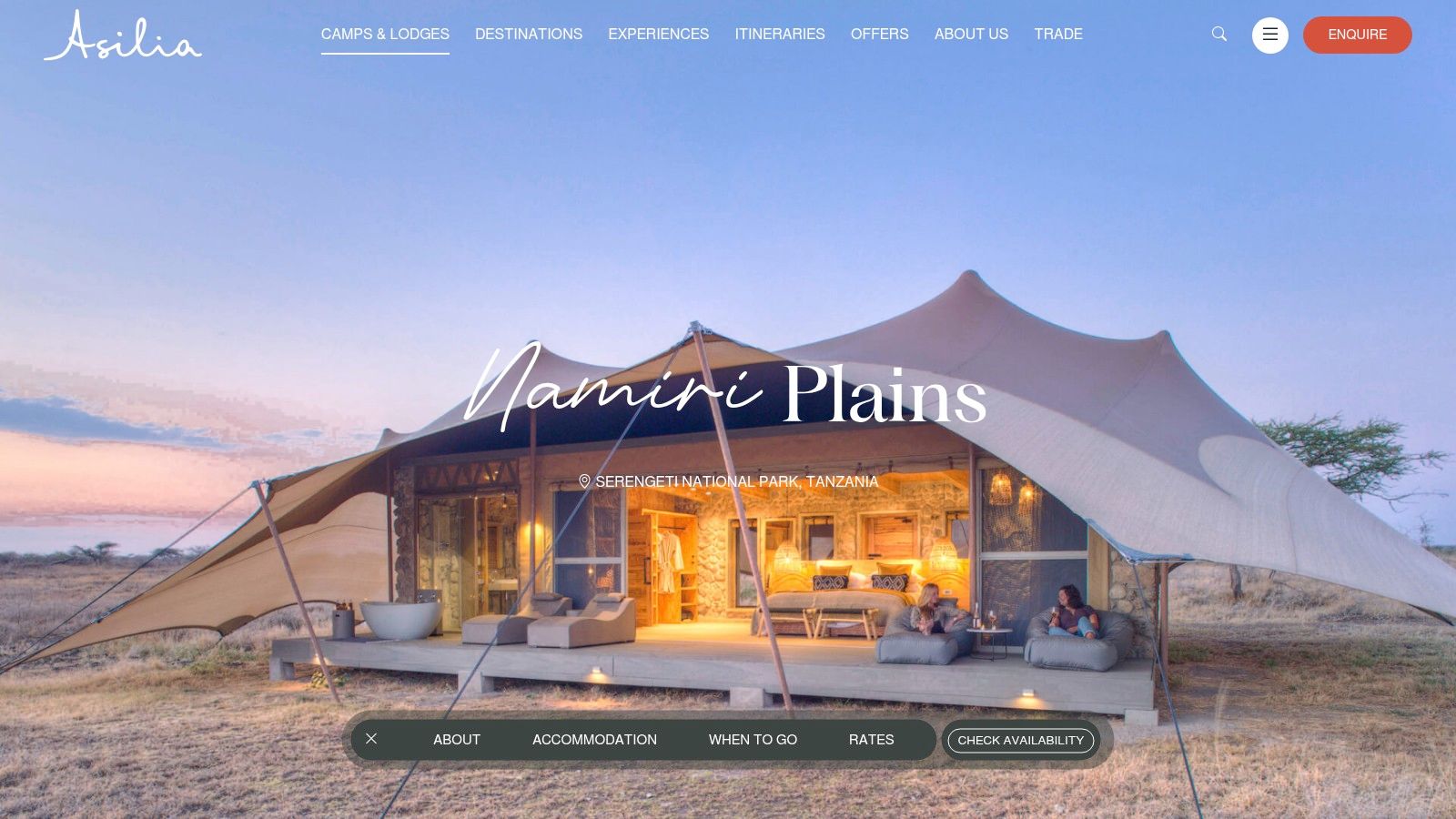
You land in the Serengeti with one clear priority: spend your time in the right ecosystem, with the right guide, at the right season. That is where Asilia earns its place on this list.
I recommend Asilia for travelers who care more about location strategy than hotel theatrics. The portfolio gives you access to prime northern circuits, and the camp choice can be matched to the kind of trip you want. Honeymooners usually do well at properties with more polish and privacy. Serious wildlife watchers and photographers benefit from camps positioned around specific game-viewing patterns. Families can use the wider network to build a route that keeps the pace sensible instead of exhausting.
Their biggest strength is camp placement. Namiri Plains and Sayari are the obvious examples because both sit in parts of the Serengeti that reward travelers who want a trip built around wildlife logic, not just a famous brand name. If you want a sense of the style, start with Asilia's Namiri Plains.
Where Asilia shines
Asilia works best for clients who want a safari that feels considered from the first flight to the last game drive. The camps are comfortable and well-designed, but their primary value lies in how easily they fit into a smart Tanzania plan. That matters if you are comparing travel styles rather than just reading lodge descriptions.
For a first Tanzania safari, I like Asilia as part of a north-focused itinerary that balances the Serengeti with another contrasting environment such as Ngorongoro. For repeat travelers, it is often a better choice than flashier brands because you can target specific regions and seasons with more precision. That makes it especially useful for migration timing, predator-focused trips, and itineraries where guiding quality matters as much as thread count.
Asilia also appeals to travelers who want their spending tied to operators with a serious conservation and community record. That does not make the safari feel preachy. It means the experience has more substance behind it.
Best for
- Travelers who want camp selection driven by wildlife goals
- Couples who want style and comfort without ultra-formal luxury
- Families building a smart northern circuit
- Repeat safari travelers who care about seasonality, guiding, and logistics
Pros and cons
Excellent camp positioning: A strong choice if your safari is built around specific wildlife priorities.
Useful range across Tanzania: Easier to plan an itinerary with contrast instead of repeating the same safari rhythm.
Conservation credibility: A good fit for travelers who want the trip to support more than the room itself.
Less private than reserve-based safaris: In national park settings, some sightings will be shared.
Varies by camp style: You need the right property for your travel style, not just the right brand.
4. Nomad Tanzania Authentic and Intimate Camps
Nomad is the choice for travelers who want Tanzania to feel like Tanzania. Less polished theater, more soul. Less “luxury product,” more place, personality, and superb guiding.
That's why I like Nomad for well-traveled clients, especially those who don't need every edge softened. Lamai Serengeti and the mobile Serengeti Safari Camp are standouts, and the wider portfolio opens the door to remoter regions beyond the standard north. Start with Nomad Tanzania's Lamai Serengeti.
Why seasoned travelers love Nomad
Nomad's camps tend to feel more intimate and more grounded in the environment. The styling doesn't fight for attention. The setting does.
For some travelers, that's the point. They want extraordinary guiding and a camp with character, not a place that feels interchangeable with other luxury brands in other countries. Nomad is also one of the operators I think about when a client wants to broaden a Tanzania trip with a more remote add-on.
If your ideal safari feels a little less staged and a little more wild, Nomad is hard to beat.
Best for
- Repeat safari travelers
- Clients who prefer smaller camps
- Travelers combining north with remoter regions
- Guests who care more about guiding and atmosphere than maximal amenities
Pros and cons
Strong guiding culture: This is one of the biggest reasons to book Nomad.
Excellent sense of place: The camps feel distinctive, not generic.
Broader routing potential: Helpful if you want a more unusual Tanzania itinerary.
Peak season can still be busy in national park areas
Remote combinations are more complex: That's manageable, but they need careful planning
5. Legendary Expeditions Private Reserves and Migration Camps
Legendary Expeditions is a smart recommendation for travelers who want a strategic mix. Private reserve exclusivity when it matters, mobile migration access when it matters more.
I like this hybrid approach. You get the calm and flexibility of private land, then move into migration-focused camp positioning when that's the point of the trip. Their camp portfolio is worth reviewing on the Legendary Expeditions lodges and camps page.
Why this model works
Some safari brands are strongest in one lane. Legendary's appeal is that it can deliver two distinct Tanzania moods in one journey. A private reserve stay gives you a more exclusive rhythm. A mobile or migration-positioned stay gives you access to the drama people came for in the first place.
That makes this a strong choice for travelers focused on the Great Migration, especially if they don't want the whole trip to feel crowded or overly exposed to traffic. If migration is your priority, my guide to planning a Great Migration safari will help you think through seasonality and routing before we lock in camps.
Best for
- Travelers who want exclusivity without giving up migration access
- Shoulder-season travelers who need smart location planning
- Couples wanting a more private southern Serengeti feel
- Guests who want variety across one itinerary
Pros and cons
Private reserve advantage: This is the key differentiator.
Good mix of fixed and mobile camps: Strong for clients who want contrast.
Works well for curated itineraries: Especially with a longer stay.
Upper-end pricing: This isn't a value play.
Limited inventory: Early planning is important.
6. &Beyond Iconic Lodges and Mobile Experiences
Arrive in Tanzania after a long overnight flight, spend your first nights somewhere dramatic, then shift into the Serengeti with a camp that follows the action. That is where &Beyond works best. It gives you a polished, high-comfort version of a classic Tanzania routing without asking you to piece together complicated camp logistics on your own.
Ngorongoro Crater Lodge is still one of the most distinctive addresses in East Africa. It is theatrical by design, and for the right client, that is the appeal. Pair it with Serengeti Under Canvas and you get contrast that feels intentional. A statement start in the crater, then a more flexible migration-focused setup in the Serengeti. You can preview the style at &Beyond Ngorongoro Crater Lodge.
Why I recommend &Beyond
I recommend &Beyond for travelers who want a trusted name, strong service culture, and a straightforward planning path. This is a very good fit for first-time safari guests, busy families, and couples who want the trip to feel easy from arrival to departure.
The primary advantage is how effectively the product matches different travel styles. Honeymooners get romance and drama. Families get reliable operations and clear standards. Travelers focused on the Great Migration get a mobile camp format that reduces the guesswork around where to stay and when. If you are still deciding on timing, my guide to the best time for a Tanzania safari will help you line up the crater, Serengeti, and seasonal wildlife patterns properly.
Ngorongoro also earns its place for practical reasons. Wildlife viewing is concentrated, the scenery is spectacular, and it delivers a lot in a short stay. For clients with limited time, that matters.
Best for
- First-time luxury safari travelers who want a proven operator
- Couples who want an iconic Tanzania pairing
- Families who value consistency and easy logistics
- Travelers combining Tanzania with Kenya, Botswana, or South Africa
Pros and cons
Strong operational consistency: Easy to recommend when execution matters.
Excellent crater and Serengeti pairing: A smart fit for classic first itineraries.
Recognizable luxury standard: Useful for guests who want confidence before they know camp names.
Mobile camps are lighter on amenities than fixed ultra-luxury lodges
The style is polished and high-profile, not especially intimate or under-the-radar
7. Thomson Safaris Tanzania-Focused Specialists
You want Tanzania handled by people who know Tanzania, not a broad Africa operator fitting the country into a bigger catalog. That is where Thomson has real appeal. They have a defined point of view, a long-standing focus on the destination, and a planning process that suits travelers who prefer clarity over endless camp-by-camp decisions.
For the right client, that works well. Thomson is a sensible choice for first-time safari travelers, busy families, and anyone who wants a Tanzania specialist with a more structured booking path. Their trip style is laid out clearly on Thomson Safaris.
My view is simple. If you want the highest level of personalization, private pacing, and camp selection built around a honeymoon, serious photography, or a multigenerational family trip, advisor-led planning still wins. If you want a specialist operator that narrows the choices and keeps the process straightforward, Thomson deserves a look.
Timing matters here more than brochure language. A Tanzania trip can feel completely different depending on month, routing, and how much flying you are willing to do. Before you commit, read this guide on the best time to plan a Tanzania safari so your itinerary matches your travel style, whether that means migration drama, easier family logistics, or drier conditions for photography.
Who should choose Thomson
Choose Thomson if you want a specialist with structure, clear expectations, and a proven Tanzania focus.
It is a particularly good fit for:
- First-time safari travelers who want a guided planning process
- Families who value clarity, pacing, and dependable logistics
- Travelers who want Tanzania expertise without building a fully custom private trip from scratch
Pros and cons
Strong Tanzania focus: Better for travelers who want destination depth, not a generalist operator.
Clear trip formats: Easier to compare options and make a decision quickly.
Good first safari choice: Reduces planning fatigue and gives less experienced safari travelers more confidence.
Less flexible than a fully bespoke luxury itinerary
Group-oriented formats can limit privacy and spontaneity
Not my first pick for travelers who want personalized camp design or ultra-luxury exclusivity
Top 7 Tanzania Safaris Comparison
| Option | Implementation Complexity | Resource Requirements | Expected Outcomes / | Ideal Use Cases | Key Advantages |
|---|---|---|---|---|---|
| A Bespoke Safari with Explore Effortlessly | High, advisor-led planning and consultations required | High, significant lead time, premium budget, planner fees | Exceptional personalization and seamless logistics; highest satisfaction | Discerning travelers, complex/multi-country trips, honeymoons | End-to-end service, insider access, single point of contact |
| Singita: The Pinnacle of Private Luxury | Low–Medium, straightforward booking but needs early reservation | Very high, premium rates and limited inventory | Unparalleled luxury, privacy, and flexible wildlife viewing; conservation impact | Ultra-luxury seekers, privacy-focused safaris, special occasions | Private concession, top-tier guiding, exclusive experiences |
| Asilia Africa: Prime Locations & Conservation Focus | Medium, route selection to optimize wildlife events | Medium–High, premium camps in prime locations; seasonal demand | Strong wildlife encounters in targeted areas; balance of comfort and authenticity | Wildlife-focused travelers, migration viewing, families | Strategic camp locations, sustainability focus, migration routing |
| Nomad Tanzania: Authentic & Intimate Camps | Medium, mobile/fixed camp logistics and seasonal positioning | Medium, good value vs. top-tier brands; remote logistics for some parks | Intimate, authentic wilderness experiences with excellent guiding | Travelers seeking authenticity, remote regions, value-conscious luxury | Mobile camps, strong guiding culture, access to remote parks |
| Legendary Expeditions: Private Reserves & Migration Camps | High, hybrid private-reserve + mobile camp logistics; early booking | High, premium pricing and limited room inventory | Exclusive private-land experiences with close migration access; lower crowding | Travelers avoiding crowds, shoulder/calving seasons, bespoke migration focus | Private concessions + migration camps, flexible activities, exclusivity |
| &Beyond: Iconic Lodges & Mobile Experiences | Low–Medium, brand-managed logistics with seasonal moves | High, luxury brand pricing, mobile camp trade-offs | Reliable, polished luxury and strategic migration positioning | Classic luxury safaris, combining properties, honeymooners | Proven operations, iconic lodges, mobile camps for migration timing |
| Thomson Safaris: Tanzania-Focused Specialists | Low, set departures and clear private options; U.S. support | Medium, transparent all-in pricing; mixes proprietary and partner camps | Structured, reliable itineraries suited to first-time or U.S. travelers | First-time safaris, travelers preferring set dates and U.S. support | 40+ years Tanzania expertise, clear pricing, dependable logistics |
Decoding Tanzania's Safari Seasons
Tanzania's rhythm is dictated by its two main seasons, the dry and the wet. Picking the "best" time really comes down to your personal vision for this trip. Are you dreaming of the high drama of a river crossing? Or maybe the heartwarming, yet intense, scenes of thousands of newborn wildebeest taking their first steps? Perhaps you'd prefer lush, green landscapes with far fewer safari vehicles around you.
My job as your travel advisor is to get to the heart of what you're imagining and then line it up perfectly with what's happening on the ground. It’s all about putting you in the right place at exactly the right time to see that vision come to life.
The Classic Safari Season: June to October
If you ask anyone when to go on safari in Tanzania, they’ll likely point to the dry season, running from June to October. There’s a good reason for this: it's the quintessential safari experience, predictable in the most spectacular way.
January & February: The Serengeti’s Secret Green Season
If you're looking for a safari experience that goes beyond the classic, dusty plains narrative, let me tell you about a little secret: the Green Season. This window, from January through February, is when the safari story shifts to the southern Serengeti for the incredible wildebeest calving season.
Forget the high-stakes drama of the river crossings for a moment. This is a chapter filled with new life, but it's just as packed with action. It's an intimate and powerful part of the Great Migration cycle that many travelers miss.
Tarangire National Park: The Elephant Paradise
Tarangire is a park of dramatic ebb and flow. While it's a wonderful place to visit anytime, it absolutely explodes with life during the long dry season, from July to October. This is when the Tarangire River becomes a magnet for wildlife from miles around.
Bringing Your Safari to Life Itineraries, Budgets and Next Steps
You land in Tanzania after a long overnight flight, excited and tired, then lose half a day to a rushed connection because the itinerary looked good on paper and made no operational sense. That is the difference between a safari that photographs well online and one that works well in real life.
Once you know which style fits you, the next step is building the route properly. For a first luxury safari, I usually start in northern Tanzania. Serengeti and Ngorongoro still earn that recommendation because they do different jobs extremely well. Serengeti gives you breadth, classic East African scenery, and the best chance to feel the scale of the ecosystem. Ngorongoro gives you concentrated game viewing, dramatic setting, and a shorter transfer for travelers who want strong wildlife density without adding another camp every two nights.
Keep a one-week trip tight. Three to four nights in the Serengeti and two nights around Ngorongoro is often the right answer. It feels full, not frantic.
With more time, I build by travel style rather than by map. Honeymooners usually do best with a strong safari core, then a beach finish in Zanzibar or Pemba. Families often benefit from Tarangire because elephant sightings are reliable and the pace is easier for younger travelers. Photographers need more nights in fewer places, often with a guide and camp team who understand positioning, light, and patience. That is where this planning gets valuable. The best Tanzania safari is not a ranked list of camps. It is the right sequence of camps, flights, and park time for the way you travel.
Budget conversations need to be direct. Premium Tanzania safaris cost more because the experience is built around small camps, skilled guiding, long distances, and low guest density. Price shifts quickly based on season, room category, private vehicle requests, internal flights, and whether you want extras such as a crater-view lodge, a migration-positioned camp, or a private beach villa at the end.
Here is the advice I give clients. Spend on location first, then guiding, then room category. A perfectly placed camp with an excellent guide will improve your trip far more than an oversized suite in the wrong area. If you are celebrating a honeymoon or major milestone, add the upgraded room where it will matter, usually at the final safari stop or beach extension.
Photography deserves its own planning track. Good images come from time in the field, flexible game drives, and a guide who understands angles, distance, and animal behavior. Gear matters less than people assume. Field craft matters more. For practical prep, I like these wildlife photography tips for beginners from Magic Eagle.
I work with clients nationwide through virtual consultations, and my role is straightforward. I help you choose where to spend, where to simplify, how to balance romance with logistics, and how to avoid the common mistake of stacking too many camps into one trip. Trusted in-destination partners handle on-the-ground support, while I coordinate the planning and trip structure before you leave home.
Start with the traveler, not the lodge.
If you're ready for the best safari in Tanzania to be planned around your travel style, not a generic package, plan your luxury trip with Explore Effortlessly. I design bespoke safaris for honeymooners, families, photographers, and milestone travelers who want smooth logistics, exceptional camps, and a trip that feels effortless from start to finish. You can also join the Explore Effortlessly newsletter for more luxury travel inspiration and planning insight.
Hi, I'm Karrah, owner, founder, and lead travel advisor at Explore Effortlessly, a luxury award winning travel agency based in Miami.
I specialize in designing bespoke, high touch itineraries to bucket list destinations around the world. Every trip is curated with intention, insight, and smooth logistics from start to finish.
From luxury cruises and private villas to honeymoons, safaris, and once in a lifetime journeys, my role is to simplify the planning process while improving every detail.