You're probably staring at a spreadsheet, three WhatsApp threads, and a stack of wedding mood boards, trying to figure out why hiring destination wedding vendors suddenly feels more like project management than romance. That's the part most couples don't expect. The flowers look easy on Instagram, the venue looks perfect in a Reel, and then it hits: remote contracts, time zones, resort rules, room blocks, and a guest list that needs hand-holding before anyone even buys a flight.
The global destination wedding market was valued at USD 34.2 billion in 2025 and is projected to reach USD 67.7 billion by 2036, with a 6.4% CAGR from 2026 to 2036, and that growth explains why the vendor field is getting more competitive and more specialized, not simpler. Future Market Insights Couples are no longer choosing between “pretty” vendors. They're choosing between teams that can execute a multi-day, logistics-heavy celebration in a place they don't live.
If you want a destination wedding that feels elegant instead of chaotic, you need to think like an operator, not a guest. That starts with the right team, the right timing, and the discipline to ignore glossy portfolios when the operational fit is wrong. For a broader planning framework, I'd start with how destination weddings work.
Key takeaways
- Remote vendor management changes everything, especially when you're coordinating from another time zone.
- Anchor vendors need to be booked first, not last.
- Outside vendor fees can change the budget fast, so source carefully.
- Instagram is not a vetting strategy, it's only the starting point.
- Contracts matter more than pretty proposals in destination markets.
Why Destination Wedding Vendors Require a Different Approach
A couple once came to me thrilled about a clifftop resort in Mexico. The venue was gorgeous, the florist's feed looked cinematic, and the photographer had the kind of light-filled portfolio that makes people hit save immediately. Then we started sorting the logistics, resort-approved vendor rules, arrival windows, local permits, and who could realistically be on-site when. The mood changed fast.
That's the difference with destination wedding vendors. You are building a temporary production team across borders, languages, and schedules. A local wedding gives you more room for last-minute fixes because vendors can usually do site visits, quick calls, and same-day adjustments. A destination wedding punishes casual planning.
Remote coordination changes the rules
Time zones matter. So do response times, contract clarity, and whether a vendor understands how destination events flow on site. Someone can be excellent at their craft and still be the wrong fit if they do not know resort load-in rules, guest arrival timing, or how quickly decisions need to happen once everyone is on location.
The economics matter too. Destination weddings usually bring higher per-event spending, smaller guest counts, and longer planning cycles, which makes the vendor team more premium and more coordination-heavy. The market is broad enough to support a full ecosystem of planners, venues, coordinators, hospitality partners, transport providers, florists, photographers, and guest-service teams, so specialization matters. Paradise Weddings
Practical rule: if a vendor sounds beautiful but cannot explain how they handle remote communication, that is a warning.
The biggest mistake couples make is treating destination vendor selection like a mood board exercise, a logistics decision with aesthetic consequences. If the team cannot coordinate cleanly, the celebration will not feel luxurious, it will feel improvised.
For a fuller breakdown of how the planning process works, see how destination weddings work.
Essential Vendor Categories for Your Destination Wedding
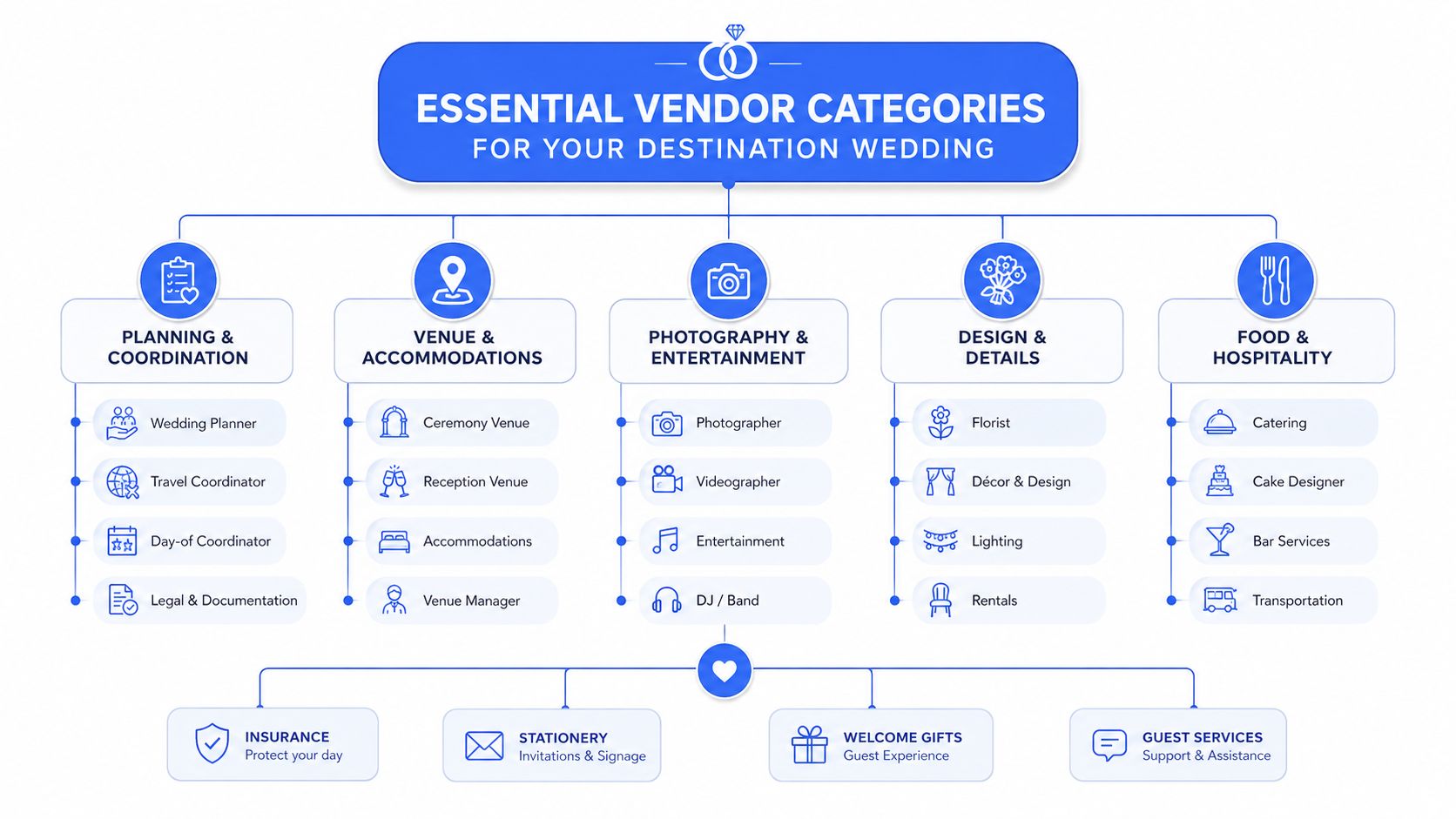
Start with the anchor vendors, then build outward. That's the only sane order for a destination wedding. The venue is obvious, but the planner or coordinator, photographer, and caterer usually drive the rhythm of the whole event. If those four aren't locked down early, the rest of the team ends up building around uncertainty.
The people who shape the event
Your planner or destination coordinator keeps everything from drifting. A venue coordinator works for the property, which is helpful, but that person is not the same thing as an independent planner protecting your interests. Your photographer needs to understand tropical light, harsh midday sun, wind, humidity, and fast-moving timelines. Your florist needs to know what can survive the climate and whether imported blooms are realistic for your destination. Your caterer has to work inside the venue's kitchen, staffing, and service rules, which is why food teams are rarely interchangeable.
Then there are the roles couples forget until the last minute. Hair and makeup artists need enough buffer for on-site prep and humidity-proof styling. Officiants may need to be local, licensed, or both, depending on the ceremony structure. Transportation matters more than couples think, especially when the venue is remote or guest hotels are spread out. Guest activity coordination matters too, because a destination wedding is usually a multi-day social experience, not a single ceremony.
A clean vendor map helps you avoid gaps. I like to think of it in layers:
- Layer one: venue, planner, photographer, caterer.
- Layer two: florist, entertainment, transportation, hair and makeup.
- Layer three: officiant, guest services, excursion support, styling details.
For couples who want a budgeting benchmark while they sort that out, keep average cost guidance for destination weddings close at hand. The point isn't to memorize a number. It's to understand where the money usually goes and which categories deserve the most scrutiny.
The vendor you book first should be the one that limits every other decision.
Local Vendors Versus Bringing Your Own Team
Couples often feel both emotional and practical during this stage. They love the reassurance of bringing trusted people from home, but they don't always price in the friction. A resort may allow outside vendors, but independent guidance notes those fees can run about $1,000 to $2,000 per vendor per event, before you even cover travel or accommodation. Tailored Travel Experiences
| Factor | Local Vendors | Outside Vendors |
|---|---|---|
| Budget shape | Usually cleaner because travel and lodging aren't added on | Can climb quickly once vendor fees, flights, and hotels are included |
| Logistics | Easier on the ground, fewer moving parts | More coordination, more arrival planning, more room for delays |
| Venue familiarity | Often stronger with local properties and local rules | May need extra briefing on the destination setup |
| Creative fit | Good for services tied to the destination itself | Useful when you need a specific style or trusted specialist |
| Risk | Lower travel risk, fewer cross-border issues | Higher risk if flights shift or permits are unclear |
The strongest case for outside vendors is usually photography, videography, and planning, especially when you already trust the person's eye, pacing, or communication style. Local sourcing often makes more sense for catering, florals, and entertainment, because those services are tied to venue operations, local sourcing, and on-the-ground flexibility. That mix is usually more efficient than trying to fly in an entire team.
If you want a smart companion read on the guest and vendor side of planning in British Columbia, wedding planning advice for BC couples offers a useful local lens on coordination and venue realities.
One more thing couples underestimate, the hidden cost is not only money. It's communication overhead. Every imported vendor adds another layer of scheduling, another arrival window, and another person who needs destination-specific instructions. That friction can be worth it for the right specialist, but it's not free.
How to Vet Vendors Beyond Their Instagram Portfolio
Instagram shows taste. It does not show discipline. A polished feed can hide slow replies, vague contracts, or a vendor who excels at styled shoots and struggles when real wedding pressure hits. If you are hiring remotely, you need a process, not a mood board.
Ask for proof, not polish
Start with recent destination-client references. Leave out old testimonials, curated highlight reels, and “happy couples” buried in comments. Ask for names, dates, and destinations recent enough to reflect how the vendor works now. Then ask what communication felt like during the planning months, not just on the wedding day.
Request a full portfolio too, because highlights are curated by definition. You want to see less glamorous conditions, different lighting, and examples of how they handle variable weather or awkward venue layouts. If they will share it, ask for a short video walkthrough of their studio, prep space, or equipment setup. That tells you a lot about how they organize themselves.
Watch the response pattern. Fast, clear replies usually signal a vendor who can handle destination pace. Long, foggy answers usually mean more work for you later.
A few red flags should stop the conversation quickly:
- Vague contracts with generic service descriptions.
- No local references for destination work.
- Slow communication before you have even paid a deposit.
- Reluctance to explain insurance, licensing, or permitting.
- Over-reliance on aesthetics without logistics detail.
One reliable filter is to ask how many virtual meetings they recommend before booking. If they cannot explain their process for remote clients, they are not ready for a destination wedding. You are hiring responsiveness, judgment, and follow-through, not just talent.
Critical Booking Timelines and Contract Essentials
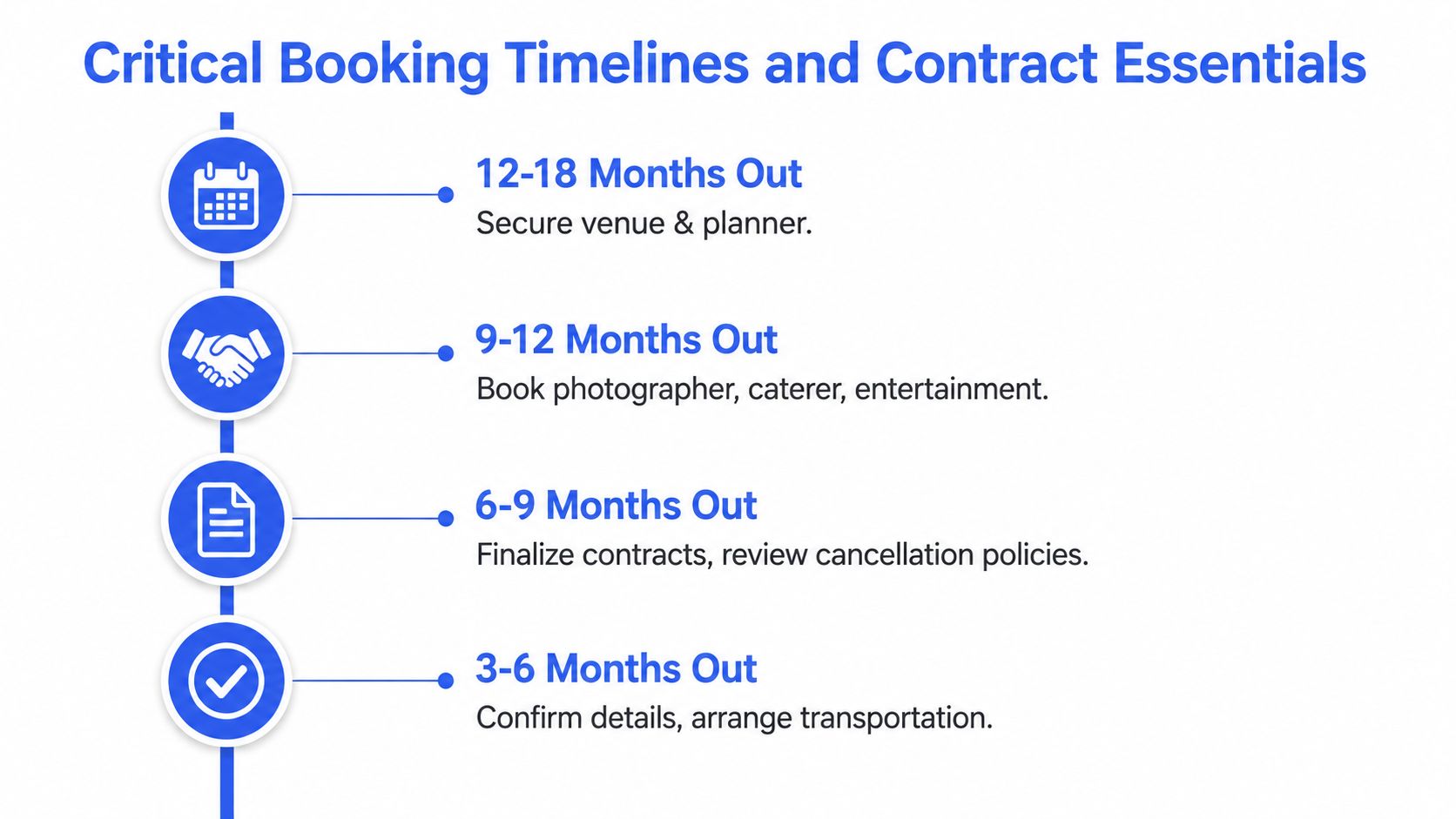
Destination timing does not bend to convenience. Anchor vendors such as the venue, photographer, and caterer are usually booked 14 to 18 months in advance, and the full vendor lineup is typically finished about 12 months out. Abastio That timeline matters because destination markets have fewer choices, and the strongest providers get claimed fast.
Build the contract like a control document
The contract should never be treated as a nice PDF with a few signatures. It needs detailed service descriptions, timeline requirements, quality standards, communication protocols, payment schedules, and milestone-based performance monitoring. Those clauses protect you when a vendor runs late, scope starts slipping, or a service promise becomes vague.
I want very specific language in destination contracts. If a vendor says they will manage florals, I want to know how many pieces, what style direction they are following, when substitutions can happen, and who approves changes. If a photographer says they will cover the event, I want the hours, the arrival time, and the deliverables spelled out clearly.
Peak-season destinations need more breathing room. As noted in the earlier booking guidance, add 2 to 3 extra months to deadlines for peak season because providers book faster and availability narrows. That is not caution for its own sake, it is how you avoid losing the best team to a tighter calendar.
For a couple trying to handle this properly, the order is simple:
- Lock the venue date.
- Reserve anchor vendors.
- Confirm contracts with specifics, not promises.
- Track milestones all the way to departure.
Use Explore Effortlessly's vacation travel agents only if you need broader travel coordination alongside vendor management, because destination weddings fall apart when travel, arrivals, and production details are handled in separate silos.
How a Luxury Travel Advisor Streamlines Vendor Coordination
There's a reason serious destination weddings often feel calm behind the scenes even when the guest count is high and the schedule is tight. A luxury travel advisor acts as the filter, the coordinator, and the keeper of the details that couples don't want to chase across six inboxes.
When I'm coordinating a destination wedding, I'm not only looking at who's available. I'm evaluating whether the vendor fits the venue, the timeline, the guest flow, and the destination's practical constraints. That includes room blocks, travel timing, guest itineraries, and making sure the vendor arrival plan doesn't collide with check-in, welcome events, or ceremony prep. For travelers who also want broader trip planning support, vacation travel agents is a useful reminder that good coordination is built, not improvised.
What good coordination actually looks like
A strong advisor keeps the whole thing moving in one direction. Vendors get one organized point of contact, not three family members with opinions and one bride answering messages from the airport. The couple gets fewer decisions at once, and the on-the-ground partners get cleaner instructions.
That matters when the destination involves language differences, local operating rules, or vendor licensing questions. It also matters when you're deciding between local specialists and imported teams. A travel advisor can help you assess whether an outside vendor is worth the added friction, or whether a destination-based partner will deliver the same result with less risk.
Explore Effortlessly includes destination weddings among its custom travel planning offerings, and that kind of end-to-end coordination is exactly what prevents a pretty plan from turning into a messy week. You still make the creative choices. You just don't have to manage the machinery yourself.
My opinion is simple: if you're trying to manage vendor contracts, travel logistics, and guest communication alone, you're doing three jobs badly instead of one job well.
Your Next Steps for Building the Perfect Vendor Team
Start with the date, not the décor. Once the venue is locked, build your anchor vendor list and book the people who will shape the entire event first. Then decide which roles belong with local experts and which justify bringing someone in from home. If an expedition is on your honeymoon list after the celebration, my Antarctica cruise planning guide can help you decide whether that kind of voyage suits you.
If you want a destination wedding that feels polished from the first contract to the final farewell, Explore Effortlessly can plan the travel, coordinate the moving parts, and manage the vendor logistics on your behalf. Visit Explore Effortlessly to start the conversation, and if you want more planning insight for high-touch celebrations, join the newsletter at Explore Effortlessly updates.