You've compared a Botswana safari quote with a Kenya or South Africa itinerary, and the difference is uncomfortable. The Botswana number can look 40 to 60 percent higher, even before you've chosen a private vehicle, a more elaborate suite, or a helicopter excursion. That reaction is normal. The important question isn't whether Botswana is expensive. It's what the premium buys, and whether those benefits match the way you want to travel.
A luxury Botswana safari is a low-volume wilderness product built around private concessions, light-aircraft transfers, small camps, and carefully controlled access. It's less about marble bathrooms and more about the space between vehicles, the silence around a sighting, and the ability to move through an ecosystem without joining a convoy. I've booked enough safari itineraries to be opinionated about this: Botswana is rarely the right choice for travelers seeking the easiest or least expensive African safari, but it can be exceptional for guests who value privacy, water-based activities, and unhurried guiding.
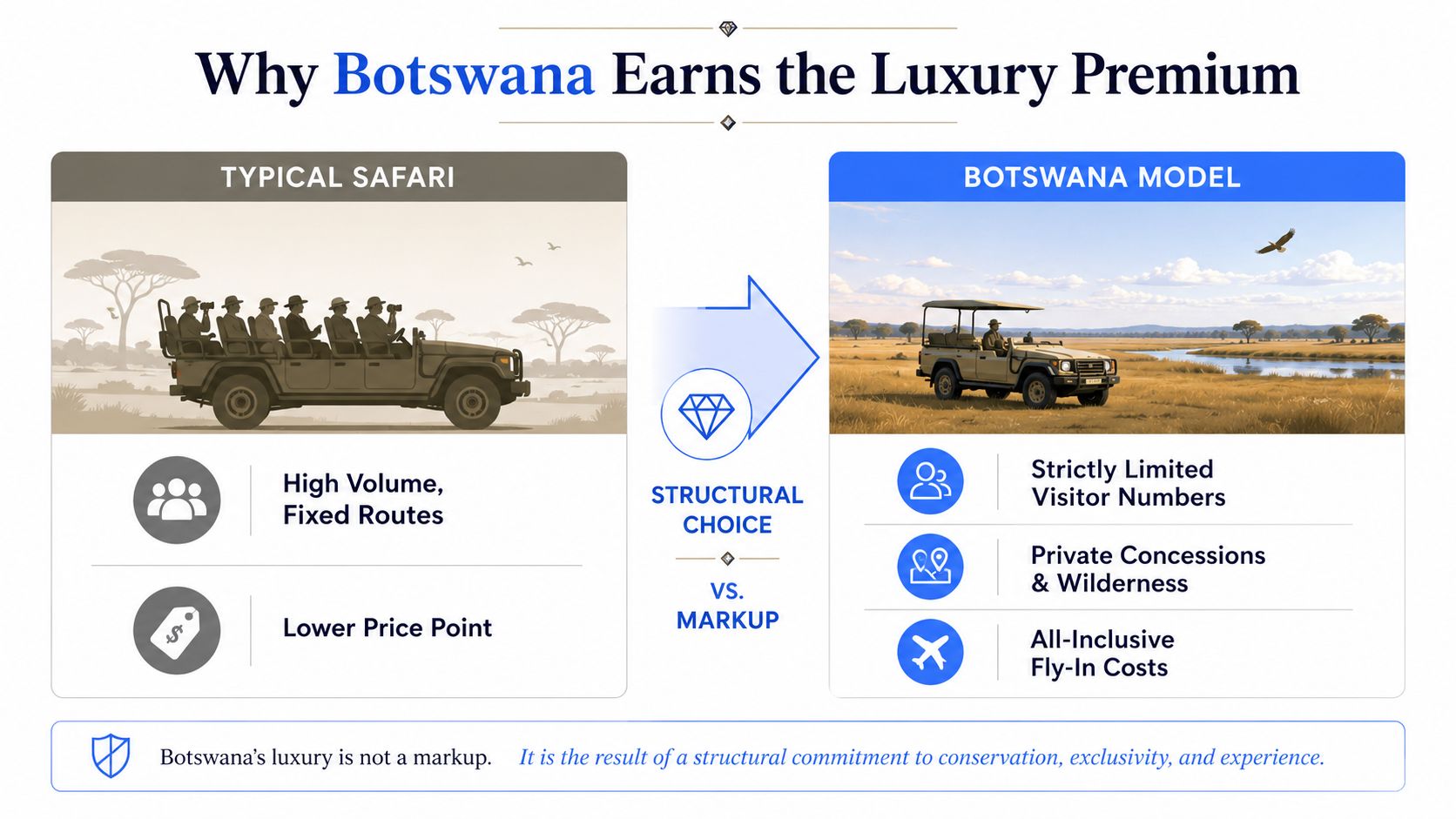
Why Botswana Earns the Luxury Premium
The premium begins with national policy, not a lodge's thread count. Botswana has set aside 17% of its land as national parks and reserves, with an additional 22% under wildlife management areas or similar protection, creating a habitat-first environment where limited camp density and remote access shape the entire guest experience (Botswana's conservation model).
Botswana's safari economy reflects that positioning. One market estimate placed the country's safari tourism market at USD 2,573.0 million in 2023, with a projection of USD 3,948.3 million by 2030, and safari resorts and lodges accounting for a 40.66% revenue share (Botswana safari tourism market estimate). Those figures don't mean every camp delivers the same experience, but they do show how strongly the destination is organized around high-end lodge inventory rather than mass tourism.
What you're actually paying for
In a private concession, a handful of lodges operate across a large wilderness area under conservation and land-use agreements. Vehicle density is controlled, off-road tracking may be permitted, and night drives or walking safaris can be available where public-park regulations restrict them. The result is not a guarantee of a leopard beside your vehicle. It's a better framework for experiencing wildlife without the visual noise of many vehicles competing for the same moment.
National parks and public reserves can offer extraordinary wildlife, often at a lower entry price. Kenya's conservancy model can provide remarkable access and strong guiding, while South Africa's Kruger region is more accessible by road and offers a broader range of accommodation styles. Botswana makes a different trade. You pay for fewer beds, fewer vehicles, less road traffic, and more deliberate logistics. If you are comparing the two, I would look at luxury safari lodges in Kenya alongside the Botswana camps before deciding.
My planning rule: Choose Botswana for the operating model, not because a brochure promises better sightings. Wildlife is wild. Privacy and access rules are what your itinerary can control.
For travelers who want to understand how that feels at lodge level, Sanctuary Chief's Camp is a useful example of the premium Okavango product, with concession access, raised accommodation, and a strong emphasis on land and water activities.
When to Go for the Best Game Viewing
Botswana's main dry season runs from April through October, while game viewing is generally strongest from May through November (Botswana safari season guidance). The calendar isn't as simple as “dry equals best,” because the Okavango Delta receives floodwater from Angola during Botswana's dry season. The flood typically peaks in July, creating the destination's signature contrast, abundant water when surrounding areas are drying.
The seasonal logic
The Okavango's flood pulse takes months to travel south, so June through August can deliver an unusually rich mix of water and land activities. Mokoro excursions and motorboat safaris are strongest where channels are navigable, while game drives continue across islands and floodplains. Wildlife may be more dispersed across available water, but the Delta is at its most distinctive.
By September and October, heat intensifies and water sources become increasingly important. Animals often concentrate near remaining water, vegetation thins, and visibility improves. These months are especially compelling for travelers who prioritize concentrated game viewing over cooler temperatures.
November through April brings the green season. Rain can interrupt drives, vegetation becomes thicker, and animals may spread across a terrain with more available water. In exchange, you get luminous scenery, dramatic skies, migratory movement in some regions, and a softer rhythm. Rates and availability can also be more favorable, though specific pricing depends on the camp and itinerary.
Botswana game viewing by month
| Month | Flood Stage | Game Viewing | Best Activities | Value Rating |
|---|---|---|---|---|
| January | Green-season water and rain patterns | Wildlife is more dispersed, with lush scenery | Game drives, birding, walking where conditions allow | Stronger value |
| February | Green-season conditions | Thick vegetation can make tracking more challenging | Game drives, birding, cultural experiences | Stronger value |
| March | Green season | Landscape remains vibrant, with changing wildlife movement | Game drives and nature-focused activities | Stronger value |
| April | Dry season begins | Visibility starts improving as conditions dry | Game drives and selected walking activities | Good shoulder value |
| May | Dry season strengthening | Game viewing generally becomes more reliable | Game drives, walking in suitable concessions | Good shoulder value |
| June | Flood pulse rising in the Delta | Water and land activities become increasingly balanced | Mokoro, boating, game drives | Premium |
| July | Flood typically peaks in the Delta | Excellent activity variety, with wildlife spread across water systems | Mokoro, motorboat, game drives | Premium |
| August | High flood in many Delta areas | Strong mixed safari conditions | Mokoro, boating, walking where permitted, drives | Premium |
| September | Late dry season | Animals concentrate near remaining water sources | Game drives, photography, walking where permitted | Peak demand |
| October | Late dry season and rising heat | Strong concentration, thinner vegetation, hotter conditions | Early drives, water activities where available | Peak demand |
| November | Transition toward green season | Game viewing remains productive, with changing weather | Drives, birding, selected water activities | Variable |
| December | Green-season pattern | Lush landscapes and rain interruptions | Game drives, birding, cultural activities | Stronger value |
The most useful booking decision isn't “dry season or green season.” It's choosing the right combination of regions. Khwai, Mombo, Linyanti, Savuti, and the Kalahari each respond differently to rainfall, floodwater, vegetation, and temperature. I track those differences when matching a camp to a client's priorities rather than treating Botswana as one uniform safari zone.
National Parks or Private Concessions
Botswana's public parks and private concessions aren't interchangeable. A national park can deliver powerful wildlife encounters, but the rules usually prioritize shared access, established routes, and broad public use. Private concessions charge more because they sell a different operating environment, not merely a more polished room.
Chobe National Park, Moremi, the Khwai area, and Nxai Pan can all play valuable roles in an itinerary. Chobe is particularly attractive for combining land-based viewing with river activity. Moremi and Khwai offer strong ecological variety around the Delta. Nxai Pan introduces a drier, more open environment. The right choice depends on what you want to add to the trip, not just which park sounds most famous.
The practical differences
In public parks, multiple vehicles may gather around a predator sighting or a kill. The exact number varies by location and conditions, but the guest generally has less control over how many other vehicles share the scene. Private concessions usually limit the number of operating lodges and vehicles, which can make a sighting quieter and more flexible.
Private areas may allow off-road driving to follow leopard or wild dog, night drives, and guided walks where public-park rules restrict those activities. That doesn't make private concessions universally better. A public park can provide excellent wildlife and a different sense of scale, while a concession gives you more freedom in how you pursue it.
| Feature | National Parks | Private Concessions |
|---|---|---|
| Vehicle access | Shared access and established routes | Lower vehicle density under concession rules |
| Off-road tracking | Often restricted | May be permitted for specific sightings |
| Night drives | Commonly restricted | Often available, subject to local rules |
| Walking safaris | More limited and regulated | Often available with qualified guides |
| Accommodation model | Broader range of access and operating styles | Small camps on conservation or community-linked leases |
| Pricing structure | Park access and lodge costs may be separated | Land-use, conservation, and access costs are often built into rates |
| Best for | Ecological variety and a broader public-park experience | Privacy, flexible activities, photography, and seclusion |
The concession model is also central to the economics. Camps on private concessions or community-leased land carry land-use and access costs that are incorporated into the guest rate, while national park fees may appear separately. The distinction matters when comparing quotes because two “all-inclusive” itineraries can include different layers of access and conservation charges.
For most first-time luxury travelers, I prefer a blended itinerary. Spend three to four nights in a private concession, then two to three nights in a public park or a contrasting region. That combination gives you the intimacy Botswana is known for without limiting the trip to one style of habitat.
Signature Safari Experiences in Botswana
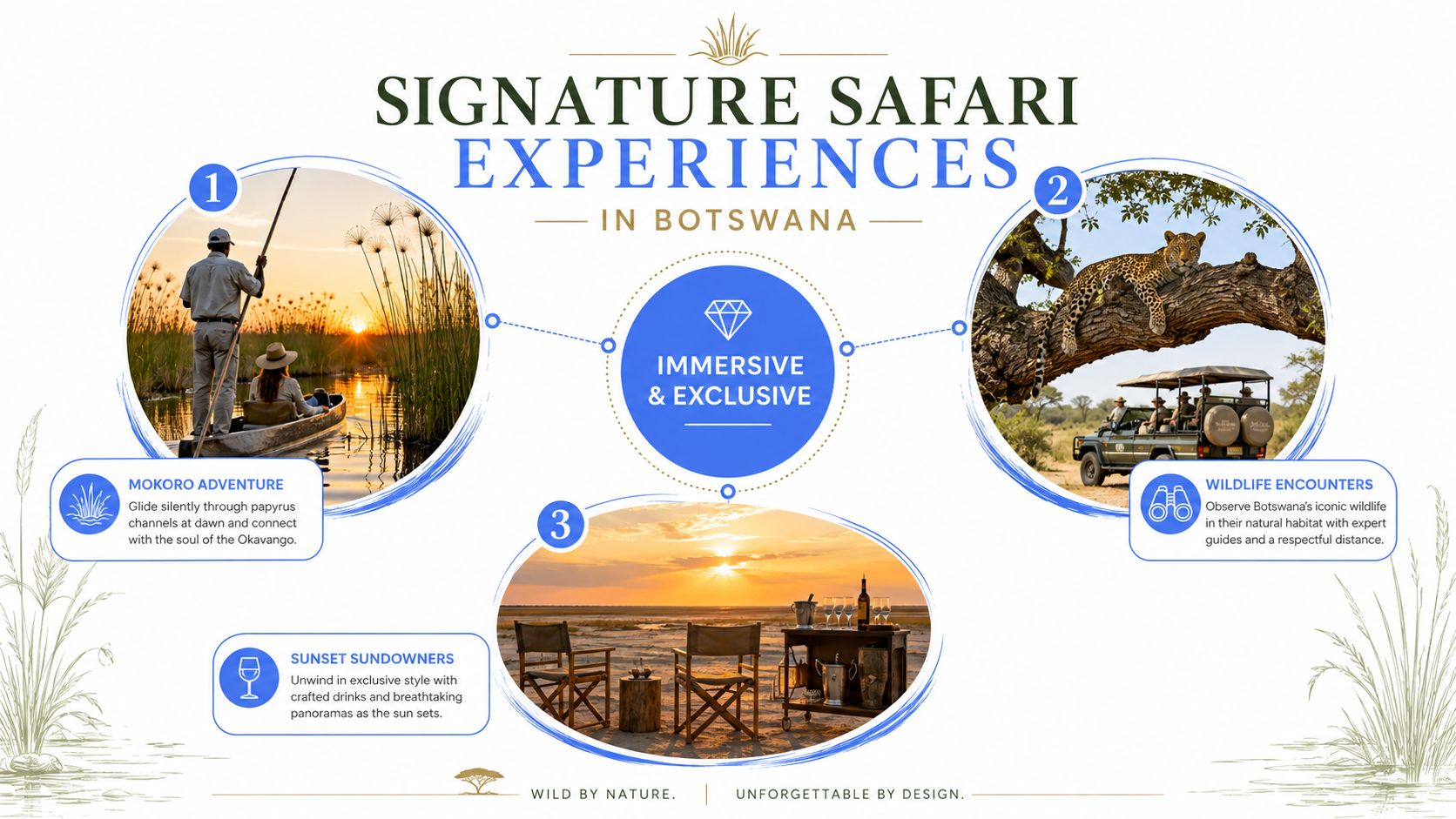
At dawn, a mokoro slides through papyrus and open channels while the poler guides the craft through shallow water. The Delta is quiet enough for small sounds to matter, reed frogs, wings brushing the vegetation, and the soft movement of the canoe. Traditional mokoros were once carved from a single tree trunk, but fiberglass versions are increasingly used to reduce pressure on trees (modern mokoro conservation practices).
That experience depends on water levels. Mokoro excursions work best in shallow flood zones, especially in the Okavango and, when conditions permit, the Linyanti. A motorboat offers a different perspective on deeper channels, letting you cover more water and watch elephants, hippos, birds, and shoreline activity from a moving platform.
Three ways to read the wilderness
A walking safari slows everything down. Your guide reads tracks, broken stems, alarm calls, and scent marks rather than driving toward a radio report. Groups move in single file, with the lead and sweep guides managing the route and wildlife awareness. Walking is about interpretation and proximity to the ecosystem, not covering the greatest distance.
After dinner, a night drive changes the visual language. A spotlight catches reflected eyes in a tree, movement appears at the edge of the road, and nocturnal species emerge from the darkness. Private concessions are usually the place to request this activity, because public parks commonly restrict driving after dark.
The full activity menu can include:
- Day game drives: The foundation for tracking elephants, buffalo, lions, leopards, wild dogs, and smaller species.
- Night game drives: A concession-led experience for nocturnal wildlife and predators becoming active.
- Mokoro excursions: Quiet, low-impact movement through shallow channels when water levels cooperate.
- Motorboat safaris: A faster water-based option on deeper channels and rivers.
- Walking safaris: A close study of tracks, plants, birds, and animal behavior with qualified guides.
- Catch-and-release fishing: A slower activity suited to travelers who want time away from vehicle viewing.
- Cultural village visits: Opportunities to learn about local communities when arranged respectfully and appropriately.
A sunset stop completes the day. It might be a simple drink beside a pan, a private setup on a sandbank, or a pause near the water while elephants cross in the distance. For a detailed look at how these experiences can be combined, explore luxury safari tours.
A Sample Luxury Botswana Itinerary
A well-designed Botswana itinerary should change scenery without turning the trip into an airport schedule. I generally build around ten nights for travelers who want the Okavango, a northern predator region, and a dry southern contrast. The light-aircraft network makes this possible, but the route still needs discipline.
Nights one through three in the Okavango Delta
Start with a water-based Delta camp. Three nights give guests time to settle into the rhythm of early drives, afternoon water activities, and unhurried meals between outings. I place mokoro and boating here, assuming seasonal water levels support them, because the Delta experience should begin with its most distinctive feature.
Nights four through six in Linyanti or Savuti
Move north into a private Linyanti or Savuti concession for a different wildlife rhythm. These areas can complement the Delta with drier woodland, strong predator interest, walking opportunities, and night drives where permitted. The sequencing also makes sense geographically, reducing unnecessary backtracking while shifting the trip toward land-based wildlife viewing.
Nights seven through nine in the Kalahari or Makgadikgadi
Finish with a terrain contrast in the Kalahari or Makgadikgadi. The open, mineral, and desert-influenced setting changes the visual experience completely. Meerkat interactions, walking, and wide horizons can provide a quieter finale after several days of wetland and predator-focused safari.
Night ten belongs near the final departure point, often Maun or a Johannesburg stopover depending on the international routing. I prefer to protect the final international connection with a sensible buffer rather than forcing a same-day chain of bush flights and long-haul travel.
Pacing advice: A safari day can be physically demanding even when the lodge is luxurious. Build breathing room into the route, especially after an international arrival and before the flight home.
Families with young children need a more customized design. Keep drives under two hours where possible, choose camps with suitable room configurations and age policies, and avoid an itinerary that demands constant unpacking. A seven-night trip can focus on the Delta plus one northern concession. Fourteen nights can add the Chobe region, Victoria Falls, or a longer Kalahari extension, but only if each addition contributes a distinctly different experience.
Flights, Transfers, Visas, and Fees
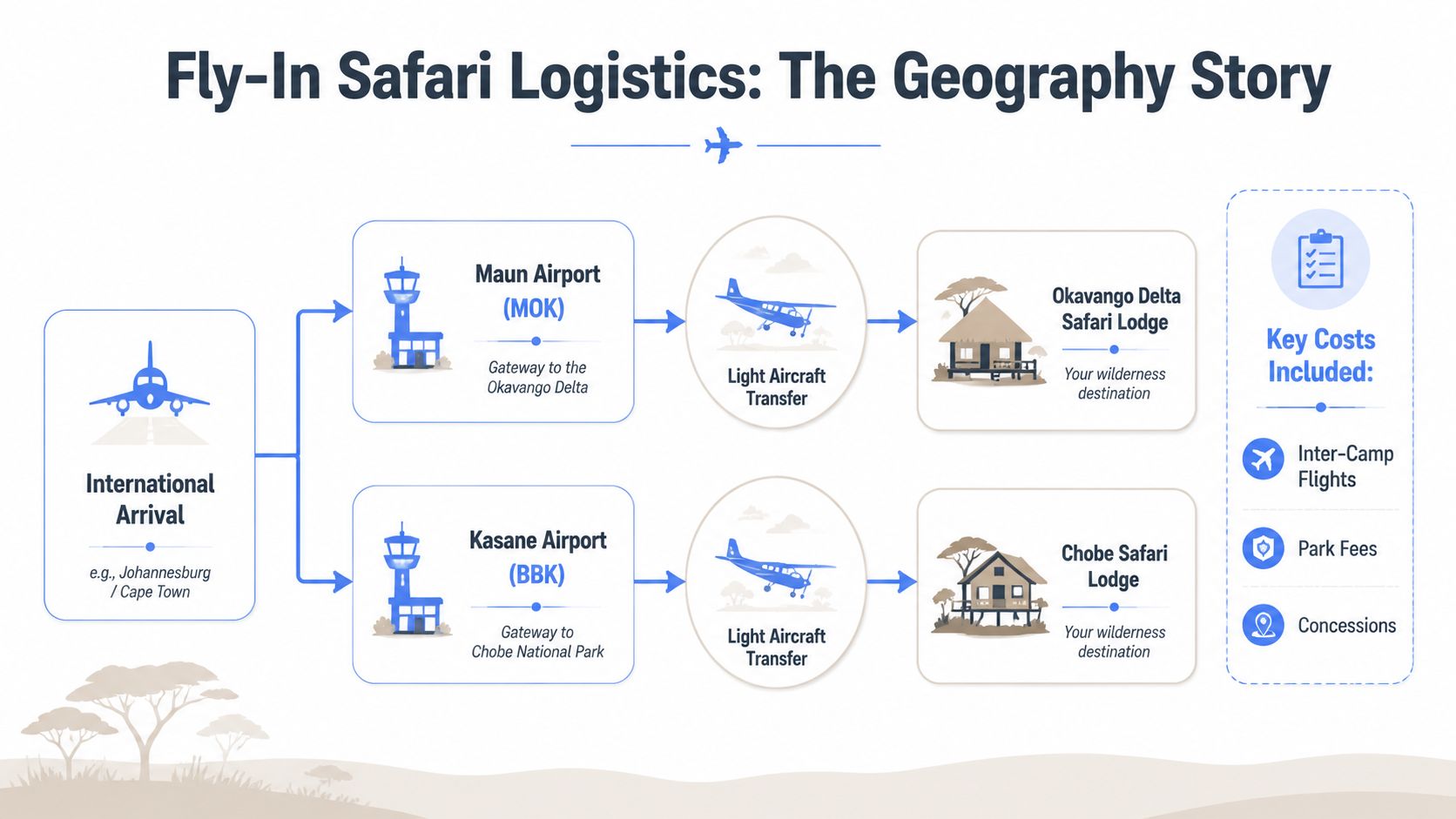
Botswana's price reflects geography as much as accommodation. Travelers typically connect through Johannesburg or Cape Town before continuing to Maun for the Okavango or Kasane for Chobe. From those gateways, small charter aircraft link camps across remote airstrips, often with intermediate stops for other guests.
Internal sectors can be short, but the day still needs flexibility. Light-aircraft transfers commonly take 15 to 60 minutes, and soft-sided luggage is generally required, with a typical allowance of 15 kilograms per guest. Aircraft may have strict dimensions as well as weight limits, so a hard suitcase can create a problem before the safari even starts.
The costs that deserve attention
Park access fees may range from USD 10 to USD 40 per person per day, while private-concession land-use charges are often folded into accommodation rates rather than itemized separately (Botswana safari cost structure). When I review a quote, I check whether it includes inter-camp flights, park or concession fees, community levies, conservation contributions, meals, activities, and transfers.
Visa rules depend on nationality and itinerary. Travelers combining Botswana with Zimbabwe should ask whether the KAZA Univisa applies to their route, and every guest should verify current requirements with official immigration and government sources before departure. Yellow fever documentation may be required for travelers arriving from endemic zones.
Travel insurance with medical coverage is a practical requirement for a remote safari. Pack neutral, breathable layers, a warm layer for early drives, a hat, sunglasses, insect repellent, sunscreen, binoculars, and a soft bag that meets the aircraft rules. Conditions and guidance can change, so travelers should review official health advice and travel advisories before leaving, remain aware of their surroundings, and follow local guidance throughout the trip.
For travelers considering a private aviation connection before the commercial portion of the journey, this guide to midsize jet range and cost provides useful context for evaluating aircraft capability and routing.
Budget Bands and What Each Tier Buys
Botswana's safari pricing is easiest to understand when you separate camp standard, access model, vehicle arrangements, and internal flights. A lower nightly rate doesn't necessarily remove the Botswana signature. It may mean fewer private touches, shared vehicles, more scheduled activity, or a different concession.
The following bands are planning ranges for 2026, not guaranteed quotes. Availability, season, camp, routing, and room type can move the final figure.
| Tier | Nightly Rate (USD) | Vehicle | Typical Camps | Key Inclusions |
|---|---|---|---|---|
| Classic | $900 to $1,400 per person per night | Shared vehicle | Splash or Kwando Tau Pan | Comfortable tented accommodation, scheduled transfers, guided activities, selected concession access |
| Premier | $1,500 to $2,400 per person per night | Private vehicle may be arranged | Sanctuary Stanley's or Belmond Eagle Island | More flexible guiding, walking opportunities, a mokoro component where conditions permit, stronger privacy |
| Ultra-Luxury | $2,800 to $6,500+ per person per night | Private or highly exclusive arrangements | Mombo, Xigera, or Wilderness Vumbura Plains | Plunge pools, elevated service, top-tier guiding, helicopter options, and exclusive traversing where offered |
Internal light-aircraft sectors can add approximately USD 400 to USD 800, depending on routing and itinerary design. Park and concession costs may also be incorporated into nightly rates, so I never compare headline accommodation figures without reviewing the inclusions line by line.
Where I'd spend more
Couples, honeymooners, and serious photographers should usually stretch into the Premier tier if a private vehicle or flexible tracking is central to the trip. That spend can matter more than a larger suite because it changes how you use the day.
Families can often stay in the Classic range without losing the essence of Botswana. The key is choosing a camp with suitable family arrangements, a sensible activity program, and low-density access. Ultra-Luxury makes sense when private service, helicopter access, wellness facilities, or a highly personalized villa experience matters as much as wildlife.
The premium is not automatically buying denser wildlife. It's buying privacy, access, guiding flexibility, and a smoother remote-travel framework.
Booking Through a Travel Advisor
Botswana rewards careful sequencing. Supplier-direct booking can secure a room, but it doesn't necessarily solve the complicated parts: matching water activity potential to the season, protecting international connections, checking soft-bag requirements, coordinating charter sectors, or choosing a camp that works for a child, solo traveler, or first-time safari guest.
A specialist can compare public parks with private concessions without treating every luxury camp as interchangeable. The advisor's value appears in decisions such as placing a water-focused camp beside a dry concession, building a buffer around the final flight, and confirming whether a requested activity is available in that region during the travel window.
What preferred partner benefits should mean
Preferred partner relationships can sometimes provide VIP amenities, special benefits, or preferred treatment, but they shouldn't drive the recommendation. I would rather place a client in a less famous camp that suits their activity priorities than chase a perk at the wrong property. Benefits can also vary by participating property, dates, and availability, so they should be confirmed in writing rather than assumed.
The right planning process is straightforward:
- Start with priorities: Decide whether privacy, water activities, predator tracking, family logistics, photography, wellness, or cultural connection matters most.
- Build the route: Select two or three regions that create contrast without excessive repositioning.
- Audit the quote: Confirm flights, fees, transfers, activities, luggage rules, insurance expectations, and gratuity guidance.
- Protect the experience: Add appropriate buffers, check camp policies, and plan around the traveler's energy rather than packing every day with excursions.
Working with a luxury travel advisor is particularly useful for travelers who want one person coordinating the commercial flights, bush transfers, lodge selection, and pre-departure details.
A good advisor should make the itinerary clearer, not more complicated. You should understand why each camp is included, what the premium buys, and which trade-offs you're accepting.
Explore Effortlessly is owned by Karrah, a Circle of Excellence Advisor and Top 5% advisor at Nexion, as well as a CLIA Accredited Cruise Counselor. She works with clients nationwide through virtual consultations and designs high-touch itineraries that can include safari travel, premium flights, private villas, cruises, and milestone journeys.
Author bio
Hi, I'm Karrah, owner, founder, and lead travel advisor at Explore Effortlessly, a luxury award winning travel agency based in Miami.
I specialize in designing bespoke, high touch itineraries to bucket list destinations around the world. Every trip is curated with intention, insight, and smooth logistics from start to finish.
From luxury cruises and private villas to honeymoons, safaris, and once in a lifetime journeys, my role is to simplify the planning process while elevating every detail.
Explore Effortlessly can design your luxury Botswana safari around private concessions, water levels, flight logistics, family needs, or a milestone celebration, then manage the details from consultation through your return. Visit Explore Effortlessly to begin planning your Botswana itinerary, and join the Explore Effortlessly newsletter for more luxury travel guidance.