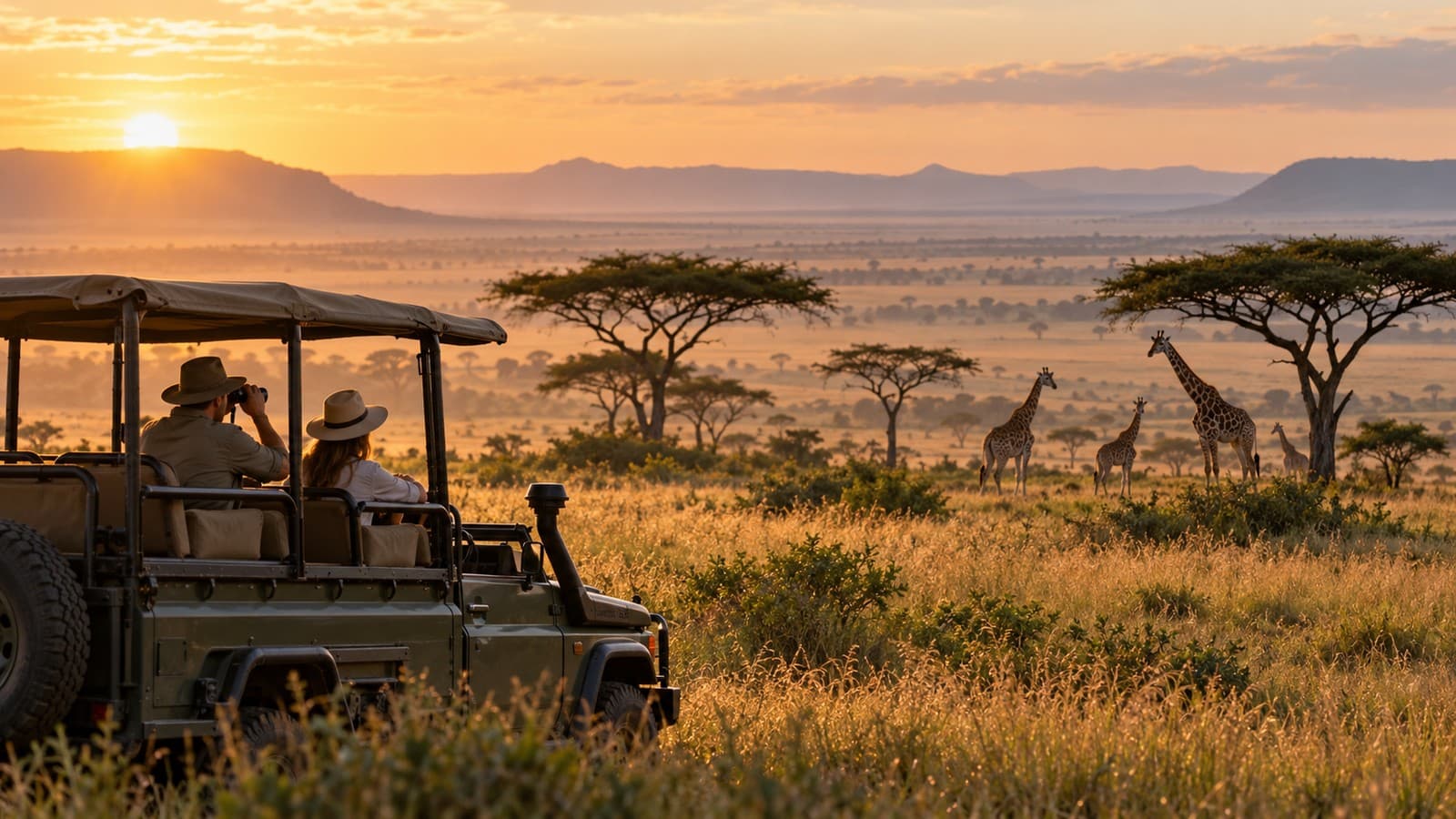
A Serengeti safari is best planned around the experience you want, not a single promised migration date. Choose the southern plains for calving season, the north for a chance at river-crossing activity, or the central Serengeti for a flexible first visit. Give the region and your travel days as much attention as the lodge.
It is easy to find beautiful camps and harder to tell whether the one you like is near the wildlife you hope to see. Add bush flights, park access, a possible Ngorongoro stop and a long journey from home, and the choices start to affect every day on the ground. Here is how I would make those decisions without turning your vacation into a logistics exercise.
Start With the Safari You Actually Want
For a first safari, I would begin with your priorities: an unhurried wildlife experience, a particular migration phase, photography, or a combination with the Ngorongoro Crater. UNESCO's account of the Serengeti ecosystem describes a broad, moving migration that reaches beyond the national park itself. A camp marketed as a migration camp is not a promise that a herd will be outside your tent on your dates.
My default for a couple with limited time is to spend enough consecutive nights in one region to settle into the rhythm of morning and afternoon drives. If a second region adds a genuinely different landscape or improves the seasonal fit, I consider a move. Otherwise, another transfer often costs more enjoyment than it adds variety. For the wider trip structure, my guide to planning an African safari explains how to connect safari days with the rest of your journey.
My planning rule: Pick the month and region together. Then compare camps on guide quality, game-drive format, transfer time and what is actually included.
Choose a Serengeti Region, Not Just a Lodge Name
The Serengeti is not a single viewing area. The Tanzania Tourism Board's migration overview describes the southern calving area early in the year, movement through the western corridor around June, and herds farther north as the year progresses. Rainfall changes the actual movement, so treat these as planning patterns rather than a wildlife timetable.
| Base | Best fit | Tradeoff to consider |
|---|---|---|
| Central Serengeti | First visits and flexible wildlife viewing | A central base is practical but may not match a specific migration phase. |
| Southern plains and Ndutu area | Travelers drawn to the calving period | Confirm the camp's precise location and access area for your dates. |
| Western corridor | A seasonal route as herds move west and north | Do not plan around a crossing on one fixed day. |
| Northern Serengeti | Travelers hoping to spend time near the Mara River | It is a long way from a central base, and crossings cannot be scheduled. |
The key question is not simply whether a lodge is in the Serengeti. Ask how much of your day will be spent reaching the viewing area, what the normal drive arrangement is, and whether your chosen camp changes location seasonally. A gorgeous room in the wrong area can leave you with long vehicle days and less time watching wildlife.
When Is the Best Time for a Serengeti Safari?
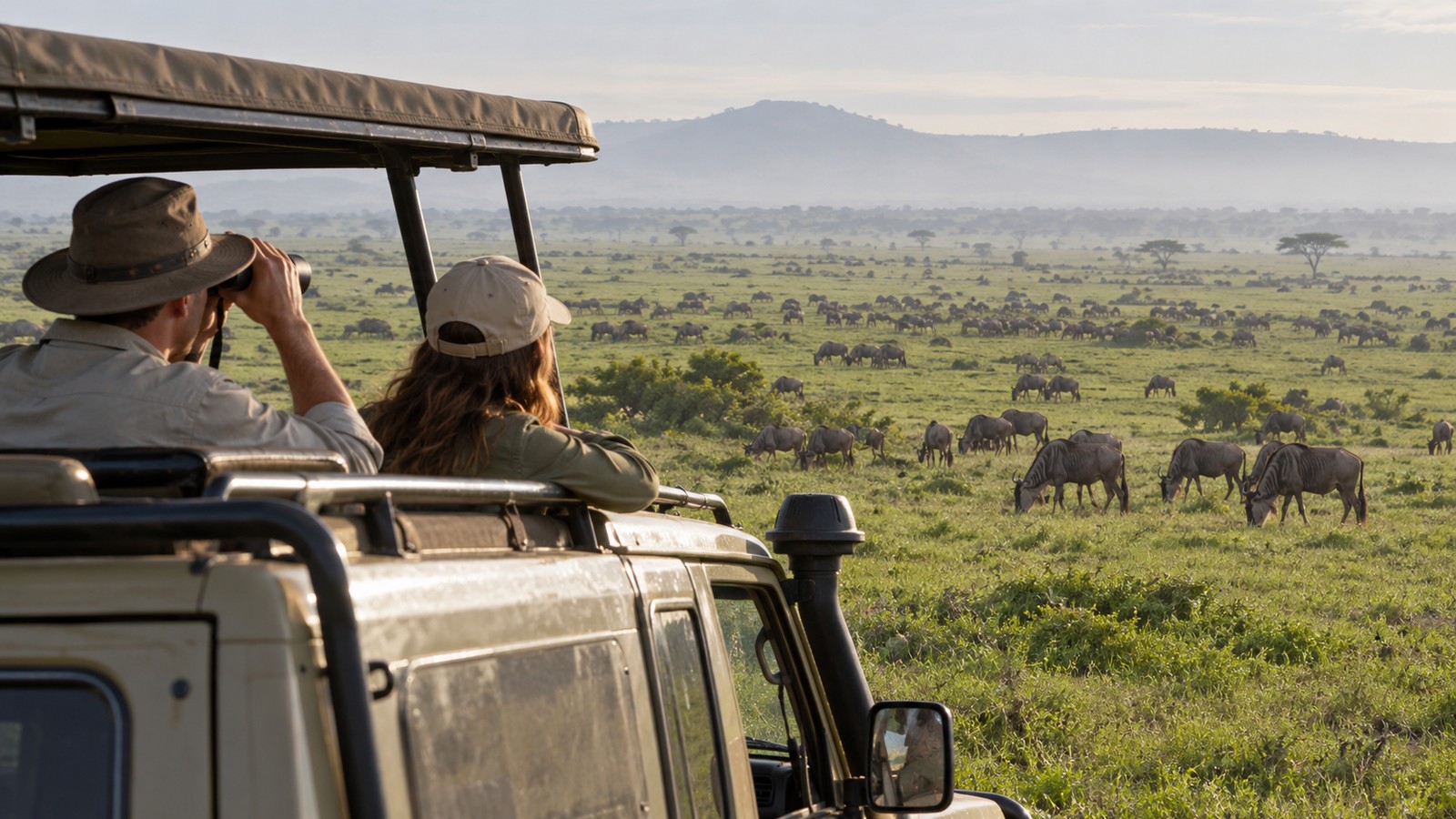
For generally drier conditions and easier wildlife spotting, I would consider late June through October. The Tanzania Tourism Board's seasonal guidance identifies these as the strongest dry-season viewing months and points to late January and February for calving in the south. Those are different experiences, not a universal winner.
If your dream is a northern river-crossing scene, allow several nights in the right region and keep expectations honest: wild animals respond to rain, grass and water, not reservations. If you love green landscapes and young animals, the southern plains in the calving window may be the more compelling choice. For a first visit with a fixed vacation week, I would rather build a strong safari around the season you can travel than chase an exact crossing date.
The Ngorongoro Conservation Area Authority notes that the short-grass plains draw animals during the rainy-season birthing period and that dry-season conditions change where wildlife concentrates. That distinction matters if your trip combines the Ngorongoro area and the Serengeti. Do not assume a camp that worked beautifully for a friend's February trip will be your best July base.
How Many Days Should You Give the Serengeti?
Three nights in one well-chosen area is my practical starting point for a wider northern Tanzania itinerary. That gives you more than a single arrival drive and leaves room for varied light and weather. If wildlife is the main reason for the trip, I would look at four or five nights, perhaps split between two regions when the season makes that worthwhile. Those are planning recommendations, not park rules.
A three-day Serengeti safari may mean just two nights on the ground, depending on arrival and departure timing. I would ask for a day-by-day breakdown rather than count the package label. A one-day Serengeti excursion is technically a very different proposition from a proper multi-night safari: Tanzania National Parks says an overland approach from Arusha may take seven to eight hours, while flights serve Seronera. For an international trip, I would not make a same-day in-and-out visit the centerpiece.
Plan the Transfers Before Comparing Safari Packages
Packages that appear similar on a search page can use very different routes. One might combine Arusha, the crater and several Serengeti nights by road and short flight; another might spend extra nights moving between camps. The number of true game-drive days matters more than the number of destinations named in the headline.
I would map every travel leg before picking a camp. Where do you arrive internationally? Is there a night to recover before an early departure? Does your flight reach the airstrip nearest your camp, and who meets you there? If a crater visit is important, is it a dedicated day or squeezed between drives? Domestic flights, airstrip assignments and baggage conditions can change, so have the current operating details confirmed for your itinerary.
- Private vehicle or shared drive: Decide how much flexibility you want for photography, stops and a slower pace.
- One region or two: Add a second base only when the seasonal wildlife or experience justifies packing up.
- Camp inclusions: Compare meals, drinks, park-related charges and transfers line by line, not from a headline rate.
- Arrival and exit: Protect enough time to make onward international connections without turning the final game drive into a race.
That is where a custom plan earns its keep. A safari is a chain of small handoffs, and the itinerary should make the handoffs feel considered rather than incidental.
Choose the Camp for the Way You Like to Travel
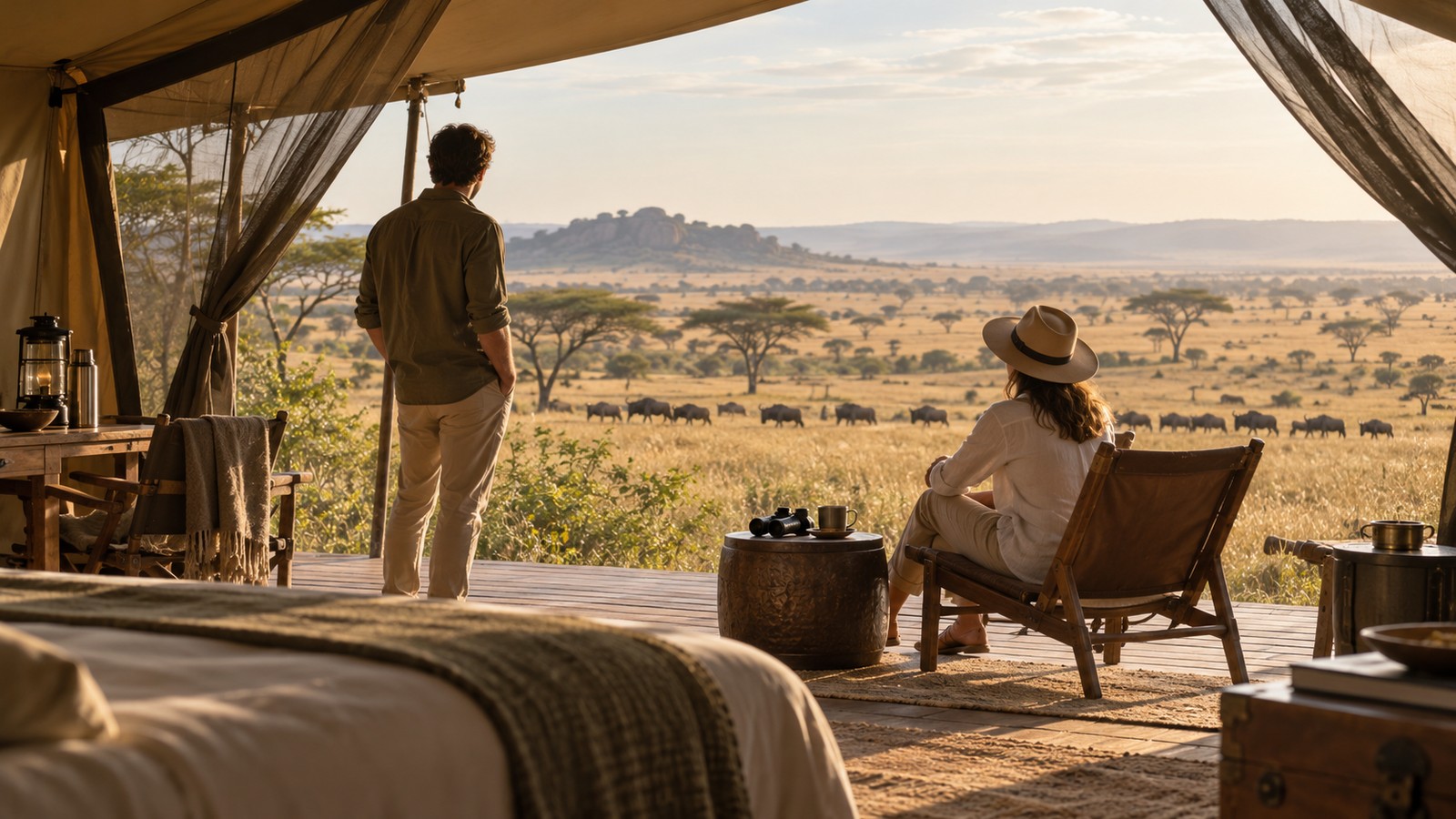
Permanent lodges and tented camps are both valid ways to experience the Serengeti. I would compare the actual room layout, privacy, distance to the departure point, dining arrangement and how the camp runs its drives. A lower room rate can lose its appeal if the location creates repeated long transfers or the experiences you want cost extra.
When a second camp is worth it
A second camp makes sense when you can gain a distinct habitat or better seasonal positioning, not merely a new room. For a couple especially keen on the migration, I might pair a flexible central stay with a seasonal base. For someone who values slower mornings and fewer packing days, I might keep one camp and spend more on the right guide arrangement instead.
I would treat a balloon flight as an optional experience, not a substitute for ground-level drives. Tanzania National Parks lists balloon safaris among the park's activities, but availability, suitability and operating conditions should be checked before you build a day around one. The upgrade I tend to value most is the one that gives you more control over your time in the field.
What a Serengeti Safari Costs
For a six-night, seven-day northern Tanzania safari that includes approximately three nights in the Serengeti, a useful published reference is about $5,000 to $11,200 per person sharing, before international airfare. Current examples from Asilia's published Great Migration Adventure show a Comfort option at $5,490 per person sharing in several 2026 travel windows; its Pure North example lists Classic from $8,738 and an upgrade from $11,157 per person sharing. These are supplier examples, not a universal market tariff or an Explore Effortlessly quote.
Your actual trip cost can vary significantly with the number of travelers, dates and season, trip length, exact region and itinerary, camp or lodge category, international and regional airfare, road and airstrip transfers, park-related charges, private guiding, tours and experiences, dining or beverage inclusions, level of luxury and current availability. Ask what is included before comparing a camp-only rate against a full itinerary. This estimate is not a quote or a guaranteed price.
A three-day safari cannot be accurately estimated from a seven-day package because its price depends heavily on whether those three days include flights, park charges, a private vehicle and two or three nights of accommodation. I would ask for an itemized proposal rather than reduce a weeklong price by the number of days.
Prepare for the Real Conditions on the Ground
Dress for early drives, dust and changing temperatures rather than a safari costume. Tanzania National Parks recommends neutral-colored clothing, insect repellent, water and following your guide's instructions. Its Serengeti visitor guidance also says to respect designated areas and not feed wildlife. If you have heard that red clothing is forbidden throughout Africa, I would not make a sweeping continent-wide rule out of it; for this trip, muted clothing is the sensible choice.
Speak with a travel-health professional before departure. The CDC's Tanzania traveler page discusses malaria prevention and medical preparation. Check the U.S. State Department's current Tanzania advisory as well. At the time of writing it advises U.S. citizens to reconsider travel due to unrest, crime, terrorism and targeting of gay and lesbian individuals. Conditions and entry requirements can change. You are responsible for meeting the requirements that apply to your citizenship and full route, including transit points.
My favorite preparation is less glamorous: know whom to contact if an arrival is delayed, keep the important transfer details accessible without a signal, and allow a realistic recovery window after the long flight. Ask which supplier contact handles urgent assistance in real time. Those details matter at least as much as choosing the most photogenic tent.
Frequently Asked Questions
Can you see the Great Migration all year?
The migration is a moving ecological cycle, not one continuous show in one place. Herd locations shift with rainfall and grazing, and a specific river crossing cannot be promised. I would choose a region appropriate to your season and make sure the rest of the safari stands on its own.
Is a three-day Serengeti safari enough?
It can work as one part of a longer Tanzania journey if those are three useful days rather than three days dominated by transfers. For a trip centered on Serengeti wildlife, I prefer at least three nights and often more. Ask how many full drives are actually included.
Can you wear red on a Serengeti safari?
I would choose neutral, practical layers because that is what Tanzania National Parks recommends for visitors. The more important clothing decisions are comfort during early drives, protection from sun and insects, and what fits your baggage allowance.
Should I pair the Serengeti with Ngorongoro?
Yes, if the extra travel days fit comfortably. The crater offers a different setting from the Serengeti plains, but I would give it a deliberate place in the route rather than sacrifice the wildlife days you most want. An advisor can weigh the sequence against the flights and season.
Plan a Safari That Fits Your Time
Explore Effortlessly designs custom safari journeys around how you want to travel, then coordinates the camps, flights, transfers and pace into a workable plan. I would start by identifying your preferred travel window and the one or two experiences you would be disappointed to miss. From there, the right region and number of nights become much clearer.
If you are still comparing destinations, read our Tanzania safari planning comparison, our guide to Kenya safari lodges, and our Botswana safari planning guide. For packing, keep our practical African safari packing list nearby.
Ready to turn the idea into dates, regions and a trip that makes sense? Start Planning My Safari.
For more thoughtful travel ideas, join the Explore Effortlessly newsletter.
About the Author
Hi, I'm Karrah Kazravan, owner and lead travel advisor at Explore Effortlessly, an award winning Miami agency serving clients nationwide. I design custom journeys for busy travelers who want confident recommendations and thoughtful coordination. I have traveled to more than 67 countries across all seven continents and am a Nexion Circle of Excellence Top 5% advisor, ASTA Verified Travel Advisor, Certified Travel Associate, and CLIA Accredited Cruise Counselor.