You're probably doing what most smart travelers do at the start of this process. You've saved a dozen villa tabs, sent a few links to your partner or family group chat, and realized very quickly that every property claims to be private, luxurious, and perfectly located. Then the questions start. Is the pool heated? Is the road access miserable? Is this a true estate or a glorified event rental with rotating staff and zero soul? And why does every listing look amazing until you ask for contract details?
That's where villas in Italy stop being a fantasy and become a planning exercise with real stakes.
A great Italian villa trip feels effortless once you're there. Breakfast on a shaded terrace. Long lunches that turn into aperitivo. Space to disappear when you want quiet, and beautiful common areas when you want everyone together. But getting to that point takes judgment. Not more scrolling. Judgment.
The Dream of La Dolce Vita Your Own Private Villa
The appeal is obvious. You want your own rhythm, not a hotel timetable. You want space, privacy, and a setting that feels authentically Italian rather than interchangeable luxury. Italy has been shaping that ideal for a very long time. Italy safeguards approximately 46,000 historic properties, including palaces, villas, and castles, under legal protection, and that legacy traces back to the ancient Roman country house, the original villa, built as an escape from urban life and part of a two-millennia tradition of elite rural residence, as noted in this guide to buying a villa in Italy.
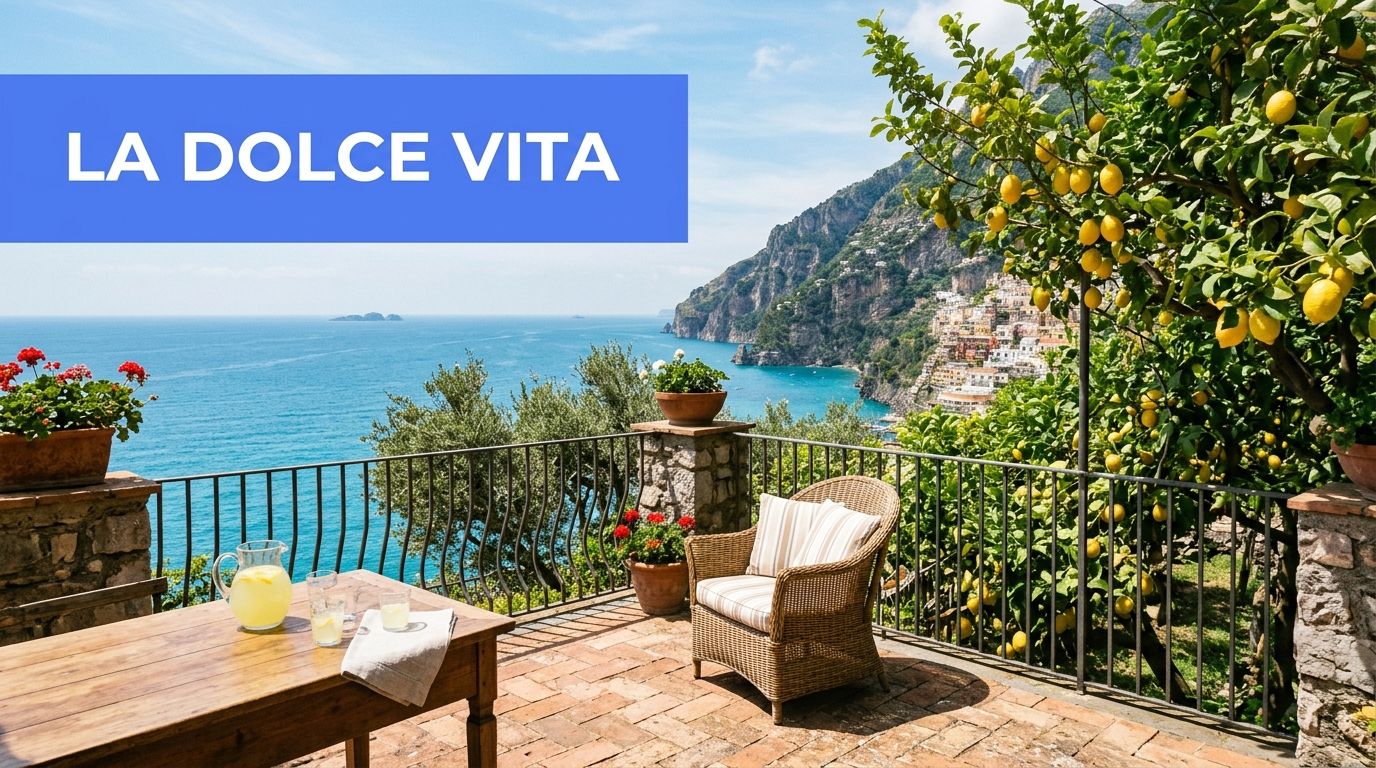
That history matters because the word villa in Italy still carries weight. It isn't just shorthand for a large vacation home. It suggests land, architecture, proportion, and a way of living that balances beauty with ease.
What clients usually want, and what they actually need
Most travelers come in asking for one of three things:
- A romantic hideaway: Sea views, privacy, beautiful interiors, and easy access to a few memorable experiences.
- A family estate: Enough bedrooms for everyone, but also enough separation so the trip doesn't feel like organized chaos.
- A celebration base: A villa that can handle chefs, drivers, day trips, and relaxed entertaining without feeling operational.
What they usually need is more specific. They need to know how far the villa is from the airport. Whether there's daily housekeeping. Whether the photos show the actual property in its current condition. Whether the air-conditioning covers bedrooms only or the full house. Whether the “near town” description means a quick stroll or a winding drive you'll hate by day three.
A beautiful villa can still be the wrong villa if the logistics are off.
That's why I'm opinionated about this category. If you want that cinematic Italian feeling, you can absolutely have it. You just need to pick with more discipline than the average traveler does.
If your trip is leaning romantic, my advice is to think about setting first and status second. These romantic places in Italy are a useful starting point because the emotional tone of the destination matters just as much as the villa itself.
Beyond the Postcard Choosing Your Perfect Italian Region
Italy isn't one villa market. It's several completely different ones wearing the same glamorous label. Tuscany, the Amalfi Coast, and Lake Como get the attention. They deserve it. But if you stop there, you miss some of the most satisfying villa stays in the country.
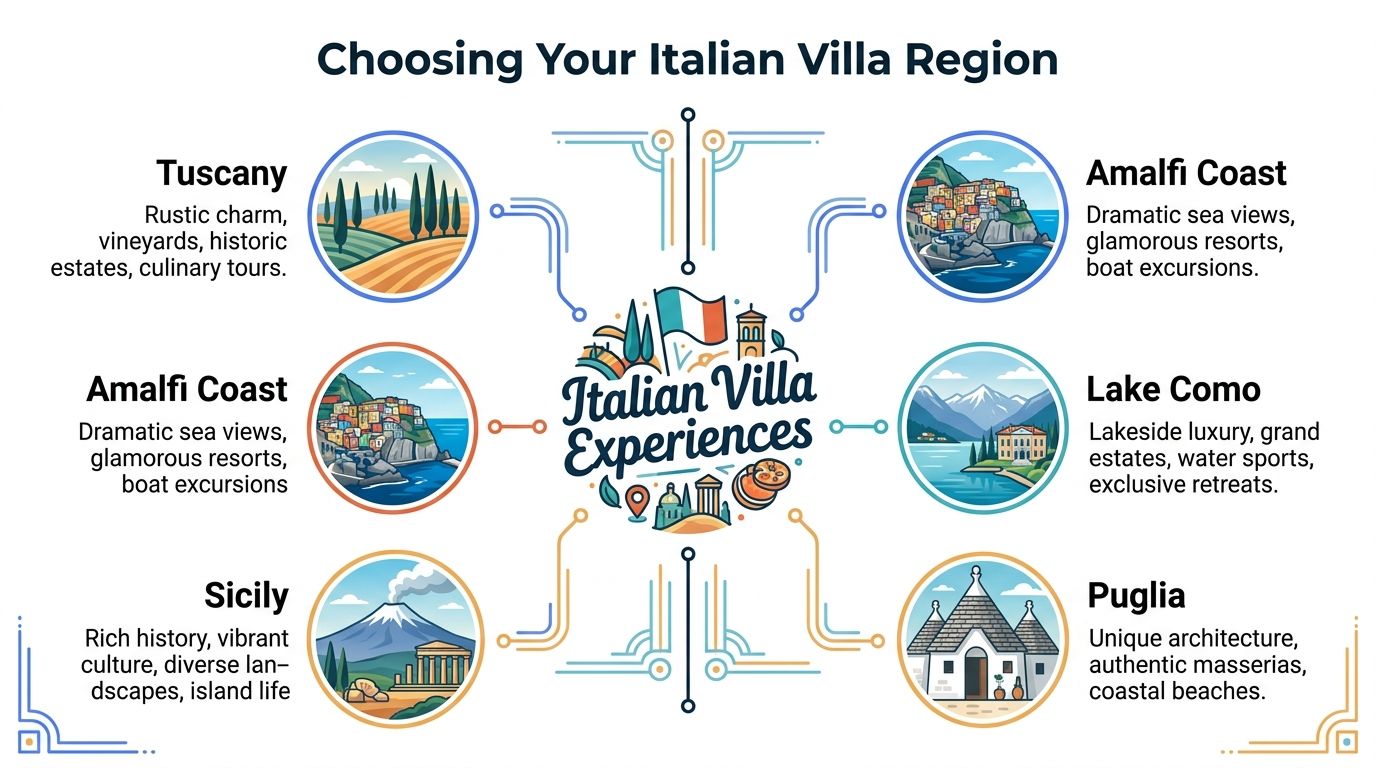
The fast read on the major villa personalities
| Region | Best for | What it feels like | My blunt advice |
|---|---|---|---|
| Tuscany | Families, milestone trips, food and wine travelers | Grounded, elegant, expansive | Ideal if you want room to breathe and don't need to be on the water |
| Amalfi Coast | Honeymoons, stylish friend trips, special occasions | Dramatic, glamorous, vertical | Worth it for views and energy, but only if you accept the transfer complexity |
| Lake Como | Prestige, polished gatherings, refined escapes | Formal, scenic, cinematic | Excellent for clients who want elegance more than rustic charm |
| Puglia | Chic but less performative luxury | Sun-bleached, design-forward, authentic | One of the smartest choices if you want value, style, and space |
| Sicily | Culture, history, larger estates, layered itineraries | Raw, vivid, sophisticated | Best for travelers who want substance with their scenery |
Where I'd steer different clients
Tuscany is still the easiest recommendation for multigenerational groups. Villas there often handle group dynamics well because the estates tend to have generous grounds, proper dining spaces, and a pace that rewards staying put. If you want cooking classes, winery access, and a home base that feels restorative, Tuscany wins.
If your vision is lemon trees, sea air, and a terrace that makes everyone go quiet at sunset, choose the Amalfi Coast. But go in with your eyes open. Cliffside glamour comes with tighter access, more transfer planning, and less flexibility for large groups with mobility concerns.
Lake Como is for travelers who care about polish. Not fake polish. Real polish. Grand villas, lakefront perspective, and a more refined social atmosphere. It's less rustic and more composed.
Then there's Puglia, which too many travelers discover too late. While most guides stay fixated on Tuscany and Amalfi, underserved regions such as Puglia are seeing rising demand. A luxury rental like Villa Ulivi in Ostuni has been listed at €14,180–€22,315 per week, signaling a shift toward high-value luxury outside the usual hubs, according to this discussion of Italy's emerging villa regions.
Puglia is the region I recommend when clients want style without the scene.
You'll see masserie, olive groves, easier coastal access, and a more relaxed kind of luxury. It works especially well for travelers who don't need to announce their trip with a famous postcode.
Sicily gives you depth. That's the word. It's not just pretty. It's layered. Baroque towns, volcanic scenery, island culture, and estates that can support longer stays without boredom setting in.
If Tuscany is on your shortlist but you want the quieter side of it, I'd also look beyond the obvious hotspots and start with these towns in Tuscany. The right town changes the entire villa experience.
Decoding Villa Styles and Luxury Amenities
A lot of disappointment happens because travelers use one word, villa, to describe wildly different properties. That's a mistake. The style of house changes the atmosphere of the trip.
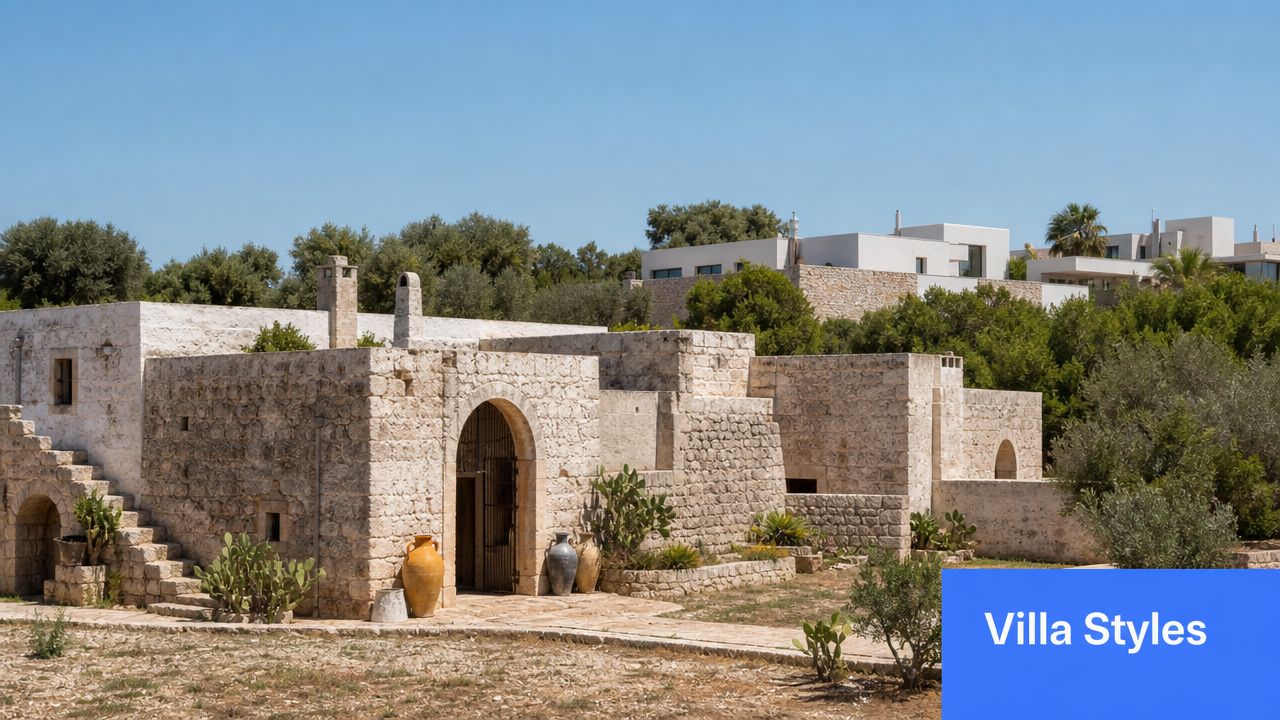
Know the architectural language before you book
Some quick decoding helps:
- Historic villa: Usually an elegant estate with formal bones, larger reception rooms, gardens, and period character.
- Masseria: Common in southern Italy, especially Puglia. Originally agricultural estates, now often restored into chic, low-slung retreats with a strong sense of place.
- Palazzo: More urban or semi-urban in spirit, often grand and decorative.
- Modern villa: Clean lines, glass, strong views, and more emphasis on contemporary systems and amenities.
Authentic Italian villas are designed to connect inside and outside living through loggias and courtyards, and higher-end modern villas build on that foundation with professional spas, private tennis courts, whole-house air-conditioning, and gourmet kitchens that go well beyond standard rentals, according to this overview of Italian villa architecture and amenities.
That indoor-outdoor flow isn't a styling trick. It's part of how these homes work.
What separates luxury from expensive
Luxury doesn't mean the villa has more bedrooms than you need. It means the property supports the way you want to live during the trip.
Look for these specifics:
- Air-conditioning clarity: Ask whether cooling covers the whole house or just sleeping areas.
- Outdoor living that's usable: Porticos, shaded dining, multiple seating zones, and a pool area that doesn't feel like an afterthought.
- Kitchen quality: If you want chef service, the kitchen needs to be built for actual cooking, not decorative photography.
- Wellness features: Spa rooms, hot tubs, saunas, or treatment space matter if you want the villa to feel like a retreat.
- Recreation on-site: Tennis courts, cinema rooms, and gardens that can handle children or larger groups add real value.
Don't pay luxury rates for a property that only looks good from one camera angle.
I also care a lot about materials and proportion. Traditional stone, arched openings, timber details, and terraces with a genuine relationship to their surroundings tend to age beautifully in person. Slick photos can sell a mediocre rental online. Good architecture holds up once you arrive.
Understanding the Investment What a Villa Rental Costs
Vague marketing language often wastes people's time. Luxury villas in Italy are expensive. The better question is whether the structure of the pricing makes sense for your group and your expectations.
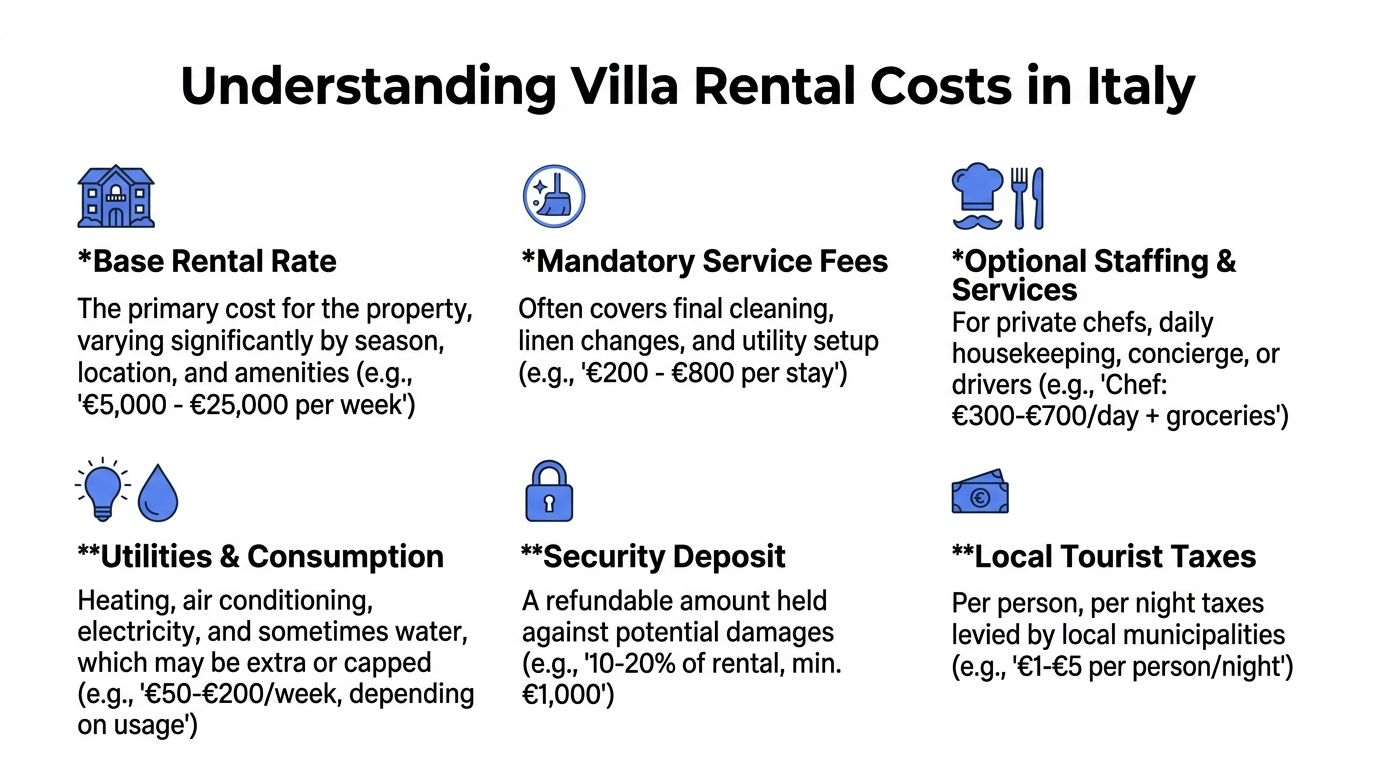
The luxury villa market in Italy is segmented by nightly rate, with premium properties in the €3,500–€5,000 and €5,000–€6,500 tiers, while top estates exceed €6,500 per night, based on Essenza Escapes' villa pricing tiers. For group scale, inventory starts at $11,997 per week for a 5-bedroom villa sleeping 10, and $21,950 per week for a 10-bedroom property sleeping 20, according to Red Savannah's Italy villa collection.
What those numbers usually mean in practice
A villa at the lower end of the luxury bracket may give you strong design, a pool, solid location, and enough comfort for a stylish family week. As pricing moves up, you're usually paying for some combination of:
- Prime positioning: Waterfront, iconic views, prestigious addresses, or easier access
- Estate scale: More land, more entertaining space, and better separation between bedrooms
- Service potential: Proper staffing setup, chef-friendly kitchens, and smoother operations
- Architectural pedigree: Historic character or exceptional modern design
- Privacy: A major factor, especially for high-profile travelers or special occasions
What clients often forget to budget for
The rental rate is not the whole trip cost. It's the property component.
You should also expect to consider:
- Staffing: Housekeeping, chef service, butlers, or hosts where available
- Food and beverage: Pantry pre-stocking, grocery runs, wine, special dinners
- Transport: Airport transfers, drivers, additional vehicles, boat days in coastal regions
- Experiences: Guides, winery visits, in-villa wellness, tastings, family activities
That's why I prefer building villa trips from the full operating picture rather than from the house alone. A slightly more expensive villa with better layout, service compatibility, and access can be the smarter choice than a cheaper property that becomes annoying and expensive to run once you add reality.
If you're comparing options, start with an advisor-led framework rather than listing sites. My take on luxury villa rentals goes deeper into how to match property type with service level and trip style.
Timing is Everything The Best Seasons for Your Villa Stay
Seasonality changes the mood of villa travel more than one might assume. The same house can feel generous and serene in one month, then crowded by context in another.
When I'd actually send you
For most clients, May, June, September, and early October are the sweet spots. The weather is generally more comfortable, the light is gorgeous, and the rhythm of daily life is easier to enjoy. Pools are in play in many regions, terraces become the center of the trip, and you're less likely to feel like you're wrestling the destination.
July and August work if you want heat, energy, and a stronger social buzz. But you need to choose the right setting. A coastal villa can thrive in high summer because sea access and outdoor living are the point. A countryside estate can still be fabulous, but only if it has serious shade, strong cooling, and a layout designed for long, hot afternoons.
Shoulder season is often where villas in Italy feel most luxurious, because you have more space around the experience.
Match the season to the style of trip
A few practical matches I use all the time:
- Honeymoon or anniversary: Late spring or early autumn. Better atmosphere, fewer logistical headaches, more romance.
- Large family week: Early summer can be ideal because the weather supports outdoor time without everyone melting down.
- Food and wine focus: Early autumn often feels richer. Harvest energy, fuller tables, and countryside scenery that's changing by the day.
- Sea-first escape: June and September are hard to beat for comfort and ease.
I also tell clients to think beyond weather. Ask what kind of day you want to have. Long market mornings and vineyard lunches? Go shoulder season. Pool, boat, and late dinners outdoors? Aim for warmer months and choose a region built for that rhythm.
The date should serve the experience. Not the other way around.
The Art of the Booking Contracts and Securing Your Stay
Booking a luxury villa is not casual. It involves meaningful deposits, legal terms, payment schedules, and cancellation language that can become painfully important if anything changes.
What goes wrong when people wing it
The most common mistakes are boring, which is exactly why they're dangerous. Travelers assume the photos are current. They assume “private” means fully private. They assume the contract is standard. It often isn't.
I'm especially cautious about exclusivity. One of the biggest blind spots in this market is that travelers want seclusion but don't always know how to verify whether a villa is a true private estate, part of a broader rental operation, or managed in a way that affects privacy and staffing flow. That distinction matters.
Why advisor access changes the game
Many exclusive villa collections in Italy are 100% private to specialist agencies and cannot be booked on any third-party platform. Access to those properties, which are vetted for quality and privacy, requires a direct inquiry through a travel advisor with established relationships, as shown in this overview of private Italian villa collections.
That matters for two reasons. First, better inventory often isn't public. Second, the vetting standard is different when someone's reputation is tied to what they place.
If you like understanding the mechanics behind why direct inventory and owner relationships matter, this piece on hostAI direct booking strategies is worth a read. It's useful context for how high-quality vacation rentals are positioned and why direct channels often carry stronger control over guest experience.
Contracts deserve the same scrutiny as the photos.
Here's what I care about before any client signs:
- Payment schedule: When deposits are due, in what form, and under whose legal entity
- Cancellation terms: Especially for peak dates and higher-value stays
- Security deposit rules: Amount, hold method, and damage procedures
- Included services: Cleaning frequency, linen changes, check-in support, utility structure
- Operational clarity: Guest limits, event restrictions, staffing permissions, and arrival windows
One factual option in this space is Explore Effortlessly, which offers advisor-led trip planning for luxury villa stays and handles broader itinerary coordination around the booking. That matters when the villa is only one part of a larger trip.
Crafting Your Perfect Stay Logistics Staff and Experiences
The villa is the stage. The trip still needs direction.
I've seen clients spend a fortune on a stunning house and then leave the week feeling oddly underwhelmed because nobody planned the middle. No arrival strategy. No dinner rhythm. No understanding of when a driver is essential and when it's unnecessary. Luxury isn't just the property. It's how smoothly the days unfold.
A honeymoon week that actually feels easy
For a couple on the coast, I'd shape the stay around calm, not overscheduling.
Arrival day should be soft. Private transfer in, pantry stocked, chilled drinks waiting, and dinner arranged at the villa so nobody has to think. The next morning, you wake up in Italy and the first decision is espresso or a swim. That's exactly the point.
A strong rhythm might look like this:
- One villa day: No agenda beyond the pool, terrace lunch, and an in-villa massage setup through trusted local partners.
- One water day: Private boat outing with a late lunch reservation and time to swim.
- One local culture day: A guided visit or tasting that adds texture without swallowing the whole day.
- One free evening with chef service: So the “special dinner” happens in your own space, not in a crowded dining room.
A family villa week needs structure, not rigidity
For a multigenerational Tuscany stay, I'd plan around layers. Grandparents want comfort. Parents want ease. Kids need movement. The villa has to carry all of that.
A good family setup often includes a private driver on key sightseeing days, a cooking class at the villa so everyone can participate without a transport headache, and at least one formal celebratory dinner at home. You don't need every day programmed. You do need enough structure that nobody ends up arguing over what to do at 10:30 in the morning.
The best villa itineraries leave room for spontaneity because the hard parts were handled in advance.
The support pieces that matter most
These are the details I never treat as optional:
- Arrival planning: Flight timing, transfer coordination, check-in procedure, luggage handling
- Pre-stocking: Water, breakfast basics, wine, dietary requests, children's staples
- Staffing fit: Daily housekeeping versus occasional service, chef nights versus full-time support
- Local movement: Driver, rental vehicle, or boat planning based on the region
- Pacing: Not every day should require getting back in a car
I work with clients nationwide through virtual consultations, and that's especially useful for villa trips because the planning usually involves multiple decision-makers. Couples, parents, siblings, wedding groups. Someone needs to bring the moving parts into one coherent plan.
I also want to be clear about support. I coordinate the planning and pre-departure logistics, while trusted in-destination partners and suppliers provide on-the-ground assistance during the stay. That's how villa travel should work. Clear roles, vetted people, no confusion.
Your Italian Villa Journey Begins Here FAQs and Next Steps
A great Italian villa trip is usually won or lost before you board the flight. The difference is rarely the pool, the view, or the kitchen. It is the contract language, the staffing fit, the arrival plan, and whether the house suits the way your group lives for a week.
That is the filter I use with clients. A beautiful villa is easy to find. A villa that works, on paper and in real life, takes sharper judgment.
Quick answers to the questions clients ask right before booking
How is staffing arranged?
Every property handles this differently. Some include basic housekeeping on set days. Others operate more like private estates with cooks, house managers, or service staff available at extra cost. I verify what is included, what can be added, who manages the staff, and whether gratuities, grocery runs, or service hours are already built into the rate.
Can dietary restrictions be accommodated?
Usually, yes. The important part is confirming it before deposits are paid, especially if chef service is limited, the villa sits in a remote area, or specialty ingredients need advance sourcing. Gluten-free in Florence is different from gluten-free in a hilltop village two hours from the nearest major market. If meals are central to the stay, I would also read my guide to planning a villa with a private chef before choosing a property.
What's the difference between self-catered and fully staffed?
Self-catered means the house is the core rental and service is added selectively. Fully staffed villas follow a service model from the start, often with fixed routines, set staffing hours, and more structure around meals and household operations. Privacy lovers often prefer selective service. Multi-generational groups usually do better with more built-in support.
How far in advance should I plan?
Start early. The strongest villas get taken first, especially those with privacy, smart bedroom layouts, and reliable management. If you are traveling in high season, over a holiday week, or with a larger group, waiting usually leaves you with weaker options and less favorable contract terms.
Can you help if we're traveling with family or another couple?
Yes, and that is often where advisor support matters most. Shared villas create friction when room categories feel uneven, payment schedules are unclear, or one party expects hotel-style service and the other expects total independence. Those issues should be settled before anyone signs.
The checklist I want clients to use before they commit
- Confirm the region first: The right house in the wrong location will frustrate you all week.
- Read the payment schedule carefully: Many villas require staged payments, strict due dates, and meaningful penalties for delay.
- Check security deposit terms: Ask whether the hold is pre-authorized or collected, how damage is assessed, and how long refunds take.
- Review house rules in plain English: Events, outside guests, children, noise limits, pool hours, and pet policies should never be vague.
- Ask who handles problems on-site: You need a named local contact, response expectations, and a clear process for maintenance issues.
- Match service to the group: Daily breakfast, grocery pre-stocking, and one or two chef dinners often serve a villa stay better than full staffing every day.
One more insider point. Some of the best villa stays are not in the regions travelers ask for first. Parts of Le Marche, inland Sicily, northern Puglia, and quieter stretches of Umbria often deliver better space, stronger value, and a calmer on-the-ground experience than the usual headline destinations. If your priority is privacy and ease, not bragging rights, those are smart places to look.
Work with me
Hi, I'm Karrah, owner, founder, and lead travel advisor at Explore Effortlessly, a luxury travel agency based in Miami.
I design bespoke itineraries for private villa stays, cruises, honeymoons, safaris, and milestone trips around the world. My role is practical. I help clients choose the right region, vet the property, review the booking terms, and organize the trip so the experience feels smooth from arrival to departure.
I work with clients nationwide through virtual consultations. I'm also a Circle of Excellence Advisor, Top 5 percent at Nexion, and a CLIA Accredited Cruise Counselor.
If you are serious about villas in Italy, I can help you avoid the common mistakes and secure a property that fits your group, your standards, and your style of travel.
Ready to stop comparing tabs and start planning the right villa stay? Plan with Explore Effortlessly. For ongoing luxury travel inspiration, join the newsletter through Karrah's newsletter sign-up.